Inspiration:
CARDIOPULSE was inspired by the growing global impact of cardiovascular diseases and how difficult it is for patients to monitor their heart health consistently outside of a hospital environment. While researching medical data related to normal heart rate ranges, reaction time performance, fatigue symptoms, and cognitive response delays, I discovered that changes in heart rate can directly affect a person's response time and mental alertness. This led me to explore the relationship between cardiovascular performance and cognitive function, and how combining both could help identify early signs of fatigue, stress, or potential cardiac risk. I wanted to build an accessible platform that could simulate real-time cardiovascular monitoring while also evaluating neurological response through reaction tests — all within a simple web interface.
What it does:
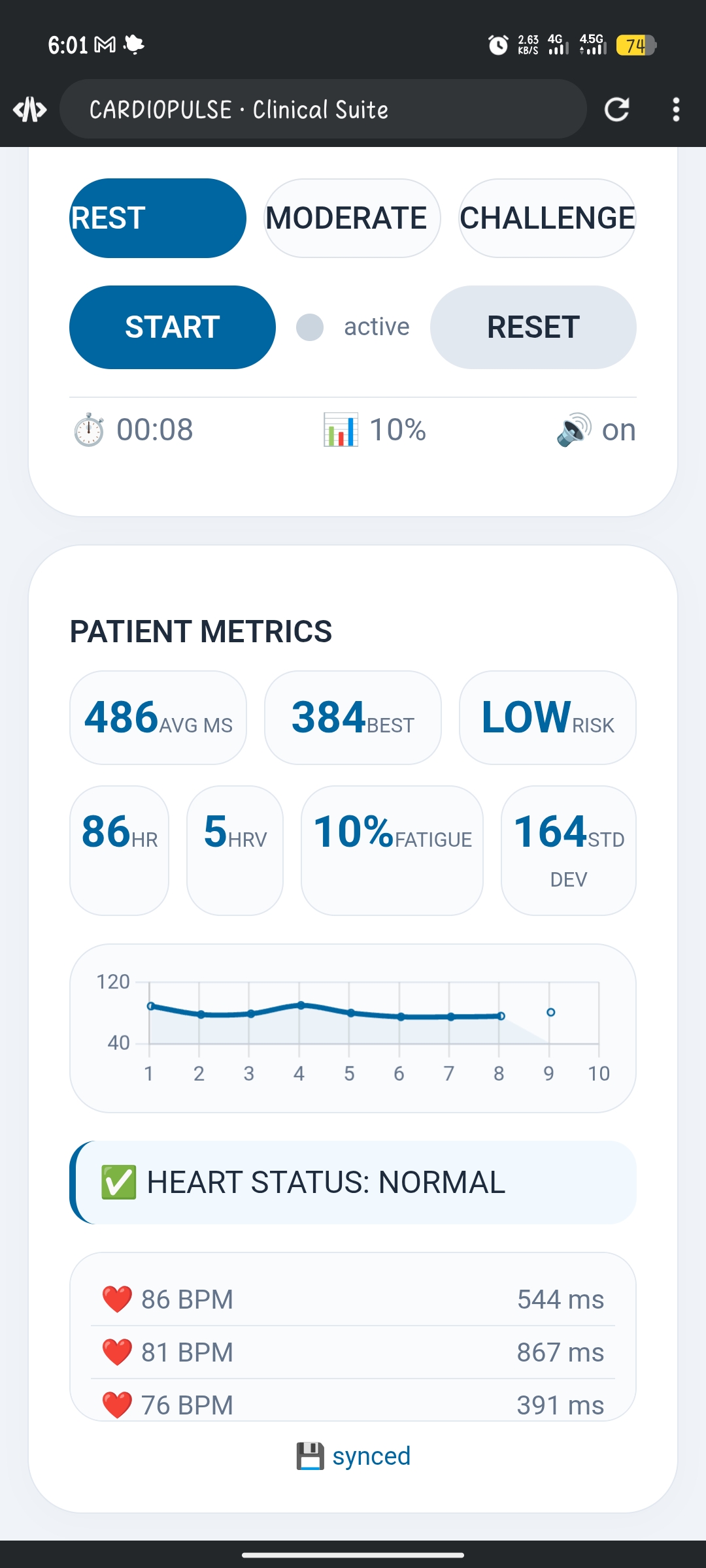
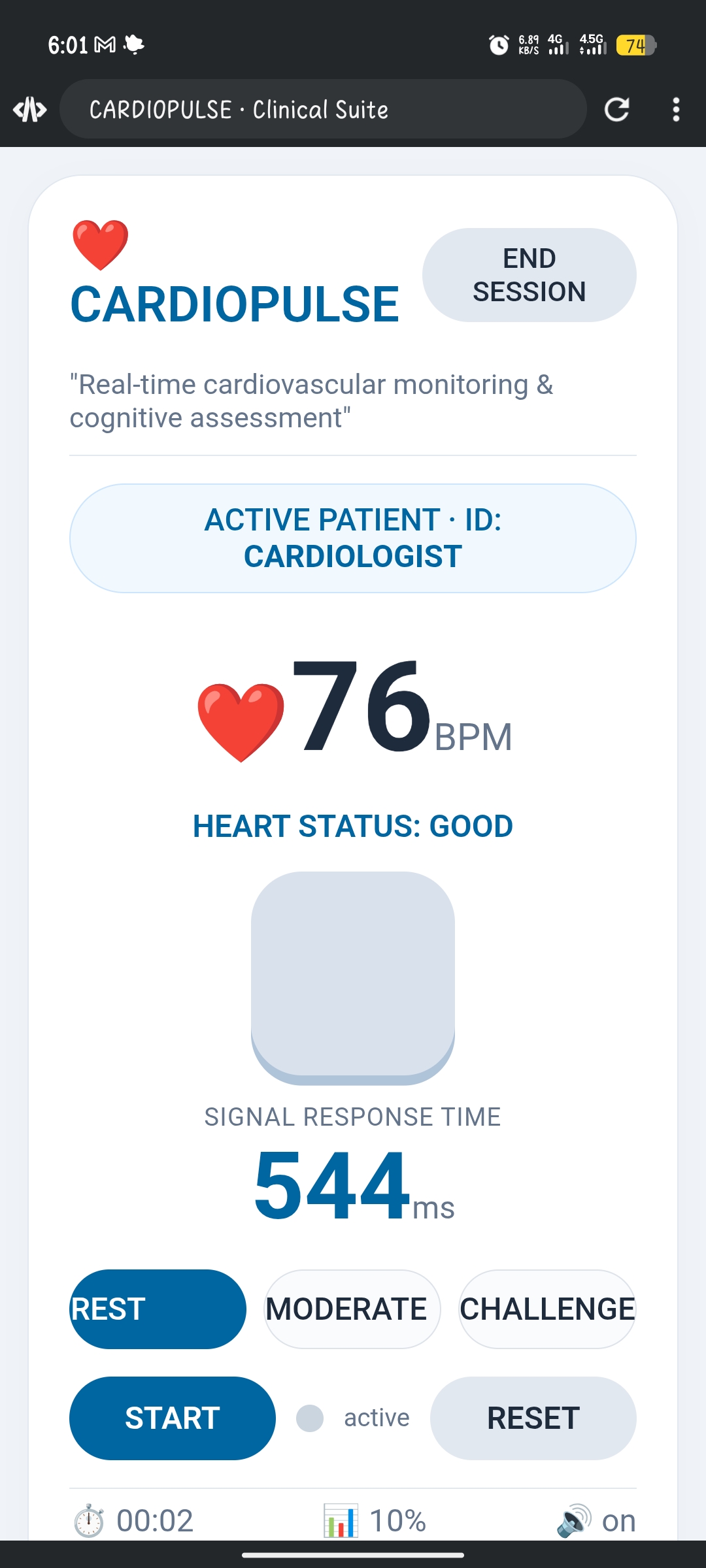
CARDIOPULSE is an intelligent cardiovascular monitoring system that evaluates both heart performance and cognitive response in real time through an interactive web-based platform. The system continuously tracks simulated heart rate (BPM) and analyzes user reaction time using visual stimulus tests to determine fatigue levels, signal response consistency, and potential cardiovascular stress indicators. Users are guided through different challenge levels that measure response speed and coordination under varying simulated heart rate conditions. Based on performance metrics such as Signal Response Time, Heart Rate Variability (HRV), and session consistency, the platform provides real-time feedback and risk-level assessments categorized as LOW, MODERATE, or HIGH. These insights help demonstrate how cardiovascular activity may influence cognitive responsiveness and overall fatigue. All session data is securely stored in the cloud, allowing users to monitor performance trends over time and enabling future integration with real-world wearable heart rate sensors.
How i built it:
CARDIOPULSE was developed as a web-based application using HTML5, CSS3, and JavaScript to create a responsive clinical-style interface. Firebase Authentication was implemented for secure user login and role-based access, while Firebase Firestore was used for storing session data and performance history in the cloud. The system combines simulated real-time BPM tracking with cognitive stimulus-response testing to calculate signal response time, fatigue levels, and overall risk assessment based on performance metrics.
challenges:
One of the main challenges I faced was implementing real-time monitoring functionality without direct access to medical-grade sensors. Since hardware integration wasn’t available during development, I designed a simulated BPM system based on medically researched heart rate ranges to demonstrate how the monitoring and analysis engine would function in real-world conditions. Another challenge was building and deploying the entire project using only mobile-based development tools, which required careful debugging and optimization of both frontend logic and cloud integration systems.
Accomplishments:
One of my biggest accomplishments was successfully developing a fully interactive cardiovascular and cognitive monitoring platform entirely on a mobile phone without access to a PC. I was able to design and implement real-time heart rate simulation, reaction time testing, fatigue analysis, and risk-level assessment into a single responsive dashboard. I also integrated secure authentication and cloud-based data storage, allowing users to track their performance across sessions and visualize trends over time. Building a system that combines simulated BPM monitoring with cognitive response evaluation and real-time analytics within a web-based clinical interface was a major milestone for me. Additionally, researching medically recognized heart rate ranges, reaction time performance standards, and fatigue indicators helped ensure that the system’s analysis logic reflects realistic cardiovascular and neurological behavior patterns.
What i learned:
Throughout the development of CARDIOPULSE, I learned more about the relationship between cardiovascular health and neurological performance, particularly how fatigue, elevated heart rate, and stress can influence reaction time and cognitive consistency. I also gained practical experience working with cloud databases, authentication systems, real-time event handling, and user-interface design under limited development resources.
Throughout the development of CARDIOPULSE, I learned more about the relationship between cardiovascular health and neurological performance, particularly how fatigue, elevated heart rate, and stress can influence reaction time and cognitive consistency. I also gained practical experience working with cloud databases, authentication systems, real-time event handling, and user-interface design under limited development resources.
What's next for CARDIOPLUSE:
Future development will focus on integrating real heart rate sensors from wearable devices such as smartwatches or fitness bands to replace the simulated BPM system. Additional enhancements may include predictive analytics, personalized health recommendations, and long-term cardiovascular-cognitive trend monitoring to support early detection of fatigue or abnormal cardiac behavior.
Built With
- css
- firebase
- firebase-authentication
- firestone
- html
- javascript

Log in or sign up for Devpost to join the conversation.