-
-
-
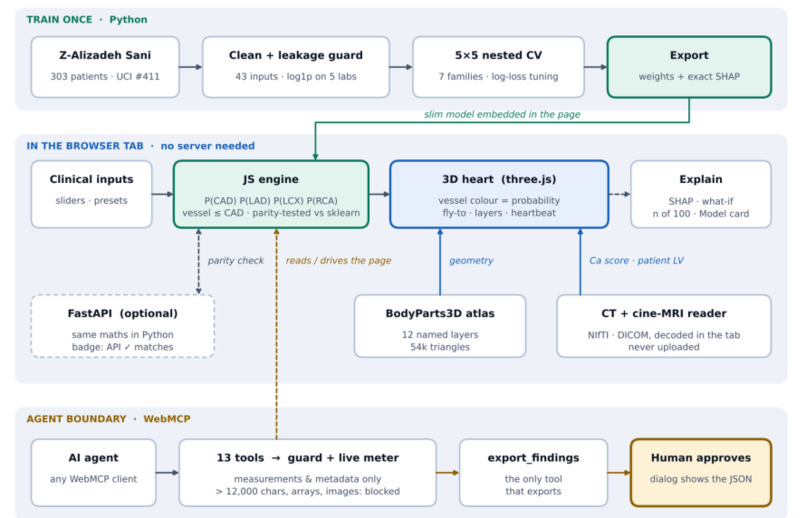
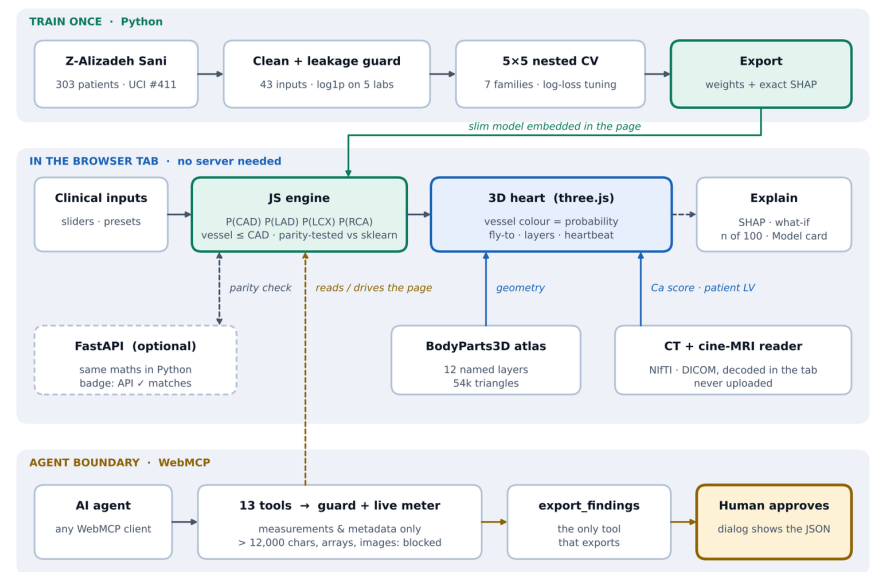
Flowchart
CardioLens
Research prototype for education and decision support only. Not a diagnostic device and not a substitute for formal diagnostic imaging or clinical judgement.
Multimodal AI Hackathon 2026 · Track A: Cardiovascular Risk Visualization & Prediction
Inspiration
Cardiovascular risk is usually handed over as one bare percentage. That tells a clinician or a patient how much risk, but not where it sits or why. We wanted a tool where the risk lives on an anatomical heart you can turn around, and where every number can be questioned.
What it does
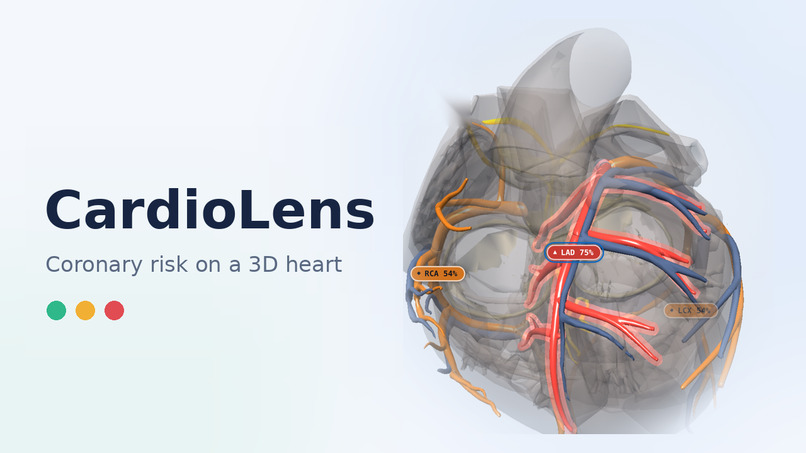
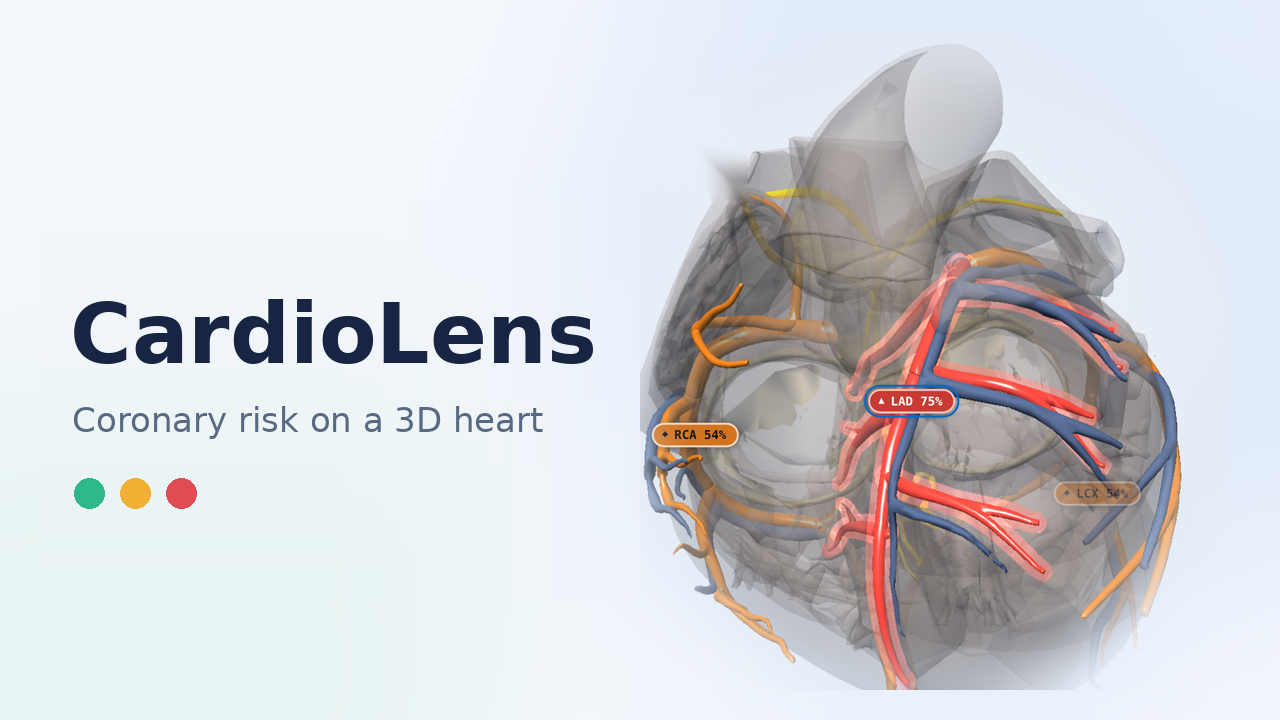
CardioLens 3D predicts overall CAD and LAD / LCX / RCA stenosis probability from 43 routine clinical inputs, then shows the result on an interactive 3D heart.
- Prediction: four models on the Z-Alizadeh Sani data set (UCI #411, n = 303). Pooled out-of-fold ROC-AUC: CAD 0.93, LAD 0.83, RCA 0.73, LCX 0.70.
- 3D heart: a real BodyParts3D atlas (12 peelable layers, 54,487 triangles). The three coronary arteries are coloured by probability (teal → amber → red, always with text and an icon). Rotate, zoom, click a vessel to fly to it.
- Explanation: exact SHAP values grouped by clinical domain, what-if curves with out-of-range hatching, "n of 100 patients like this", and an in-app model card.
- Scan reading room: open a CT (NIfTI or DICOM) or a cardiac cine MRI, decoded in the browser tab and never uploaded. From the MRI it measures left-ventricular volumes and ejection fraction and shows the beating left ventricle inside the heart.
- Agent-native: 13 WebMCP tools let an AI agent drive the page. It only ever receives numbers.
export_findingsis the only tool that can move anything off the page, and it waits for a human to approve. - Runs without a GPU, in one self-contained file, including an offline build.
flowchart LR
    A[Clinical inputs<br/>43 features] --> B[Logistic-regression models<br/>CAD · LAD · LCX · RCA]
    B --> C[Cap: P vessel ≤ P CAD]
    C --> D[Dashboard<br/>probabilities + exact SHAP]
    C --> E[3D heart<br/>vessels coloured by probability]
    F[CT / cine MRI<br/>decoded in the tab] --> G[Measurements<br/>calcium candidates · EF · volumes]
    G --> E
    G -. MRI EF as echo-EF input .-> A
    H[AI agent<br/>WebMCP, 13 tools] -->|numbers only| D
    H -->|numbers only| G
    G --> I{Human approval}
    I -->|approved| J[JSON report]
    I -->|denied| K[Nothing leaves the page]
How we built it
- Models (Python): 7 model families compared with 5×5 repeated stratified nested cross-validation, preprocessing inside the folds, outcome columns (Cath, LAD, LCX, RCA) never used as inputs. We exported logistic regressions, so SHAP is exact and the model runs in the browser.
- Engine: a dependency-free JavaScript engine that reproduces the scikit-learn models (60 parity cases, max difference 5.6e-16).
- 3D: three.js with a BodyParts3D heart, vessels driven directly by the model outputs, adaptive resolution for machines without a GPU.
- Reading room: our own NIfTI and DICOM readers, a calcium-candidate finder, and a classical contour tracer for the cine MRI (JavaScript, checked against a Python reference to 1e-6).
- Agent layer: WebMCP tools with a payload guard on every result, a live privacy meter and a human-approval dialog.
- Optional backend: FastAPI serving the same maths, cross-checked against the sklearn pipelines at start-up.
- Quality: 462 automated checks across seven suites, including real-Chromium tests.
Challenges we ran into
- Keeping the story consistent. Separate vessel models can say a vessel is more likely than CAD itself (it happened for 19% of patients). We cap each vessel at P(CAD) and flag it on screen.
- Honest 3D. Clinical features are not anatomical coordinates, so SHAP is never drawn onto the heart, and the heart is labelled a generic atlas.
- Weak targets. LCX (0.70) and RCA (0.73) are only modestly predictable. We kept that visible rather than hiding it.
- A privacy boundary for agents. Tool results had to be numbers only, so we built a guard and a meter instead of trusting good intentions.
- MRI without a deep model. Tracing the left ventricle with classical methods meant dealing with papillary muscles, unreliable slice locations and varying heart-rate tags.
- Smooth 3D with no GPU, on 54k triangles.
Accomplishments that we're proud of
- Cross-validated CAD ROC-AUC of 0.93, with a validation protocol we can defend and a model comparison that shows where linear models are good enough.
- A heart whose colours are the model outputs, so the picture and the numbers cannot disagree.
- A scan-to-model path: MRI ejection fraction (41.0% on the built-in sample) measured in the browser and shown as a beating ventricle in the 3D heart.
- An agent interface that cannot leak a scan, with a human approval gate.
- 462 / 462 automated checks passing, and limits stated on screen and in the video.
What we learned
- With 303 patients, a well-tuned linear model plus exact explanations beats a fancier model you cannot explain.
- Calibration, leakage guards and coherence between outputs matter as much as AUC.
- Saying what the system cannot do (generic atlas, no external validation, unvalidated MRI estimate) makes it more credible, not less.
- Privacy is easiest to keep as an architectural rule, not a policy.
What's next for CardioLens
- External validation on other centres and cohorts.
- A patient-specific heart from whole-heart segmentation instead of a generic atlas.
- Validated MRI measurements against manual contours, and tests on real DICOM CT series.
- Wire scan findings into the risk model, with proper validation.
- Test on Safari, Firefox and real GPUs.
- More clinical features, models and anatomical structures through the existing extension points.
Built with
Python · scikit-learn · SHAP · JavaScript · three.js · WebGL · WebMCP · FastAPI · BodyParts3D · Sunnybrook Cardiac Data · UCI Z-Alizadeh Sani
Credits and licences
- Data: Extension of Z-Alizadeh Sani Dataset, UCI #411 (CC BY 4.0), Alizadehsani, Roshanzamir & Sani (2013), https://doi.org/10.24432/C5461K
- 3D anatomy: BodyParts3D, © DBCLS, CC BY-SA 2.1 Japan
- Cardiac MRI sample: Sunnybrook Cardiac Data, CC0 (Radau et al., 2009)
- WebMCP (MIT), three.js (MIT), Faraday (MIT) as design inspiration
Built With
- bodyparts3d
- cardiac
- data
- fastapi
- javascript
- python
- scikit-learn
- shap
- sunnybrook
- three.js
- uci
- webgl
- webmcp
- z-alizadeh


Log in or sign up for Devpost to join the conversation.