Inspiration
Cardiovascular Disease (CVD) remains the leading cause of death worldwide, yet many people do not understand why they are at risk or what changes could actually reduce that risk. Most existing prediction tools provide only a risk score without explanation.
This project was inspired by the need for an accessible, transparent, and actionable AI system that not only predicts cardiovascular risk but also helps users understand the driving factors behind it and how they can improve their health outcomes.
What it does
CardioInsight AI predicts a person’s 10-year cardiovascular disease risk and goes beyond traditional models by:
Explaining which health factors contribute most to the predicted risk
Showing how much the risk could reduce if certain factors (like blood pressure, BMI, cholesterol, or smoking) are improved
Providing actionable insights instead of just a numerical score
Supporting both full clinical data and limited feature inputs, making it usable in real-world scenarios
The system also evaluates population-level risk using a real cardiovascular dataset and supports interactive individual risk analysis.
How we built it
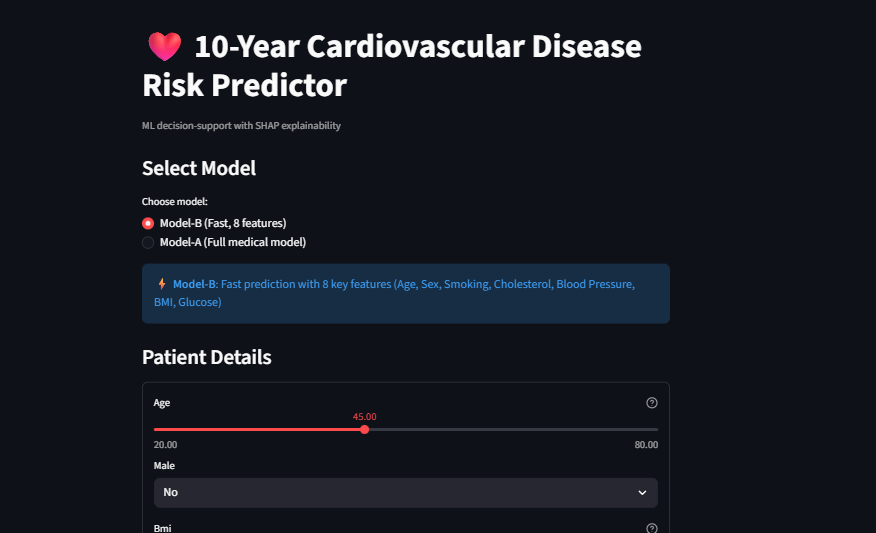
We built CardioInsight AI using a two-model architecture:
Model A (Clinical Model): Uses a comprehensive set of medical features for high-accuracy risk estimation in clinical or research settings.
Model B (Lightweight Model): Uses a smaller, commonly available feature set to ensure usability when full medical data is unavailable.
Both models are trained using XGBoost, optimized for class imbalance, and calibrated using probability calibration to ensure reliable risk estimates.
To improve transparency and trust:
We used SHAP (Explainable AI) to identify which features increase or decrease risk
Implemented what-if simulations to estimate risk reduction if a modifiable factor improves
Deployed the system as an interactive Streamlit web application
Challenges we ran into
Handling class imbalance in real medical datasets without sacrificing recall for high-risk patients
Ensuring probability outputs are well-calibrated, not just accurate
Making complex ML explanations understandable to non-technical users
Designing medically safe what-if simulations without unrealistic assumptions
Aligning different datasets (training vs evaluation) while maintaining consistency
Accomplishments that we're proud of
Built an explainable CVD risk prediction system, not just a black-box model
Successfully implemented actionable risk-reduction insights
Designed a dual-model approach for both clinical and real-world usability
Deployed a fully working interactive web application
Maintained reproducibility with clean notebooks and saved model artifacts
What we learned
In healthcare AI, interpretability is as important as accuracy
Calibrated probabilities matter more than raw predictions in medical decision support
Small, well-chosen features can still produce meaningful predictions
Explainable AI greatly improves user trust and adoption
Building for real-world constraints is just as important as model performance
What's next for CardioInsight AI – Interpretable Cardiovascular Risk
Clinical validation using larger and more diverse datasets
Personalized lifestyle recommendations based on demographic profiles
Integration with wearable or routine health data
Improving fairness and bias analysis across population groups
Exploring collaboration with healthcare researchers for real-world impact
Built With
- github.
- google-colab
- jupyter
- numpy
- pandas
- python
- scikit-learn
- shap
- streamlit
- xgboost

Log in or sign up for Devpost to join the conversation.