Inspiration
Cardiovascular disease remains the leading cause of death worldwide. In real clinical settings, physicians frequently operate with incomplete or fragmented patient data. Sometimes only structured clinical measurements are available; in other cases, only an ECG recording exists without full laboratory workup.
Most AI systems assume perfectly aligned and complete datasets, which rarely reflects reality. This disconnect inspired us to design a system that adapts to real-world constraints rather than ideal research conditions.
What the project does
CardioFusion AI is a flexible, multimodal clinical decision-support system for early cardiovascular risk detection.
The system operates under three realistic scenarios:
- Clinical data only
- ECG data only
- Combined clinical + ECG data
Instead of failing when information is missing, CardioFusion AI dynamically selects the appropriate prediction pathway and produces a robust risk estimation tailored to the available inputs.
How we built it
We developed two complementary modeling pipelines:
Clinical Risk Model
A logistic regression classifier trained on structured clinical features (age, blood pressure, cholesterol, fasting glucose, maximum heart rate, ST changes, etc.).
The model achieved strong discriminative performance with an AUC of 0.93, demonstrating reliable cardiovascular risk stratification.ECG Risk Model
An unsupervised learning pipeline applied to high-dimensional ECG time-series data. Statistical features (mean, variance, extrema) were extracted from each ECG signal, and clustering methods were used to identify high-risk electrophysiological patterns. This produces an interpretable ECG-based risk score without requiring direct label alignment.
A decision-level fusion mechanism integrates both outputs when available. This modality-aware fusion mimics real clinical reasoning and avoids unrealistic row-level dataset merging.
Challenges we faced
The primary challenge was the absence of shared patient identifiers across datasets. Direct merging would have introduced artificial assumptions and reduced clinical validity.
Instead, we redesigned the architecture to support independent modality processing with late-stage decision fusion. This significantly improved robustness and maintained real-world applicability.
What we learned
This project reinforced that clinical usability is just as critical as predictive accuracy. High AUC values are important, but deployment-ready AI must tolerate incomplete data, fragmented records, and heterogeneous sources.
Designing for clinical realism increases both practical impact and translational potential.
Deployment & Reproducibility (Coder Integration)
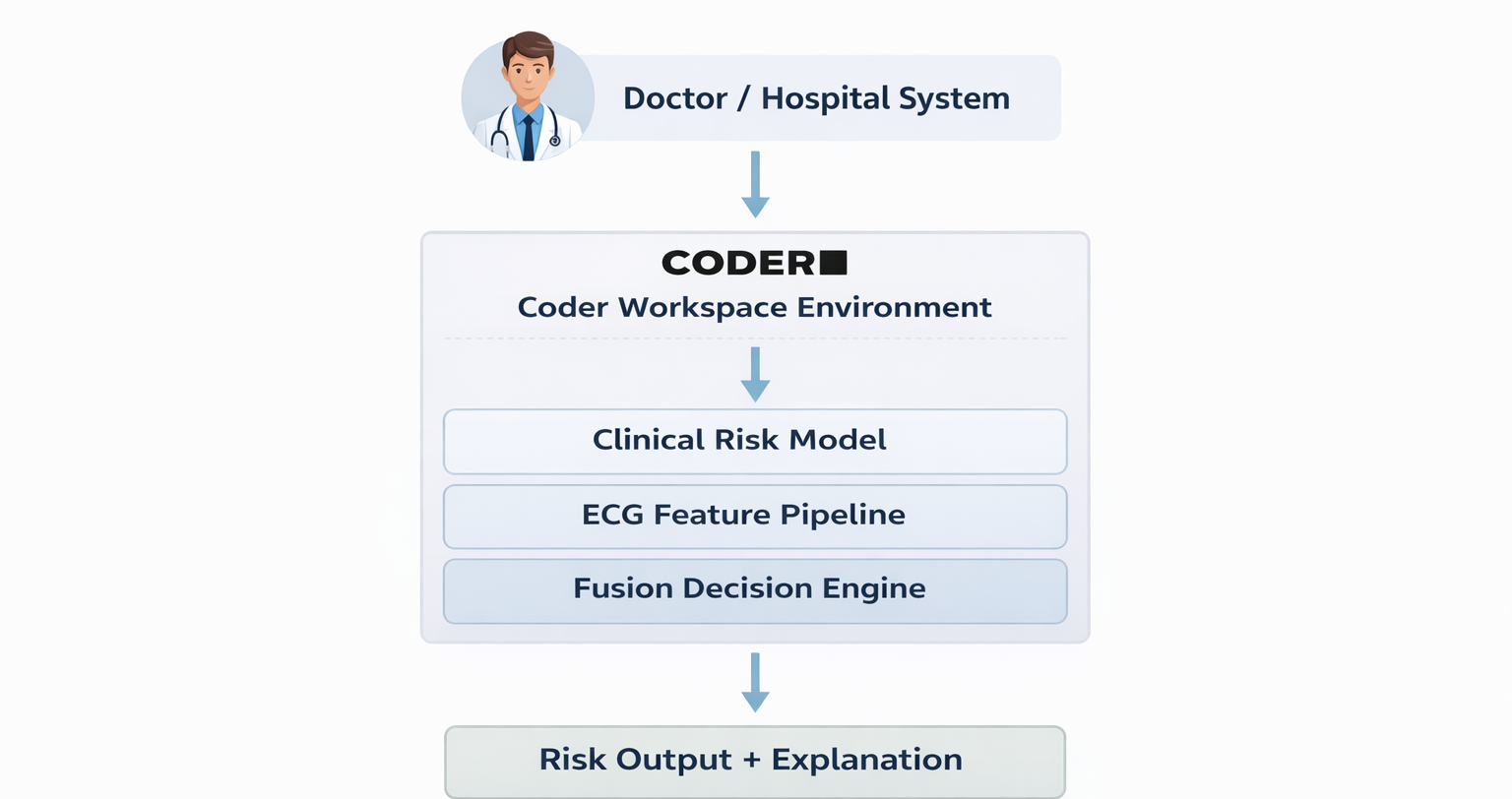
To support scalable and reproducible deployment, we designed a Coder-based workspace provisioning strategy for CardioFusion AI.
Using Coder’s secure development workspace model, the entire CardioFusion AI pipeline can be deployed inside an isolated cloud environment containing:
- Python runtime and ML dependencies
- Clinical risk modeling components
- ECG feature extraction pipeline
- Fusion decision logic
This architecture enables reproducible execution environments, secure multi-user collaboration, and scalable hospital-grade deployment. By leveraging Coder’s infrastructure provisioning framework, CardioFusion AI can transition from research prototype to production-ready clinical deployment while maintaining controlled, secure environments.
Impact
CardioFusion AI supports early cardiovascular risk stratification across multiple clinical contexts, including emergency departments, outpatient clinics, and resource-limited settings.
By functioning reliably even when data is incomplete, the system improves triage prioritization, enables earlier cardiology referral, and reduces diagnostic delays.
This approach bridges the gap between academic machine learning research and real-world clinical implementation.
Built With
- googlecolab
- jupyternotebook
- kmeansclustering
- logisticregression
- numpy
- pandas
- python
- scikit-learn


Log in or sign up for Devpost to join the conversation.