Inspiration
Cardiovascular disease remains one of the leading causes of death worldwide, yet many patients are still diagnosed only after symptoms become severe. We were inspired by the urgent need for earlier, more interpretable, and more accessible cardiovascular risk assessment tools. Traditional diagnosis often relies on fragmented clinical data and specialist interpretation, which can delay intervention and make risk harder to communicate clearly.
CardioAI was created to bring together machine learning, clinical decision support, and 3D medical visualization to make cardiovascular risk prediction more understandable and actionable. The goal was not only to predict disease risk, but also to show why a prediction was made and how it connects to the patient’s anatomy and clinical profile.
What it does
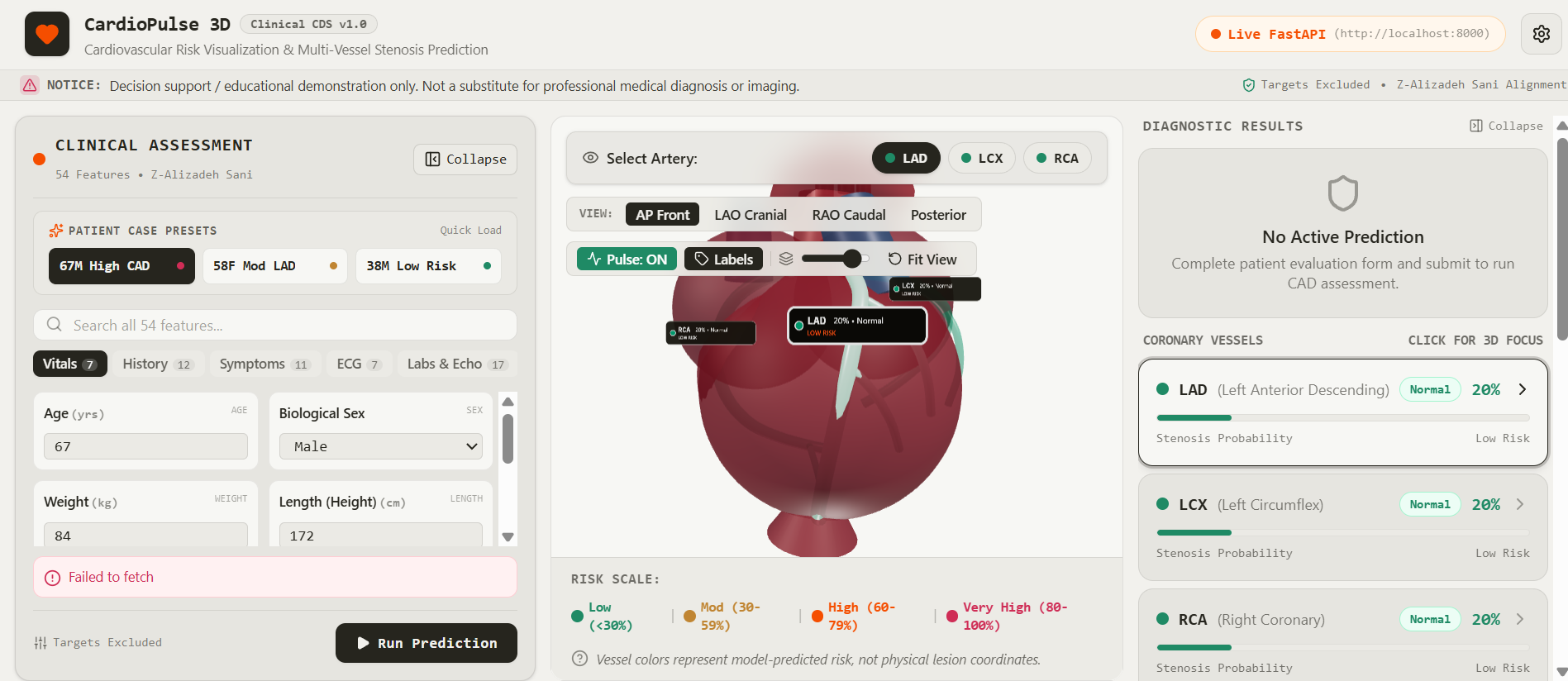
CardioAI is a full-stack clinical decision-support prototype that predicts coronary artery disease (CAD) risk and vessel-specific stenosis risk across the LAD, LCX, and RCA arteries. It accepts structured clinical input features such as demographics, vitals, ECG findings, comorbidities, lab values, and echocardiography-related indicators.
The system then:
- Predicts overall CAD probability
- Predicts stenosis risk for the LAD, LCX, and RCA arteries
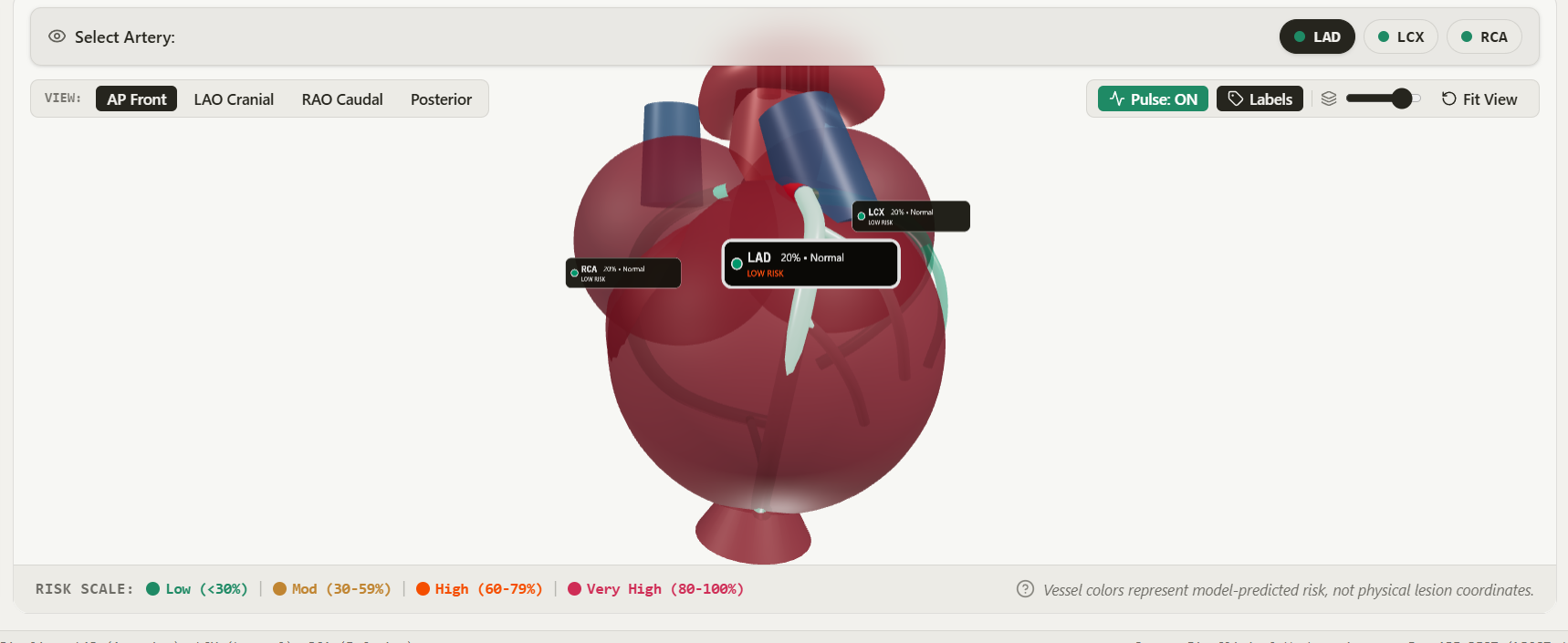
- Renders a 3D heart visualization with vessel coloring based on risk
- Uses SHAP-based explanations to highlight the most influential clinical features
- Provides a responsive web dashboard for exploring predictions
The project is designed as both a clinical AI prototype and an educational tool for understanding how risk factors influence cardiovascular outcomes.
How we built it
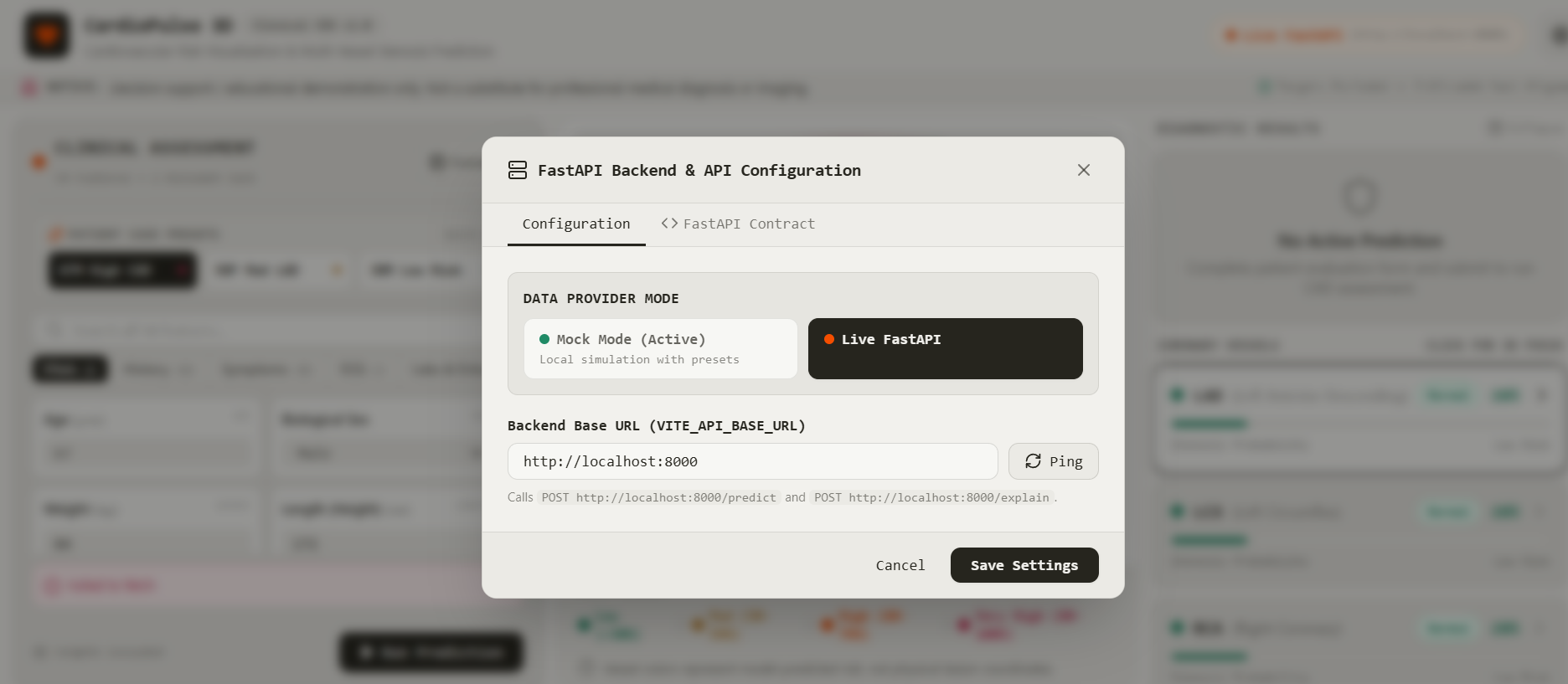
We built CardioAI as a full-stack application with a Python FastAPI backend and a React + TypeScript frontend.
The backend handles:
- Feature validation
- Model inference using trained ML pipelines
- Prediction aggregation for CAD and vessel-specific disease risk
- Health and feature endpoints for integration
The frontend handles:
- Clinical input forms
- Patient presets
- Dashboard layout
- 3D heart rendering with Three.js
- Risk visualization cards and explainability panels
The project uses multiple trained models for different prediction tasks and maps model outputs into an interactive 3D anatomical view. This allows the system to connect abstract risk probabilities to tangible heart structures and vessel-specific clinical risk.
Challenges we ran into
One of the biggest challenges was integrating machine learning outputs with a real-time 3D visualization in a way that remained intuitive and clinically meaningful. Mapping probability values to vessel colors and keeping the UI synchronized with backend predictions required careful design.
Another challenge was working with a large and heterogeneous clinical feature set. The dataset included many variable types, including numeric, categorical, binary, and string-based inputs, which needed consistent validation and preprocessing.
We also had to balance technical complexity with interpretability. A clinically useful tool cannot just output a probability; it must also explain the decision in a way that is understandable to users.
Accomplishments that we're proud of
We are proud to have built a working end-to-end prototype that combines:
- AI-driven risk prediction
- 3D coronary visualization
- interpretability through SHAP explanations
- a modern full-stack application architecture
The project demonstrates how AI can be applied in a high-impact healthcare domain while still being transparent and educational. We are especially proud of the way the model outputs are visually connected to heart anatomy, making the system easier to understand than a standard black-box prediction model.
What we learned
This project reinforced the importance of explainability in healthcare AI. Even when a model performs well, users still need to understand what influences the prediction and how to trust it. We also learned that user experience matters just as much as model accuracy—especially in clinical domains where communication and clarity are critical.
We also gained experience in:
- full-stack application design
- backend/frontend integration
- medical data handling
- model deployment for inference
- visualization of model results in an interactive interface
What's next for CardioAI
The next step is to evolve CardioAI from an educational prototype into a more clinically realistic decision-support system. Potential improvements include:
- integrating real patient datasets and validation workflows
- adding more advanced explainability tools and model benchmarking
- expanding the platform to include additional cardiovascular conditions
- improving the 3D anatomical model fidelity
- connecting the app to secure clinical data pipelines
- conducting user testing with clinicians and medical students
Our long-term goal is to make CardioAI a useful bridge between AI research, medical education, and thoughtful clinical support—without replacing human judgment, but helping clinicians make better-informed decisions.
