💡 Inspiration
Cardiovascular disease is the leading cause of death globally. While statistical algorithms can generate risk percentages, raw numbers fail to give clinicians or patients an intuitive understanding of where and how severe pathology is developing inside the body.
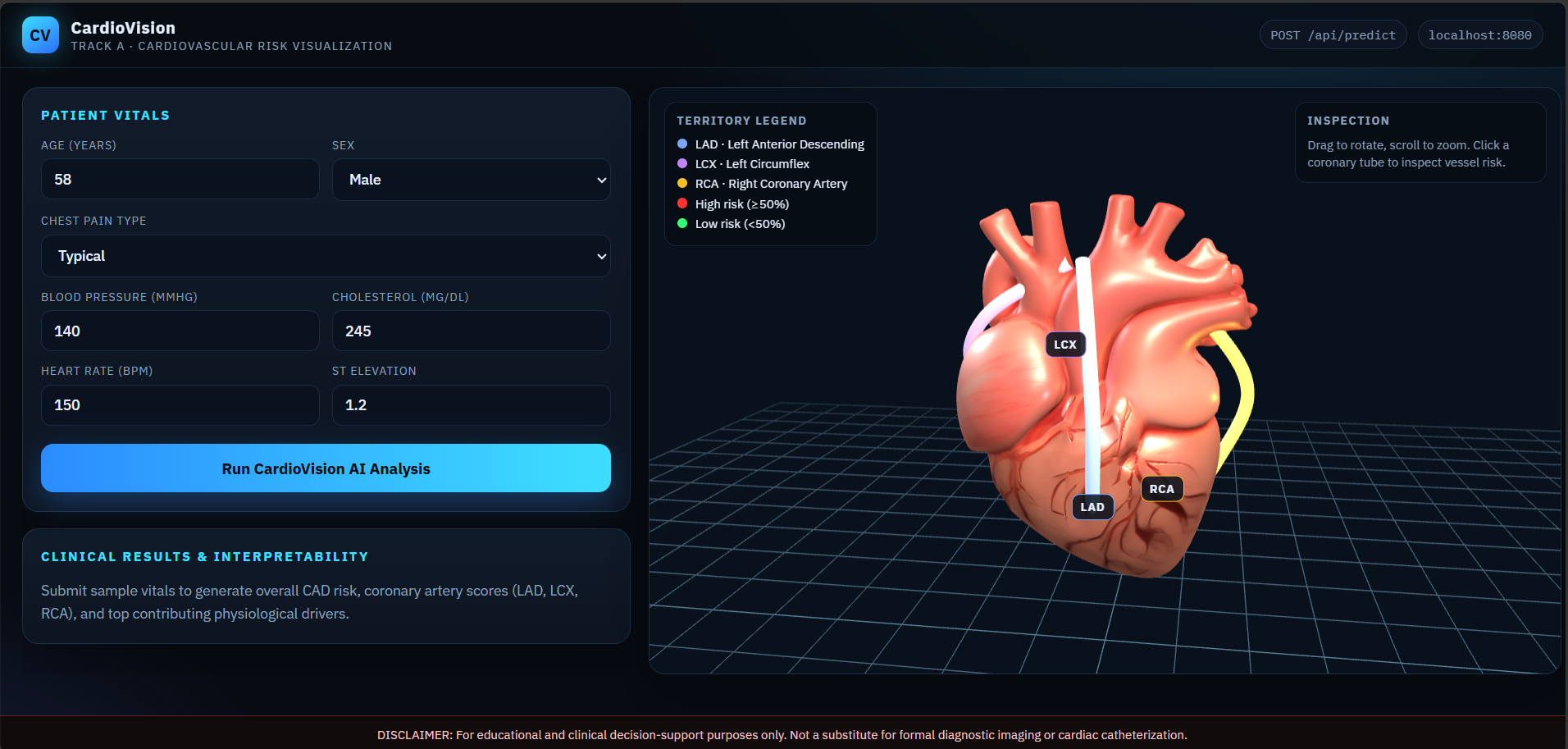
CardioVision was built to bridge this gap by transforming complex clinical data into real-time, vessel-specific 3D anatomical visualizations that highlight localized risk directly on a 3D human heart.
🫀 What It Does
CardioVision is an interactive web-based decision-support platform for Track A (Cardiovascular Risk Visualization & Prediction):
- Patient Vitals Form: Accepts patient examination, laboratory, and ECG metrics (e.g., Age, Blood Pressure, Cholesterol, Heart Rate, ST Elevation).
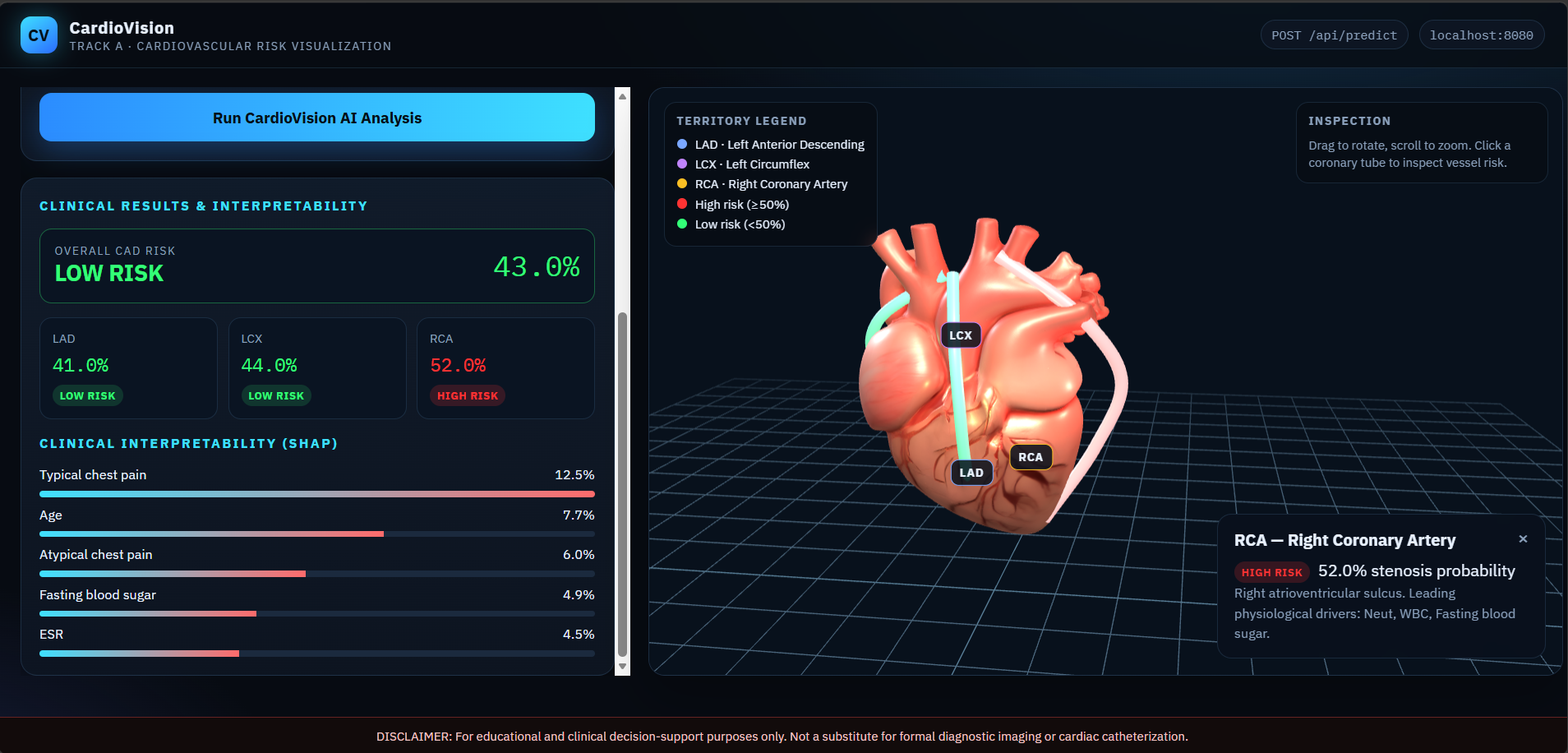
- Multi-Vessel Risk Prediction: Predicts overall Coronary Artery Disease (CAD) status and individual vessel stenosis probabilities for:
- LAD (Left Anterior Descending)
- LCX (Left Circumflex)
- RCA (Right Coronary Artery)
- Dynamic 3D Visual Mapping: Renders a realistic 3D anatomical heart using Three.js (WebGL). High-risk vessels light up in glowing red with pulse emission, while low-risk vessels appear in bright green.
- Interactive Raycasting Inspection: Users can rotate, zoom, and click directly on any coronary artery (LAD, LCX, RCA) to open localized risk inspection cards.
- Clinical Interpretability (SHAP): Displays top physiological drivers powering predictions to ensure model transparency.
⚙️ How We Built It
CardioVision utilizes a decoupled, enterprise-grade 3-tier microservice architecture:
- ML Engine (Python 3.11 & FastAPI): Trained 4 independent Random Forest Classifiers on the Z-Alizadeh Sani cardiac dataset. Target columns (
Cath,LAD,LCX,RCA) were strictly excluded from input features to prevent target leakage. - Backend API (Java 17 & Spring Boot 3): Serves as the core orchestration engine, receiving client requests, applying business logic, communicating via
RestTemplatewith the Python ML microservice, and managing CORS policies. - Frontend Canvas (Three.js & HTML5): Loads an open-source 3D GLTF anatomical heart model overlaid with dynamic
TubeGeometrycoronary vessels and raycasting mouse listeners.
🚧 Challenges We Ran Into
- Target Leakage Prevention: Ensuring all direct vessel indicators were stripped from the feature matrix while retaining high predictive accuracy across all 4 models.
- 3D Mesh Rendering & WebGL CORS: Resolving browser security restrictions when loading GLTF anatomical meshes locally by deploying a dedicated local HTTP server.
- Java-Python Orchestration: Mapping incoming JSON feature payloads smoothly between Java Spring Boot controllers and Python FastAPI Pydantic schemas.
🏆 Accomplishments That We're Proud Of
- Building a full-stack, AI-integrated 3D healthcare web prototype solo as a B.Tech 2nd-year student!
- Successfully integrating Java Spring Boot for backend API orchestration while learning Java backend development.
- Achieving a seamless, GPU-independent 60 FPS WebGL 3D visualization that updates vessel colors dynamically in real time.
🎓 What We Learned
- Building microservices using Java Spring Boot 3 (
@RestController,RestTemplate,WebMvcConfigurer). - Interactive 3D web graphics, material emission, and camera animations using Three.js and OrbitControls.
- Implementing feature attribution (SHAP) for medical AI transparency.
🤖 AI Tools Disclosure
In full compliance with hackathon guidelines, AI tools were utilized as coding assistants for rapid prototyping:
- Cursor AI & ChatGPT: Used for generating starter boilerplate code (Spring Boot controllers/services, Three.js scene setup, FastAPI routing, and documentation formatting). All AI-generated code was manually reviewed, edited, integrated, and verified by the developer.
- ElevenLabs: Used to produce a clear, high-quality audio voiceover for the demonstration video.
⚠️ Clinical Safety Disclaimer
CardioVision is intended strictly for educational and decision-support purposes only. It is not a substitute for formal diagnostic imaging, cardiac catheterization, or professional medical judgment.
Built With
- chatgpt
- css3
- cursor-ai
- elevenlabs
- fastapi
- html5
- java
- javascript
- joblib
- python
- scikit-learn
- spring-boot
- three.js
- webgl

Log in or sign up for Devpost to join the conversation.