-
-
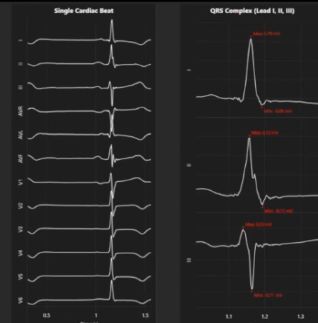
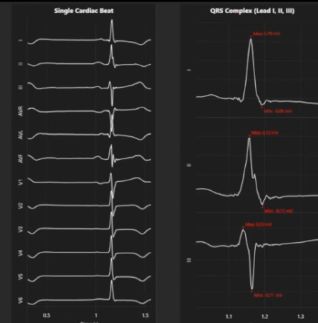
ECG waveform view from our recorded UH capstone presentation.
Cardio Vision
Cardio Vision is a Boston Scientific-sponsored University of Houston Computer Science capstone, developed by a six-person student team from January to May 2025. It brings ECG data management, waveform visualization, and electrical-axis calculations into a web interface.
The problem
ECG exploration combines large data files, structured records, multiple leads, and visual analysis. Our capstone connected those pieces so users could upload records, inspect cardiac beats, compare lead measurements, and view an electrical-axis visualization in one workflow.
What we built
The team built a Python/Flask web application backed by a MySQL database and SQLAlchemy. The project includes dataset and bulk-record upload workflows, ECG graphing, beat selection, lead measurements, and an electrical triaxial-axis view. Matplotlib, Plotly, NumPy, and wfdb support the data and visualization work; JavaScript, HTML, and CSS support the interface.
My contribution — Rami Abdelrazzaq
I contributed to backend database operations, bulk uploads and schema handling, graphing, responsive UI improvements, troubleshooting, and tests. I also participated in final sponsor communication. This was a collaborative academic project: these are my contributions within the team's work.
How we approached it
We connected the upload and database workflows to ECG plots and an axis calculation based on Leads I, II, and III, using parallelogram and cosine-law geometry. The stack included pytest and Vitest/jsdom for backend and frontend testing, with Jenkins in the development workflow.
Challenges and learning
Handling different input schemas, keeping bulk uploads consistent with the database, and making visualizations usable across screen sizes required coordination between the backend and interface. The project strengthened my experience with data-driven web applications, debugging across layers, automated testing, and communicating technical results to a sponsor.
See the project
Watch the recorded capstone presentation. The gallery uses frames from that presentation.
Project status
Completed academic capstone, May 2025. This is an educational software prototype; the portfolio does not claim clinical validation or regulatory approval.
Built With
- css
- flask
- html
- javascript
- jenkins
- matplotlib
- mysql
- numpy
- plotly
- pytest
- python
- sqlalchemy
- vitest
- wfdb

Log in or sign up for Devpost to join the conversation.