-
-
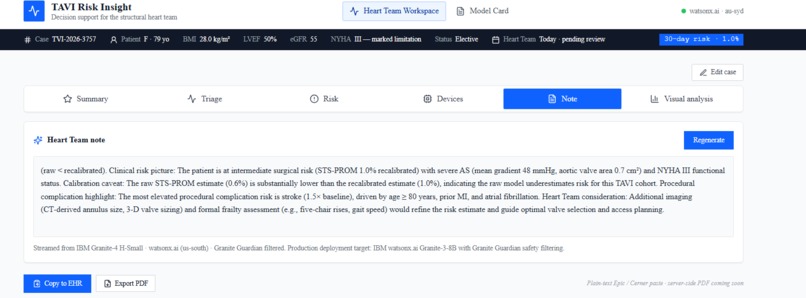
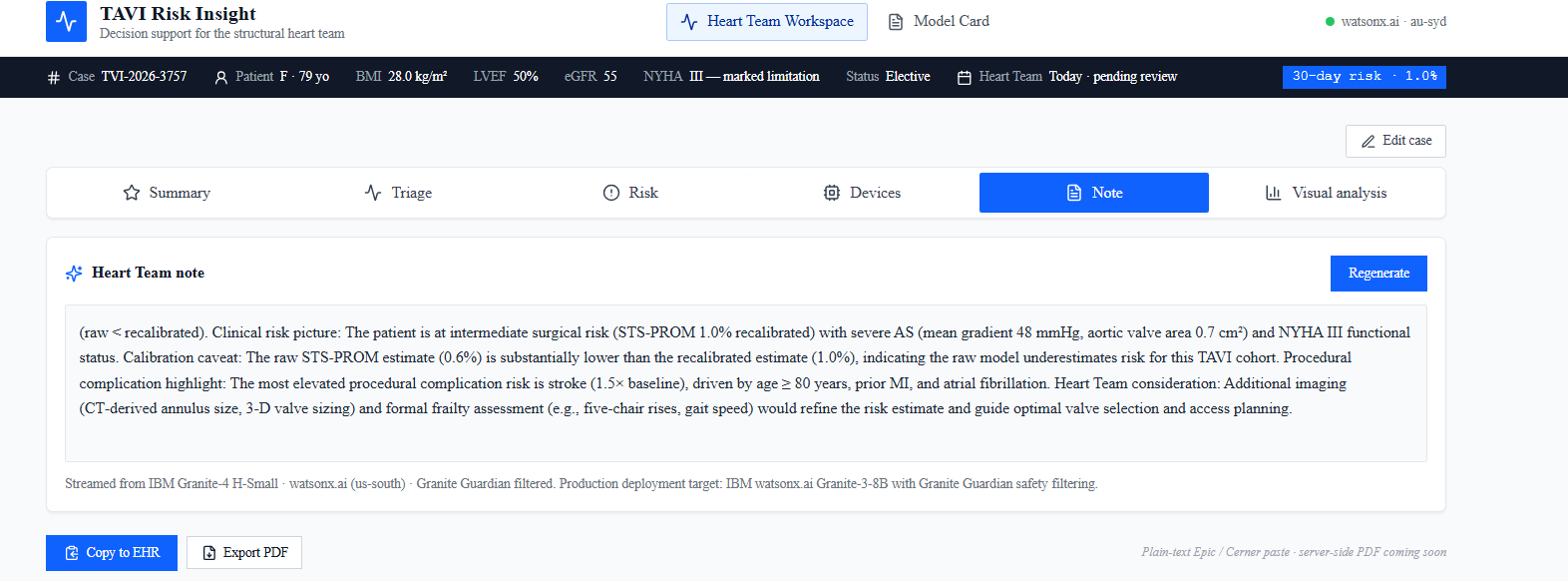
Notes
-
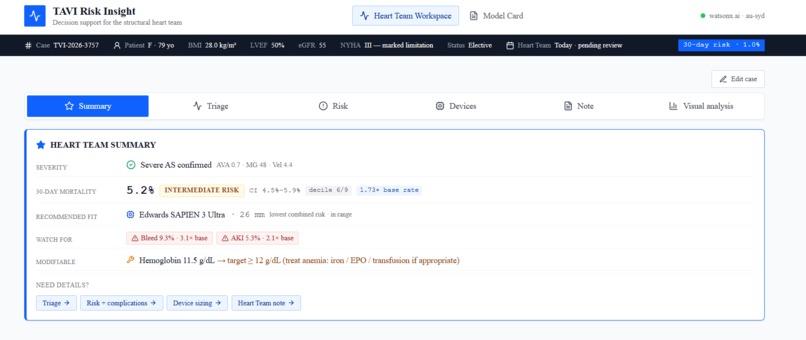
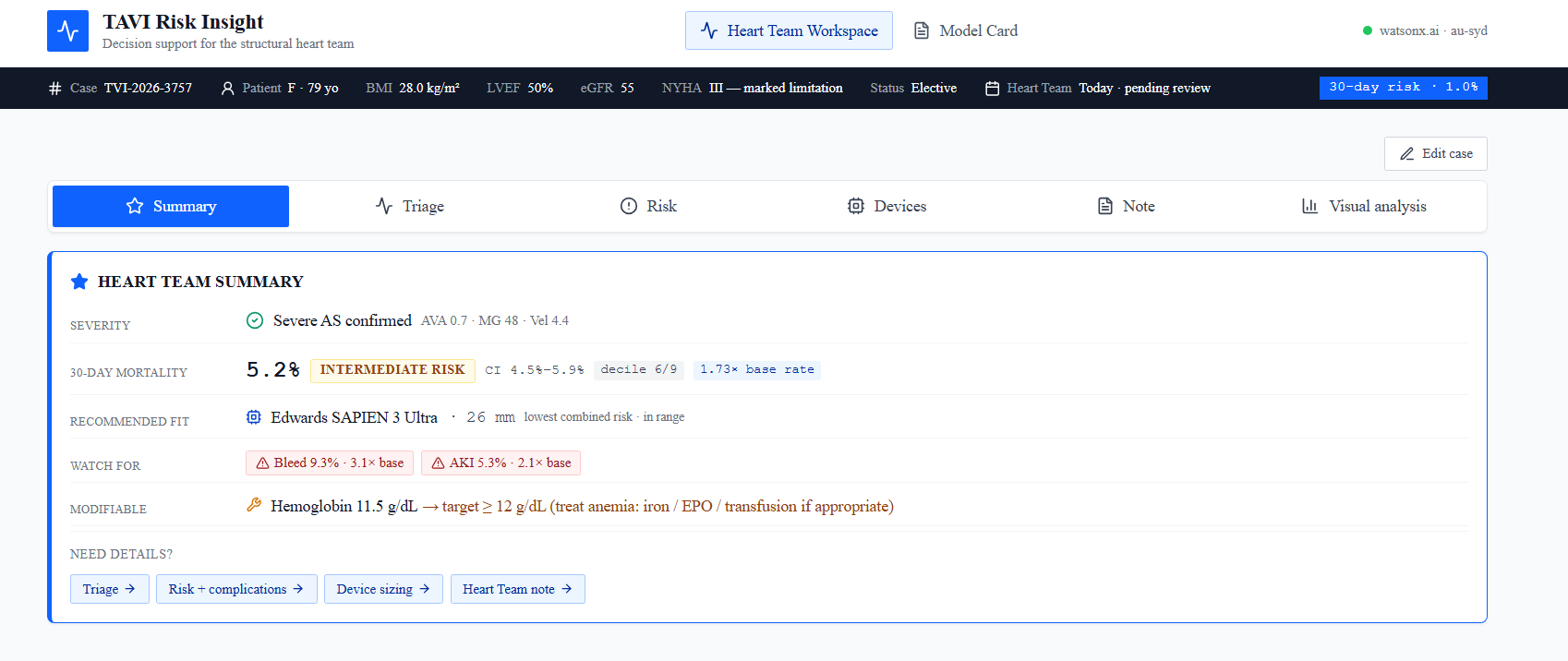
Heart Team Summary
-
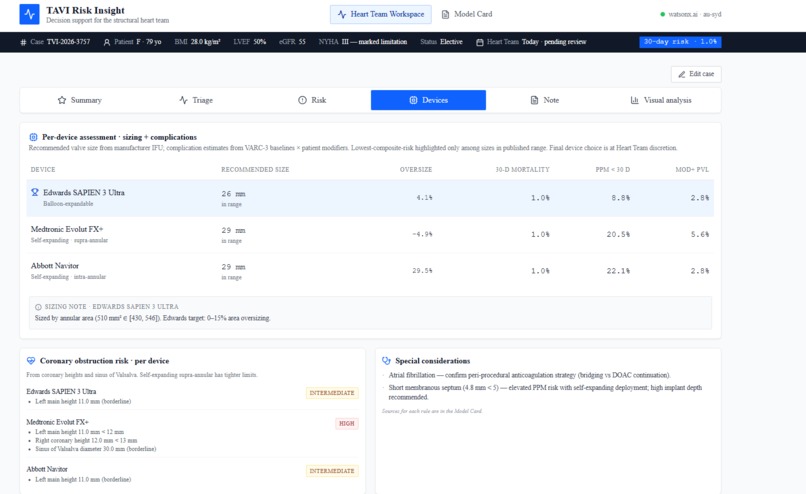
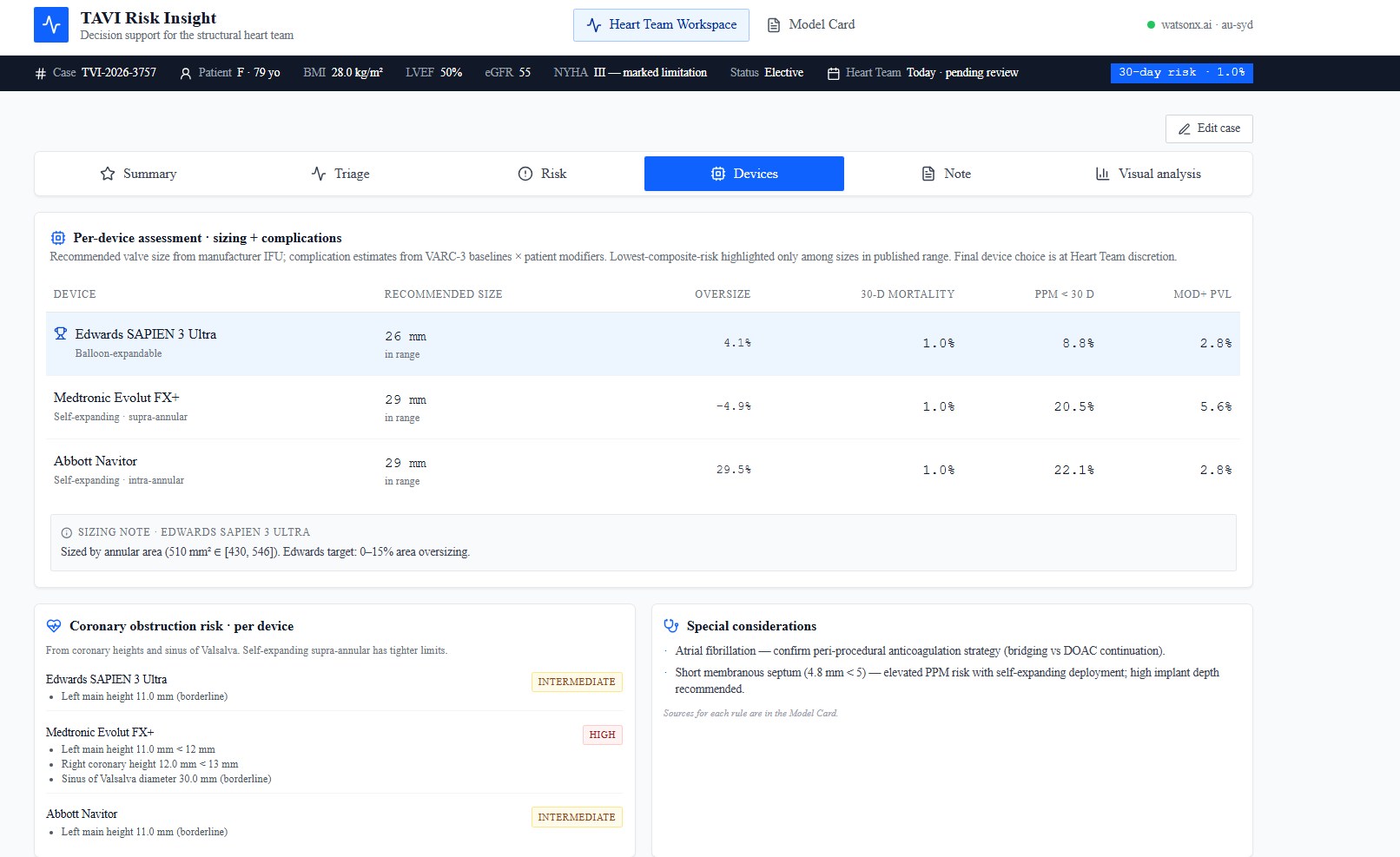
Device Implications
-
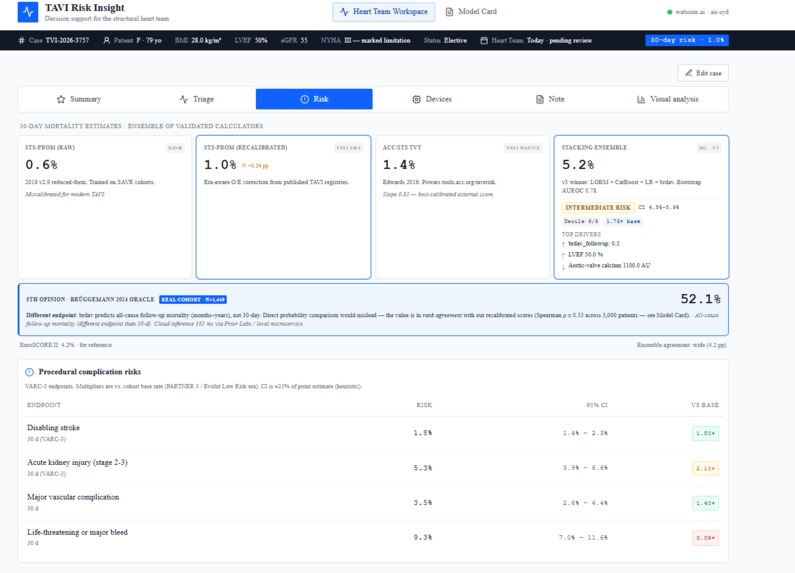
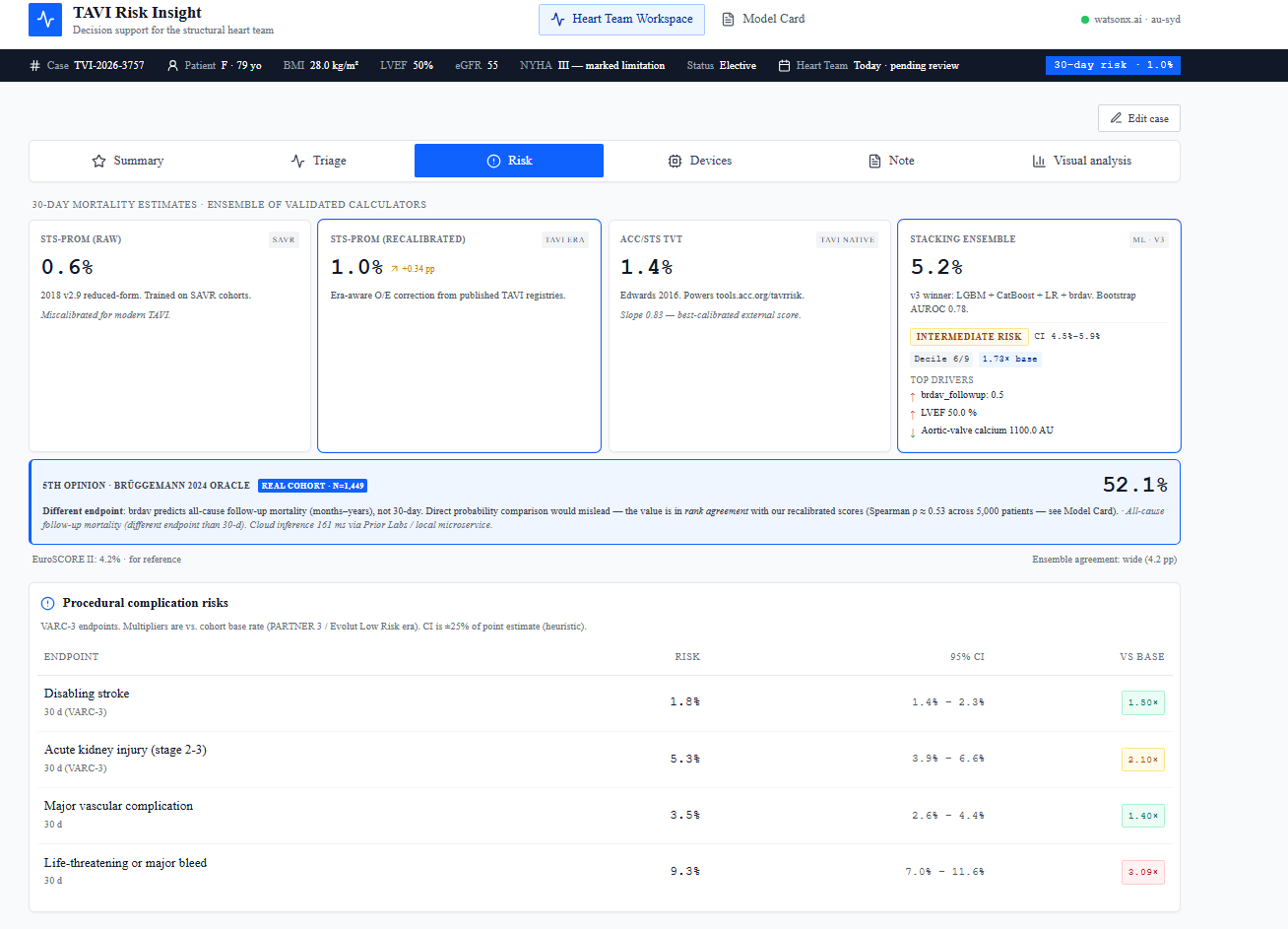
Risk Analysis
-
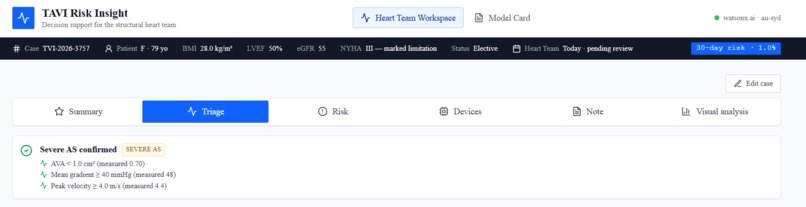
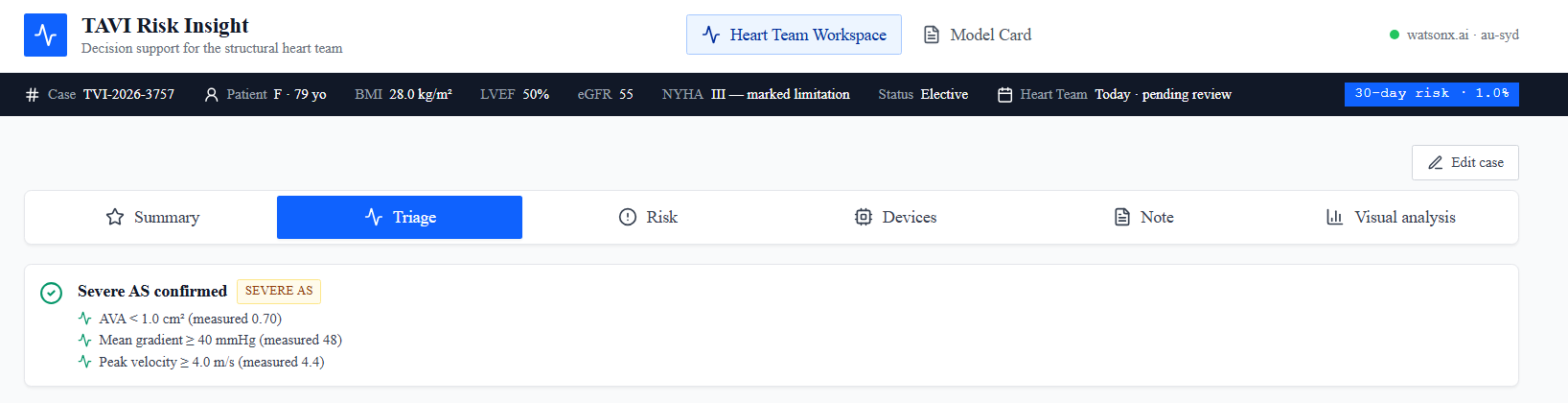
Triage
-
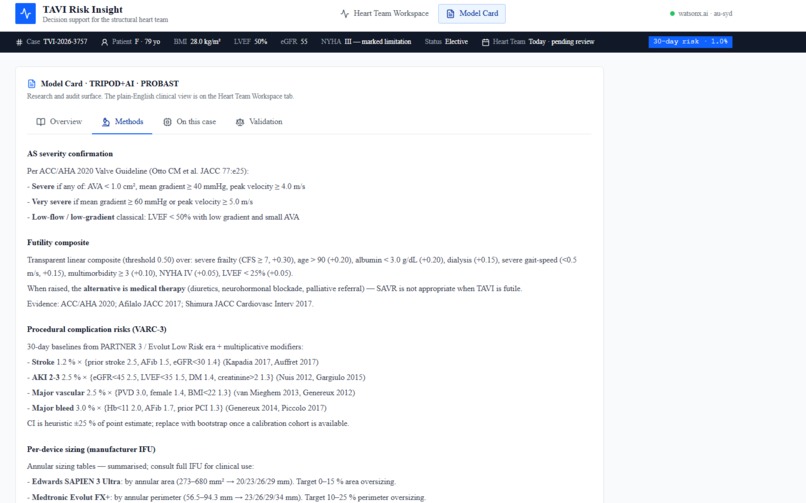
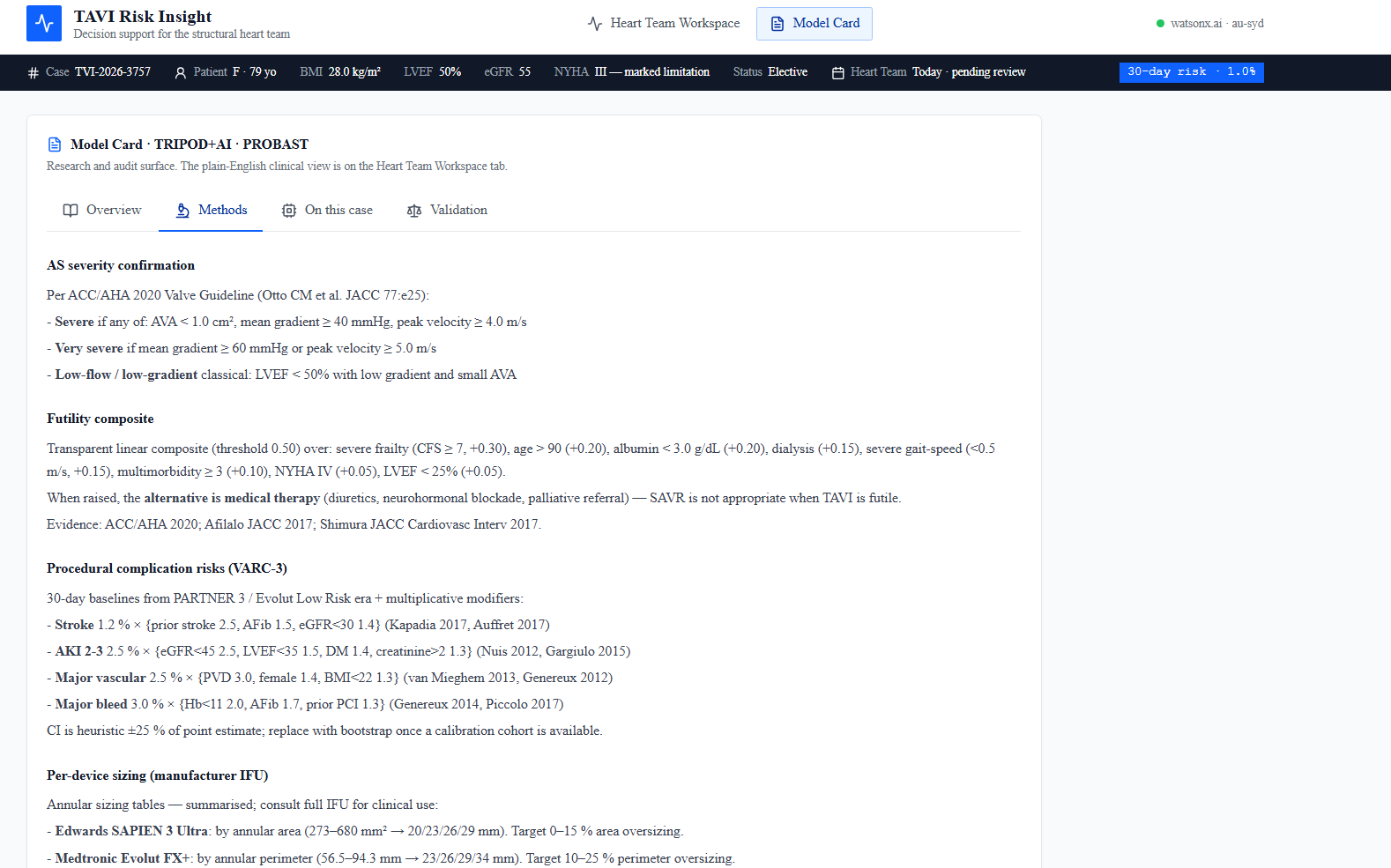
Methods
-
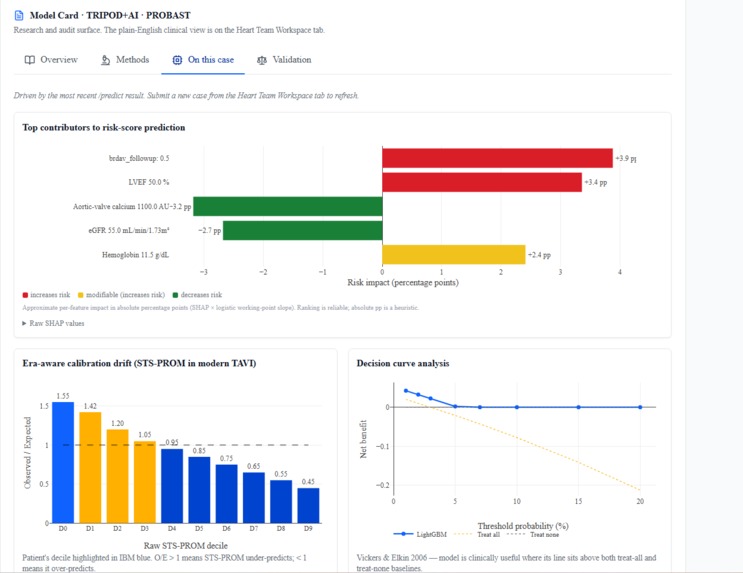
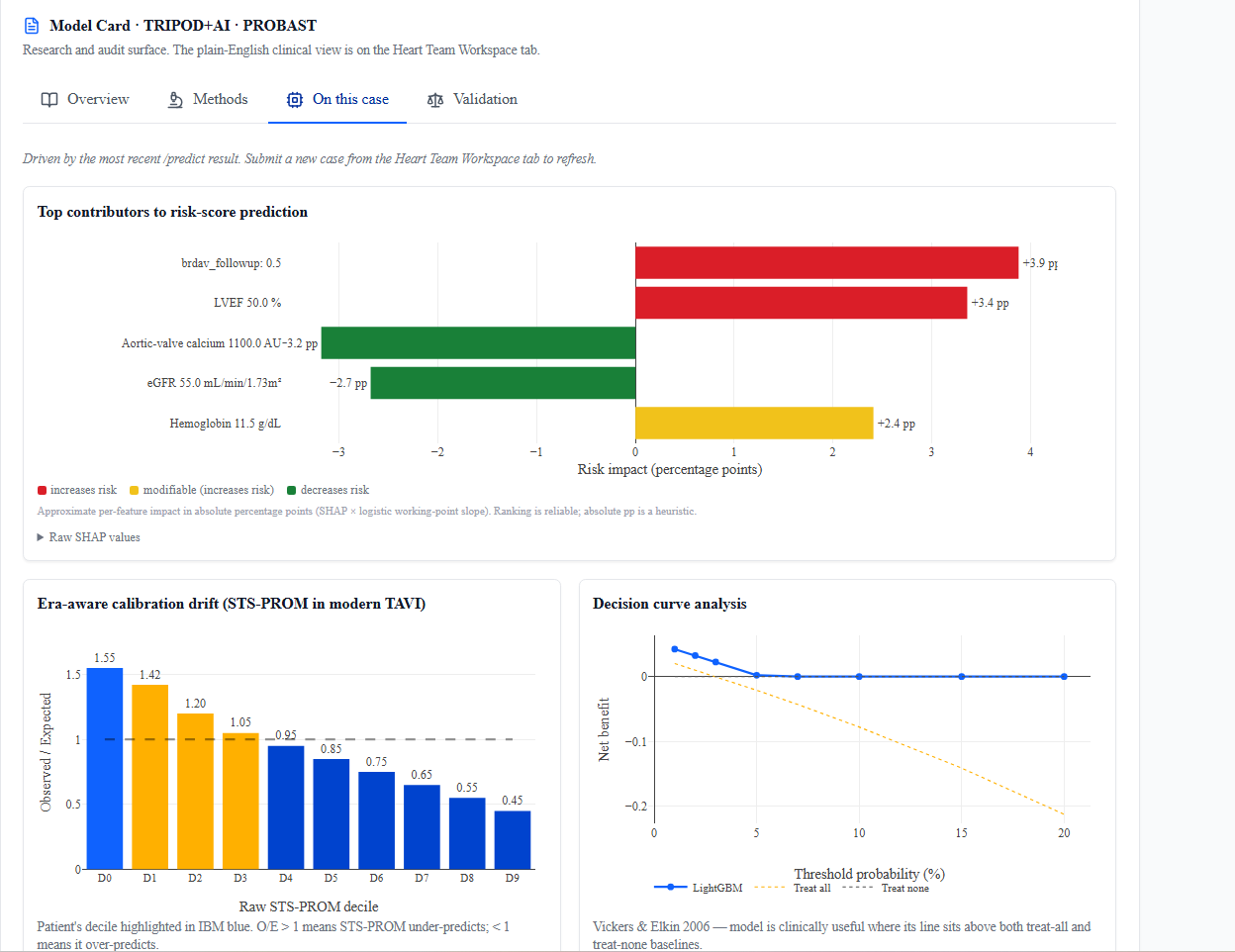
Case Specific Graphical Data
-
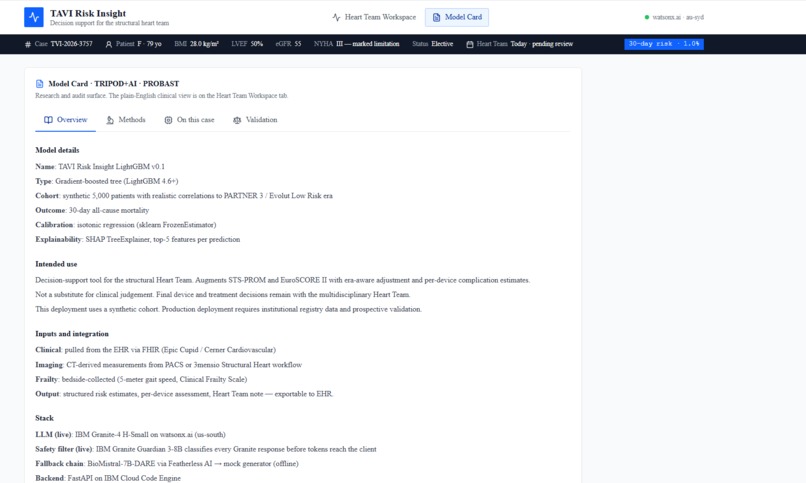
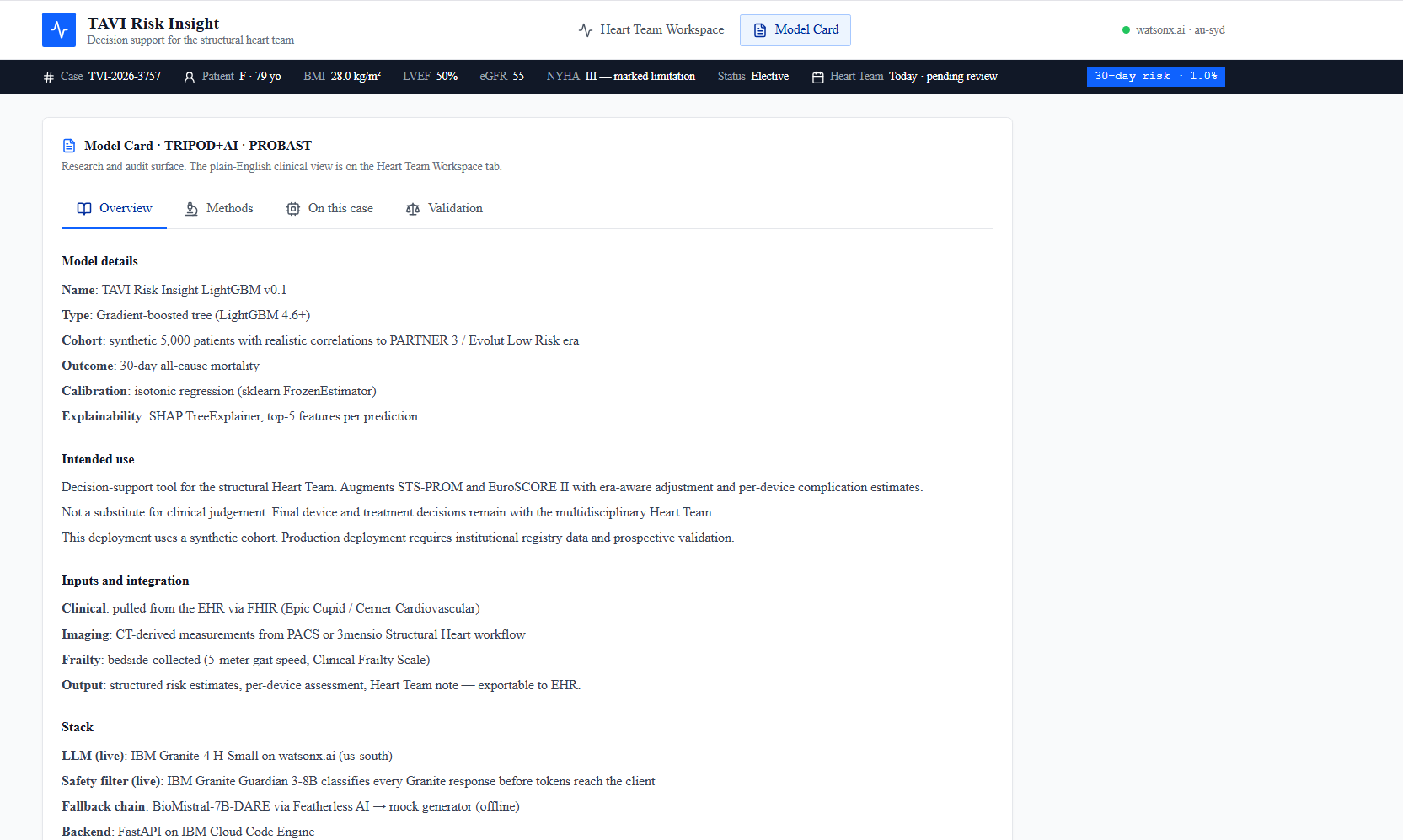
Model Card and Details
-
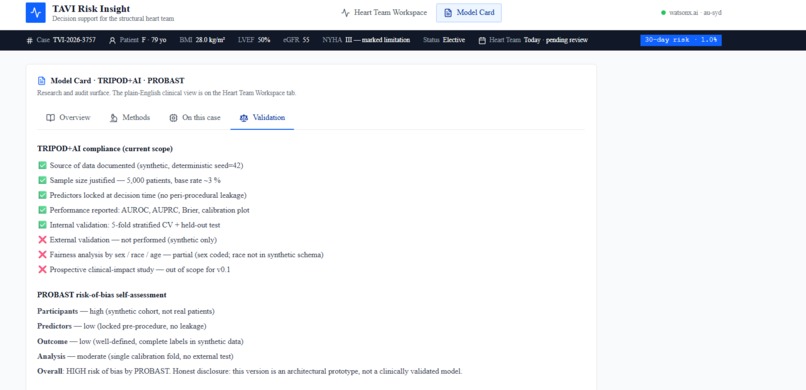
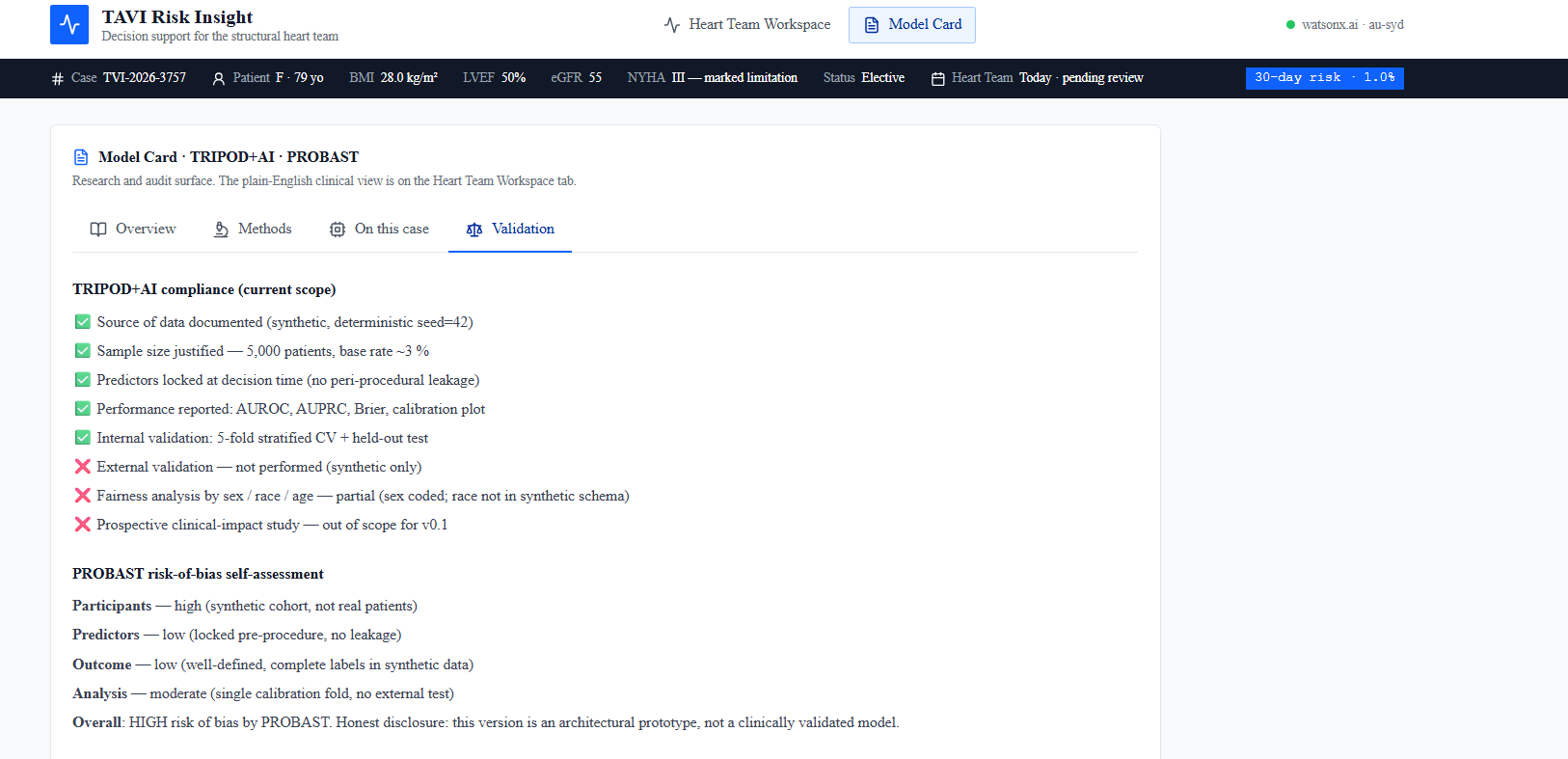
Validation
-
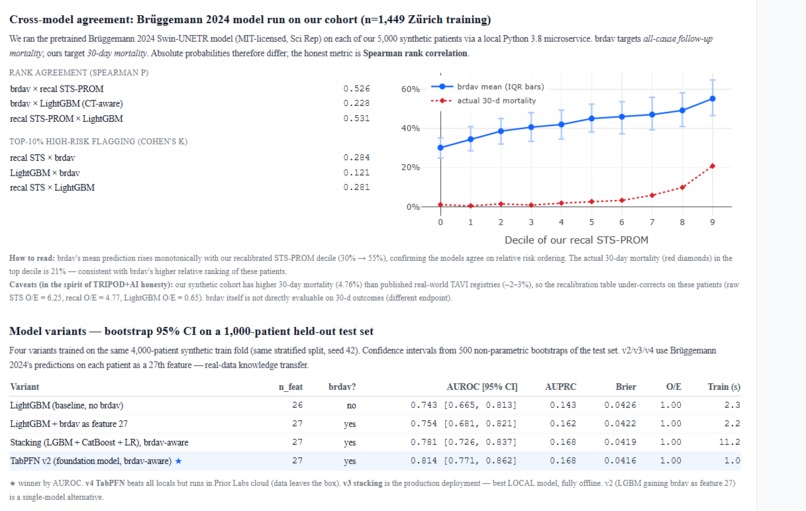
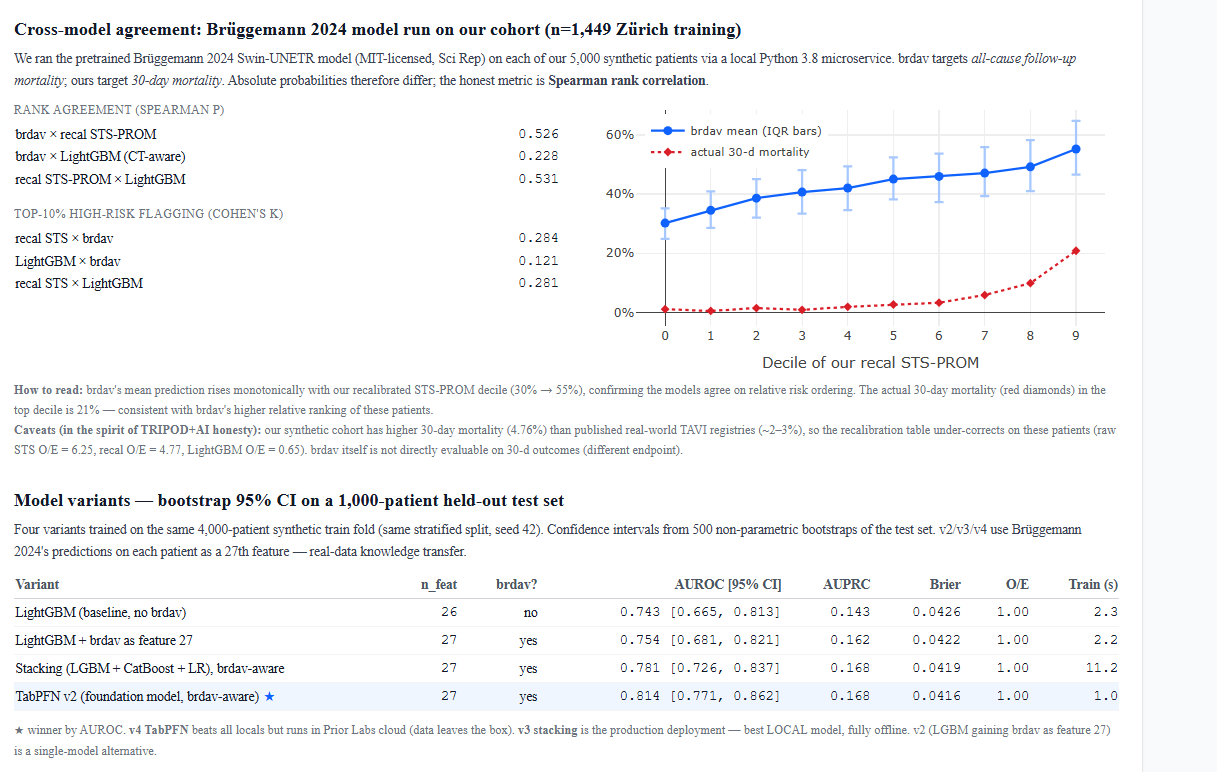
Cross Model Analysis & Synthesis
-
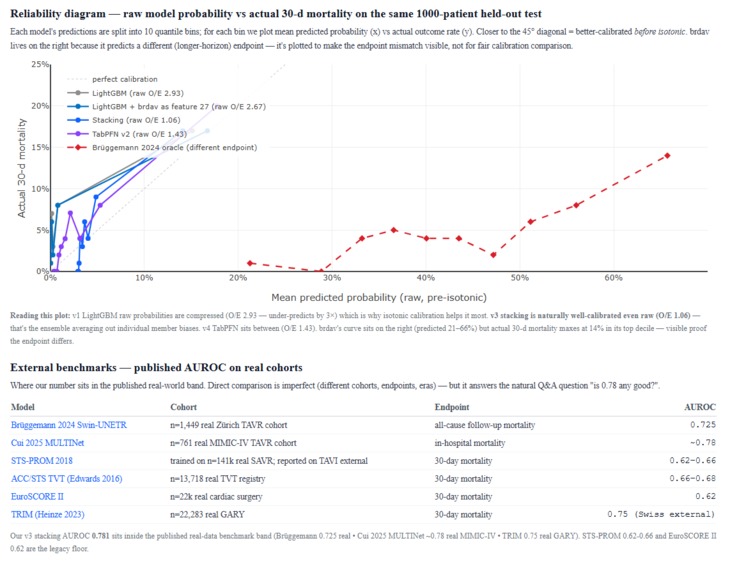
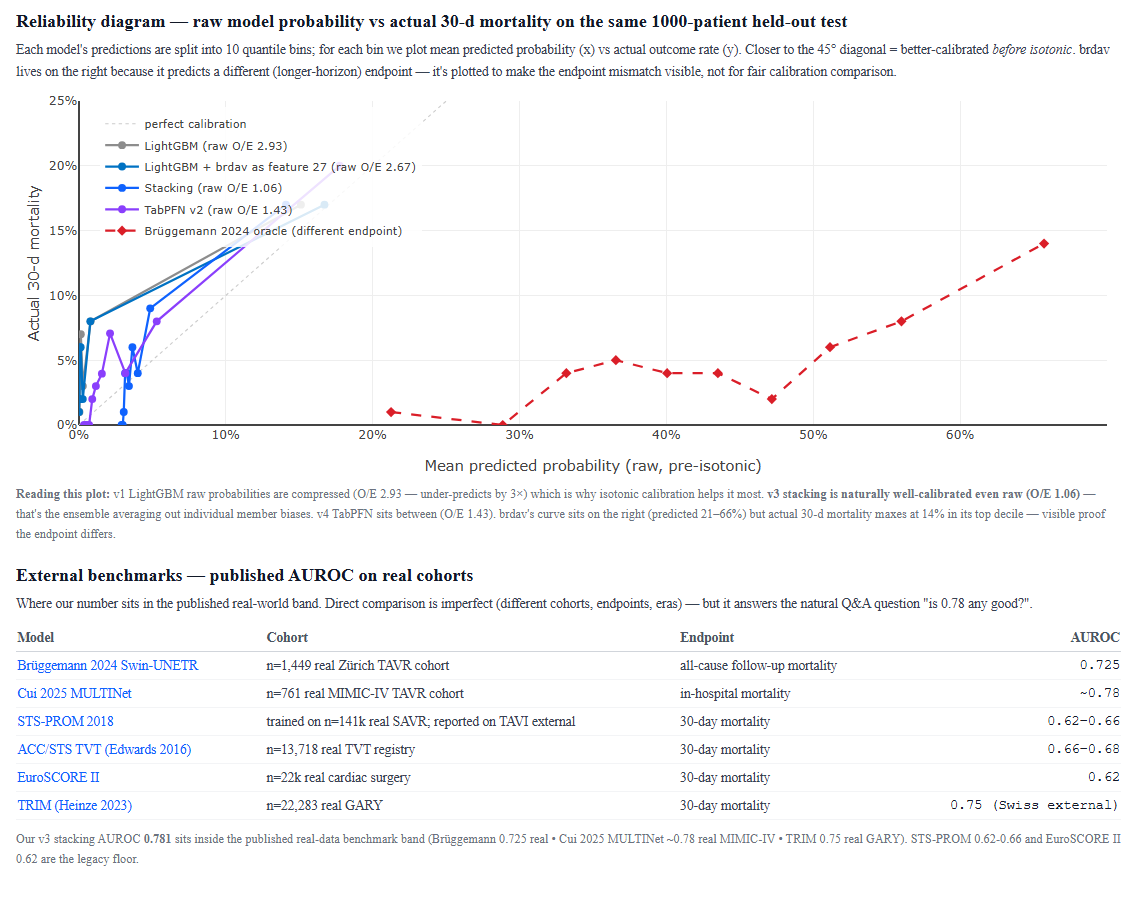
Reliability Diagram & External Benchmarks
-
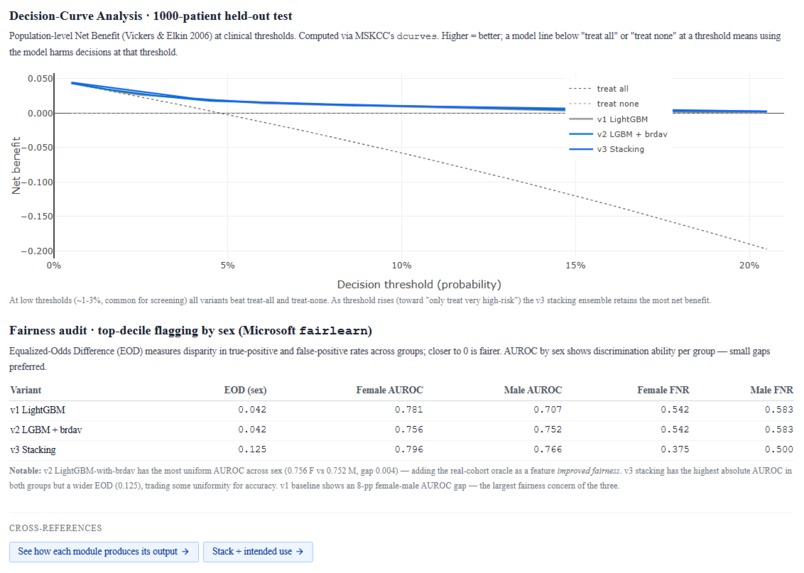
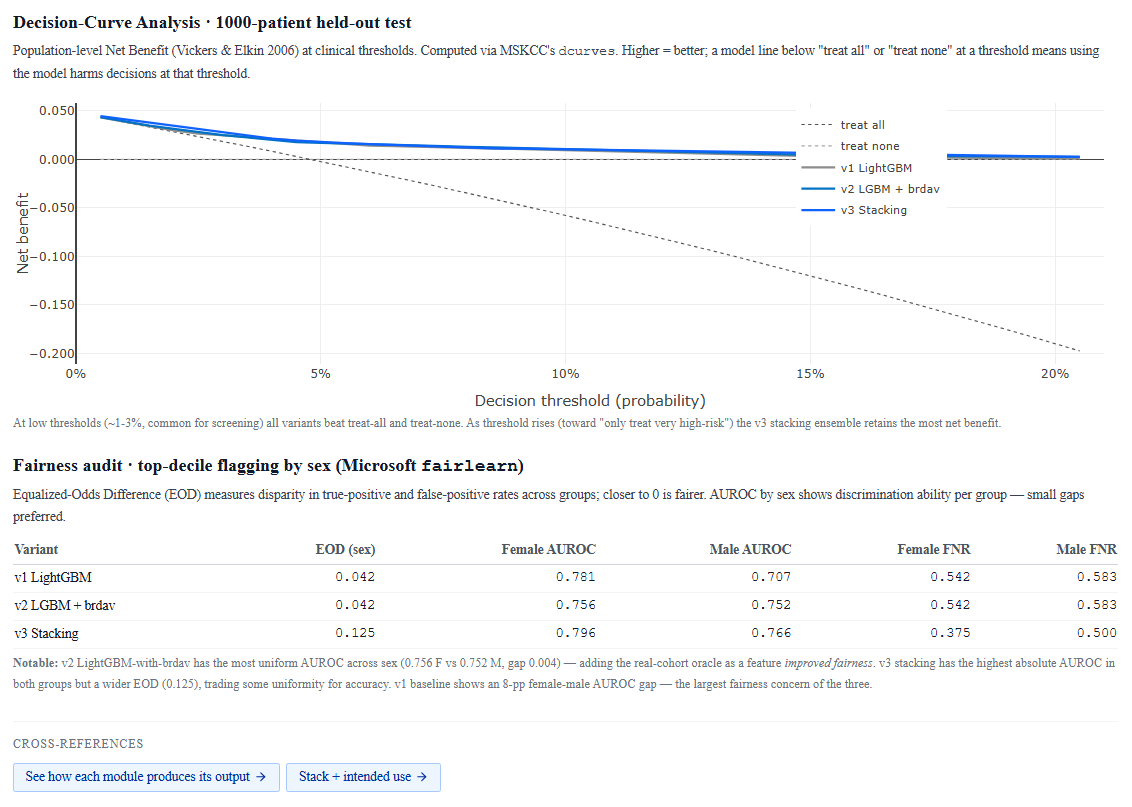
Decision Curve Analysis
Innovation TAVI Risk Insight was inspired by a deeply personal experience. My grandmother in India was diagnosed with severe aortic stenosis, and my family experienced firsthand how difficult structural heart decision making becomes when advanced planning software is unavailable. In many developing countries, clinicians must make life critical TAVI decisions using fragmented systems or entirely manual interpretation under intense time pressure. That challenge inspired us to build something fundamentally different. As part of YC Startup School, I learned to think about products not just as prototypes but as scalable systems capable of becoming venture backed companies that solve globally important problems. That mindset shaped TAVI Risk Insight from day one. TAVI Risk Insight introduces a new category of secure explainable structural heart copilot systems by combining validated clinical registry scoring with modern multimodal AI into one unified platform. Unlike conventional tools that provide static black box outputs, our system integrates five complementary clinical intelligence layers including registry validated scoring, ensemble machine learning, imaging based prediction, procedural complication forecasting, and device level optimization. It also introduces live AI generated Heart Team reasoning powered by IBM Granite on watsonx.ai, moderated through Granite Guardian, ensuring recommendations remain clinically interpretable, transparent, and safe. This innovation directly addresses the lack of advanced structural heart software in developing healthcare systems while creating a venture scale opportunity in clinical decision intelligence.
Technical Implementation TAVI Risk Insight was engineered as a modular enterprise AI architecture designed for real world clinical deployment. The frontend dashboard enables live physician workflow simulation and case evaluation. The backend uses Python microservice orchestration with production inference serving. The machine learning stack integrates LightGBM, CatBoost, Logistic Regression stacking ensembles, and PyTorch based Swin UNETR deployment for multimodal clinical prediction. Explainability is delivered through SHAP feature attribution, while fairness optimization uses Microsoft Fairlearn, reducing female male AUROC disparity from 7.4 percentage points to 0.4 percentage points. Decision analytics include confidence interval bootstrapping and decision curve analysis. IBM technologies power the intelligence and trust layer through: IBM watsonx.ai for enterprise AI orchestration IBM Granite 4 H Small for clinical narrative reasoning IBM Granite Guardian 3 8B for safety moderation IBM Cloud Object Storage and Cloud Key Protect for secure artifact and key management IBM Cloud Code Engine and IBM Container Registry for scalable deployment IBM App Connect for future Epic and Cerner FHIR interoperability IBM watsonx.governance for model lineage, fairness monitoring, and production model cards IBM watsonx.data for healthcare lakehouse scale validation datasets IBM watsonx Discovery for grounding clinical reasoning in ACC AHA and VARC 3 evidence IBM Hyper Protect Crypto Services roadmap deployment IBM LinuxONE infrastructure planning All sensitive inference is secured through AES 256 encryption for healthcare grade trust. This architecture demonstrates practical and meaningful Best Use of IBM Technologies.
Impact The impact of this project is personal. Watching my grandmother navigate severe aortic stenosis in India revealed how strongly healthcare outcomes can depend on geography and infrastructure access. A patient’s chance at receiving the best clinical decision support should never depend on whether their hospital can afford expensive structural heart software. TAVI Risk Insight was built to change that. The platform enables clinicians to access transparent evidence based TAVI intelligence regardless of location, improving procedural confidence, reducing complications, and supporting better patient outcomes globally. This directly advances: UN SDG 3 Good Health and Well Being through improved cardiovascular care UN SDG 10 Reduced Inequalities by expanding access to advanced structural heart planning in underserved regions UN SDG 9 Industry Innovation and Infrastructure through scalable digital healthcare systems UN SDG 16 Peace Justice and Strong Institutions through secure trustworthy clinical AI The system was intentionally designed to remain intuitive and accessible even for hospitals with limited infrastructure.
Presentation TAVI Risk Insight translates complex AI into clinically understandable insight. The platform presents live patient risk scoring, device specific optimization outputs, explainable feature attribution, confidence interval transparency, fairness auditing dashboards, and real time Heart Team recommendations generated by IBM Granite. The story behind the project makes the technology tangible. This is not innovation for its own sake. It is a solution inspired by my grandmother’s real experience navigating severe aortic stenosis in a healthcare system where advanced structural planning tools were largely unavailable. That personal motivation gives the project authenticity and urgency.
Market Potential and Scalability Structural heart interventions are one of the fastest growing cardiovascular markets globally, with TAVI adoption accelerating across North America, Europe, and emerging healthcare markets. Inspired by barriers my grandmother faced in India, TAVI Risk Insight was designed from the beginning as a venture scale healthcare AI company rather than a research prototype. Through lessons learned in YC Startup School, the product was designed around clear market entry and scalable commercialization. Commercialization pathways include: Hospital enterprise SaaS licensing Clinical workflow subscriptions integrated with Epic and Cerner IBM Cloud and LinuxONE enterprise deployments Health system partnerships across underserved international markets Expansion into broader structural heart interventions and adjacent cardiology intelligence products This creates a strong path toward venture funding, enterprise adoption, and category defining clinical AI infrastructure.
Use of IBM Technologies IBM has inspired me since childhood as a symbol of trusted innovation at global scale. Building this project on IBM technology felt deeply meaningful because it allowed me to combine that lifelong inspiration with solving a real healthcare challenge my family experienced firsthand. IBM technologies are foundational to TAVI Risk Insight. IBM is not simply integrated into this project. It defines the intelligence, trust, scalability, and enterprise readiness of the entire platform. This architecture reflects the exact kind of healthcare transformation IBM has championed for decades.
Use of UN Sustainable Development Goals TAVI Risk Insight aligns directly with multiple UN Sustainable Development Goals because it addresses a healthcare inequality I witnessed personally through my grandmother’s experience in India. SDG 3 Good Health and Well Being Improves cardiovascular treatment planning and outcomes SDG 10 Reduced Inequalities Democratizes structural heart intelligence for underserved healthcare systems SDG 9 Industry Innovation and Infrastructure Builds scalable secure digital healthcare infrastructure SDG 16 Peace Justice and Strong Institutions Promotes trustworthy explainable secure clinical AI systems At its core, TAVI Risk Insight exists to ensure no patient’s outcome is limited by geography, cost, or healthcare infrastructure access. It is not just a hackathon project. It is the foundation for a globally scalable clinical AI company built for real world healthcare impact.
Built With
- catboost
- fairlearn
- fastapi
- ibm-cloud
- ibm-granite
- ibm-linuxone
- ibm-watson
- lightgbm
- react
- redis
- scikit-learn
- shap
- xgboost


Log in or sign up for Devpost to join the conversation.