-
-
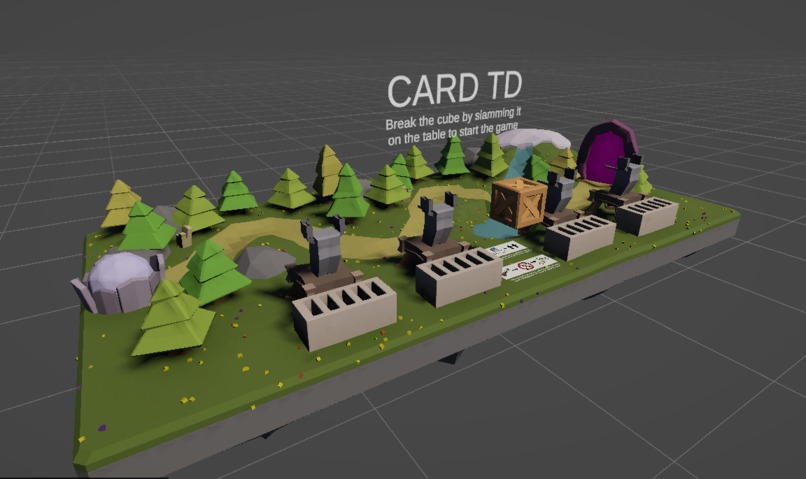
The map
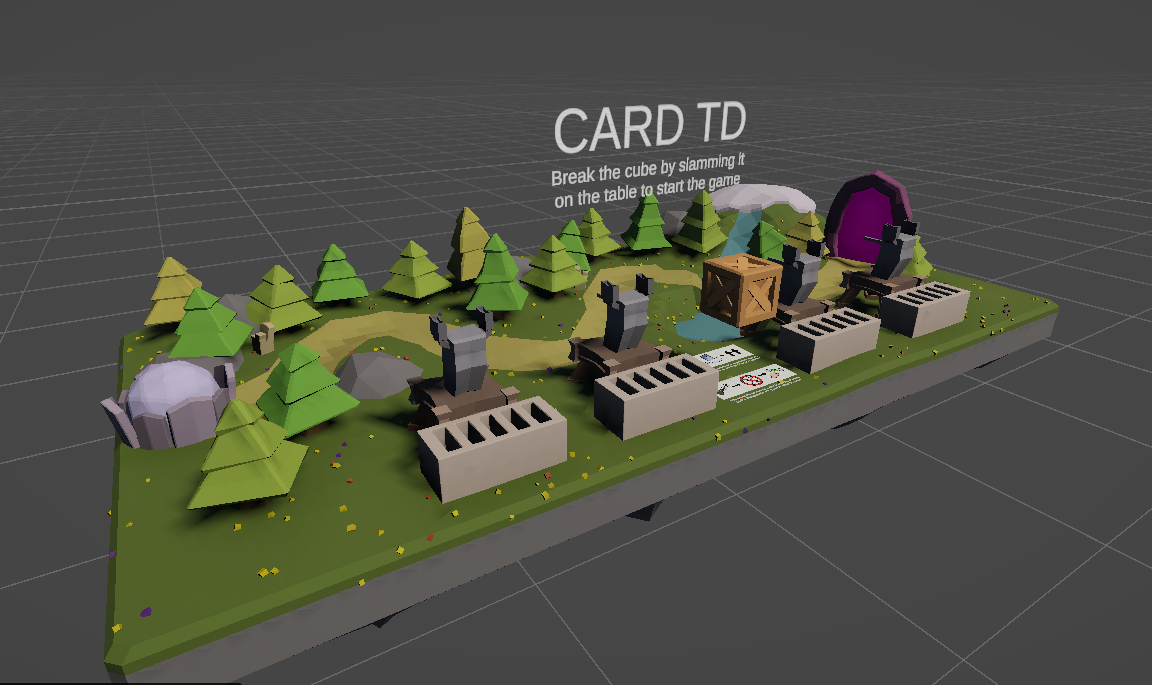
Inspiration
I have always loved the Tower Defense genre, but I felt the traditional "click-and-wait" gameplay needed an evolution. I wanted to bring the action into the real world, making it more comfortable and interactive by removing controllers entirely. The goal was to replace abstract menus with physical actions. Instead of just clicking an "Upgrade" button, I wanted players to physically insert "floppy disk" style cards into turrets, combining different modules like Black Holes or Overdrive Levers to create custom defenses.
What it does
Card TD turns your physical environment into a battlefield using Mixed Reality.
- Tactile Gameplay: You don't just watch; you act. You physically smash supply crates with your bare hands to find loot.
- Modular Upgrades: The "cards" act like physical floppy disks. You insert them into turrets to modify their behavior. You can combine different disks to create unique effects, such as a gravity-sucking Black Hole or attaching a manual lever to activate "Overdrive" mode.
- Active Maintenance: Turrets don't run forever; you have to manage them with quick reload minigames using hand gestures, keeping the adrenaline high.
How we built it
The project was built from scratch using Unity and the Meta Quest SDK.
- Tech Stack: I utilized the Interaction SDK for precise hand tracking and gesture recognition, and the Passthrough API to blend the game world with the user's living room.
- Optimization: To ensure a smooth framerate on standalone hardware, I implemented Object Pooling for projectiles and enemies, minimizing garbage collection spikes.
- Solo Development: I am a solo developer. I created all the code, 3D models, particle effects, and sound design myself. I only used AI tools to generate the 2D tutorial images.
Challenges we ran into
The biggest hurdle was the learning curve: this was my first time using Unity. I had to learn the engine and the complexities of VR development simultaneously.
- Physics Interactions: Tuning the physics for the crate smashing was difficult, it had to feel responsive and satisfying without glitching.
- Game Logic: Designing a modular system where "cards" could dynamically alter turret behavior (and interact with each other) required complex backend logic.
Accomplishments that we're proud of
- The "Game Feel": The physical sensation of smashing a crate and grabbing the loot feels incredibly satisfying.
- Modular Systems: I’m proud of the system that allows multiple cards to be slotted into one turret (e.g., combining a manual lever with a damage boost).
- The Reload Mechanic: The quick minigame to reload turrets adds a layer of frantic fun that prevents the player from standing still.
What we learned
I learned that Mixed Reality requires a different design philosophy than standard VR. Interactions need to be exaggerated and physical to feel "real." I also mastered the basics of Unity architecture, specifically how to manage heavy distinct waves of enemies without compromising performance through efficient memory management.
What's next for Card Tower Defense
The foundation is solid, but I plan to expand the chaos:
- Content: More variety of "Floppy Disk" cards and new enemy types to force different strategies.
- Boss Fights: Interactive bosses that physically enter the room (e.g., coming out of the ceiling or walls).
- Progression: A sophisticated main menu, a leaderboard system, and potentially local multiplayer to defend the living room with a friend.


Log in or sign up for Devpost to join the conversation.