
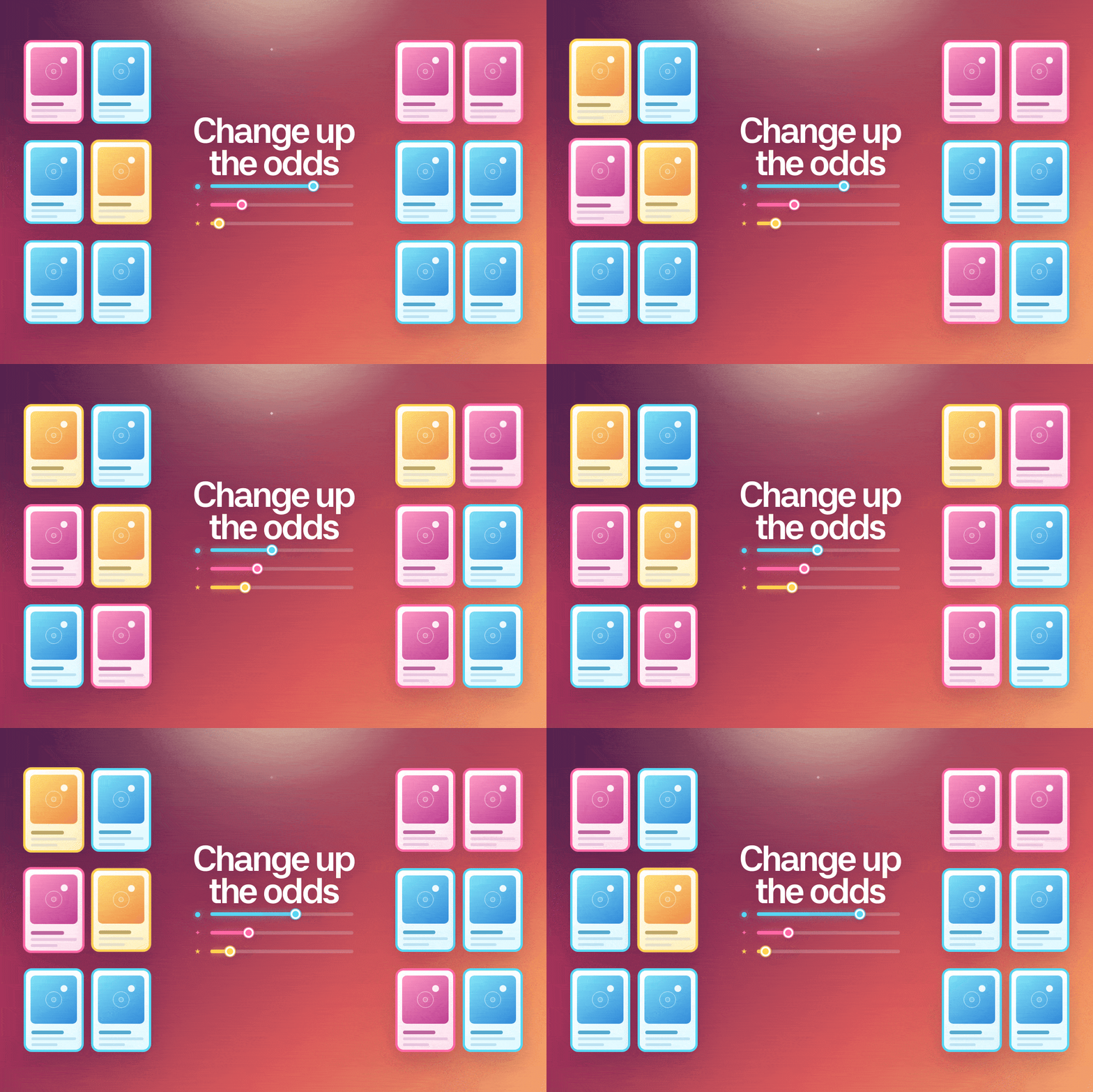

Turn memories, ideas, and rewards into collectible and customizable card packs
Inspiration
The idea for what became Packerel was a desire to create my own set of trading cards. Although making individual cards was a straightforward task, the opening experience I wanted was much harder to achieve. I wanted an interactive, animated experience but none of the models I tried over the past year could generate a convincing prototype. It became one of my personal model benchmarks.
GPT-5.6 was the first model to show me a compelling version of the idea. This project goal turned from Can AI build this? to How far can Codex take one person and one product idea in a single build week?
What it does
Packerel is a collectible-card platform for making and sharing digital booster packs.
A creator can:
- Start from an occasion, theme, or blank pack.
- Design cards in a visual editor.
- Configure card rarity, pack size, pull odds, opening limits, and reveal order.
- Publish a pack as private, unlisted, or public.
- Share it directly with friends or family, with no account needed to open a pack.
Pack recipients can open the link, tear their pack open, reveal each card through a tactile animated sequence, and see their results. Discovered cards are tracked in a personal collection. Players can track set completion, missing cards, duplicates, best pulls, and see previous openings.
Customizable booster packs have surprising applications beyond collecting! They can turn family memories into a birthday gift, help students practice vocab terms or demonstrate their learning, let friends reveal travel plans, and give businesses a playful way to introduce products and rewards. Packerel recaptures the excitement of opening a pack and discovering what’s inside.
Seven days of building
The project grew from a pack-opening experiment into a functioning platform with a card studio, publishing system, guest openings, collection persistence, sharing, moderation, analytics, responsive design, and a production-minded OpenAI integration.
How I built it
Packerel was built entirely through Codex; I did not need to manually add or edit a line of application code. Even small copy changes were given to Codex to implement.
I used Replit as my development infrastructure. Codex was given access to the full repo and seamlessly worked across the frontend and backend, ran tests, and managed all the packages and frameworks needed.
My main role was to decide on the scope of the features I wanted and ensure the prototype was working well. 5.6 Sol worked flawlessly for new features and technical implementations. I alternated between Plan mode and /goal for ambitious tasks that like custom backgrounds and CSS refactoring. 5.6 Sol even created the GIFs and demo video. 5.6 Terra high/xhigh worked great on lighter tasks like visual fixes and copy changes that I would log and submit in batches of work. I also tasked ChatGPT Work to navigate the prototype and critique the design and navigation. Its feedback went directly into 5.6 Sol, where it carefully reviewed it and presented me a variety of approaches to take.
The breakthrough
The pack-opening sequence was the reason Packerel had remained an idea.
A convincing version required more than animation generation. It needed coordinated state transitions across pack selection, tearing, card movement, face-down and face-up states, rare reveals, sound, haptics, progression, results, and collection persistence.
GPT-5.6 was the first model in my testing that could study a high-fidelity reference, reason about the underlying sequence, implement it across the application, and keep refining the result. That was the moment the project became viable.
The final opening flow includes direct-manipulation pack selection, responsive foil and glare, drag or tap opening, staged card disclosure, dedicated rare and legendary treatments, hold-to-inspect behavior, duplicate-safe progression, audio and haptic cues, and a compact results handoff into the collection.
Challenges I ran into
- Making motion feel physical: it took several iterations to clean up the timing, state, input, and visual continuity so the pack and cards felt like the same objects throughout the experience. Cards and packs had to be rendered at different sizes for various uses. Codex helped create simplified SVG versions to ensure consistency.
- Building for guests: it was important to let users jump into core building and opening experiences without an account wall. Codex determined how states and data could be stored and persisted for guest users.
- Building for power users: A simple builder quickly needed more features: front and back customization, foil and border treatments, autosave, revision protection, retry states, undo/redo, CSV import, and bulk editing all had to be integrated into the Editor. I took design and interface cues from creator tools like Figma and Canva.
- User-generated content: Image uploads are normalized and moderated before publication with omni-moderation-latest. Users can also report packs and a moderation flow lets admins audit flagged issues.
What’s next on Packerel's roadmap
- Collaborative packs
- Lots more customization options for images, music, backgrounds
- Generate and reimagine images with AI
- Reward and redemption tracking
- Account and data controls
- Creator analytics
Try Packerel
Look back at OpenAI's legacy with the OpenAI Pack on Packerel! Will you be lucky enough to pull the legendary Golden Sam Altman Bobblehead card?
Built With
- codex
- replit


Log in or sign up for Devpost to join the conversation.