-
-
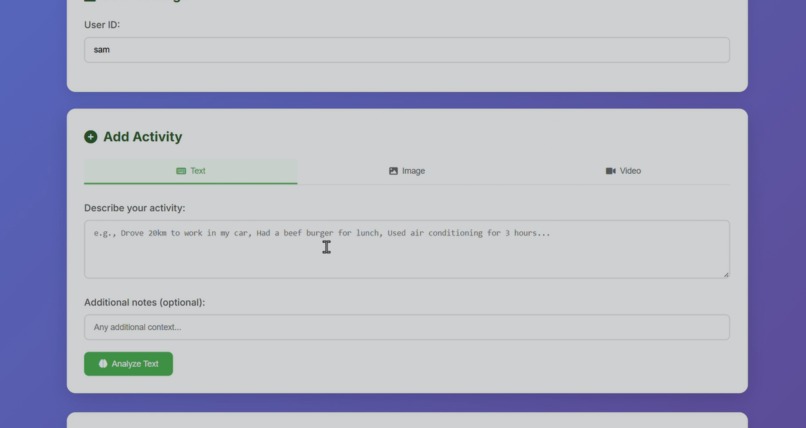
UI
Inspiration
Climate change is no longer a distant concern—it’s a daily reality. Most of us want to live sustainably, but we lack awareness of how our everyday choices contribute to carbon emissions. The inspiration behind CarbonVision was simple: make carbon tracking as effortless as calorie tracking. By combining the power of AI with intuitive design, we wanted to empower people to understand their impact and take meaningful action.
What it does
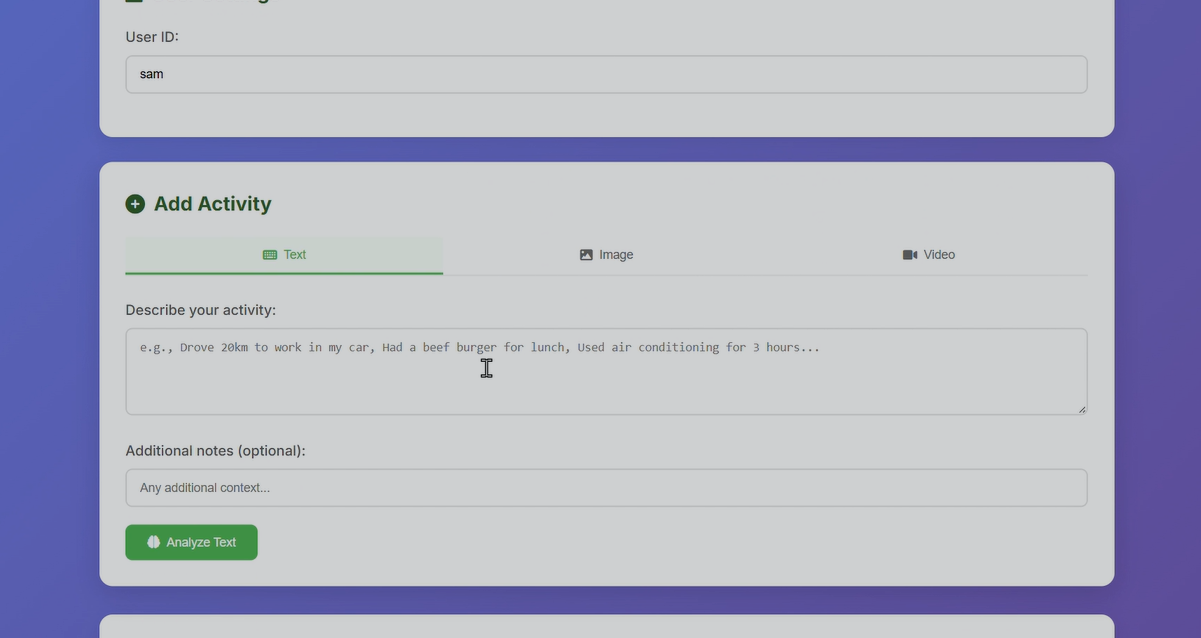
CarbonVision is an AI-powered carbon footprint tracker that lets users log their daily activities through text, images, or even videos. Whether it’s driving to work, eating a meal, or using electricity, the system calculates the associated emissions in real time. Users get instant insights, daily summaries, and personalized recommendations—all wrapped in a clean, responsive interface.
How we built it
We built the backend using FastAPI for speed and scalability, integrating Google Gemini AI for multimodal analysis of text, images, and videos. Emission factors are applied to estimate carbon footprints. For persistence, we used SQLite with SQLAlchemy ORM. The frontend was designed with vanilla HTML/CSS/JS, focusing on responsiveness and simplicity. Image and video processing leveraged **PIL and OpenCV. Finally, API endpoints power the seamless communication between frontend and backend.
Challenges we ran into
One of the biggest challenges was ensuring accurate carbon estimates from diverse inputs. Translating user text into quantifiable emissions required careful prompt engineering. Handling images and videos also brought complexity—extracting meaningful features without overwhelming the model was tricky. On the engineering side, keeping the system lightweight while supporting multimodal input demanded thoughtful architecture.
Accomplishments that we're proud of
We’re proud of building a truly multimodal system where text, image, and video inputs flow into a single carbon tracking pipeline. The real-time feedback loop and AI-generated summaries elevate the user experience beyond traditional trackers. Above all, we’re proud that CarbonVision makes sustainability approachable for anyone—no spreadsheets, no jargon, just clear and actionable insights.
What we learned
We learned how to balance AI power with practical usability. Integrating Gemini for multimodal analysis taught us a lot about handling complex inputs, designing prompts, and managing computational trade-offs. We also discovered the importance of user-centric design—a tool that’s too technical or clunky won’t drive real change.
What's next for CarbonVision
We plan to enhance CarbonVision with gamification features like streaks and achievements to encourage consistent tracking. Adding social sharing will let communities compete and collaborate on sustainability goals. On the technical side, we’re looking to integrate real-time IoT data (e.g., from smart meters and wearables) for even more accurate tracking. Ultimately, we envision CarbonVision becoming a personal sustainability assistant—guiding users toward greener habits in every aspect of life.
Built With
- fastapi
- python

Log in or sign up for Devpost to join the conversation.