Inspiration
We are all very interested in sustainability and addressing challenges associated with combatting climate change. Climate change can often feel like an overwhelming and global problem, and we have noticed that individuals care about doing their part but sometimes feel like they cannot make a difference. We entered this field with the goal of empowering individuals to better understand their role in climate change and how they can address it - a sort of common sense.
At the same time, we are intellectually inspired by the possibilities of artificial intelligence. The companies and mentors around us have demonstrated how advancements in LLM and other areas of AI can be used to support and assist individuals, such as Mem making a personal assistant. We believe that this same technology can be employed in a personalized way that serves as an assistant for individuals' climate goals.
We thought about our own daily habits, such as walking around the Stanford campus and checking our daily steps, which would affect our exercise and physical well-being choices. We want to make it a habit to check one's daily carbon emissions while personalizing choice options to reduce them, with the intent of empowering individuals and reducing global emissions. We realized that by tracking our consumption, we could see how we contribute to emissions. Your carbon footprint comes from your daily consumption, which can be tracked by your purchases.
What it does
CarbonSense tracks personal daily carbon emissions in a user-free manner. It collects consumption data throughout the day and uses LLMs to estimate the carbon emissions associated with a user's activities. For example, let's say you eat at Los Carnalitos in Redwood City and order seven delicious tacos. As you order, you can send your receipt to your email, where LLM reads your receipt and estimates the carbon emissions caused by your consumption. In this case, the estimate would be 29.54 lbs of CO2. This estimate is then aggregated with the rest of your consumption estimations in an intuitive and personalized dashboard.
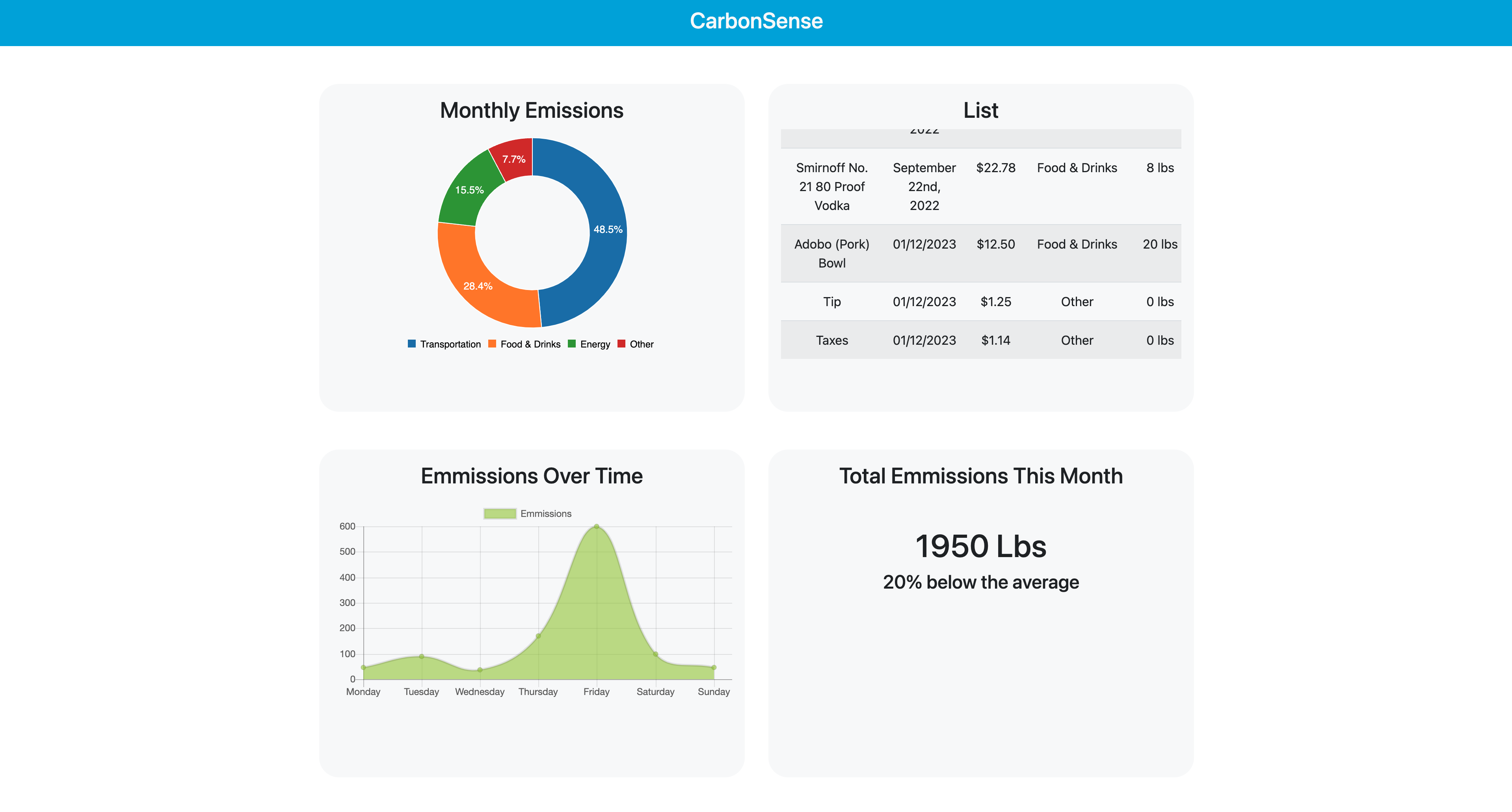
The user can understand long-term trends of their carbon emissions, source breakdowns such as the proportion of emissions associated with transportation, energy use, food, and spending, and finally, what they can do to effectively reduce their emissions based on their behavior. Interestingly, CarbonSense does this all behind the scenes, meaning that all the user has to do is log into their account and look at their personalized dashboard.
How we built it
We used Flask for Backend and BootStrap for FrontEnd. The server listens to an email port, and whenever a new email is received, it checks to see if it's a receipt of an order or not. If yes, it fetches the content, and uses LangChain's Refine to clean it and turn it into a json file. We save the json data in a database. So the database essentially contains all of the products and services you use. It works autonomously and effortlessly. The only things the user need to do is to make a carbon sense account once, and he's good to go!
Challenges we ran into
We ran into a number of problems with how to make CarbonSense as relevant, useful, and accessible as possible. Many existing personal carbon trackers work by having the user physically input their activities. This makes it easy to develop, but not as useful in practice because of the time and effort the user must put in. This is a challenge for others, which explains why there is no other user-free carbon tracker that we know of but was also, of course, a challenge for us.
At the same time, we ran into some technical challenges as well. Emails are messy and have a lot of text that is unrelated to understanding the carbon emissions associated with that consumption. We are trying to create a generalized model and result, which is difficult because each receipt has its own style. Connecting the email to the data and model along with how to communicate between the backend AI and the frontend dashboard was also a challenge. Determining the color scheme and background of our dashboard was more of a struggle than we may have expected as well!
Accomplishments that we're proud of
We feel accomplished in creating an idea that addresses one of the main issues with carbon emission tracking, user-data input. CarbonSense has the potential to remove the bottleneck for individuals' carbon emission tracking by making information collection much easier.
We also feel accomplished in being able to wire together different technologies to apply them to a seemingly unrelated area.
We are proud of experiencing our first hackathon together, recognizing each other's skillsets and mindsets, and working together as a team to turn an idea into a product.
What we learned
We learned about the accessibility and possibilities of LLMs and AI interfaces, especially at an individual and personal level. We were able to consider ideas for how LLMs could address many sustainability-related questions and ended up creating a product that does that. Although it may seem very unrelated at first, LLMs have the power to impact lives in the sustainability space as CarbonSense proves.
We also learned the power of having diversity in ideas, knowledge bases, experiences, and skills when there is a common goal. We met on a Friday night, having come from different parts of the world, with varying technical and academic backgrounds. However, we shared a common motivation to solve a problem. This collection of abilities and ideas proved invaluable as we faced and addressed challenges during our time here.
What's next for CarbonSense
There is a lot of potential still to be realized for CarbonSense! The carbon estimation can be understood and explained in many more ways. The data can be aggregated so that individuals can ask their own questions for how they can reduce their emissions. Over time, their consumption data can be used to improve the model associated with personalizing recommendations. In addition, there is opportunity to sort of "gamify" the tracking and allows users to compete against their friends to see who can have less of a carbon footprint. Lastly, improvements can be made for how data is collected to estimate the carbon footprint. Not everything is represented through receipts and consumption can be hard to estimate that way. There is potential to use speech-to-text so that people can explain their activities further, which would improve the accuracy of their carbon footprint estimation. Speech-to-text is very user-unintensive, which supports CarbonSense's goal of being as user-free, accessible, and accurate as possible.
ChatGPT poem about our experience
In a room at TreeHacks, three guys sat, Their laptops open, coding away, Their mission clear, their goal exact: To build a tool that would track carbon's sway.
The first guy typed with quickened pace, His fingers danced across the keys, As lines of code began to race, And a website came to be.
The second guy crunched data with might, His algorithms swift and true, To help calculate the carbon's flight, And track it all anew.
The third guy tested and debugged, His eyes locked onto the screen, Till all the errors had been unplugged, And the code was smooth and clean.
Together they worked, hour by hour, With coffee cups in hand, Till their tracker had enough power, To help the world understand.
For personal carbon emissions count, And how we can each reduce, The footprint we leave, in any amount, And help the planet choose.
Their code was a marvel, a work of art, And at TreeHacks it took first place, For the world they had played a small part, In making a sustainable space.
So here's to the three guys at TreeHacks, Who built a tool that will inspire, And help the world keep on track, Towards a future that's much brighter.
Built With
- bootstrap
- css
- flask
- html
- imap
- javascript
- langchain
- openaiapi
- vercel

Log in or sign up for Devpost to join the conversation.