-
-
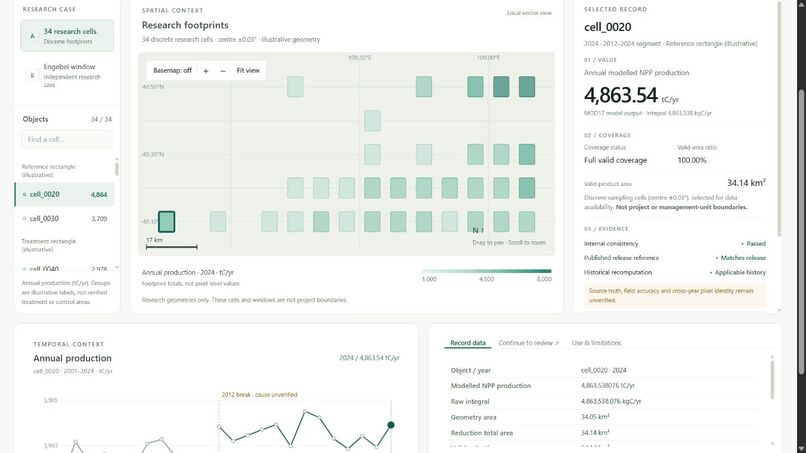
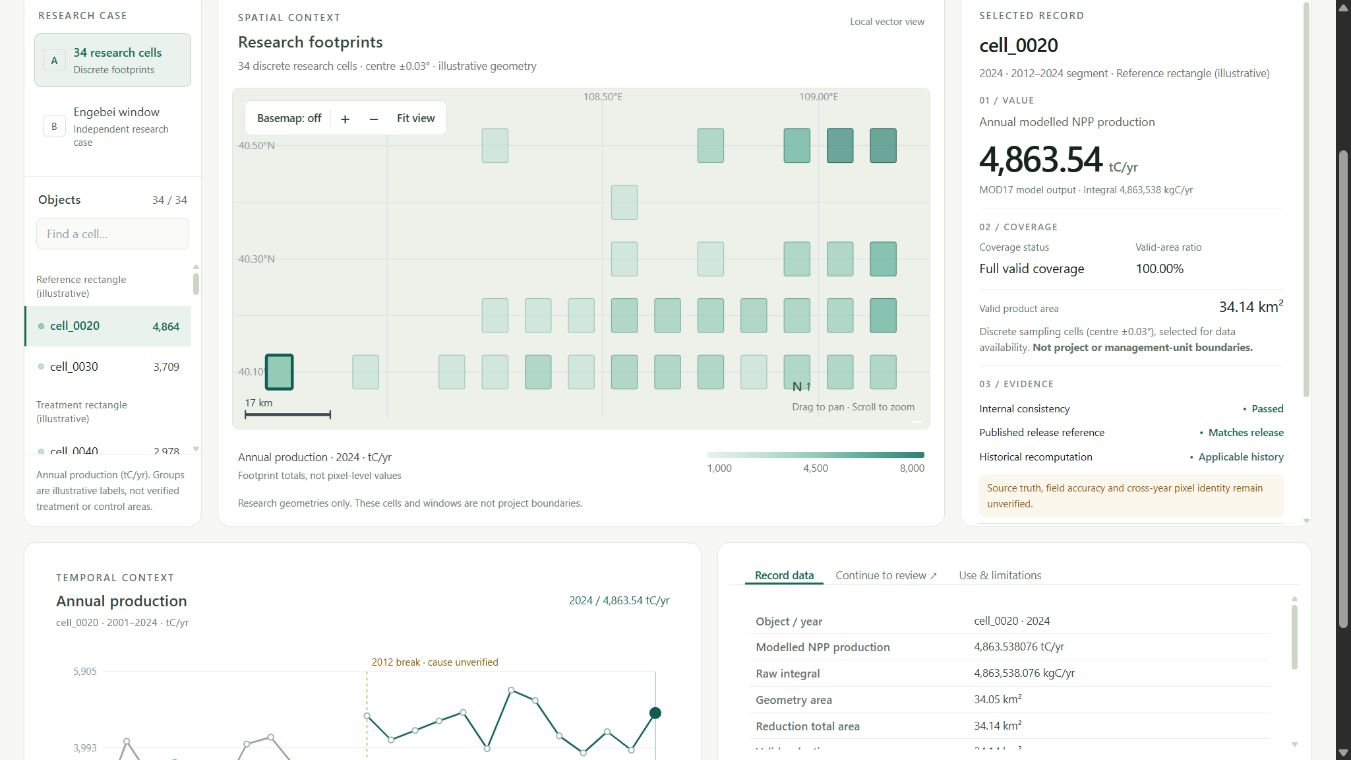
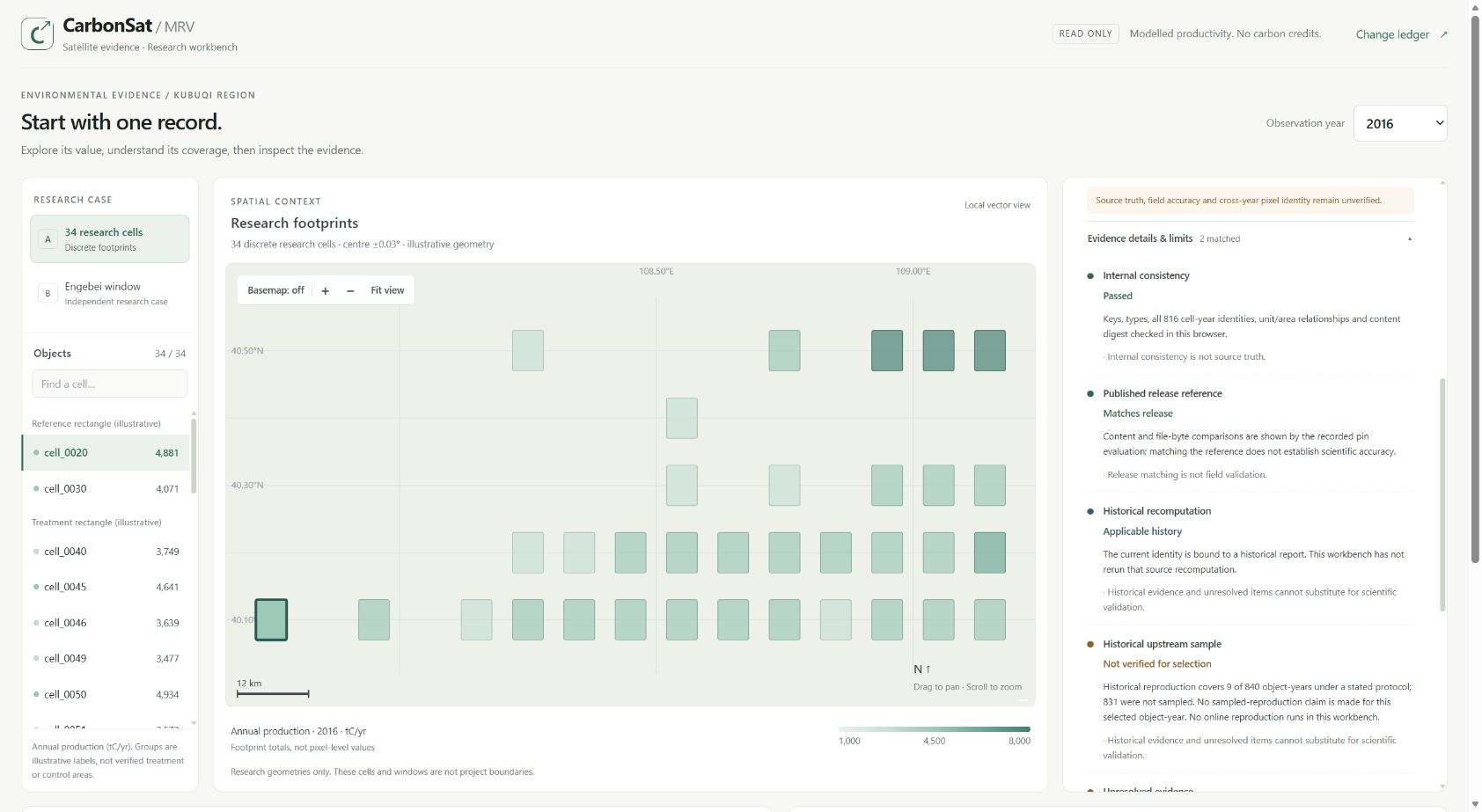
cell_0020, 2024: 4,863.54 tC/yr of modelled NPP production, with valid area, coverage and evidence shown together.
-
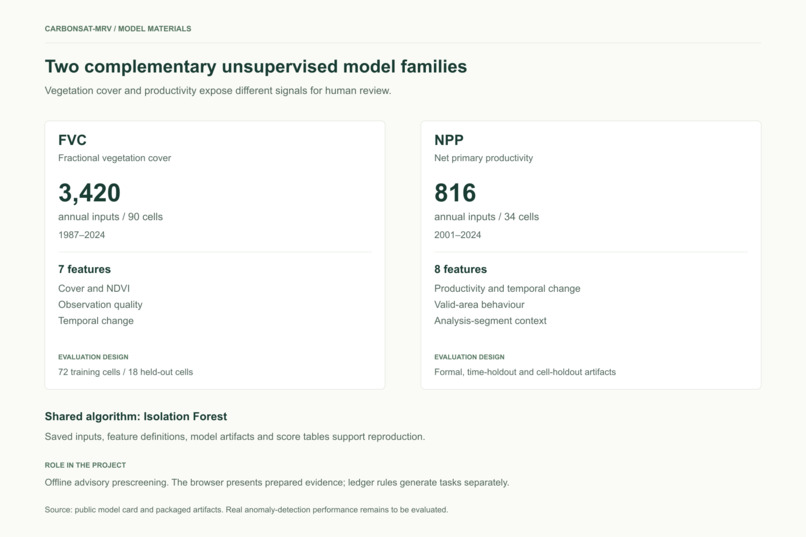
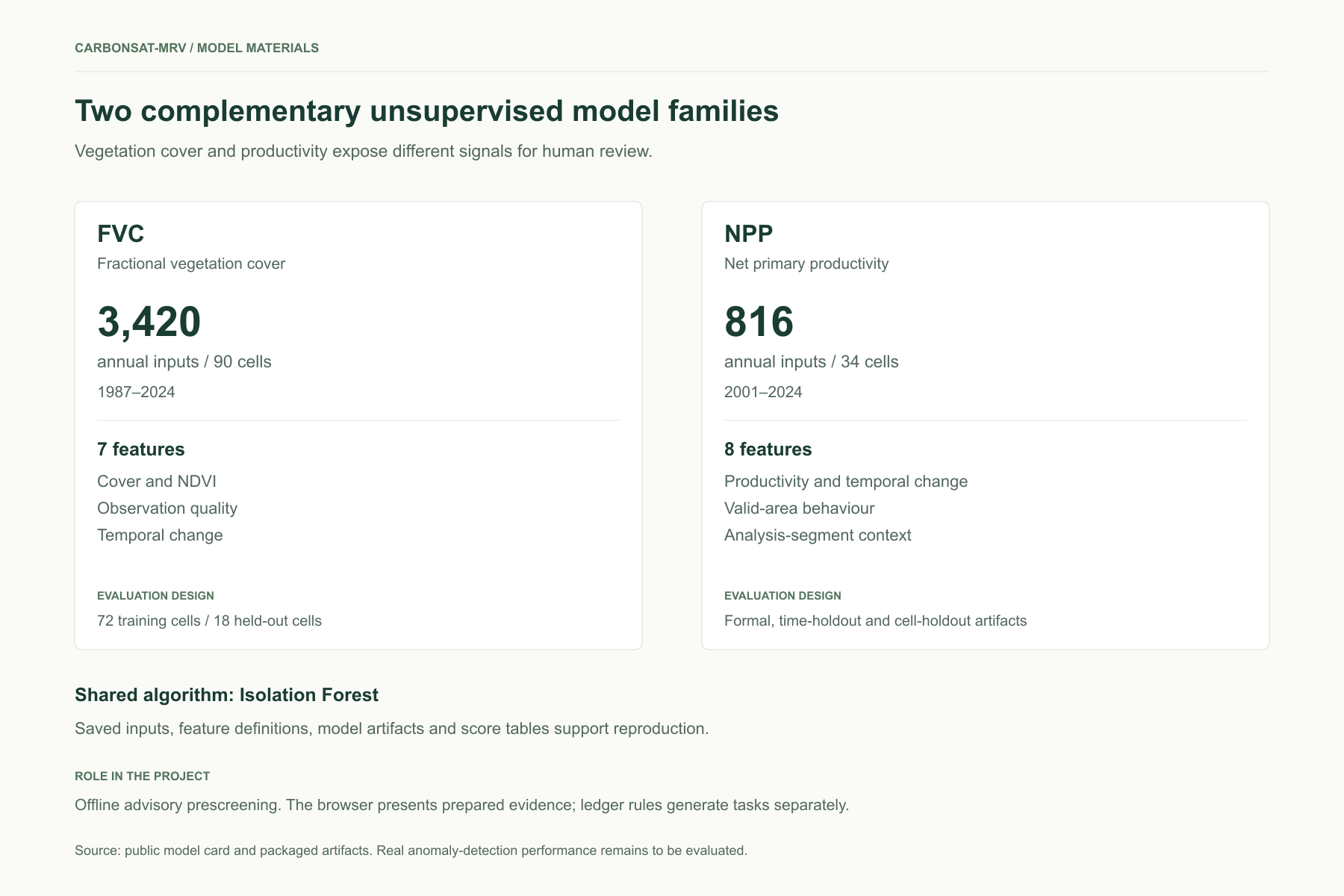
Two offline Isolation Forest model families: FVC examines cover and observation quality. NPP examines productivity and valid area.
-
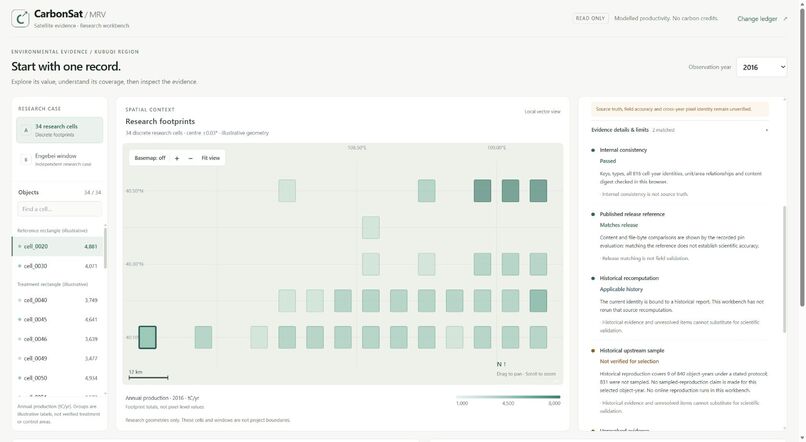
Inspect internal consistency, release-reference agreement and applicable historical source checks, each with its own scope.
-
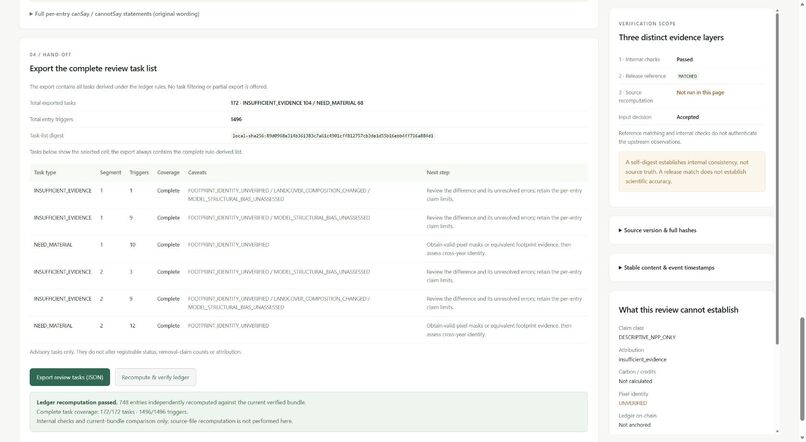
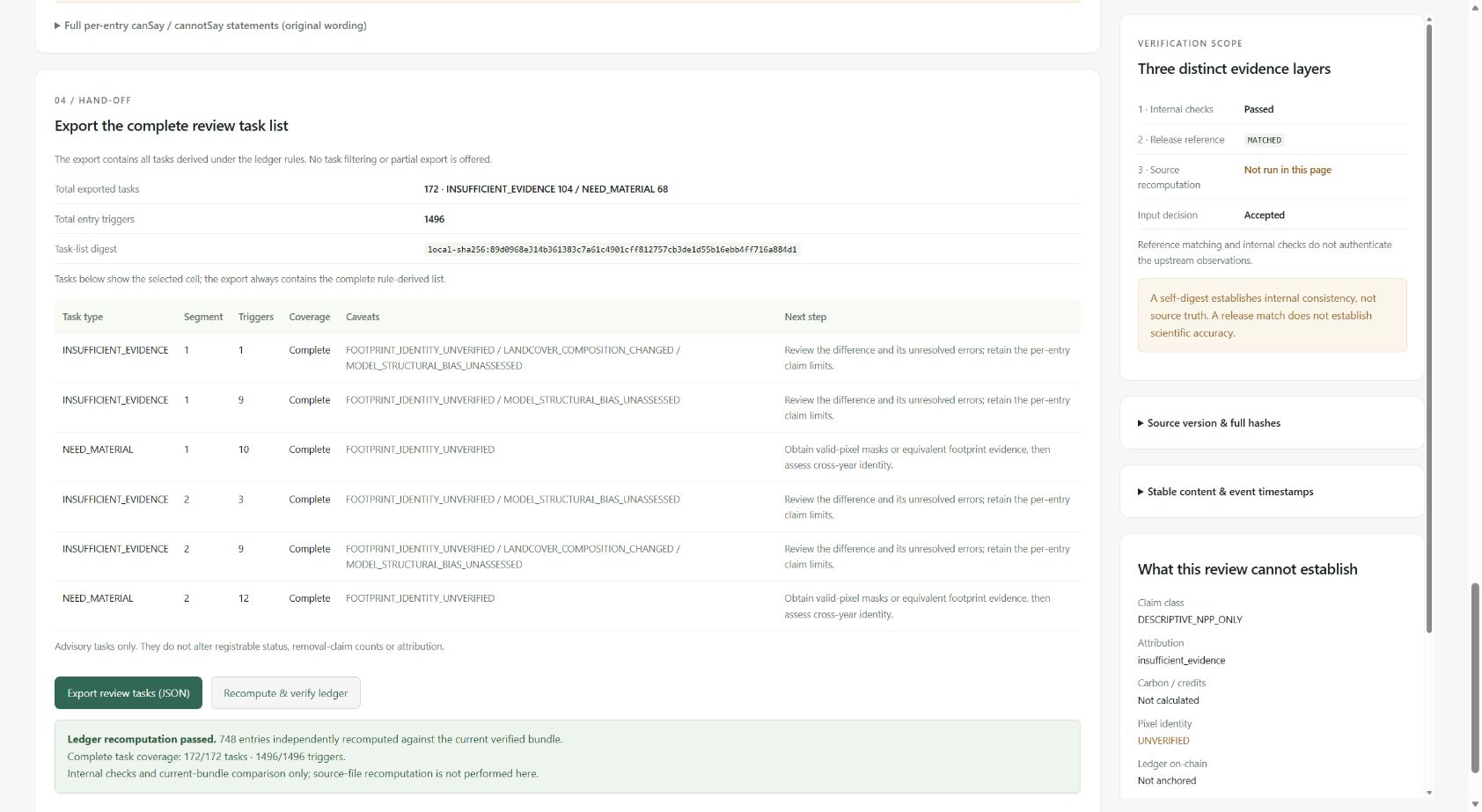
Export all 172 rule-derived review tasks with triggers, sources and limits. Stable content identity is separate from export time.
-

From satellite context to a review handover: inspect the result, check its evidence and export follow-up tasks.
-
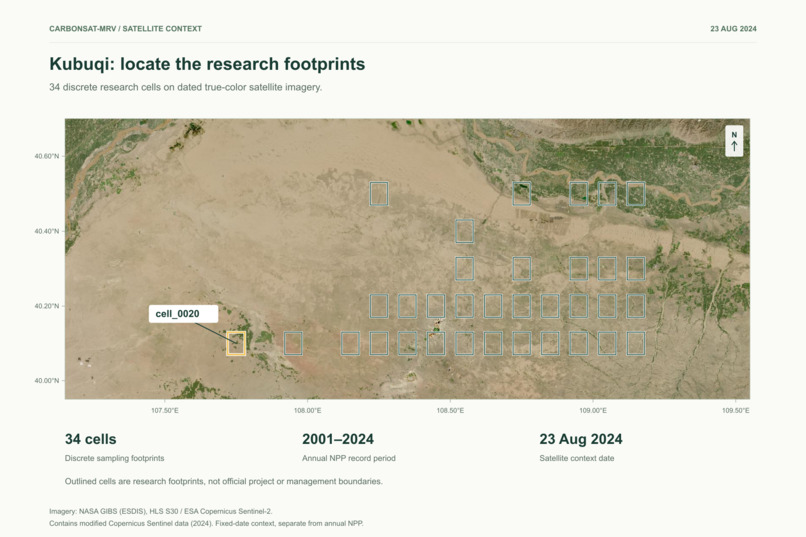
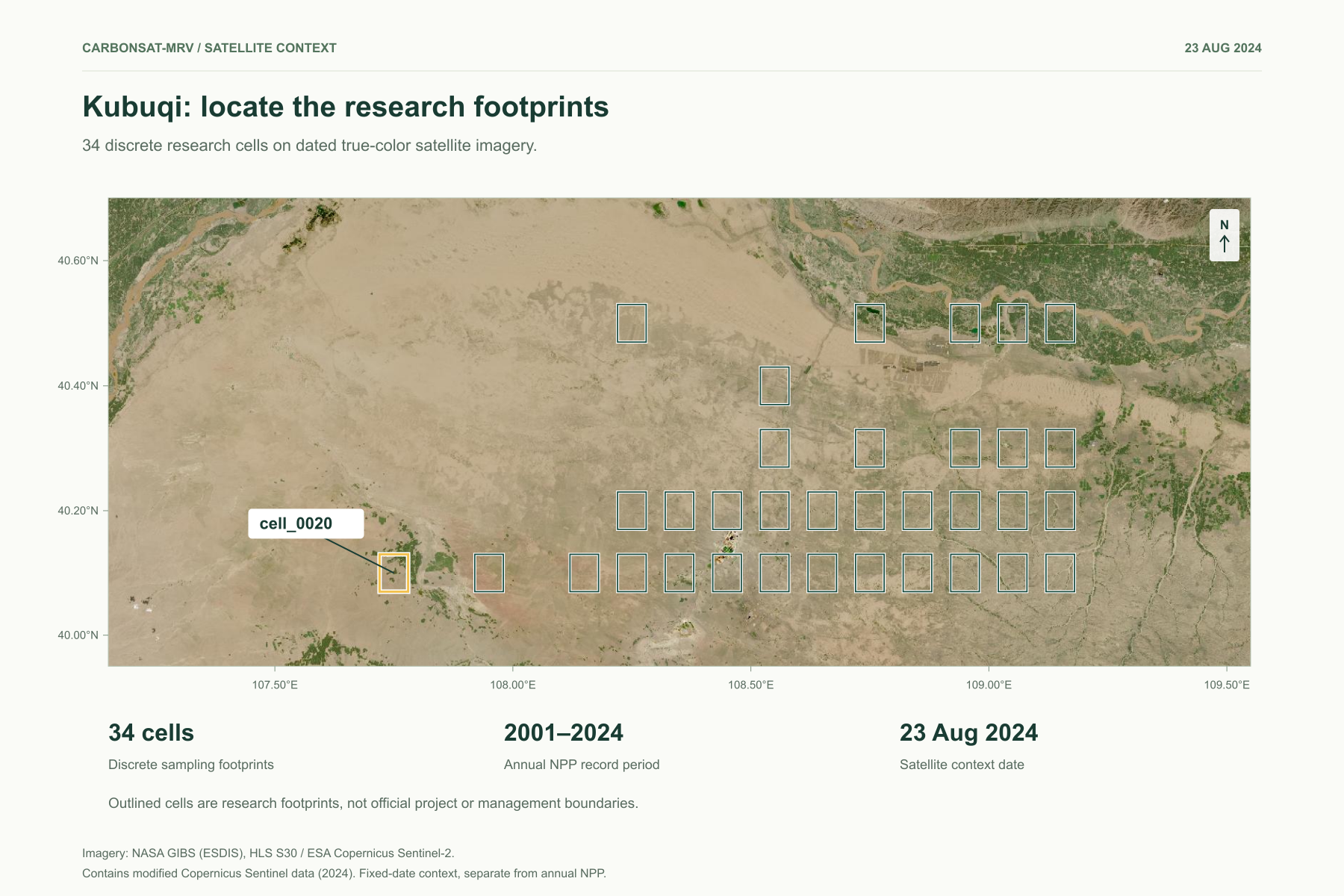
Kubuqi: 34 research footprints on Sentinel-2 imagery, 23 Aug 2024. Research footprints, not official project boundaries.
-
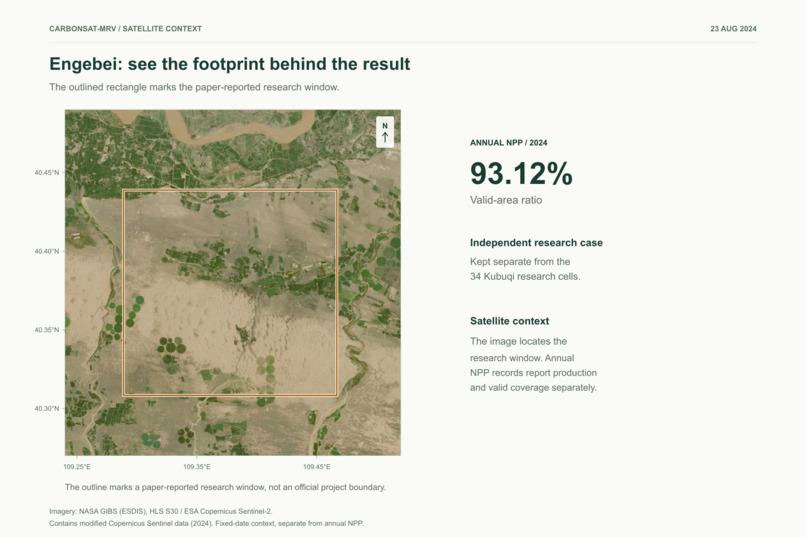
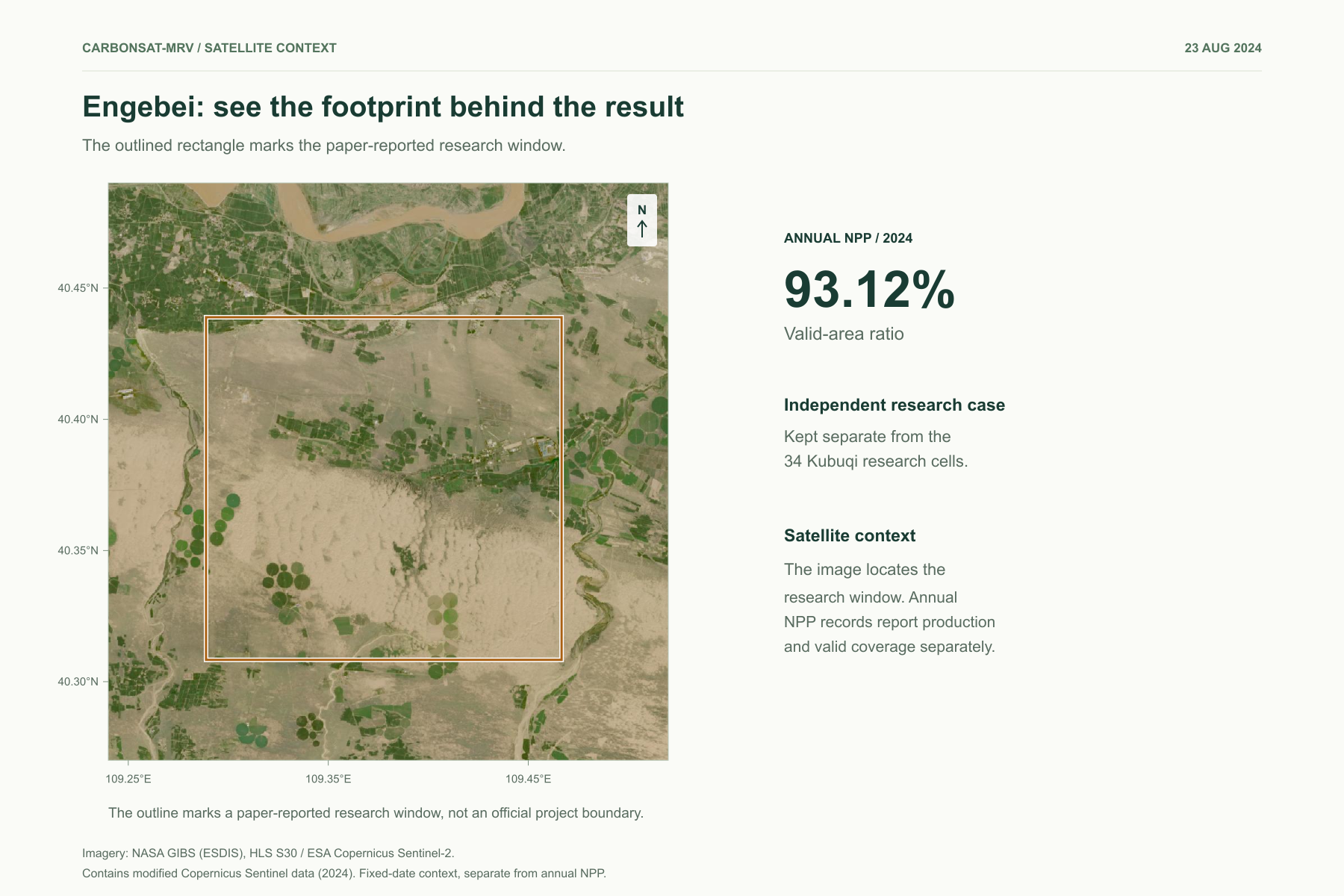
Engebei research window on Sentinel-2 imagery, 23 Aug 2024. The separate 2024 NPP reduction has 93.12% valid coverage.

Inspiration
Before a satellite result supports an environmental claim, someone has to review the evidence behind it.
For a researcher preparing a report, a vegetation total is one part of the handover. The receiving reviewer needs to understand its footprint, calculation basis and comparison limits. Those details often sit in separate files.
Our Kubuqi and Engebei cases make this concrete. Engebei's annual NPP reduction has approximately 93.12% valid coverage. A reviewer needs that condition beside the production total to understand what area the number represents.
We built CarbonSat-MRV for researchers preparing satellite evidence and reviewers receiving it. For Track 4: Climate Data & Environmental Monitoring, we address fragmented environmental evidence where it matters in practice: the review that precedes a report or a follow-up investigation.
What it does
CarbonSat-MRV is an English satellite evidence workbench that keeps a result, its coverage and the next review actions together.
The reviewer can follow a complete route:
- Inspect a result. Open
cell_0020, 2024: 4,863.54 tC/yr of modelled annual NPP production, with 34.14 km² of valid product area and a 100% valid-area ratio for this reduction. - Examine what supports it. Inspect the area definitions and evidence checks. Switch to the independent Engebei window to examine partial coverage. Return to
cell_0020, select 2016 and follow the located ledger link to its admitted 2015–2016 comparison. - Hand over the follow-up work. Recompute the ledger and export the complete 172 rule-derived tasks, with triggers, sources, interpretation limits and stable content identity. The export spans the ledger, independently of the selected cell filter.
The recipient can examine the footprint, see which comparisons were permitted and identify evidence needed next. Two complementary offline model families supply prescreening materials, and one historical blockchain registration supplies a public reference for its registered fields.
How we built it
Two models for complementary vegetation signals
Both unsupervised model families use Isolation Forest, with separate features and evaluation designs:
| Model family | What it examines | Packaged evidence |
|---|---|---|
| FVC: fractional vegetation cover | Cover, observation quality and temporal change | 3,420 annual inputs from 90 cells; seven features; training and held-out cells |
| NPP: net primary productivity | Productivity variation, valid-area behaviour and analysis-segment context | 816 annual inputs from 34 cells; eight features; formal, time-holdout and cell-holdout artifacts |
Saved inputs, models and score tables support reproduction. Scoring runs offline. The browser presents prepared evidence, and ledger rules generate tasks separately from model scores.
Evidence that stays connected to the result
Google Earth Engine reductions of MODIS MOD17A3HGF v6.1 and MCD12Q1 supply derived NPP and land-cover inputs. Production integrates NPP density over valid pixel area. Python and Node.js support preparation and checks; HTML, CSS and JavaScript provide the interface.
Record identity carries into the ledger. Stable task content has a digest separate from its export timestamp, allowing recipients to compare content across handovers.
Our submission gallery adds HLS Sentinel-2 true-color imagery from 23 August 2024, supplied through NASA GIBS, with the Kubuqi research footprints and separate Engebei window outlined. These dated context images are separate from the annual MODIS NPP data.
A specific role for the blockchain reference
Our Solidity prototype uses Hardhat and ethers.js. One historical descriptive record, cell_0030_2012, has a Sepolia registration for its single-record payload hash, method version and declaration category. A later reader can compare those fields with the corresponding local record. The full evidence bundle and current task workflow remain off-chain.
Challenges we ran into
Spatial meaning: geometry area, reduction total area and valid area describe different quantities. We retained all three beside the result.
Comparison decisions: the cause of the 2012 break remains unresolved. We split analysis into two segments and expose cross-boundary refusals in the ledger.
Reproducibility: the FVC v1.1 repair aligns preparation and inference with the saved training imputer, without retraining the formal forest.
Handover identity: export timestamps stay outside the stable task digest, preserving unchanged content identity.
Accomplishments that we're proud of
- A working English route from record selection to evidence inspection and task export.
- Two inspectable model families, with saved artifacts and reproduction materials.
- 748 within-segment differences, 34 refused boundary pairs and 172 complete rule-derived tasks for the packaged input.
- Public source, worked examples, model documentation, dated satellite figures and an English demonstration video.
- Historical engineering reports recording 331 passing contract/integration tests, 19 read-only model checks and 11 FVC preprocessing regressions.
What we learned
Environmental transparency becomes practical when another person can examine a result's meaning and continue the review. That shaped the workbench and its portable task output.
Current evidence covers implementation behaviour and stored-score reproduction. Historical upstream reproduction covers 9 of 840 object-years under its stated protocol. Field accuracy, real anomaly-detection performance and user benefits require further evaluation. NPP describes modelled vegetation productivity, rather than net carbon removal, carbon-stock change or carbon-credit quantities. Neither research extent is an official project boundary.
What's next for CarbonSat-MRV
Research groups can begin with prepared cases through the public English link, without a browser wallet or paid API key. Local use requires a static server and no frontend build step. New study areas need documented inputs, explicit scope, a prepared bundle and corresponding checks before broader operation is evaluated.
Our next milestone is an independent reviewer trial comparing a result-only handover with this workflow. We will measure completion, elapsed time, interpretation errors and assistance. Further priorities include independently labelled anomaly examples, broader upstream reproduction, investigation of the 2012 break and valid-pixel footprint evidence.
Open one result. Inspect the evidence behind it. Carry the review forward.
Try the English workbench · Watch the demonstration · Inspect the source and documentation
Built With
- css
- ethers.js
- gee
- hardhat
- html
- javascript
- jsonschema
- node.js
- python
- scikit-learn
- solidity


Log in or sign up for Devpost to join the conversation.