-
-
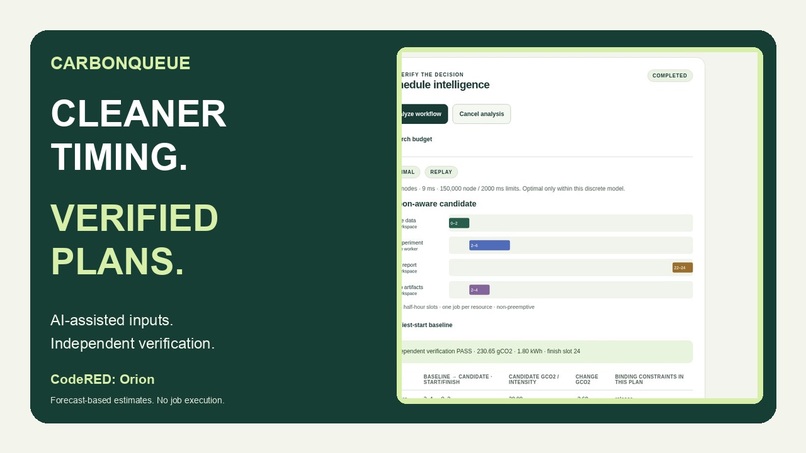
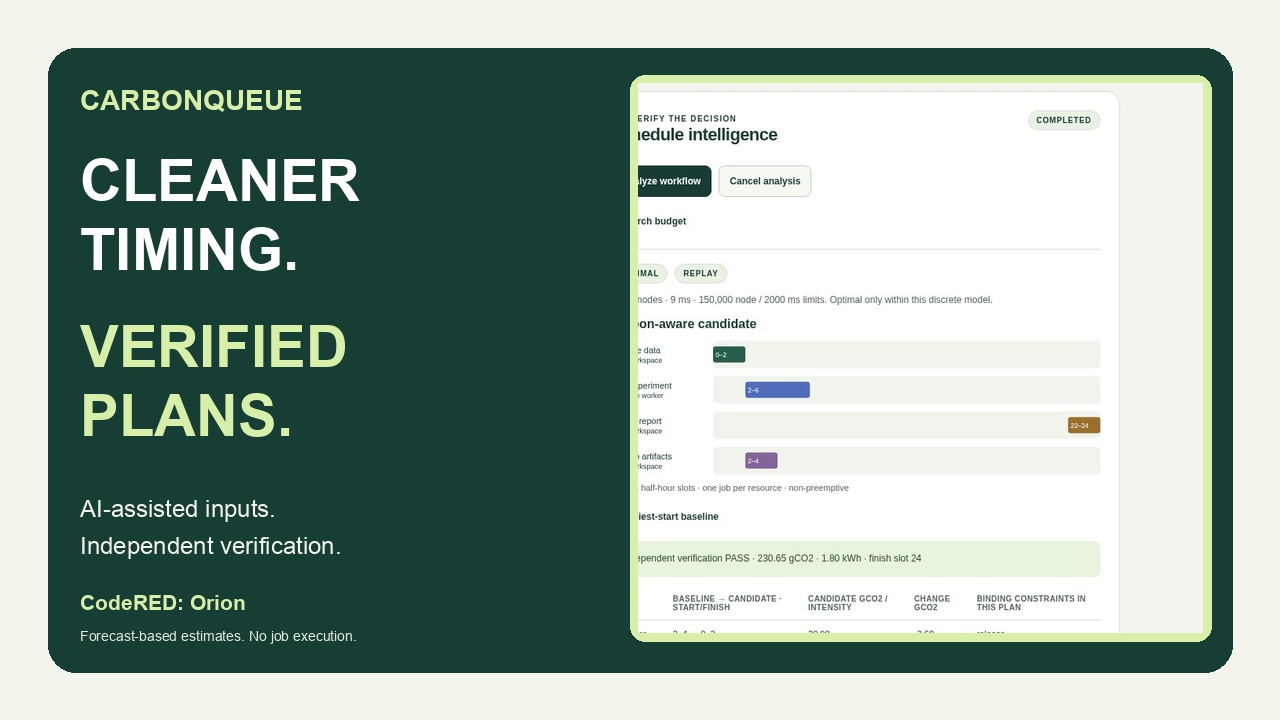
CarbonQueue Thumbnail
-
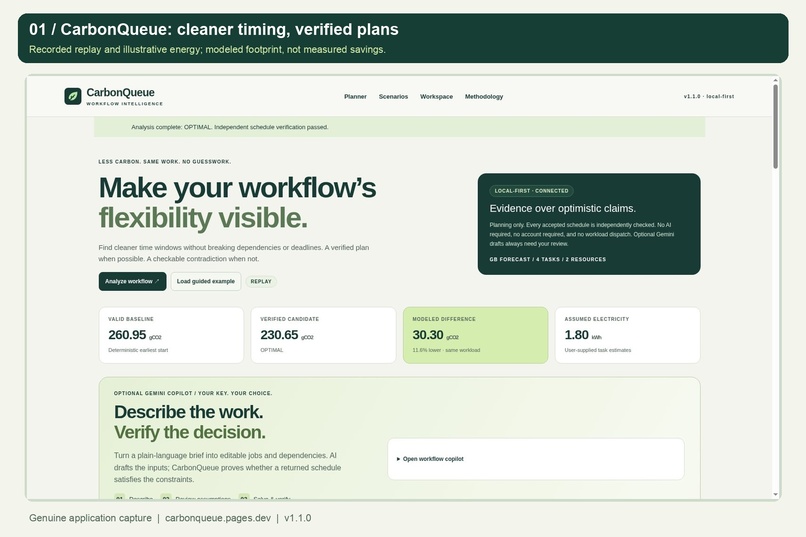
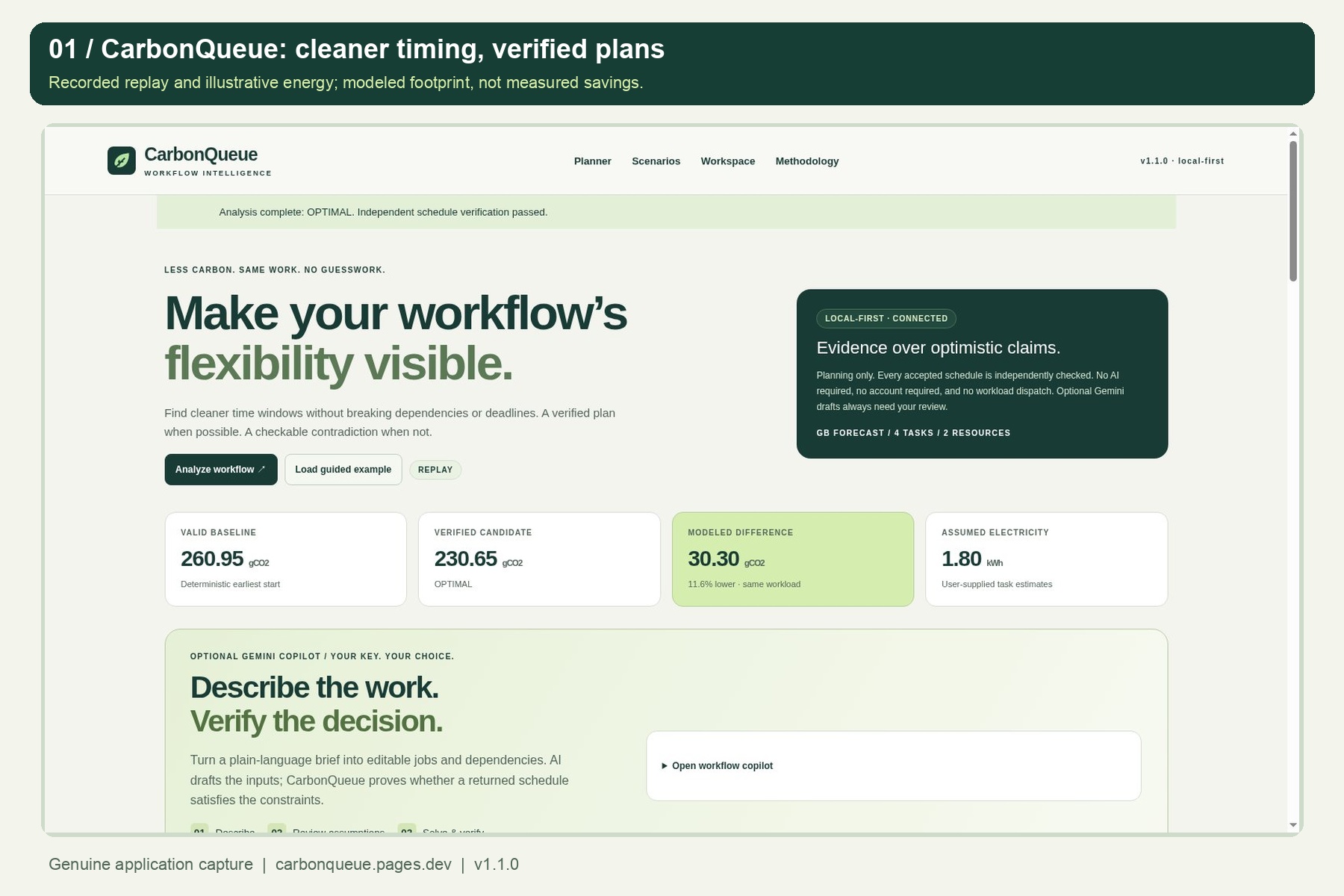
01-CarbonQueue-Project-Overview
-
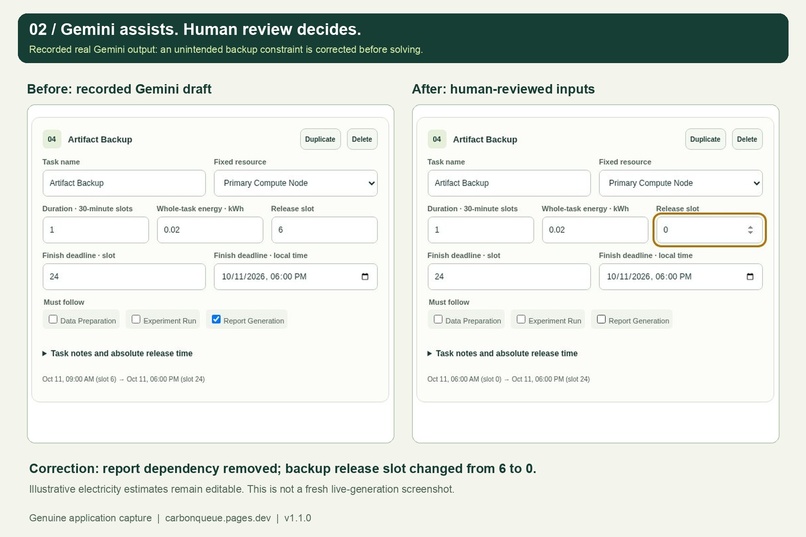
02-CarbonQueue-Gemini-Draft-Human-Review
-
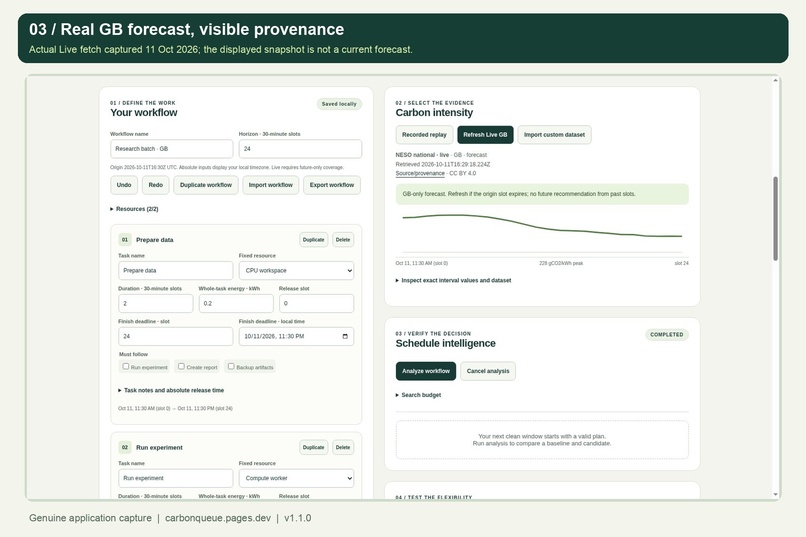
03-CarbonQueue-GB-Forecast-Provenance
-
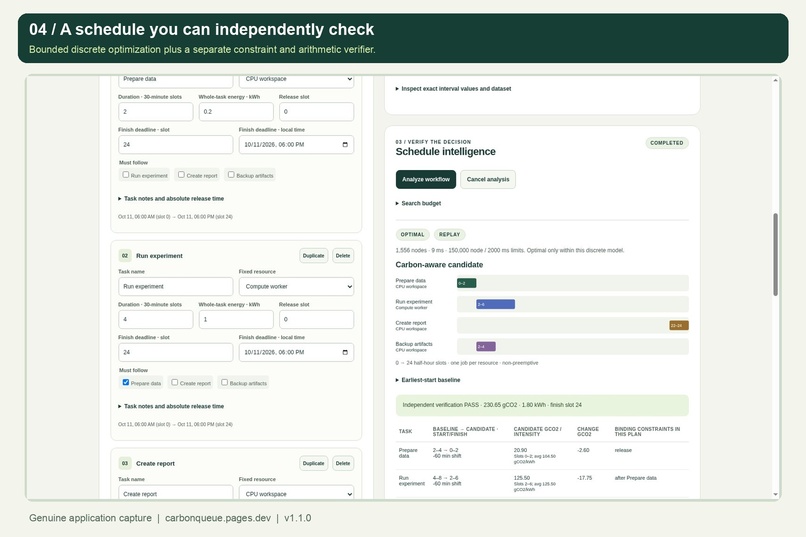
04-CarbonQueue-Verified-Schedule
-
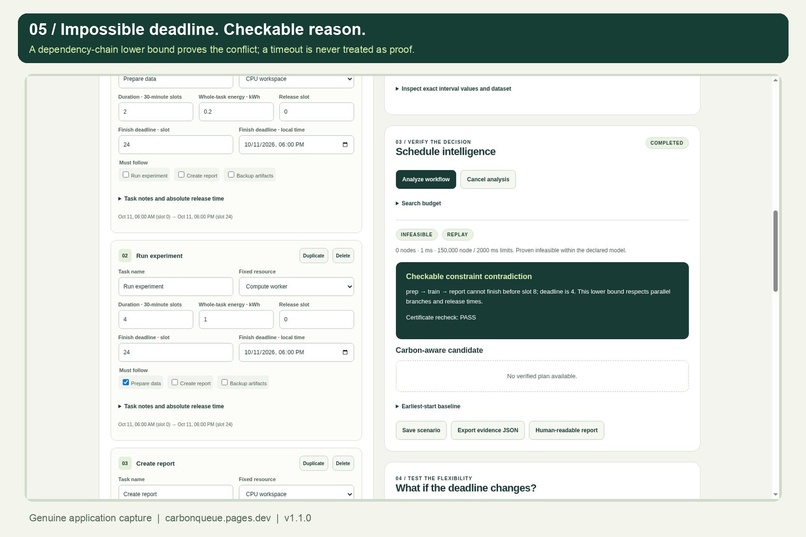
05-CarbonQueue-Impossible-Deadline-Proof
-
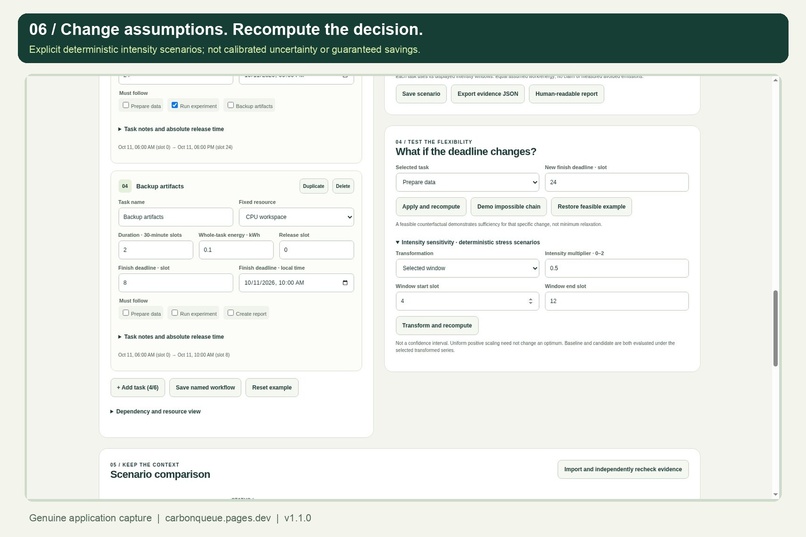
06-CarbonQueue-Intensity-Sensitivity
-
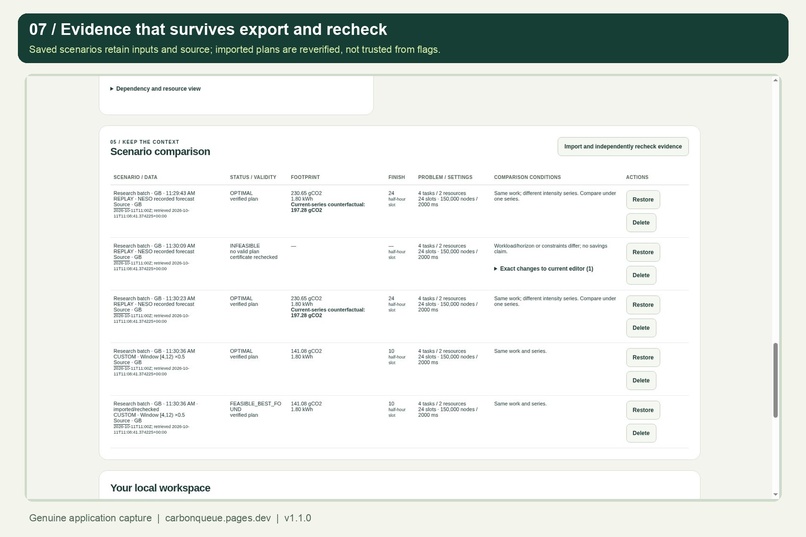
07-CarbonQueue-Evidence-and-Scenario-Comparison
-
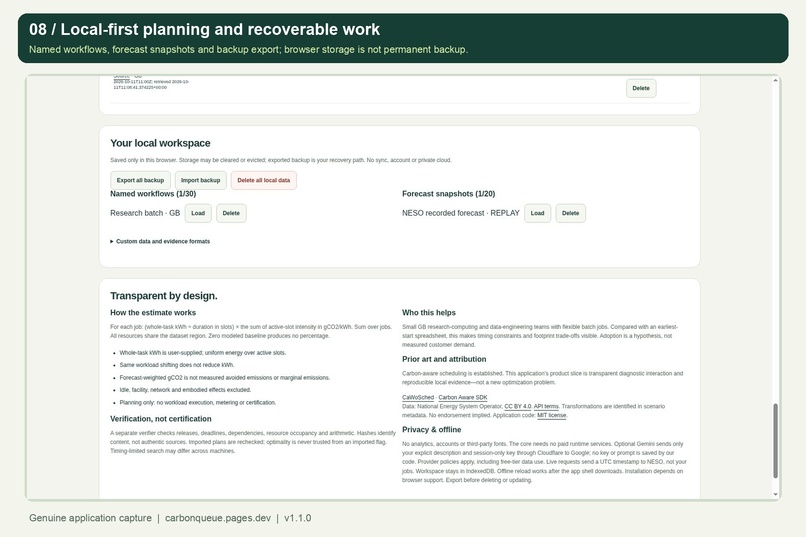
08-CarbonQueue-Local-Workspace-and-Backup
-
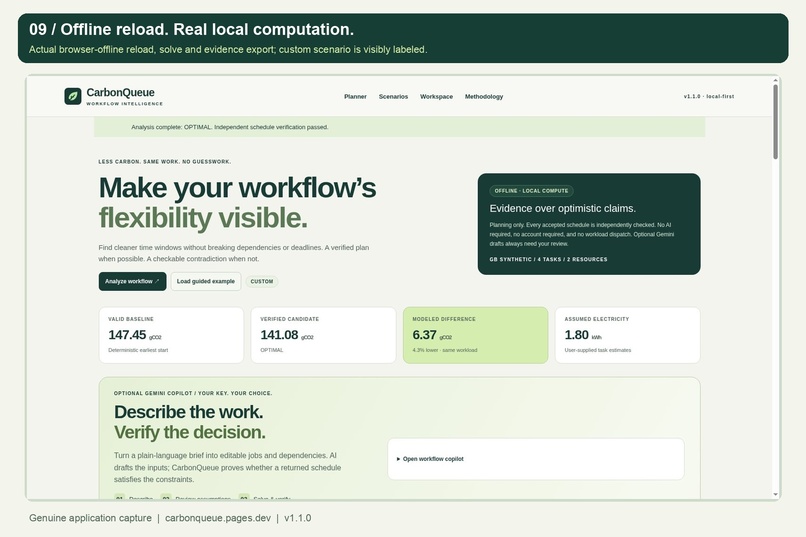
09-CarbonQueue-Offline-Recompute-and-Export
Inspiration
“Run the job when electricity is cleaner” sounds simple—until preparation, experiments, reports, and backups have dependencies, shared resources, and deadlines. The cleanest-looking time window may not fit the complete workflow.
CarbonQueue is built around a different question: can we produce a lower-footprint plan that is actually feasible, and make the reasons understandable when a deadline cannot be met?
The intended users are small research-computing and data-engineering teams with flexible GB-hosted batch work. Compared with an earliest-start spreadsheet, CarbonQueue makes timing constraints and forecast-based trade-offs visible before anything is executed.
What it does
CarbonQueue is a local-first, explainable carbon-aware workflow planner. Users can:
- Define up to six non-preemptive jobs on two fixed resources, including dependencies, duration, release times, deadlines, and whole-task electricity estimates.
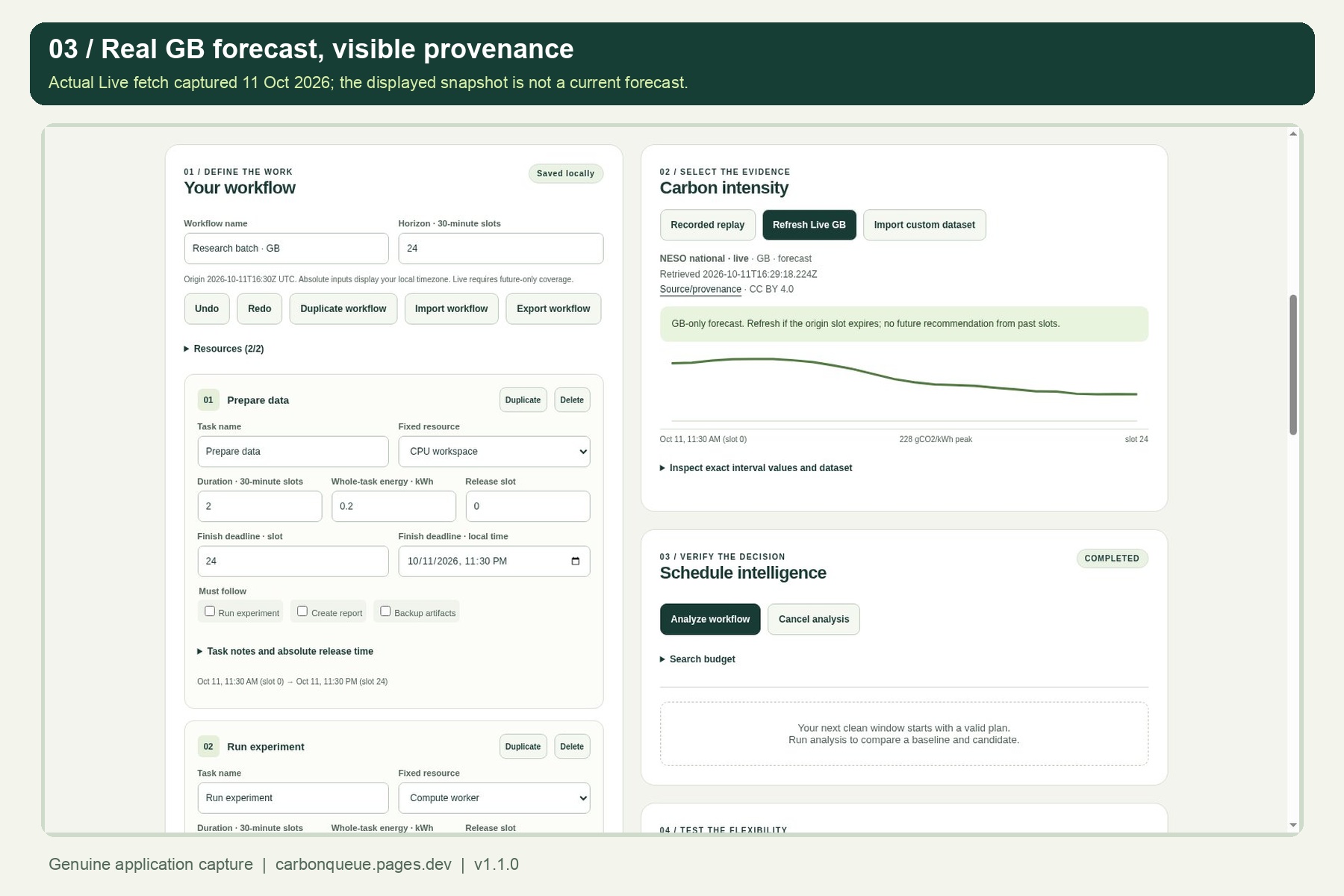
- Use real GB forecast data, clearly labeled recorded replay, or validated custom scenarios.
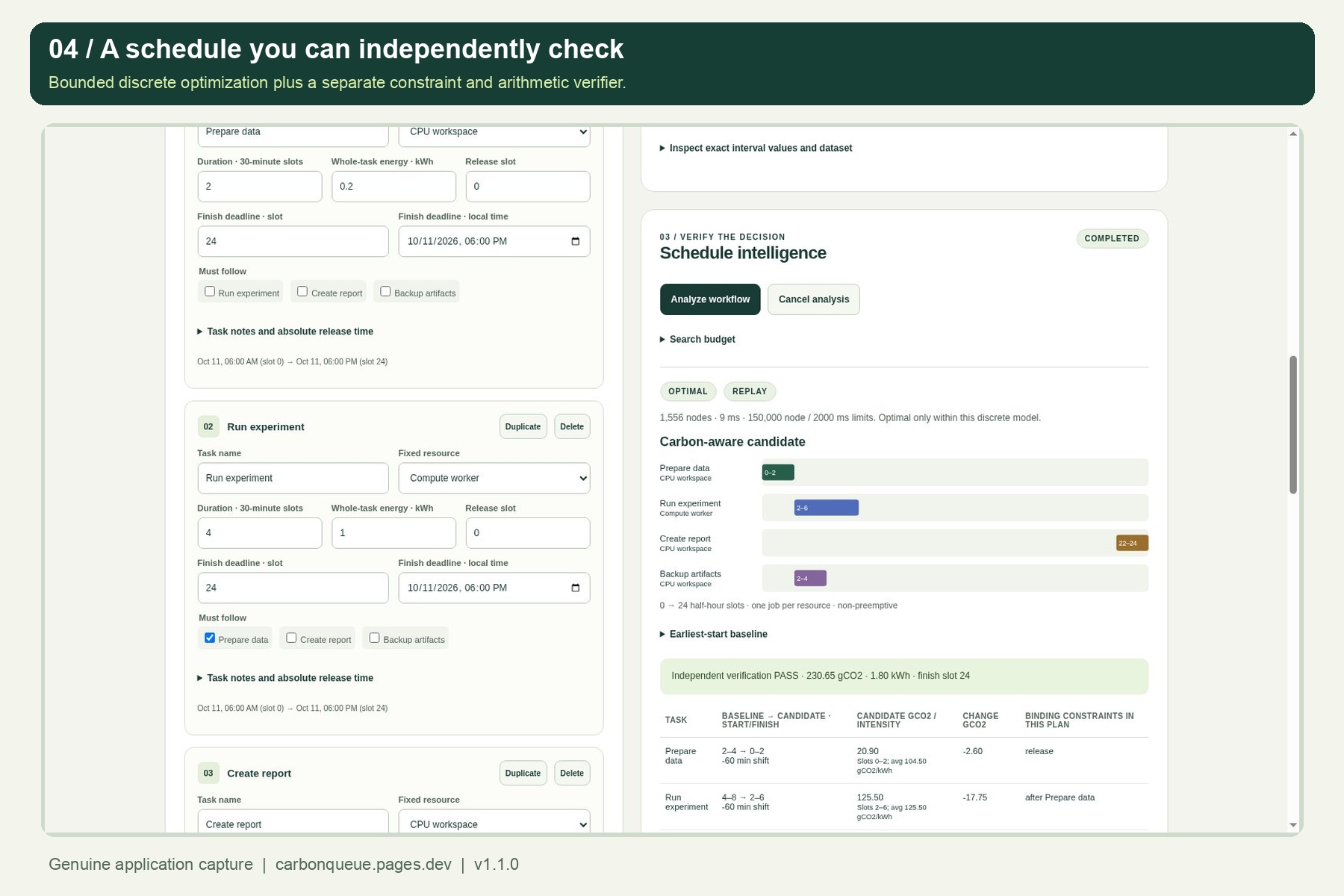
- Compare a valid earliest-start baseline with an independently verified carbon-aware schedule.
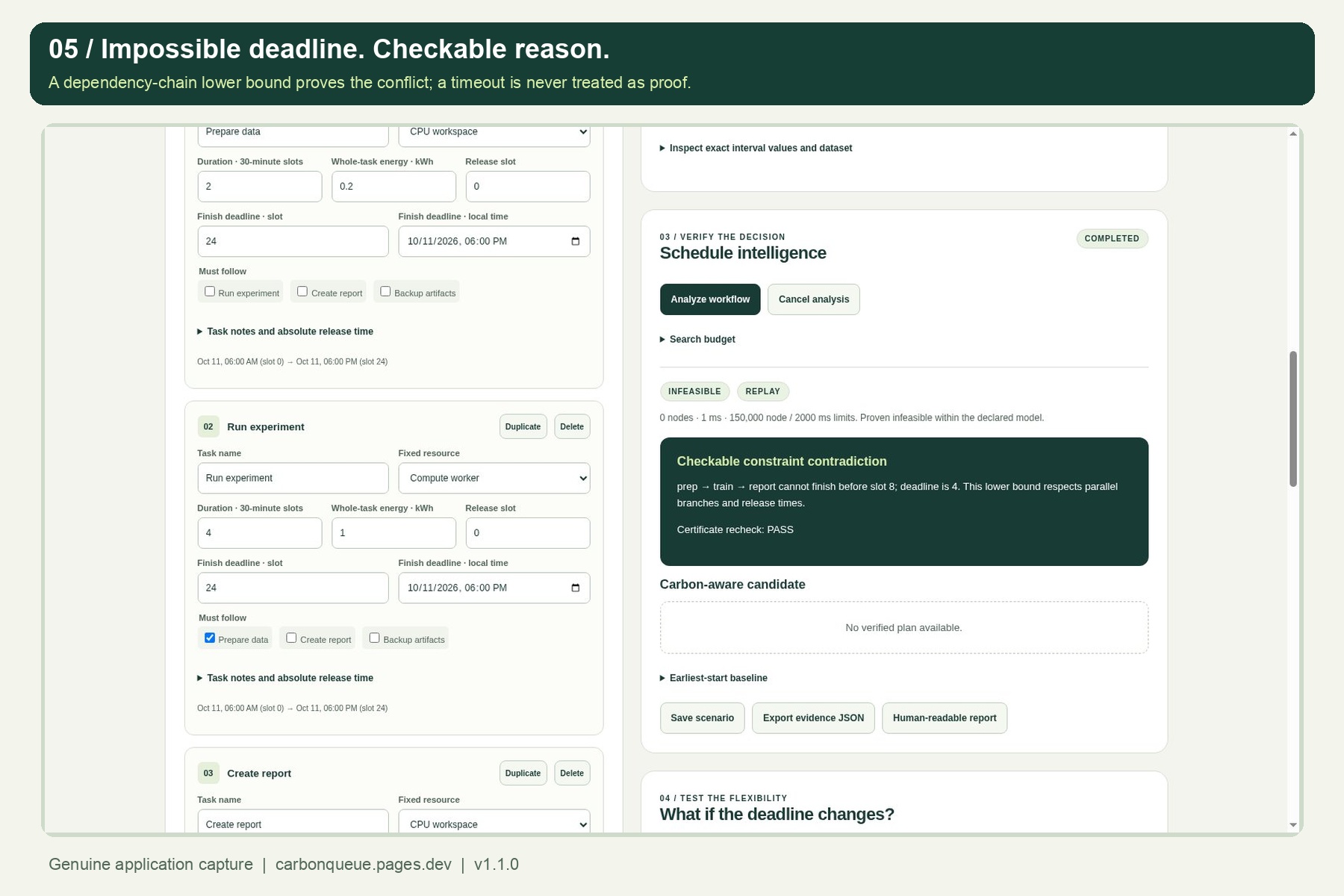
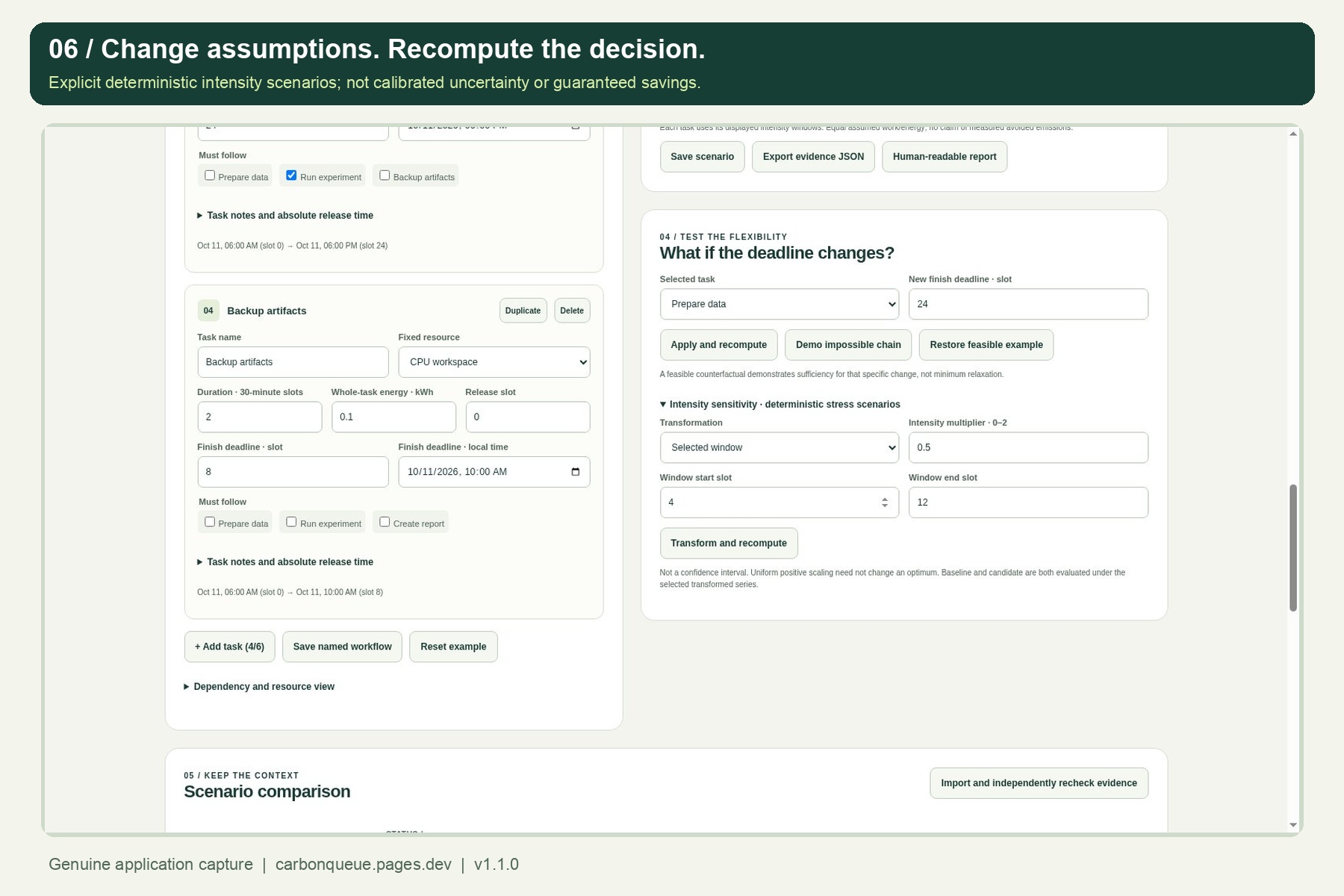
- Tighten a deadline to see a checkable contradiction, then recompute a feasible counterfactual.
- Explore deterministic intensity sensitivity and save scenarios without hiding changed assumptions.
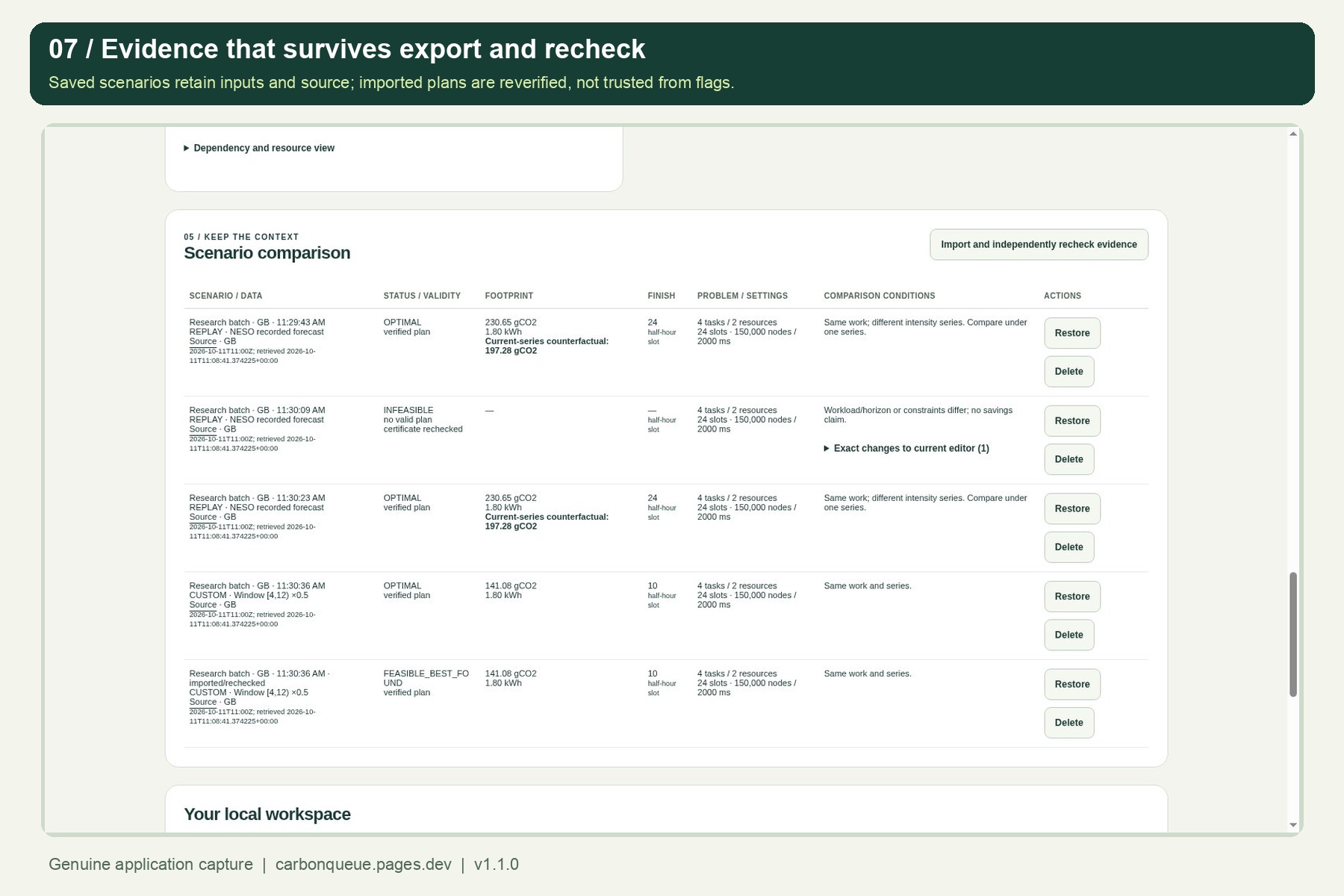
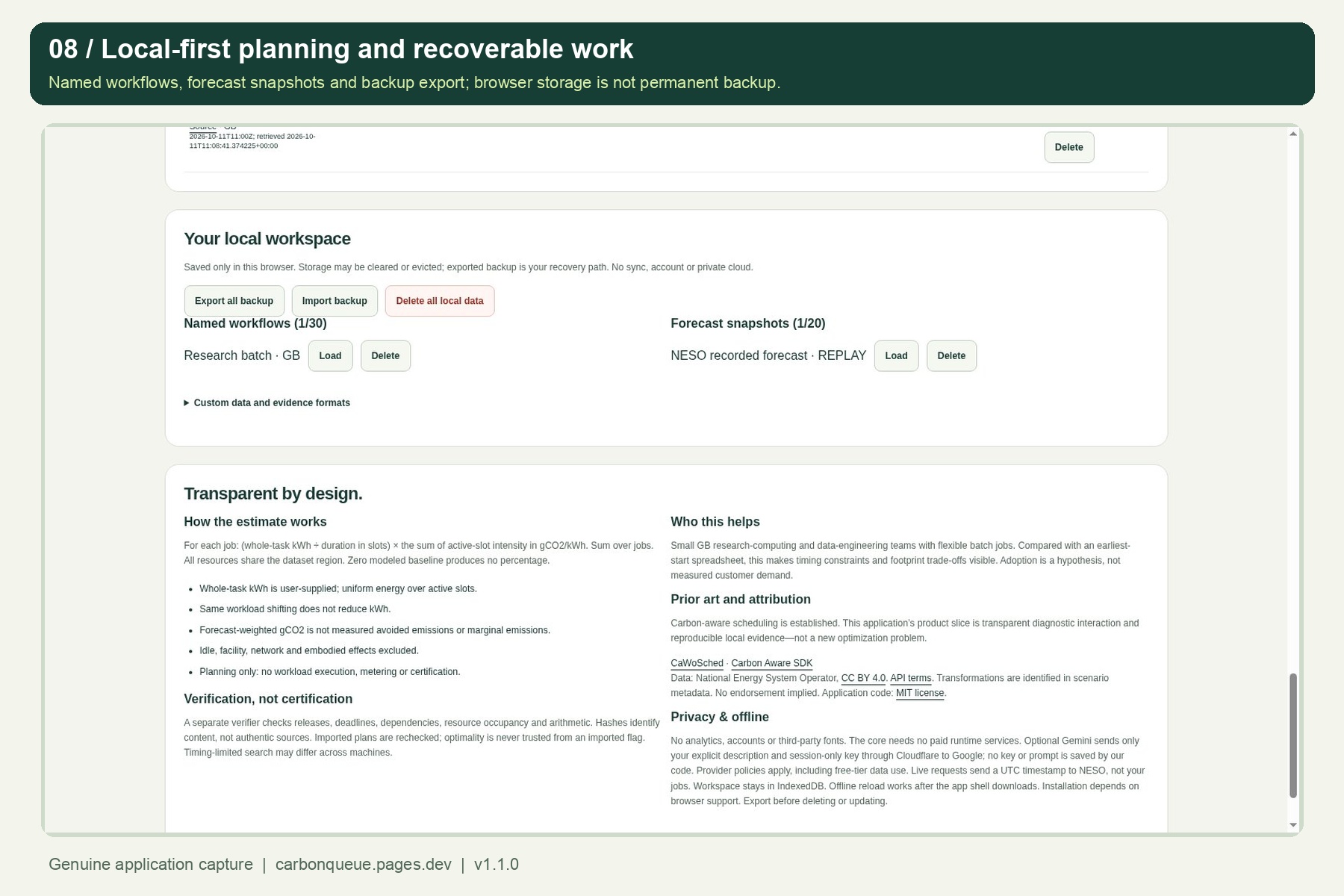
- Save locally, back up the workspace, and export evidence that can be imported and independently rechecked.
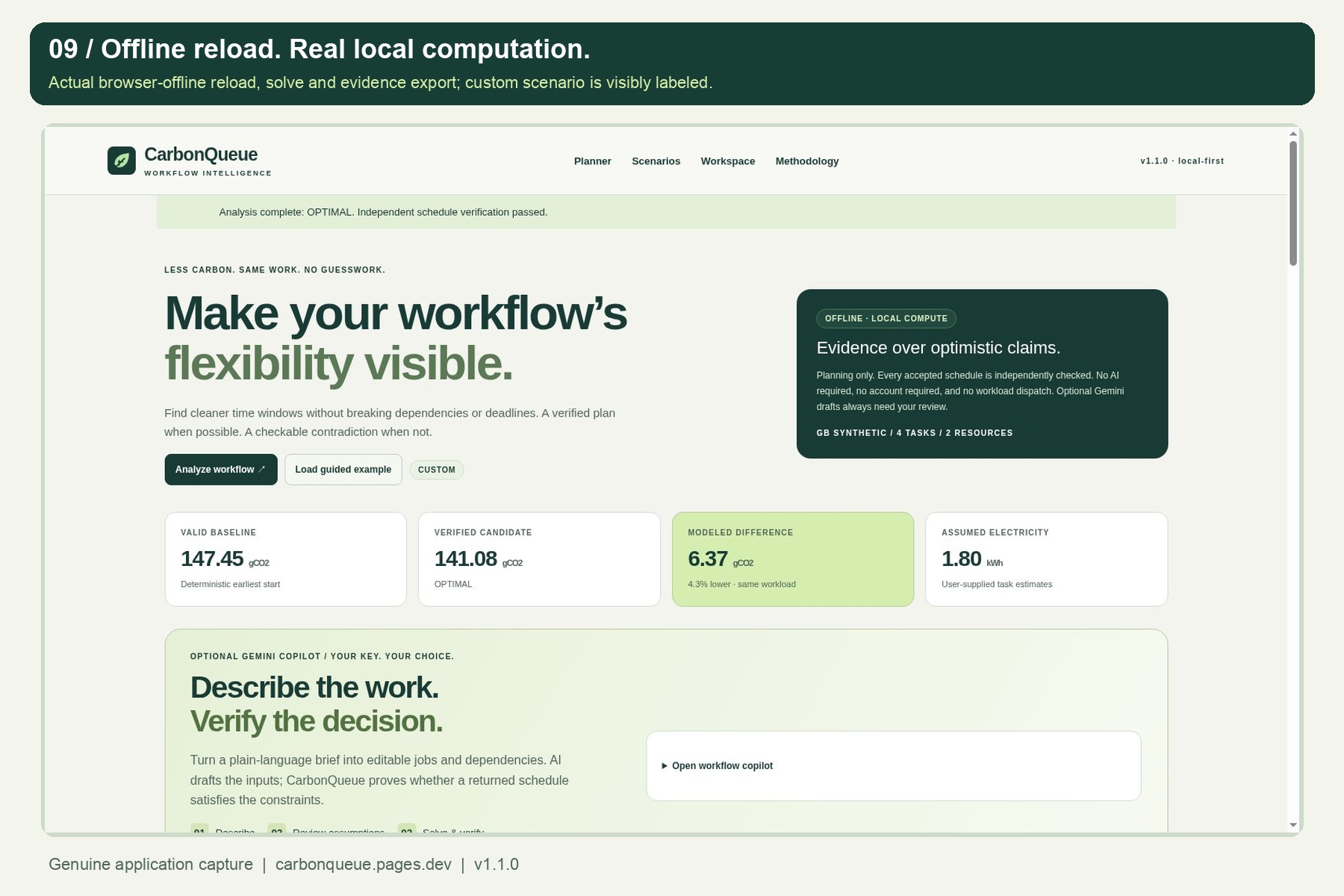
- Reload, edit, solve, and export offline after the application shell has downloaded.
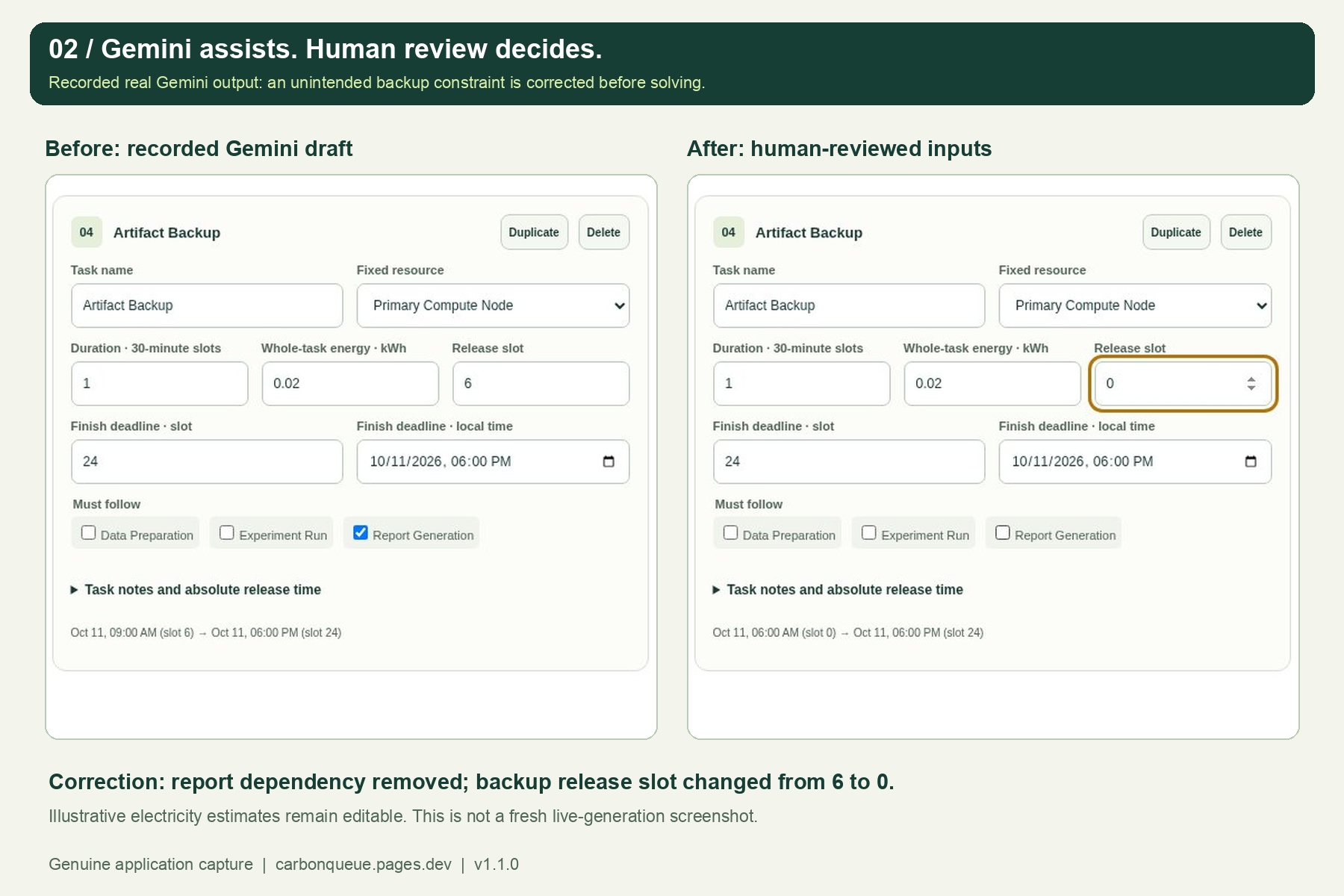
An optional Gemini copilot converts a plain-language brief into editable task inputs. Human review is required. AI output is never accepted as a scheduling proof.
How we built it
The application uses TypeScript domain modules, native HTML/CSS/JavaScript, and a browser Web Worker. Scheduling uses bounded discrete search with sound constraint pruning; an independent verifier checks releases, deadlines, dependencies, resource occupancy, and objective arithmetic.
Solver status is explicit: OPTIMAL only when the discrete search proves optimality; otherwise FEASIBLE_BEST_FOUND, UNKNOWN, or proven INFEASIBLE. A timeout never becomes an infeasibility claim.
IndexedDB supports local workflows and recovery. A service worker provides offline operation and a controlled update lifecycle. Cloudflare Pages hosts the interface; a narrowly scoped Cloudflare Worker handles optional Gemini requests. The user's key remains session-only, and our application code does not persist or log keys or prompts. Cloudflare and Google still process requests under their own policies.
Real GB intensity data comes from NESO's Carbon Intensity API. The model distributes each task's assumed whole-task electricity uniformly across its active slots and multiplies it by the selected forecast intensity. Inputs, units, provenance, and transformations are included in exported evidence.
Challenges we ran into
The hardest problems were correctness and honest uncertainty—not just rendering a timeline.
A greedy baseline can fail even when a feasible plan exists, so baseline failure is not treated as proof. Bounded searches must distinguish a verified incumbent from a proven optimum. Editing inputs or cancelling a run must never allow stale Worker messages to overwrite current results.
AI introduced another important challenge: a real Gemini response made an intended independent backup depend on the report. Human review corrected that dependency and release delay before the actual solver verified the workflow. This reinforced the separation between useful AI input assistance and trustworthy computational checks.
Offline caching, transactional backups, malformed imports, API failures, accessible controls, and mobile layout also needed real browser testing.
Accomplishments that we're proud of
- A public deployed application and public source repository, with no mandatory AI dependency for core planning.
- 35 executed automated test groups and 51 hosted browser checks passing, including 100 seeded small cases compared with a separate reference solver.
- Verified deadline contradictions, counterfactuals, scenario sensitivity, evidence reimport, backup/recovery, and offline reload-to-export workflows.
- A successful real Gemini 3.1 Flash-Lite draft followed by human correction and independently verified scheduling.
- A recorded same-workload example changing from 260.95 gCO2 to 230.65 gCO2—11.6% lower modeled footprint—with the same assumed 1.80 kWh.
That last result uses a recorded forecast and illustrative task electricity. It is not measured avoided emissions or a promise of the same reduction on other workloads.
What we learned
A fluent explanation is not a proof. Useful AI integration can make a technical workflow easier to describe, while deterministic validation protects the decisions that follow.
We also learned that environmental claims need the same care as algorithmic claims: provenance, units, assumptions, valid baselines, and clear separation between forecasts and measurements.
Carbon-aware scheduling is established prior art. CarbonQueue's contribution is the coherent, operator-facing combination of editable constraints, checkable diagnostics, local-first operation, and reproducible evidence—not a claim to invent carbon-aware scheduling.
What's next for CarbonQueue
The declared release is implemented and deployed; no required feature is deferred to a roadmap. The immediate next step is to use the shipped application with representative workflows and evaluate whether its planning experience is useful to the intended users. Adoption and measured environmental impact have not been validated, and are not claimed as completed results.
The release deliberately remains a planner: no autonomous workload execution, certified carbon accounting, cloud collaboration, or unsupported global data coverage is implied.
AI assistance and evidence
Gemini AI assisted with implementation, tests, documentation, and release work. Gemini API is integrated into the application for optional workflow drafting, with explicit user consent and review. Demo narration was supplied separately and merged with a real application-only recording; the Gemini segment is transparently labeled as previously generated output.
Data: National Energy System Operator, CC BY 4.0. See the application's attribution and source timestamps. CarbonQueue makes forecast-based planning estimates; it does not execute jobs or certify measured emissions savings.
Built With
- api
- carbon
- cloudflare
- css3
- gemini
- html5
- indexeddb
- intensity
- javascript
- neso
- node.js
- pages
- playwright
- service
- typescript
- web
- workers

Log in or sign up for Devpost to join the conversation.