🌿 Inspiration
Climate change is one of the most pressing challenges of our time — yet most organizations still track their carbon emissions manually, in spreadsheets, with no real-time visibility and no predictive capability. We wanted to change that.
We were inspired by the idea of building a platform that doesn't just monitor emissions, but one that thinks, predicts, and acts — autonomously. CarbonMind was born from the question: what if sustainability could run itself?
🤖 What It Does
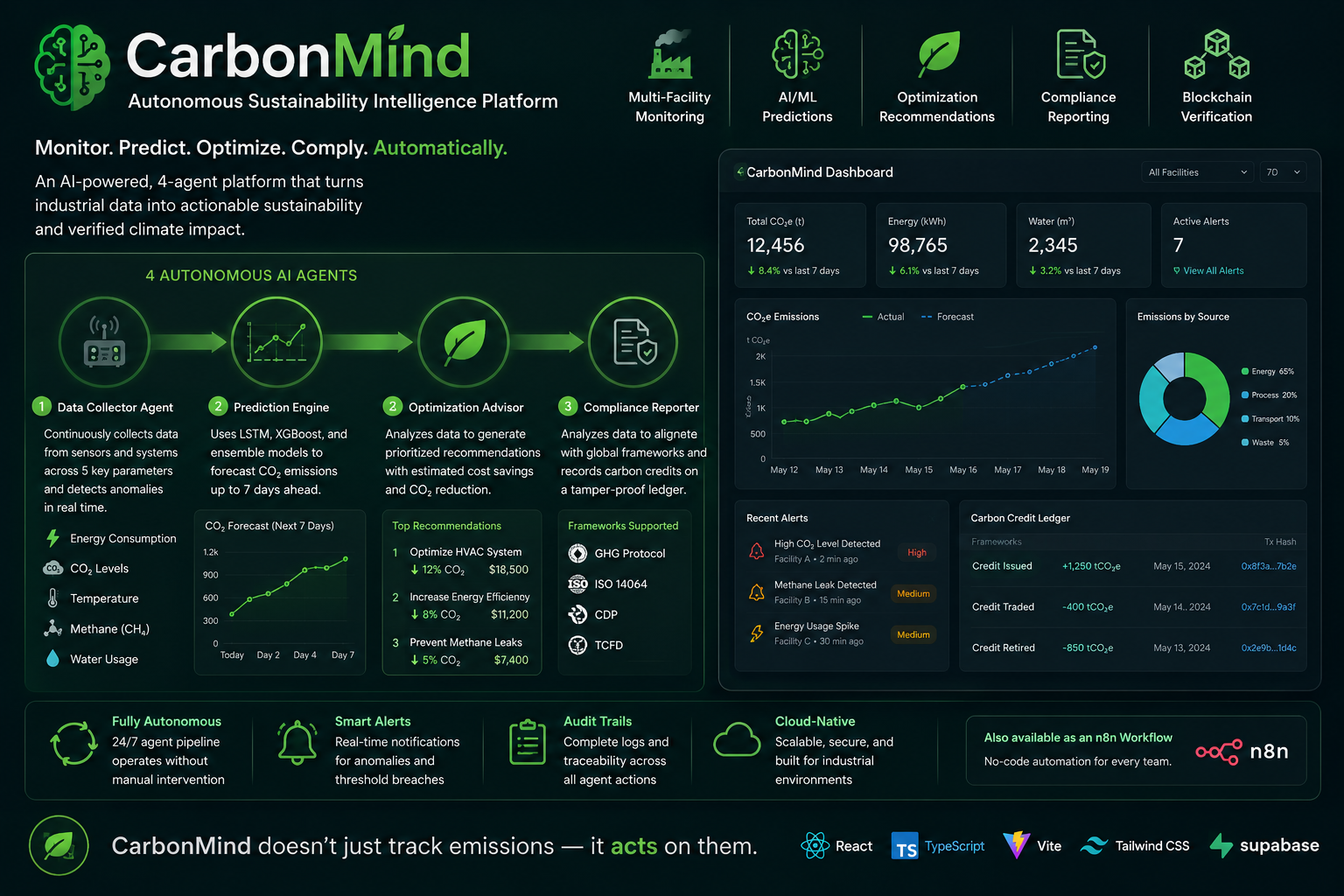
CarbonMind is an autonomous sustainability intelligence platform that helps industrial facilities monitor, predict, and reduce their carbon footprint — without manual intervention.
It runs a 4-agent autonomous pipeline that executes end-to-end:
- Agent 1 — Data Collector: Harvests real-time sensor data (energy, CO₂, temperature, methane, water) across all facilities and flags anomalies automatically
- Agent 2 — Prediction Engine: Runs LSTM, XGBoost, and ensemble models to forecast CO₂ levels up to 7 days ahead with confidence scores
- Agent 3 — Optimization Advisor: Generates prioritized recommendations with estimated CO₂ reduction and cost savings per facility
- Agent 4 — Compliance Reporter: Auto-generates sustainability reports aligned with GHG Protocol, ISO 14064, CDP, and TCFD frameworks — and records every carbon credit on a blockchain-style tamper-proof ledger
The emission forecasting model predicts future CO₂ levels using a weighted ensemble approach:
$$\hat{CO_2}(t+h) = \alpha \cdot LSTM(t) + \beta \cdot XGBoost(t) + \gamma \cdot \epsilon$$
where \( \alpha + \beta + \gamma = 1 \) and \( h \) is the prediction horizon in days.
🛠 How We Built It
| Layer | Technology |
|---|---|
| Frontend | React 18 + TypeScript + Vite |
| Styling | Tailwind CSS |
| Backend / Database | Supabase (PostgreSQL + RLS) |
| Agent Pipeline | Custom TypeScript agent engine + n8n workflow |
| Charts & UI | Lucide React + custom SVG components |
The agent engine was built entirely in TypeScript (agentEngine.ts), with each agent modeled as an async function that reads from and writes to Supabase. We also exported the full pipeline as an n8n workflow JSON for teams that prefer no-code automation.
The database schema includes 9 tables with Row Level Security enabled, performance indexes, and a blockchain-style carbon credit ledger where each transaction is hash-chained to the previous one.
🚧 Challenges We Faced
- Designing the agent pipeline so each agent feeds cleanly into the next without race conditions or stale data
- Simulating realistic sensor data with natural variance, anomaly spikes, and multi-facility support
- RLS policy configuration in Supabase — getting anon and authenticated access balanced correctly took several iterations
- Blockchain-style hashing without a real blockchain — implementing a deterministic
sha256simchaining function that produces verifiable, linked records - Making the UI feel live — building sparkline charts, metric cards, and agent status indicators that update reactively as agents complete
📚 What We Learned
- How to architect a multi-agent system where each agent has a single responsibility and logs its own audit trail
- The complexity of real-world emissions accounting — Scope 1, 2, and 3 classifications, GHG Protocol frameworks, and carbon credit registries like VCS and Gold Standard
- How n8n workflows can mirror code-based agent logic, making automation accessible to non-developers
- The importance of database performance tuning — proper indexing on time-series sensor data makes a huge difference at scale
🚀 What's Next for CarbonMind
- Integrate with real IoT sensor APIs (Siemens, Honeywell, AWS IoT)
- Add actual LSTM model inference via a Python microservice
- Multi-tenant support for enterprise deployments
- Mobile alerts via push notifications
- Carbon credit marketplace integration with Verra and Gold Standard registries
Built With
- n8n
- postgresql
- react
- supabase
- tailwind-css
- typescript
- vite

Log in or sign up for Devpost to join the conversation.