-
-
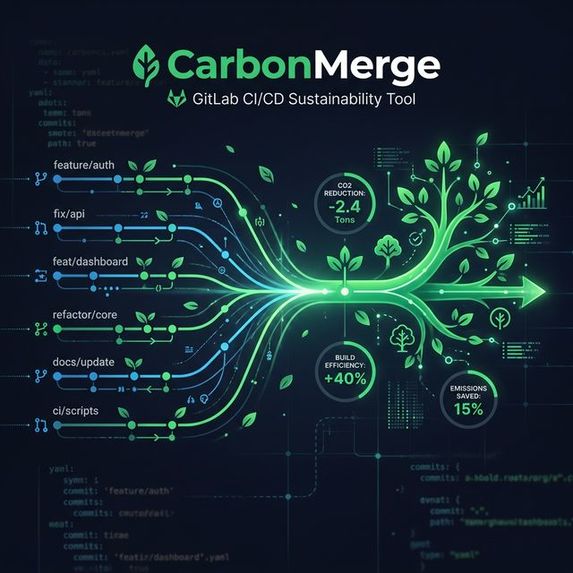
CarbonMerge — AI agent that consolidates bot dependency MRs to cut CI/CD waste and track carbon savings
-
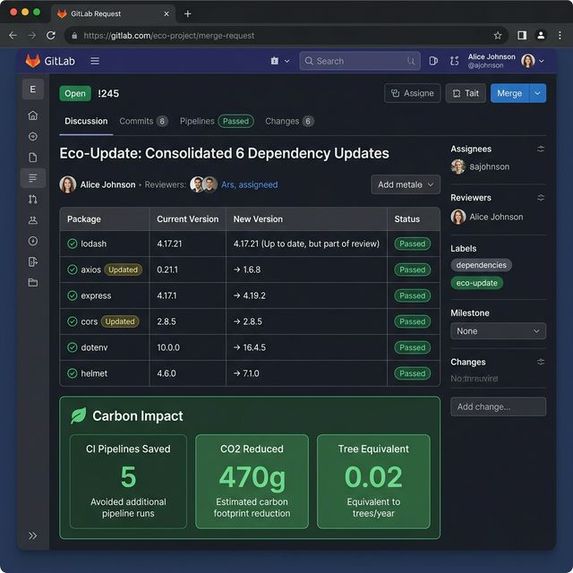
Eco-Update MR: 6 bot dependencies consolidated into 1 MR, saving 5 pipelines and 470g CO2
Inspiration
Every modern software project uses dependency bots (Dependabot, Renovate, GitLab Dependency Bot) to keep packages up to date. But these bots create individual merge requests for every single update — sometimes 10-30 MRs piling up per week. Each MR triggers its own CI/CD pipeline: builds, tests, linting, security scans.
The result? Hundreds of wasted CI minutes, redundant compute, and a real carbon footprint that nobody talks about.
We asked: What if AI could consolidate all of these into one smart MR and track the environmental savings?
What it does
CarbonMerge is a multi-agent AI system built on the GitLab Duo Agent Platform that:
- Scans all open bot-generated merge requests in a project
- Merges compatible dependency updates into a single unified commit
- Publishes one "Eco-Update" MR with detailed change tables and carbon metrics
- Reports sustainability insights using Google Cloud Vertex AI — including annualized CO2 projections, industry benchmarks, and AI-powered optimization recommendations
Real Impact Example
- Before: 6 bot MRs → 6 CI pipelines → 120 CI minutes → 470g CO2
- After: 1 Eco-Update MR → 1 pipeline → 20 CI minutes → 83% reduction
How we built it
CarbonMerge uses a 4-agent orchestrated flow on the GitLab Duo Agent Platform:
| Agent | Role | Tools |
|---|---|---|
| Scanner | Finds all bot-generated MRs | list_merge_requests, get_merge_request |
| Merger | Consolidates changes into one commit | read_file, create_commit |
| Publisher | Creates the Eco-Update MR | create_merge_request, create_merge_request_note |
| Reporter | Generates sustainability analysis | Google Cloud Vertex AI via MCP |
The agents are orchestrated via flows/carbonmerge_flow.yml using the v1 flow definition spec. The Reporter agent connects to Google Cloud Vertex AI through the official Google Cloud MCP server for AI-powered carbon analysis.
Challenges we ran into
- Flow orchestration complexity: Designing the data handoff between 4 sequential agents required careful input/output mapping and error handling at each stage
- Carbon calculation methodology: Finding reliable CI-to-CO2 conversion factors and building a credible carbon footprint model
- Duo Agent Platform beta limitations: Working with a new platform that was still evolving during the hackathon period
Accomplishments that we're proud of
- Clean 4-agent architecture that's modular and extensible
- Realistic carbon impact calculations based on Google Cloud's own carbon footprint methodology
- Google Cloud Vertex AI integration for intelligent sustainability reporting
- A compelling demo showing the before/after of CI/CD waste reduction
What we learned
- The GitLab Duo Agent Platform makes it surprisingly natural to compose AI agents into complex workflows
- MCP (Model Context Protocol) integration enables powerful connections to external AI services
- The sustainability angle in DevOps is underexplored — there's real impact potential here
What's next for CarbonMerge
- Auto-scheduling: Run CarbonMerge on a weekly cron to automatically batch bot MRs
- Conflict resolution: Handle merge conflicts between dependency updates using AI
- Organization dashboard: Track cumulative CO2 savings across all projects in a GitLab group
- Carbon badges: Show a real-time CO2 savings badge in project READMEs
Built With
- gitlab-duo-agent-platform
- google-cloud-vertex-ai
- mcp-(model-context-protocol)
- python
- yaml

Log in or sign up for Devpost to join the conversation.