Inspiration
Climate change is one of the most pressing challenges of our time, yet many people struggle to understand how their daily choices contribute to carbon emissions. While awareness around sustainability is growing, there is still a gap between understanding environmental impact and taking meaningful action.
We wanted to create a solution that makes sustainability simple, practical, and personalized. Our inspiration was to build an AI-powered assistant that helps individuals understand their carbon footprint, track everyday activities, and receive actionable recommendations that can lead to measurable environmental impact.
What it does
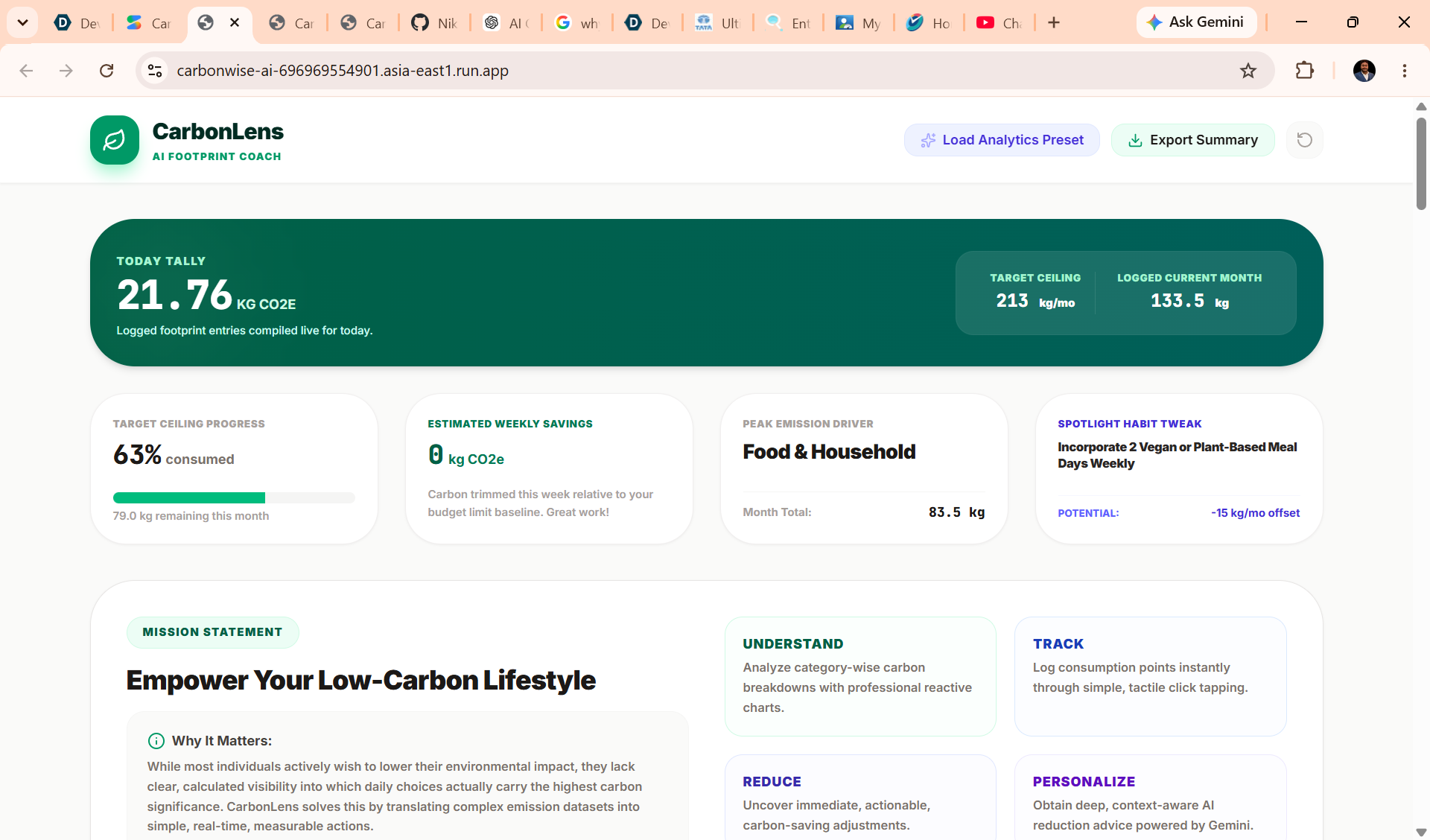
CarbonLens AI is an intelligent carbon footprint tracking and reduction platform that helps users understand, track, and reduce their environmental impact.
The platform allows users to:
- Estimate their carbon footprint across transportation, energy usage, food habits, shopping behavior, and waste management.
- Visualize emissions through an intuitive dashboard.
- Track daily activities that contribute to carbon emissions.
- Receive personalized AI-powered sustainability recommendations.
- Monitor progress toward carbon reduction goals.
- Build long-term climate-positive habits through actionable insights.
By transforming complex carbon data into simple recommendations, CarbonLens AI empowers users to make more sustainable decisions in their daily lives.
How we built it
CarbonLens AI was built using modern AI and web technologies.
Technology Stack
- Google AI Studio
- Google Gemini
- React
- TypeScript
- Antigravity
- Carbon Emission Analytics Engine
- Cloud Run Deployment
Architecture
- Users log lifestyle activities and consumption habits.
- CarbonLens calculates estimated CO₂e emissions using predefined emission factors.
- Activity data is categorized into transportation, energy, food, waste, and household impact.
- Gemini-powered recommendation logic analyzes user behavior patterns.
- Personalized reduction strategies are generated based on the highest emission contributors.
- The dashboard visualizes footprint trends, reduction opportunities, and progress toward sustainability goals.
Challenges we ran into
One of the biggest challenges was balancing simplicity with meaningful insights.
Carbon accounting can quickly become complex due to variations in regional emission factors, user behavior, and consumption patterns. We needed to create an experience that remained easy for users while still providing valuable and realistic recommendations.
Another challenge was designing personalized recommendations that feel relevant and actionable rather than generic sustainability advice.
We also focused heavily on usability, accessibility, and creating a clean user experience that encourages long-term engagement.
Accomplishments that we're proud of
- Successfully built and deployed a fully functional AI-powered sustainability platform.
- Integrated Google Gemini to provide personalized carbon reduction insights.
- Created an intuitive dashboard for carbon footprint visualization.
- Developed a scalable framework that can be expanded with additional environmental datasets.
- Delivered a working solution that addresses a real-world sustainability challenge.
- Designed the platform to be accessible, easy to understand, and practical for everyday users.
What we learned
Through this project, we gained valuable experience in:
- Building AI-powered sustainability applications.
- Designing user-centric environmental impact tools.
- Converting complex carbon footprint calculations into understandable insights.
- Integrating generative AI into decision-support systems.
- Balancing technical accuracy with user experience.
- Rapid prototyping and deployment using modern AI development platforms.
Most importantly, we learned that effective climate solutions are not just about providing information—they are about enabling action.
What's next for CarbonLens AI
Our vision is to evolve CarbonLens AI into a comprehensive personal sustainability ecosystem.
Future enhancements include:
- Region-specific carbon emission factors.
- Real-time utility and smart meter integrations.
- Location-aware transportation recommendations.
- Personalized sustainability challenges and gamification.
- Carbon reduction goal planning and forecasting.
- Community leaderboards and social sustainability initiatives.
- Multilingual support for broader accessibility.
- Corporate sustainability programs and employee engagement features.
- AI-powered long-term carbon reduction planning.
- Integration with carbon offset and environmental impact programs.
Ultimately, we aim to transform CarbonLens AI from a carbon tracking tool into a trusted personal sustainability companion that helps individuals make informed, measurable, and lasting environmental contributions.

Log in or sign up for Devpost to join the conversation.