-
-
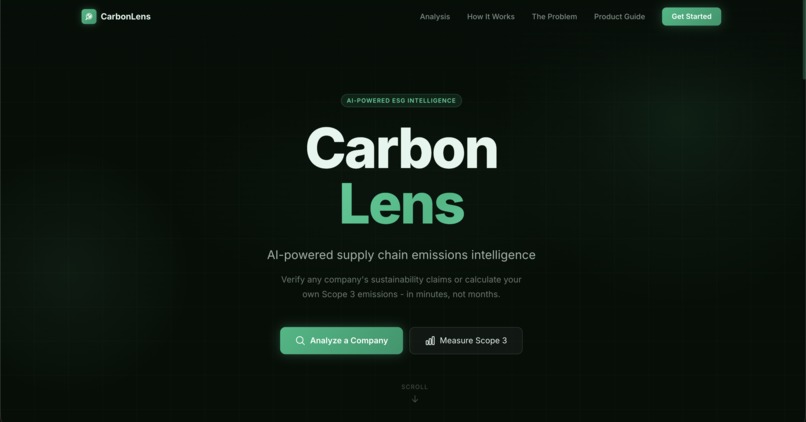
Landing Page
-
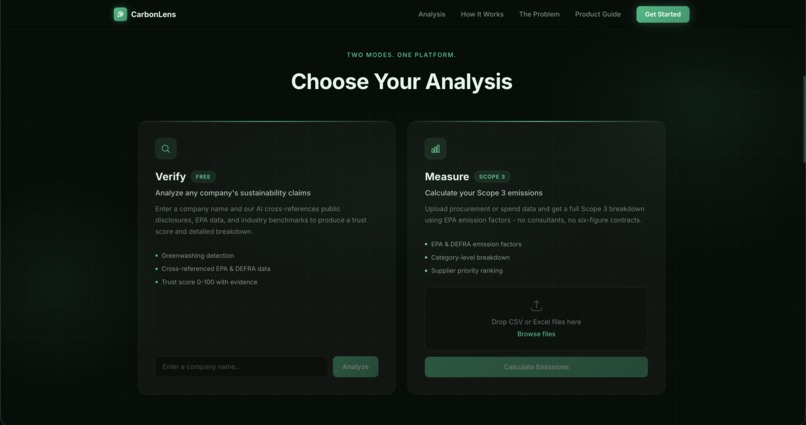
Analysis Page
-
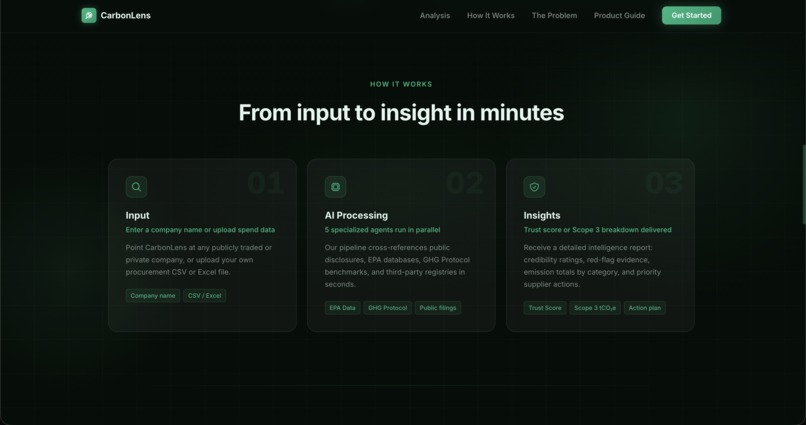
Features Page
-
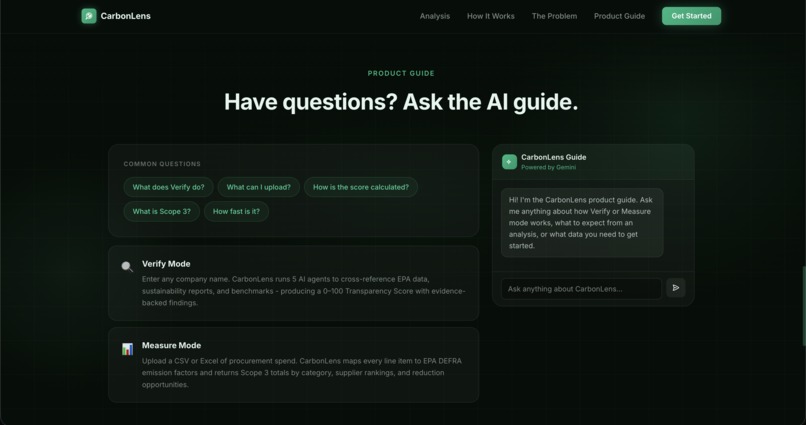
Chat Interface
-
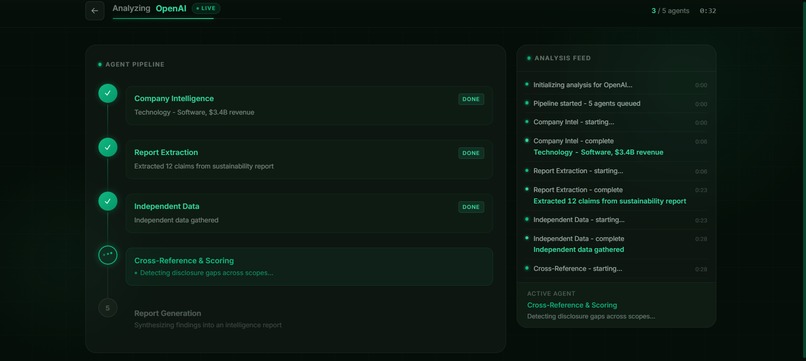
Processing Page
-
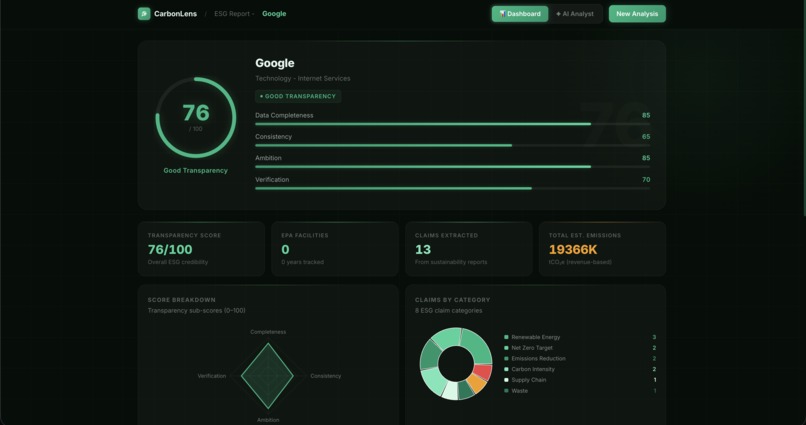
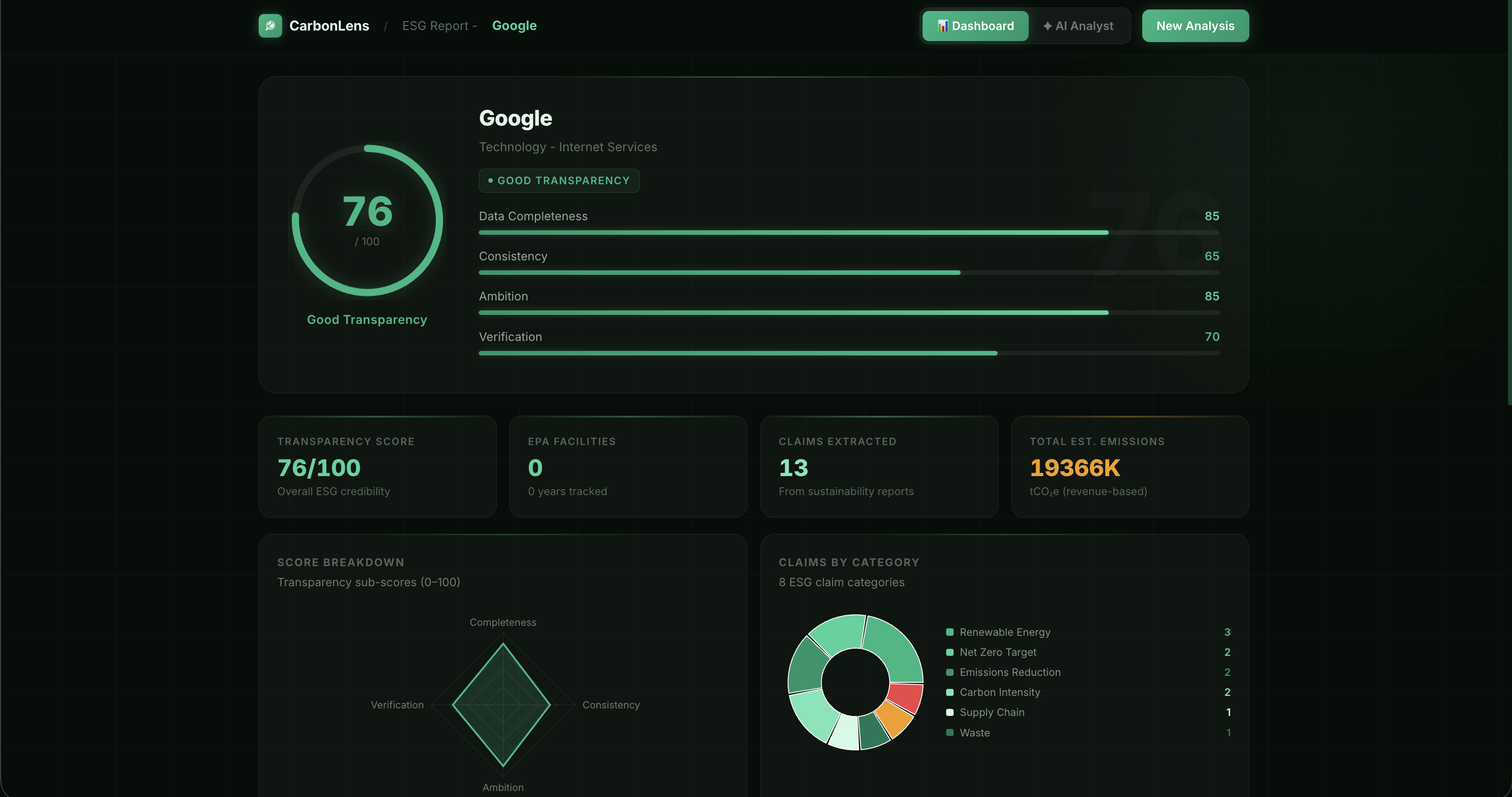
Report Page (Dashboard)
-
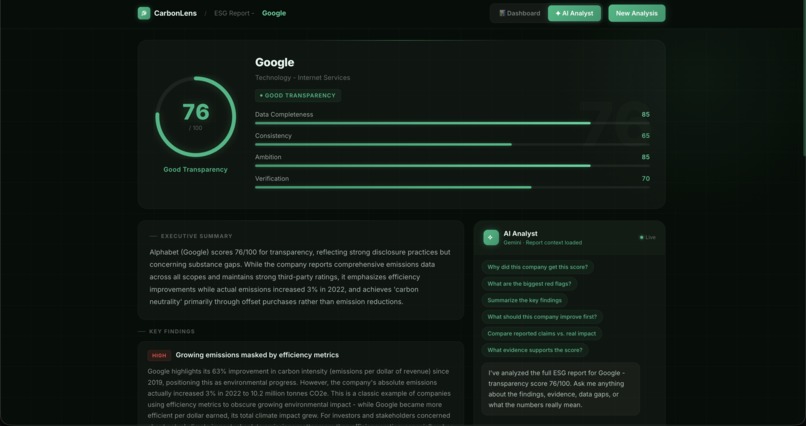
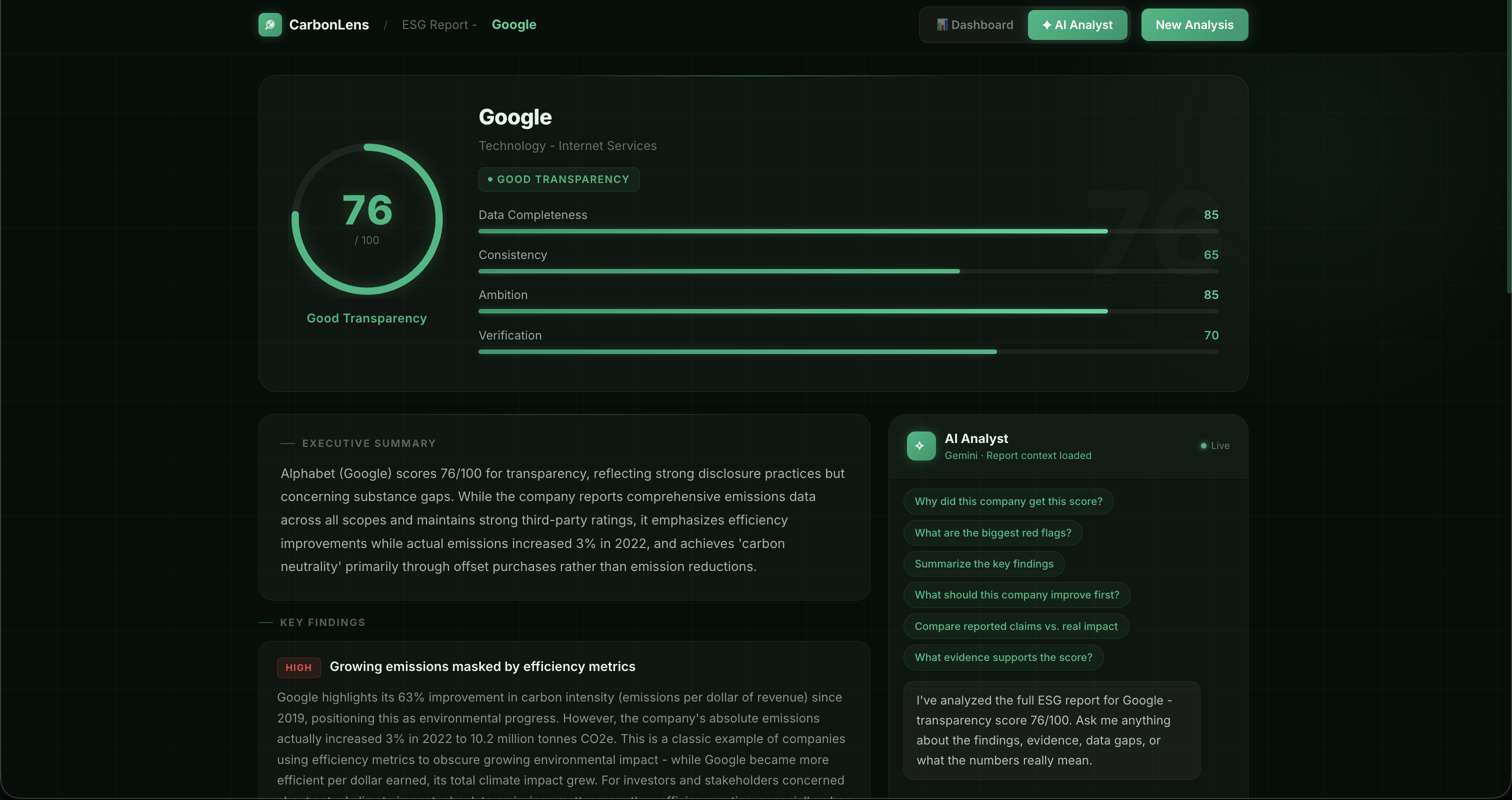
Report Page (AI Analysis)
Inspiration
Climate disclosures are everywhere, but verifying them is incredibly difficult. Companies publish sustainability reports filled with ambitious claims, yet regulators, investors, and the public often lack the tools to determine whether those claims match real-world emissions data.
Today, analyzing a single ESG report can take analysts hours or days, requiring manual cross-referencing with independent data sources. We wanted to explore whether AI could automate climate transparency analysis by combining corporate disclosures with verified emissions datasets.
CarbonLens was built to answer a simple question:
Do corporate climate claims match the data?
What it does
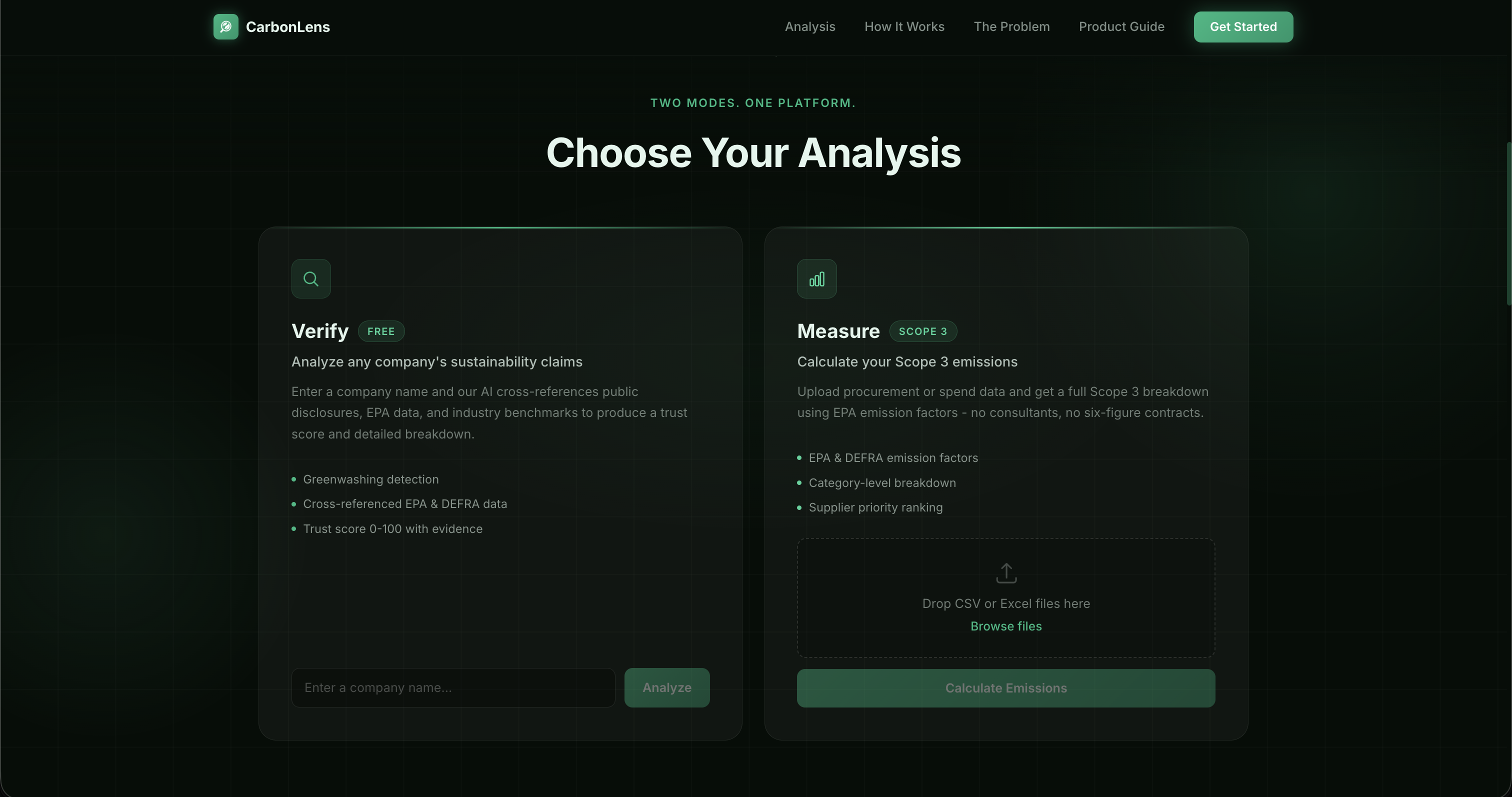
CarbonLens is an AI-powered emissions transparency platform that analyzes corporate climate disclosures and compares them with independent emissions data.
The platform has two modes:
Verify Mode Users enter a company name, and CarbonLens analyzes its sustainability report alongside external datasets (such as EPA GHGRP emissions data). Multiple AI agents extract claims, gather independent emissions evidence, and cross-reference the information to produce:
- A Transparency Score
- Key findings and inconsistencies
- Identified data gaps
- A breakdown of disclosure quality
AI-generated insights explaining the score
Measure Mode Users upload supply chain or facility emissions data via CSV. CarbonLens processes the data and generates emissions summaries, visualizations, and insights to help organizations understand their operational footprint.
The result is an instant ESG intelligence report that turns complex climate disclosures into clear, structured insights.
How we built it
CarbonLens combines AI-driven analysis with real-world emissions datasets.
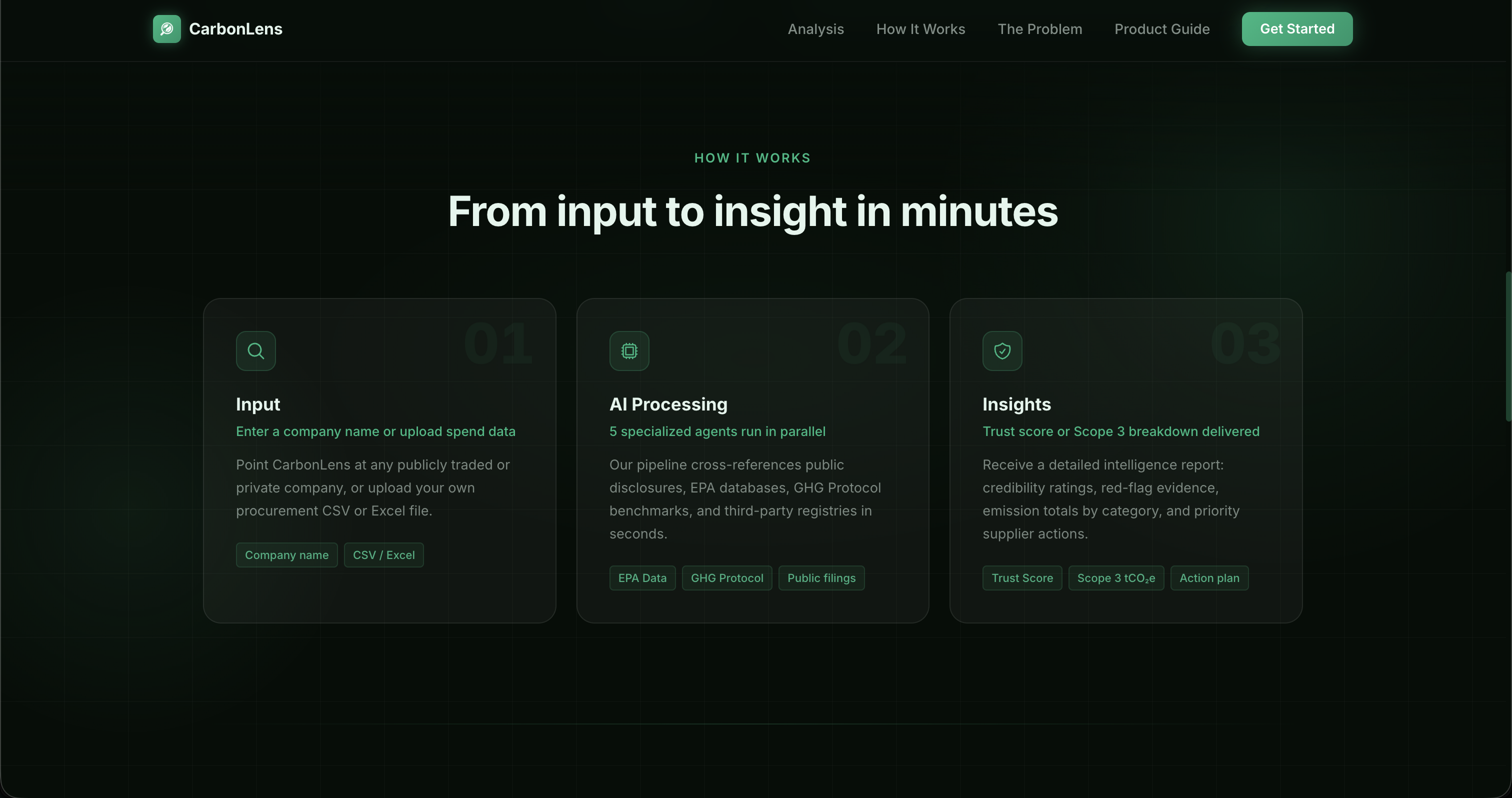
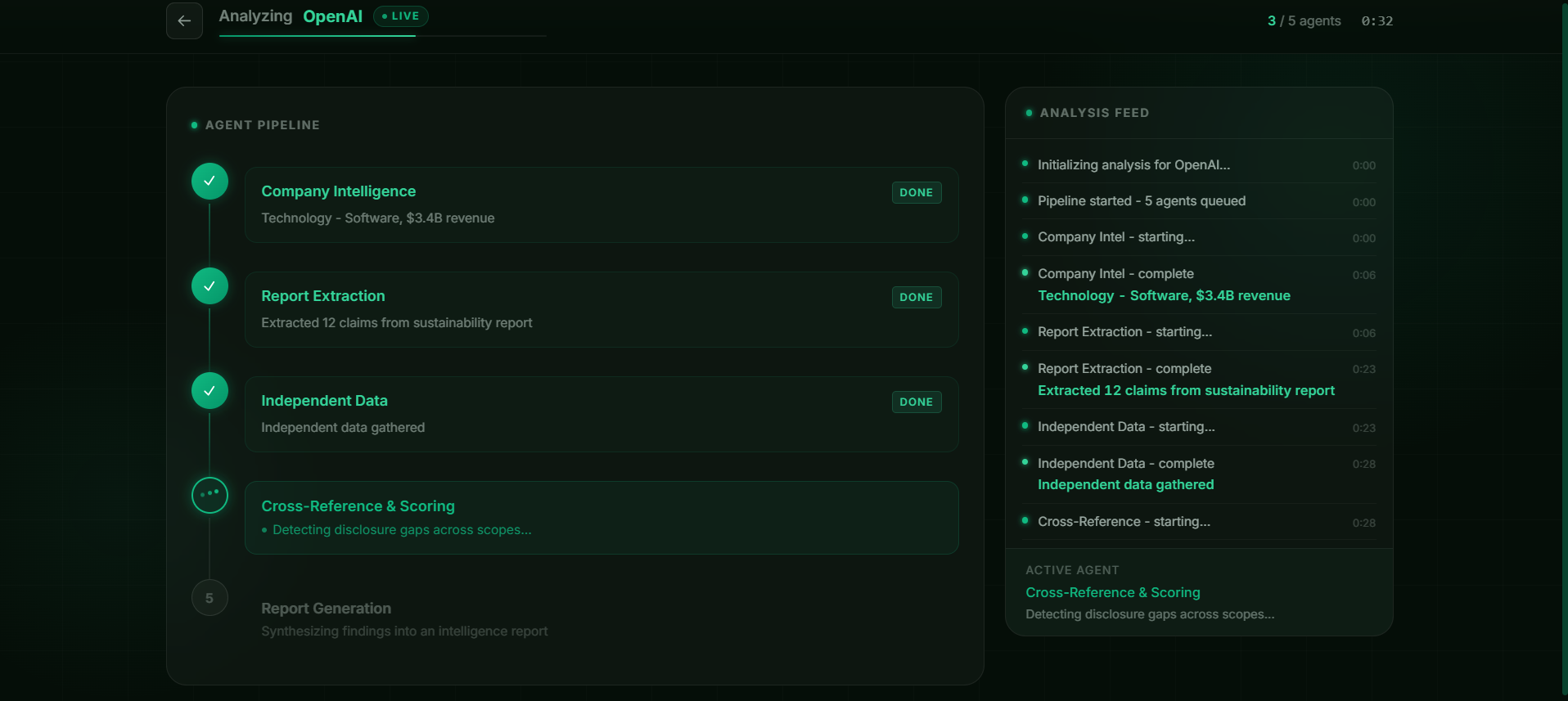
The backend is built with Python and FastAPI, running a multi-agent analysis pipeline that processes climate disclosures through several stages:
- Company Intelligence Agent gathers company context and emissions data from external datasets.
- Report Extraction Agent parses sustainability reports and extracts structured climate claims.
- Independent Data Agent aggregates external emissions evidence and benchmarks.
- Cross-Reference Agent compares corporate claims with independent data and calculates a transparency score.
These agents work sequentially, sharing structured outputs that feed into the final analysis.
The frontend is built with React + Vite, featuring an interactive dashboard that visualizes emissions data, claims analysis, and transparency scoring. The UI uses a dark glassmorphism design system to make complex climate data easier to explore.
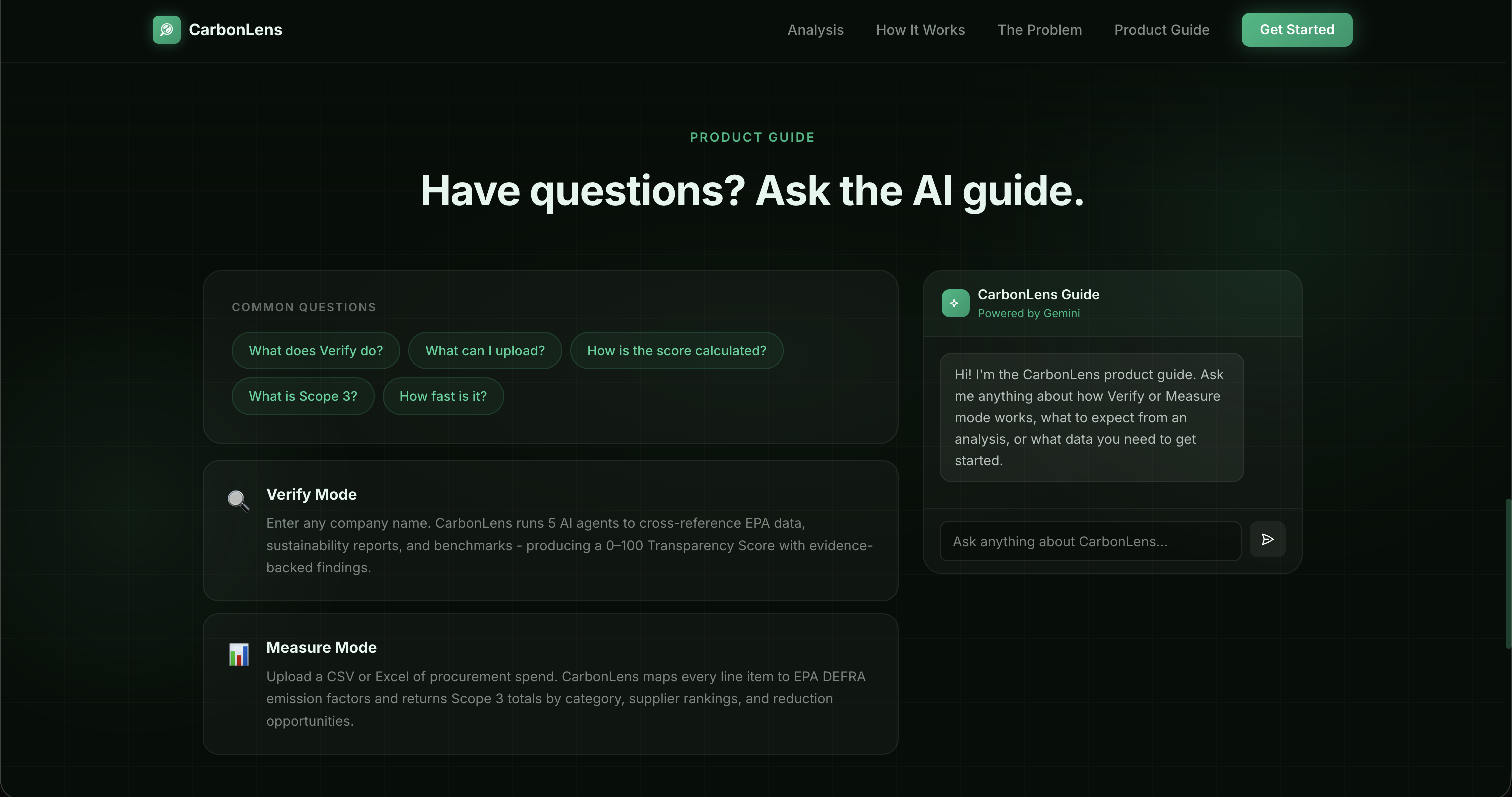
For natural language interaction, CarbonLens includes an AI Analyst assistant powered by Gemini that allows users to ask questions about the analysis results.
Challenges we ran into
One of the biggest challenges was normalizing data across multiple sources. Corporate reports use inconsistent formats, units, and disclosure structures, while external emissions datasets often have entirely different schemas.
We also had to design a pipeline that could combine AI reasoning with structured emissions data without hallucinating conclusions. This required carefully separating extraction, evidence gathering, and cross-referencing into different agents.
On the engineering side, synchronizing the multi-agent pipeline outputs with the frontend dashboards required careful data contracts and debugging across both the backend and UI layers.
Accomplishments that we're proud of
We're proud that CarbonLens can take a complex sustainability disclosure and produce a structured transparency analysis in seconds.
Key accomplishments include:
- Building a multi-agent ESG analysis pipeline
- Integrating real-world emissions datasets into AI-driven analysis
- Creating a transparency scoring framework that explains why companies receive certain scores
- Designing a full interactive analysis dashboard for exploring emissions insights
- Implementing an AI analyst that can answer questions about the results
Most importantly, we built a working prototype that demonstrates how AI can make climate accountability more accessible and transparent.
What we learned
This project taught us how difficult climate data analysis actually is. ESG disclosures are complex, inconsistent, and often difficult to compare against external datasets.
We also learned the importance of combining AI reasoning with structured data pipelines. Pure AI analysis isn't enough for something as sensitive as climate reporting. It needs grounding in real-world evidence.
Finally, we learned how powerful multi-agent systems can be when each agent has a clear, focused role in the analysis pipeline.
What's next for CarbonLens
Our next goal is to expand CarbonLens into a more complete climate transparency platform.
Future improvements include:
- Supporting more global emissions datasets beyond GHGRP
- Adding supply chain Scope 3 emissions modeling
- Improving the transparency scoring framework with additional metrics
- Building historical tracking so users can compare disclosures across years
- Creating persistent shareable reports for organizations and analysts
Ultimately, we hope CarbonLens can help make climate reporting more transparent, data-driven, and accountable.
Built With
- fastapi
- google-gemini-api
- javascript
- node.js
- python
- react
- recharts
- sqlite
- tailwindcss
- vite

Log in or sign up for Devpost to join the conversation.