-
-
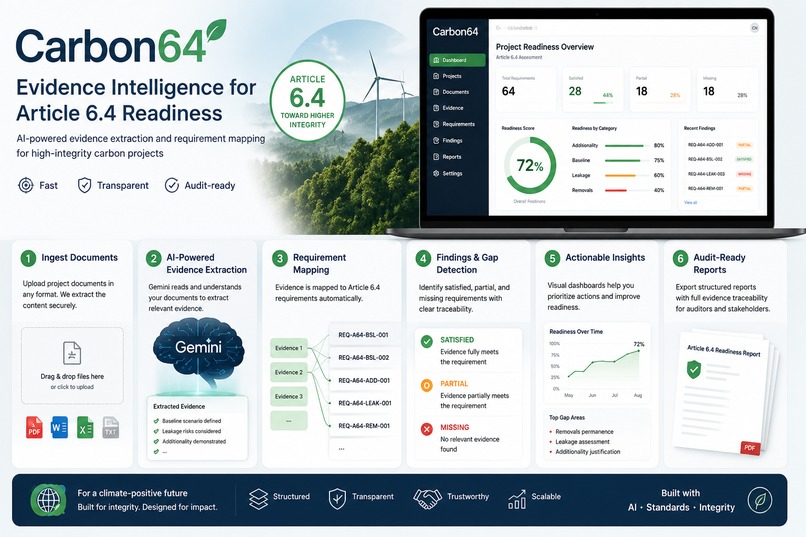
Carbon64 Dashboard
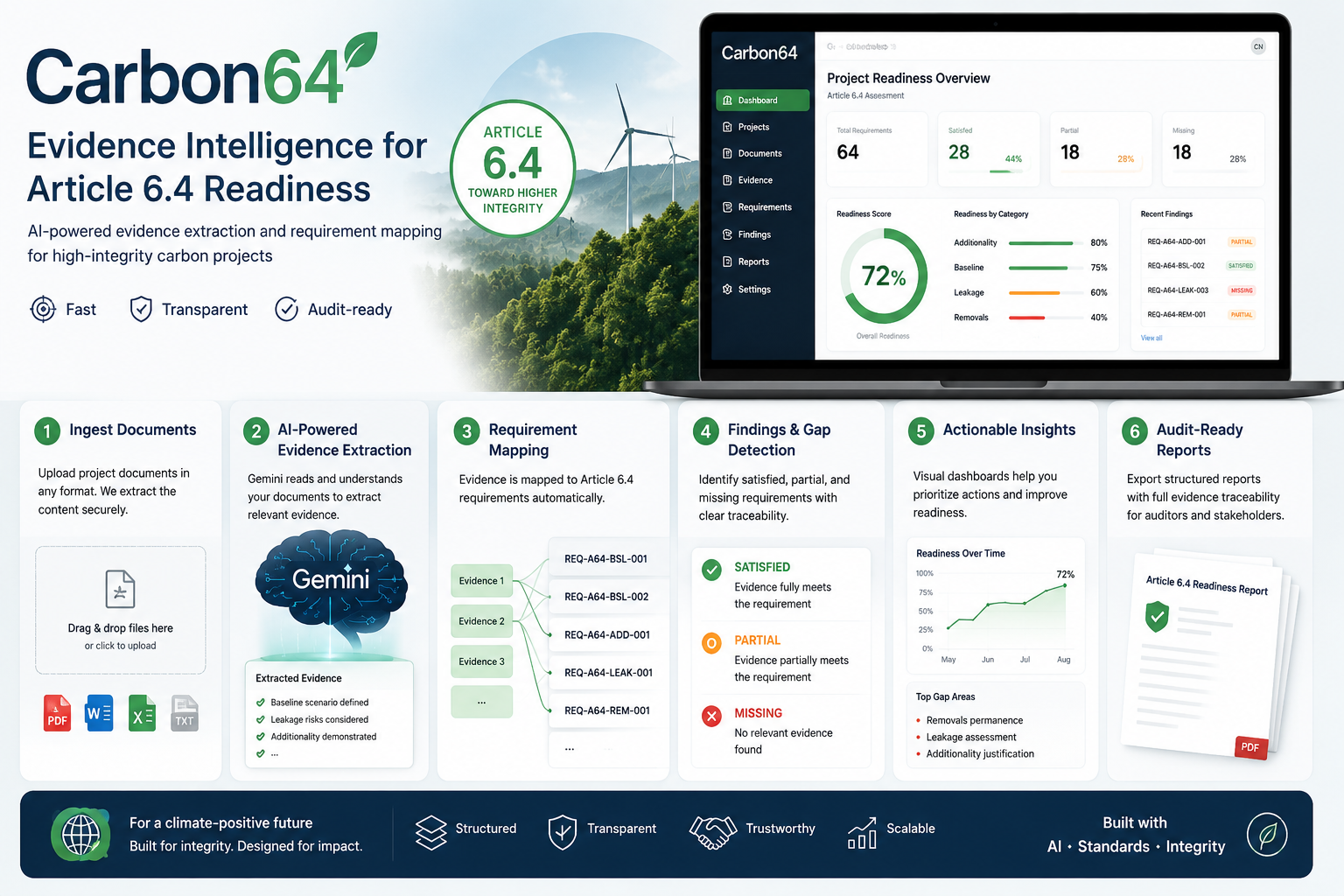
Inspiration
Article 6.4 of the Paris Agreement is creating a new global carbon-crediting mechanism, but the transition will not happen overnight. Many active carbon projects continue to operate under established systems such as the Clean Development Mechanism, Verra, and Gold Standard, while project developers, host countries, auditors, and market participants begin adapting to more demanding Paris-aligned requirements.
The underlying evidence is complex and fragmented. Project design documents, methodologies, monitoring reports, verification reports, calculation spreadsheets, authorization records, and registry events may span hundreds of pages and several years. Reviewers must determine which rules apply, reconstruct key assumptions and calculations, identify gaps or contradictions, and assess whether the available evidence supports the project’s claims.
Carbon64 was inspired by a practical question:
Can Gemini-powered evidence intelligence make carbon-project assessment and Article 6.4 readiness faster, clearer, more transparent, and more defensible?
The project also builds on earlier work developing an eight-dimensional carbon-integrity scoring system. Rather than extending the Thailand-focused KISS TH platform, Carbon64 is being developed as a separate, globally oriented product focused on carbon-project evidence, scientific integrity, and the transition toward Article 6.4 alignment.
What it does
Carbon64 transforms complex carbon-project records into structured, explainable assessment intelligence.
For projects operating under established standards, Carbon64 applies two separate assessment lenses:
Current-standard integrity
How strongly does the available evidence support the project under its governing standard, methodology, monitoring plan, and verification requirements?Article 6.4 alignment
Which requirements already appear aligned with Article 6.4, which require stronger evidence, and which may require recalculation, revalidation, safeguards upgrades, host-country action, or corresponding-adjustment arrangements?
Carbon64 is designed to:
- identify the governing standard, activity pathway, methodology, and project lifecycle stage;
- extract page-, section-, table-, and spreadsheet-level evidence;
- reconstruct claims, assumptions, parameters, and calculation lineages;
- connect evidence to version-controlled requirements;
- detect missing, unsupported, outdated, inconsistent, or contradictory information;
- assess indicators and aggregate them into transparent dimension scores;
- report assessment score, confidence, evidence coverage, and risk flags separately;
- compare current-standard performance with Article 6.4 alignment;
- generate transition-gap registers and reviewer questions; and
- preserve an auditable record of model outputs, corrections, and assessment snapshots.
Critically, Carbon64 does not generate results when required evidence is missing.
Instead, it explicitly returns a NOT ASSESSABLE status to prevent false confidence and misleading outputs.
Carbon64 does not determine official eligibility, registration, authorization, validation, verification, or credit issuance. It provides independent, evidence-grounded decision support for project preparation, assessment, transition planning, and expert review.
How we are building it
We use Google Antigravity for specification-driven, agentic product development and Gemini for multimodal interpretation of technically complex project records.
Gemini supports tasks that require semantic intelligence, including:
- document classification;
- evidence and claim extraction;
- assumption and parameter identification;
- methodology-to-evidence mapping;
- cross-document comparison;
- contradiction-candidate detection; and
- explanation generation.
Gemini does not directly assign final project scores. Structured model outputs are schema-validated before entering the assessment pipeline, while deterministic code controls scoring, weighting, aggregation, confidence, and coverage calculations.
The application follows a strict Body–Controller–Brain architecture:
- The Body provides the user interface, evidence visualization, and reporting.
- The Controller manages orchestration, validation, and workflow execution.
- The Brain contains protected logic for standards interpretation, evidence mapping, scientific integrity checks, and scoring.
- A project-scoped repository preserves source hashes, page-level provenance, execution logs, and immutable assessment snapshots.
Carbon64 operates in STRICT MODE:
- no fallback logic;
- no simulated or default values;
- no output without sufficient evidence;
- no execution without valid AI access.
What we learned
The principal challenge is not extracting text from PDFs. Reliable carbon-project assessment requires understanding which requirements apply, where parameters originate, and whether evidence truly supports the resulting claims.
We also learned that the most critical capability is not generating answers, but knowing when not to generate them.
During development, a mock parameter set used for testing was mistakenly allowed into a benchmark assessment. Carbon64 detected that these values were not present in the source document, invalidated the result, and introduced strict safeguards to prevent this from happening again.
This led to a dedicated Scientific Integrity Layer that enforces:
- source provenance verification;
- detection of unsupported parameter values;
- prevention of mock-data contamination;
- page-level evidence traceability;
- methodology-version consistency;
- calculation reproducibility;
- detection of missing inputs; and
- strict separation between live AI outputs and test data.
We also established that four outputs must remain independent:
- Assessment score
- Confidence
- Evidence coverage
- Risk and review flags
A missing document is not evidence of failure. Carbon64 therefore distinguishes between unsupported, missing, provisional, and not-assessable conditions.
Challenges
The main development challenges include:
- translating evolving standards and methodologies into controlled, versioned requirement systems;
- supporting multiple existing standards while aligning with Article 6.4;
- extracting reliable evidence from heterogeneous technical documents;
- reconstructing parameter and calculation lineage across documents;
- preventing AI from inventing values or overstating conclusions;
- enforcing strict execution rules without fallback behavior;
- separating integrity assessment from alignment and transition readiness;
- ensuring no mock or test data enters production outputs;
- maintaining explainability while protecting proprietary logic; and
- delivering useful decision support without acting as an official authority.
Our objective is to keep the system simple for users while enforcing rigorous internal controls on evidence, logic, and execution.
Carbon64 does not ask users to trust AI outputs. It shows the evidence, validates it, and refuses to produce results when the evidence is insufficient.
Log in or sign up for Devpost to join the conversation.