-
-
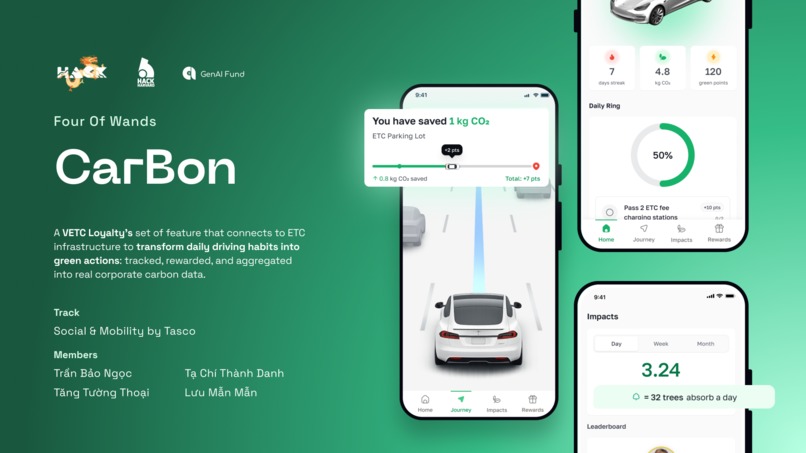
Cover
-
-
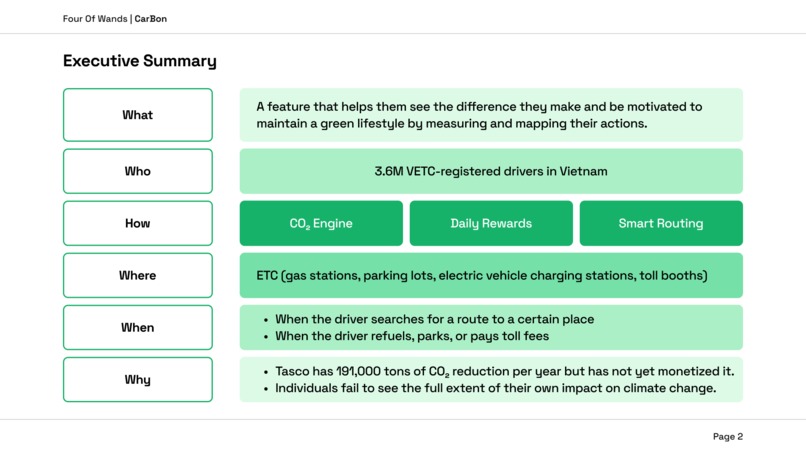
Executive Summary
-
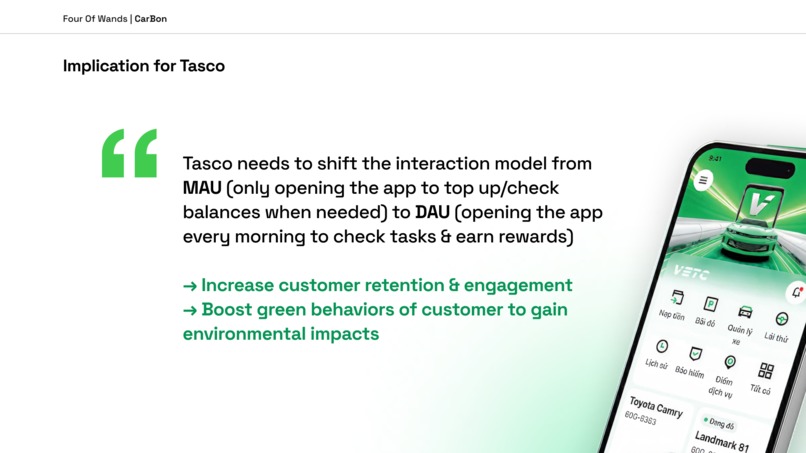
Implication for Tasco
-
Problem Statement
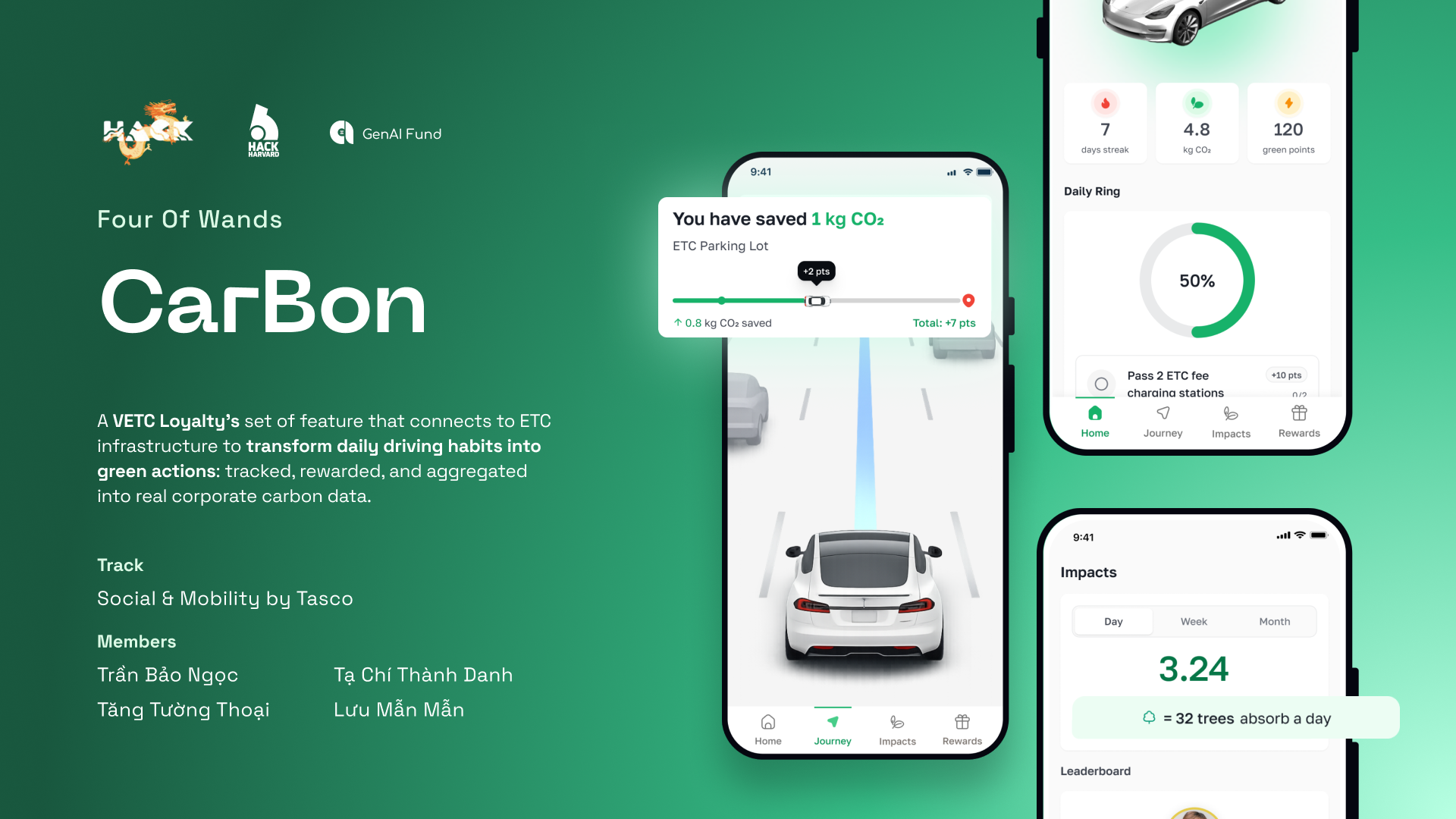
A VETC Loyalty's set of features that connects to ETC infrastructure to transform daily driving habits into green actions.
Inspiration
Vietnam's transport sector emits 46.4 million tonnes of CO₂ annually. The government's 2050 Net Zero target — reinforced by Circular 63/2024/TT-BGTVT — creates urgent pressure to measure, report, and reduce transportation emissions. But existing emission data is fragmented and incomplete. It is missing the crucial, micro-level green behaviors of millions of individual drivers.
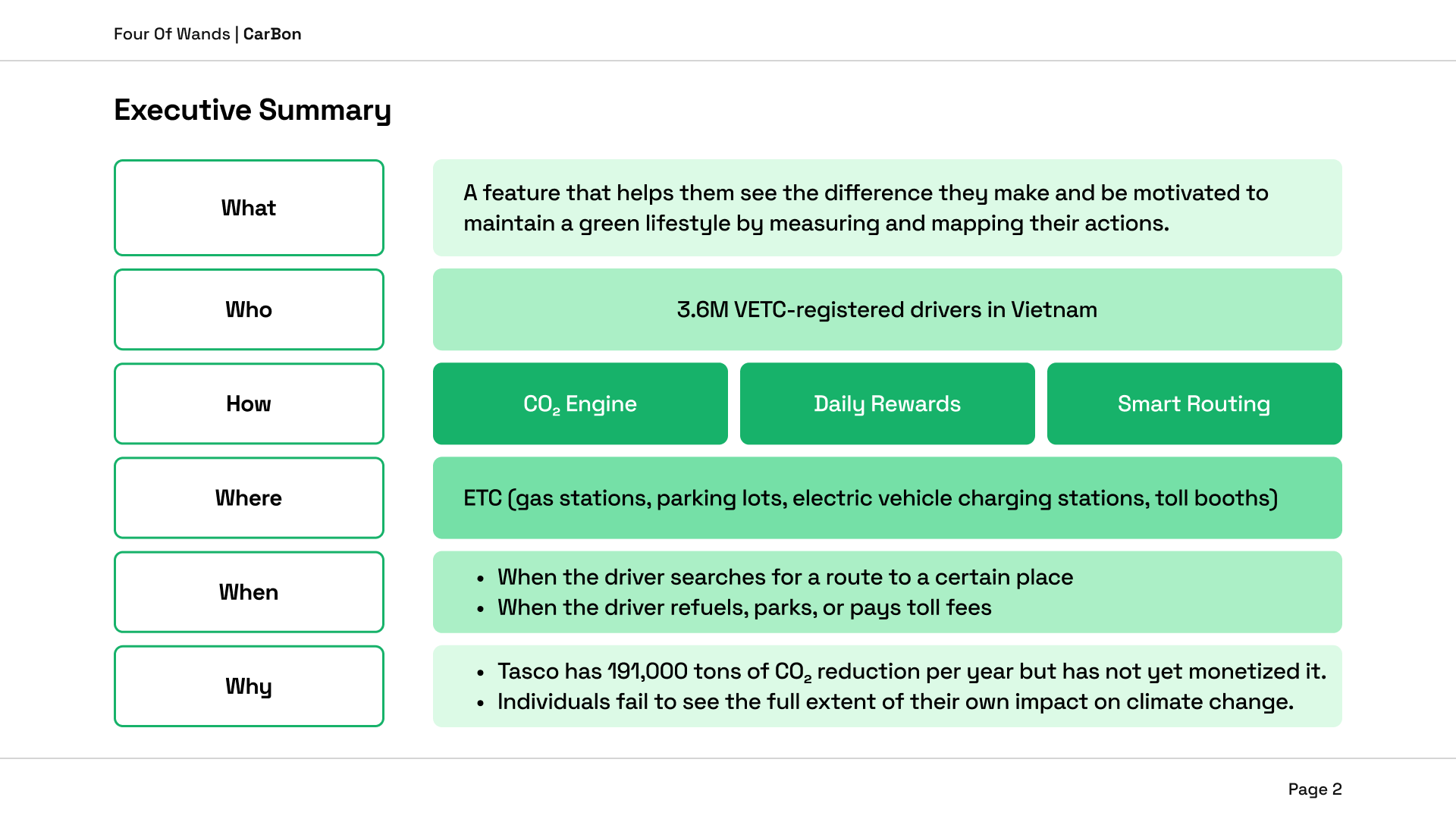
Every day, millions of Vietnamese drivers make small decisions that affect the environment: choosing the ETC lane instead of queuing in cash, departing before rush hour, parking efficiently. These micro-habits collectively amount to 191,000 tonnes of CO₂ reduced per year — verified by research published at the National University of Singapore in 2024.
BUT NOT A SINGLE DRIVER KNOWS IT.
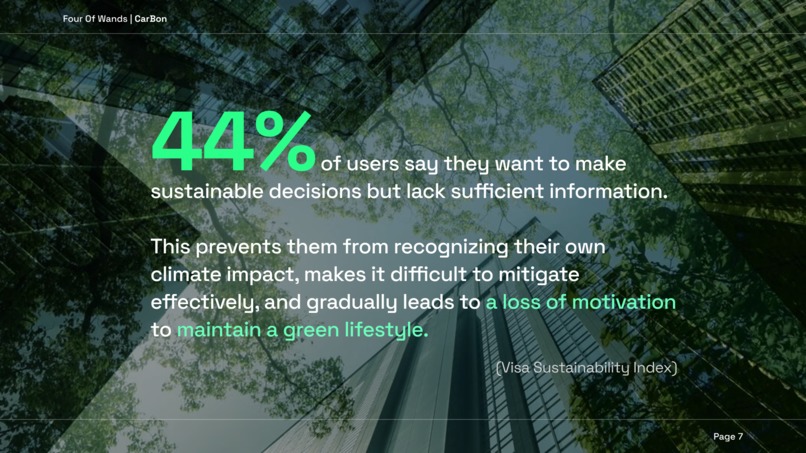
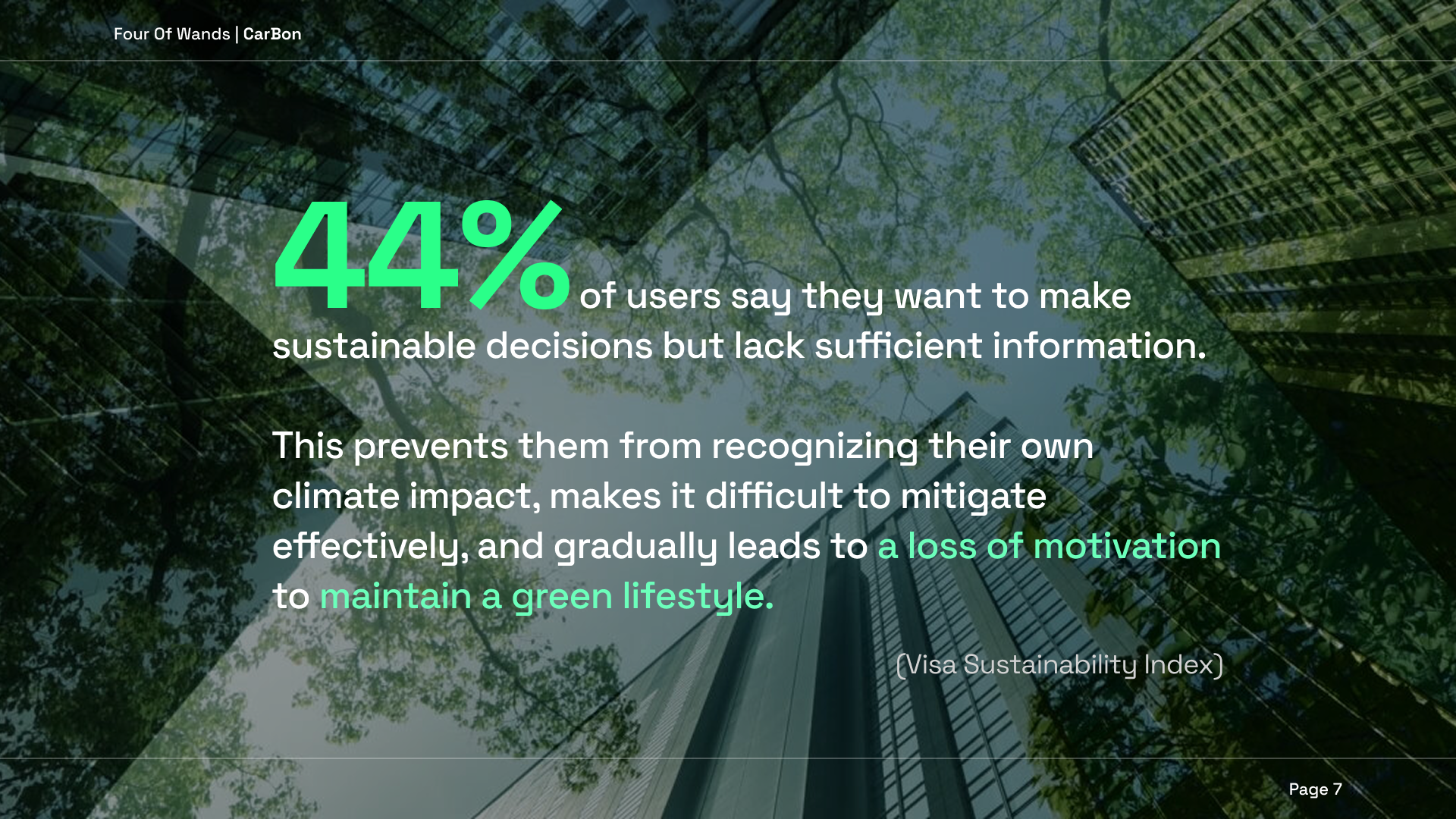
According to the Visa Sustainability Index, 44% of users say they want to make sustainable decisions but lack sufficient information. This prevents them from recognizing their own climate impact, makes it difficult to mitigate effectively, and gradually leads to a loss of motivation to maintain a green lifestyle. We asked: what if every ETC transaction — every toll gate passed without stopping, every off-peak departure — sent an immediate, rewarding signal back to the driver who made it?
What It Does
CarBon is a set of features built on top of Tasco's VETC loyalty infrastructure that transforms daily driving habits into tracked, rewarded, and aggregated green actions.
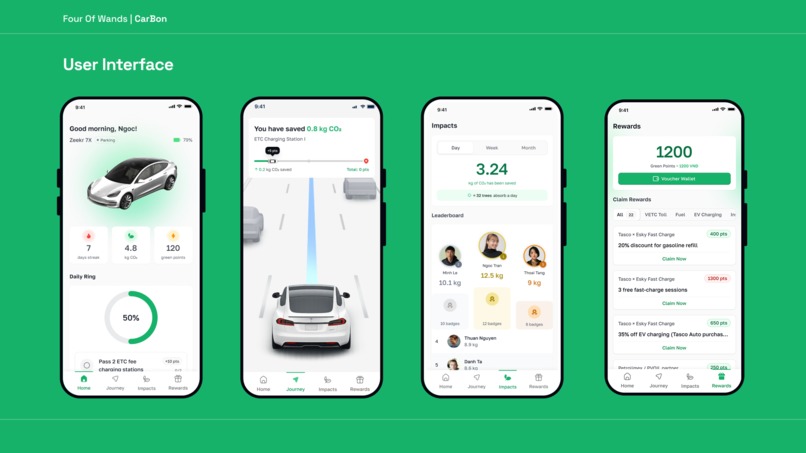
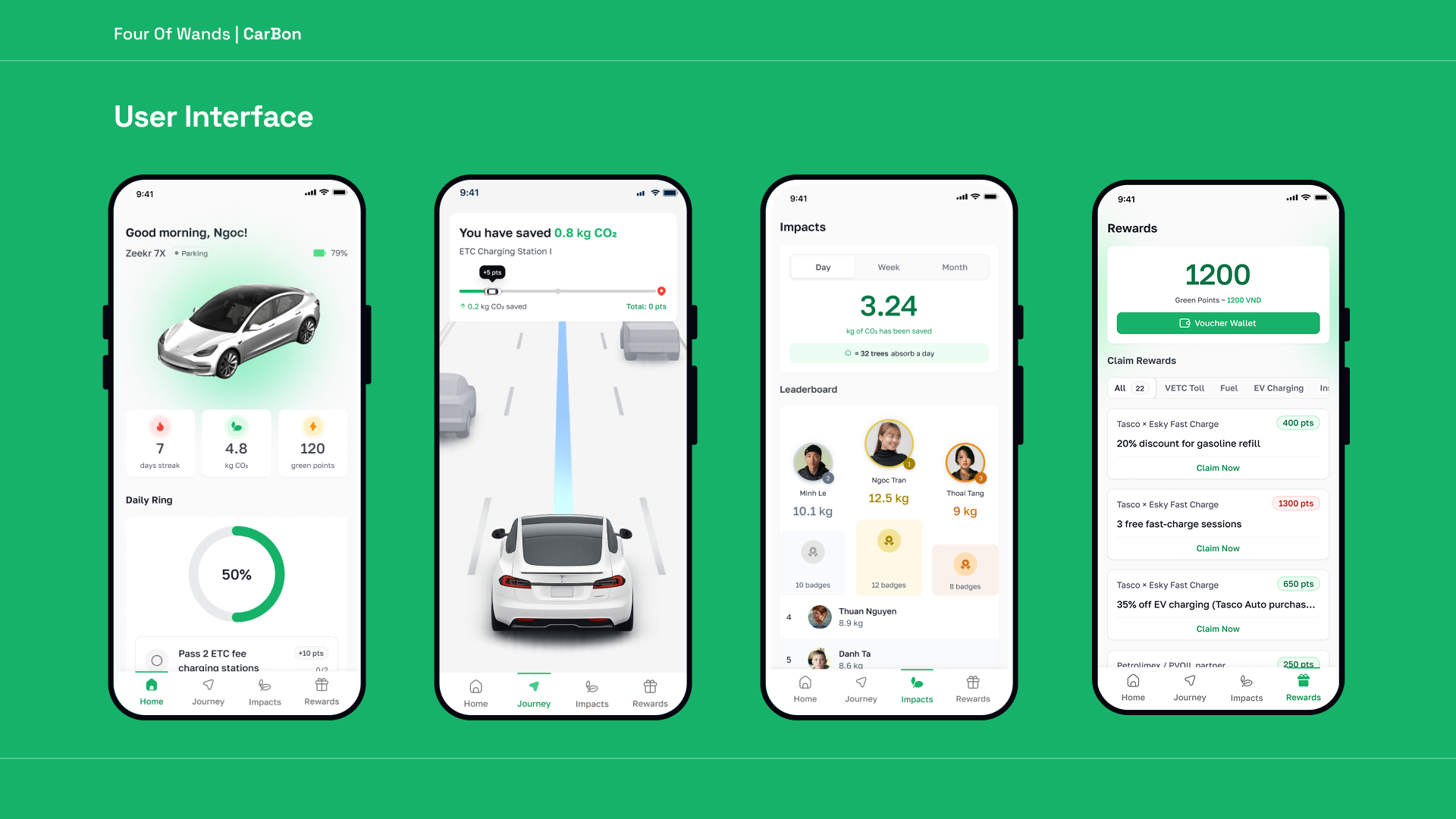
Live Green Ring — Every morning, users receive personalised green tasks based on their commute route. Tasks like "Pass 2 ETC fee charging stations", "Complete the full suggested trip on time", "Use a Tasco fast-charger station", or "Use ETC lane for shopping" auto-complete via VETC transaction detection. Each completed task fills a circular daily ring and earns Green Points. A streak system rewards consistency.
Real-Time CO₂ Engine — During journeys, a live emission display shows CO₂ per km based on vehicle type and driving state. When the user passes an ETC gate, the app detects the transaction and shows exactly how much CO₂ was saved versus stopping in a cash lane — translated into tangible equivalents (e.g. "= 32 trees absorbing for a day").
Smart Routing — Before each trip, users receive route options scored by CO₂ impact, ETC gate presence, travel time, and Green Points potential — helping drivers choose greener paths without sacrificing too much time.
Green Impacts & Rewards — The Impacts screen shows personal CO₂ reduction (daily / weekly / monthly), a community leaderboard, and tangible equivalents. Users see their tiny daily action as part of something city-scale. Green Points are redeemable across the Tasco ecosystem: VETC toll credits, fuel discounts, EV charging, Carpla servicing, Tasco Insurance, and rescue coverage.
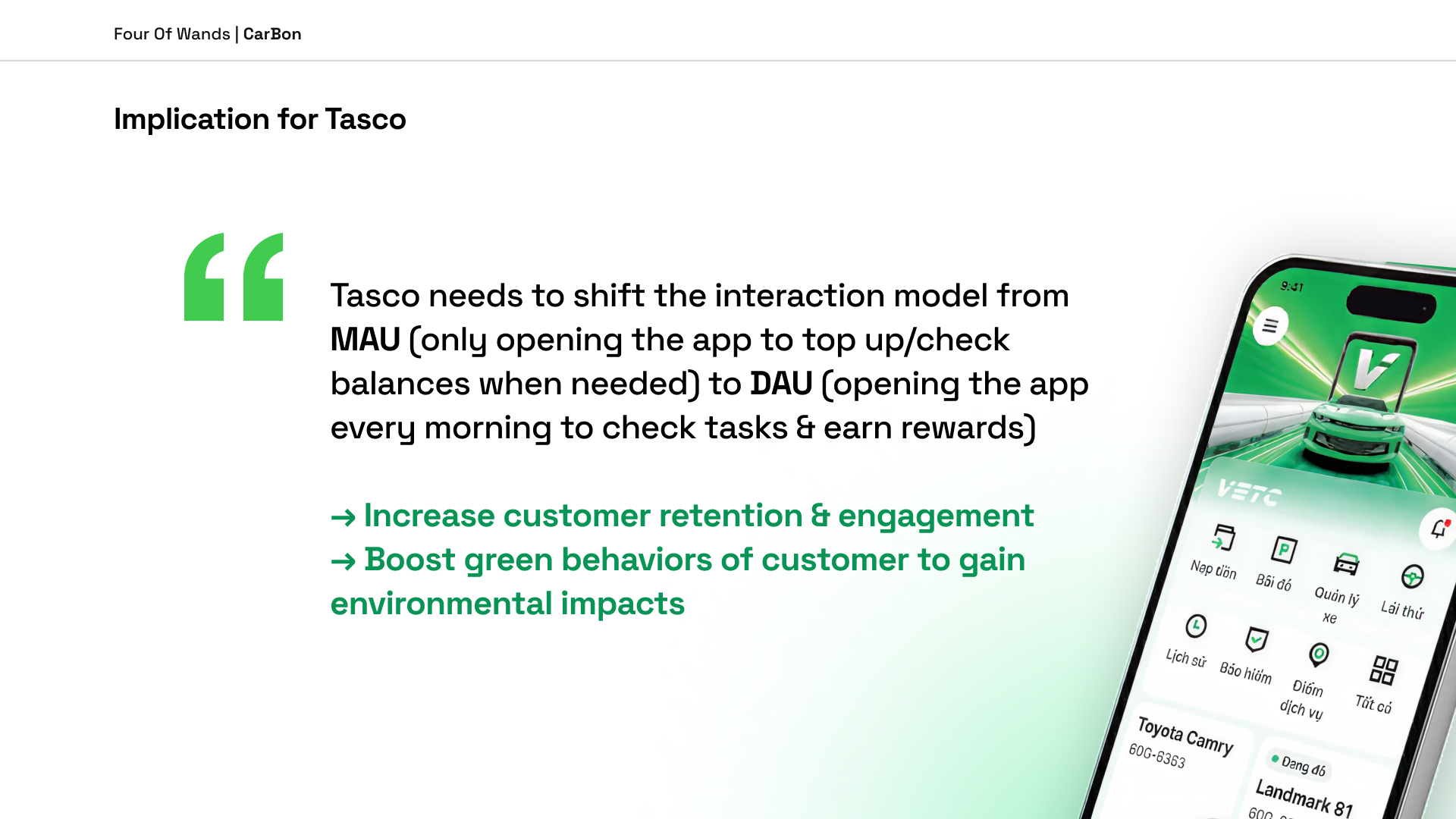
The key business shift: CarBon transforms the VETC app from MAU (users open it only to top up or check balance) to DAU (users open it every morning to check tasks and earn rewards) — increasing customer retention, enabling cross-selling across Tasco services, and generating real environmental impact simultaneously.
How we built it
We built CarBon as a React / Next.js Progressive Web App — one codebase that works on any smartphone and in-car touchscreen without requiring App Store approval.
- CO₂ Engine: Activity-based formula using EPA MOVES emission factors and EVN grid data (0.5 kgCO₂/kWh). Formula:
total CO₂ = Σ(distance × emission_factor[vehicle_state]) + Σ(idle_duration × 0.03) − ETC_passes × 0.06 - VETC API integration: Webhook-based ETC transaction detection. Task completion and push notification triggered within 3 seconds of gate pass. GPS validates user was within 300m of the gate at transaction time.
- Smart Routing: Mapbox / Google Maps Directions API overlaid with VETC toll gate locations. Routes scored by CO₂ impact, ETC gate count, travel time, and Green Points potential.
- Design system: Prototyped in Figma using Tasco's brand green. Full component library covering the Live Green Ring, CO₂ Meter bar, task checklist, Impact charts, and Rewards voucher catalog.
- In-car mode: Responsive landscape layout (1024×600px) with split-panel design — speed + road visualization on the left, map + live CO₂ stats on the right.
Why Tasco is uniquely positioned: While other entities can only estimate emissions based on vehicle sales data, Tasco can accurately determine the travel frequency and vehicle type of millions of customers through VETC's network — 75% of all ETC transactions in Vietnam, 126 stations, 711 lanes, 1.8 million transactions per day. This verified behavioral data is not buildable from scratch by any startup.
Challenges we ran into
We almost discarded this idea entirely. And this is the most important challenge to be honest about.
When we first developed the concept of individual carbon credits tied to driving behavior, we hit a wall we could not build around: Vietnam currently has no legal framework for individual carbon credits in mobility. The national ETS pilot launched in August 2025 covers only large industrial enterprises — power, steel, cement. There is no mechanism for a driver passing an ETC gate to receive a tradeable carbon credit. And Vietnam's carbon exchange, where individual participation might eventually be possible, is not scheduled to open until 2028–2029 under Decision 232/2025.
For several hours, we seriously considered abandoning the project. If the core value proposition — turning individual driving behavior into carbon credits — was legally impossible today, what were we actually building?
The pivot that saved the project: We separated what is valuable from what is legal today. The measurement of carbon behavior is possible. The gamification of green actions is possible. The aggregation of that data into corporate ESG reporting is possible. Only the direct individual carbon credit transaction requires a legal framework that does not exist yet.
So we reframed: users earn Green Points — a loyalty mechanism that is fully legal and familiar. Tasco aggregates the verified reduction data and claims carbon credits at the corporate level through Voluntary Carbon Market frameworks (Gold Standard, Verra), which do not require Vietnamese domestic legislation. The individual's contribution is real, measured, and rewarded. Only the legal form of "credit" is deferred to when the market opens.
This single reframe changed everything. CarBon became more honest, more deployable, and paradoxically more compelling — because we were not overpromising a future that depends on regulation we cannot control.
Second challenge — no carbon trading platform in Vietnam: There is currently no domestic carbon exchange where these credits can be formally traded. The revenue model for Tasco's carbon credit monetization depends on international Voluntary Carbon Markets in the short term and Vietnam's domestic exchange in the long term. We had to be explicit about this timeline rather than treating it as a solved problem.
Technical challenge — vehicle fuel type: VETC currently stores only plate number and vehicle class. No fuel type. This single missing data point blocks the CO₂ calculation engine entirely — you cannot assign an emission factor without knowing if the vehicle is petrol, diesel, electric, or hybrid. Our solution: a one-time fuel type selection during CarBon onboarding, stored alongside the existing vehicle profile.
Accomplishments that we're proud of
Beyond the demo, we are most proud of two things:
Intellectual honesty about legal constraints. We identified a real, concrete legal gap — individual carbon credits are not possible in Vietnam today — and we designed around it transparently instead of ignoring it. The Green Points model is deployable today. The carbon credit layer activates when Vietnam's market opens. That is not a compromise. That is a roadmap.
The MAU → DAU insight. The VETC app is currently opened only when users need to top up — a monthly, transactional interaction. CarBon turns it into a daily ritual: check the ring, complete tasks, earn points, see your impact. This shift from Monthly Active Users to Daily Active Users is the single most valuable thing CarBon delivers to Tasco as a business — independent of carbon.
- Working demo: Live Green Ring with task auto-completion, Real-Time CO₂ Meter, Smart Routing, Impacts leaderboard, and Rewards voucher catalog — all functional
- Full design system in Figma + React components aligned to Tasco brand identity
- Carbon calculation engine validated against EPA MOVES and EVN grid emission factors
- Clear scalability roadmap: loyalty rewards today → corporate carbon credits mid-term → individual market participation when Vietnam's exchange opens 2028–2029
What we learned
Constraints are the best design brief. The legal gap around individual carbon credits forced us to ask a better question: what can we build that is valuable right now, that also becomes the infrastructure for what will be valuable in 3 years? The answer is better than what we would have built without the constraint.
Behavior change is a product problem, not a communication problem. 44% of people want to be more sustainable but lack information. The solution is not more information — it is a feedback loop. Immediate, specific, rewarding. CarBon's entire design is built around this insight: the 3-second ETC notification, the daily ring, the streak. The environmental impact is the outcome; the feedback loop is the mechanism.
Tasco's data moat is its real competitive advantage. Any competitor trying to replicate CarBon without VETC data would have to rely on GPS-estimated behavior — far less accurate and far less verifiable than a confirmed ETC transaction. Tasco's 75% market share is not just scale. It is an irreplicable verification layer.
Vietnamese context requires Vietnamese data. The 3.2-minute idle baseline at toll gates comes from a Vietnam-specific NUS study. The emission factor for xe máy xăng differs from European motorcycle data. The task timing reflects HCMC's specific congestion pattern. Building for a specific context produced a more useful product than starting from global frameworks and adapting down.
What's next for CarBon
CarBon scales in three distinct phases, each unlocking more value than the last.
Phase 1 — Internal loyalty rewards (now) Green Points redeemable across Tasco's ecosystem: toll credits, fuel discounts, EV charging, servicing, insurance, rescue. MAU → DAU for VETC. Customer retention and cross-selling across all Tasco subsidiaries. Deployable today with no regulatory dependency.
Phase 2 — Corporate carbon monetization (2026) Tasco aggregates verified individual reduction data and submits to Gold Standard or Verra for Voluntary Carbon Market certification. 191,000 tCO₂/year becomes tradeable at $15–25/tonne on international markets — $2.8–4.8M USD latent annual value currently unclaimed. Tasco becomes a verified data provider for corporate ESG reporting.
Phase 3 — Individual carbon market (2028–2029) Vietnam's carbon exchange opens under Decision 232/2025. CarBon activates individual credit participation — users move from Green Points to actual tradeable carbon credits. Tasco enters this market with 3+ years of verified behavioral data, a proven methodology, and a trained user base that no competitor can replicate from a standing start.
Tasco scales by transitioning from internal loyalty rewards to becoming a verified data provider for Vietnam's future individual carbon market.


Log in or sign up for Devpost to join the conversation.