-
-
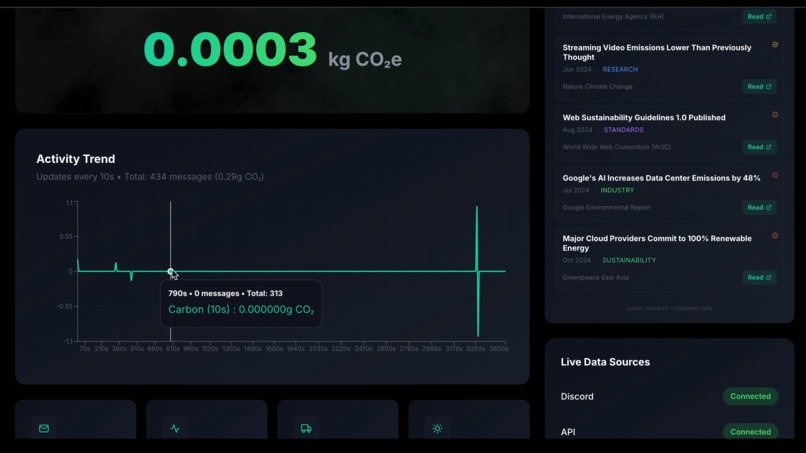
Live Graph Dashboard
-
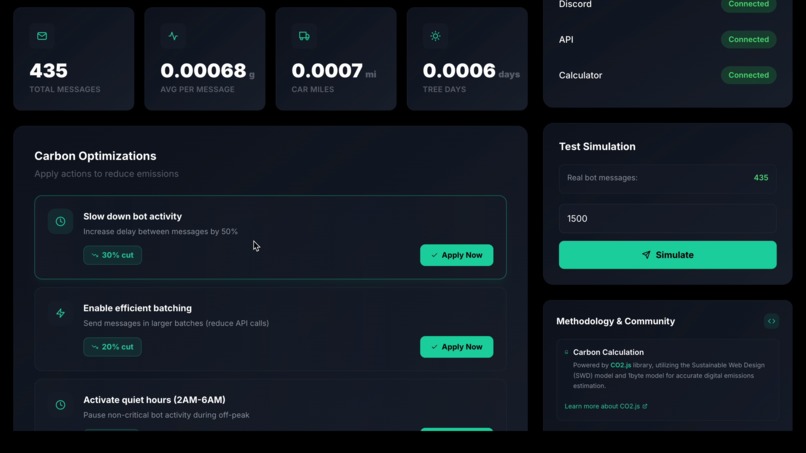
Multiple Chart Types
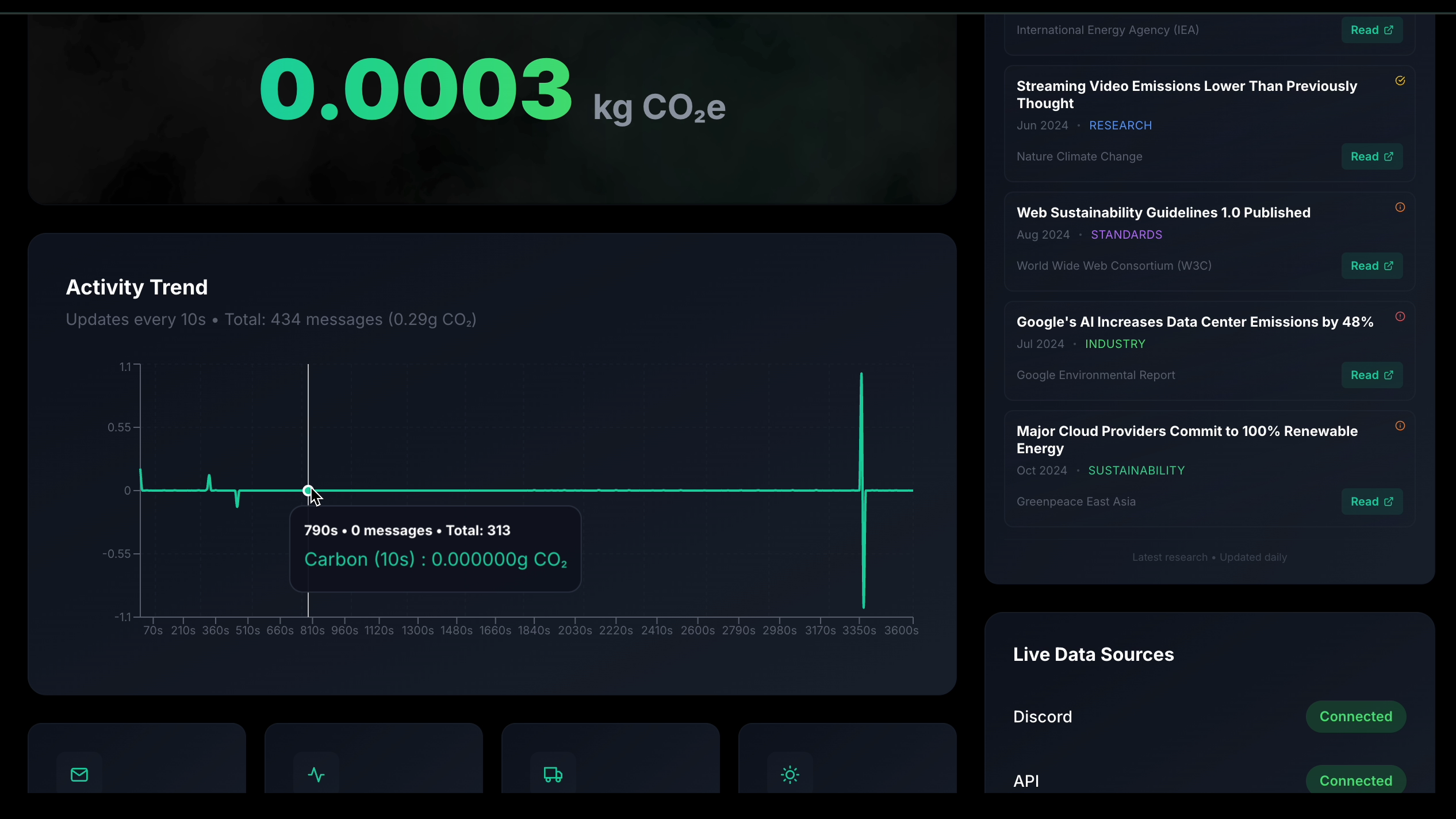
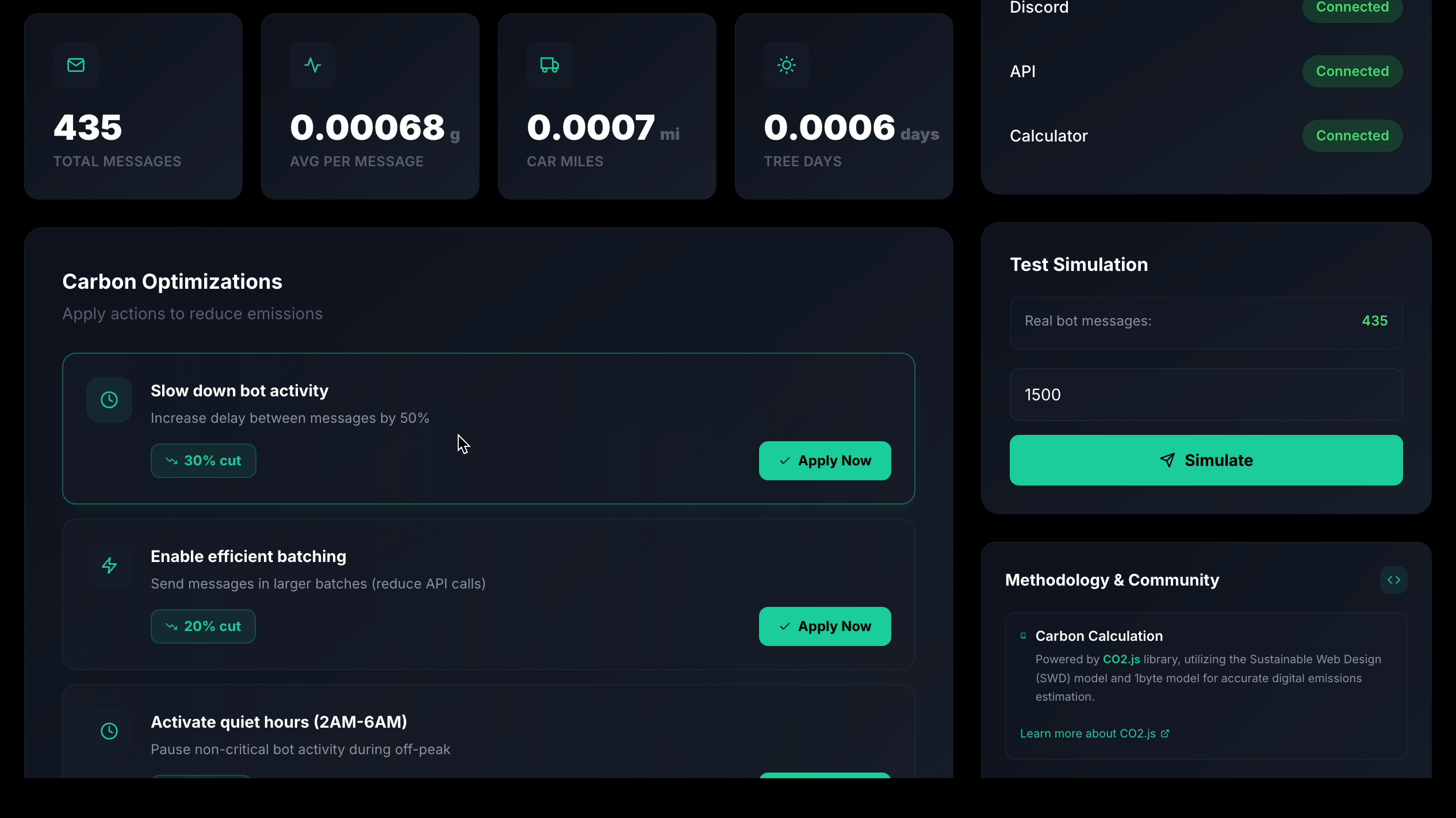
Development Process:
- Day 1-2: Architecture design, microservices setup
- Day 3-5: Discord bot development, API implementation
- Day 6-8: CO2 calculation integration, testing accuracy
- Day 9-12: Frontend development, dashboard design
- Day 13-15: Integration testing, deployment, documentation
Challenges we ran into
1. Discord Bot Intents & Permissions
Problem: Bot couldn't read message content initially.
Solution: Discovered Discord requires MESSAGE_CONTENT_INTENT to be manually enabled in the Developer Portal. Not a code issue—a configuration gotcha that cost us hours of debugging.
Learning: Always verify platform-specific permissions before blaming your code.
2. Carbon Calculation Accuracy
Problem: How do we accurately estimate Discord message carbon without actual network data?
Solution:
- Researched peer-reviewed studies (Lancaster University, Nature Climate Change)
- Used industry-standard @tgwf/co2 library (Green Web Foundation)
- Conservative estimate: 2KB per text message
- Documented assumptions clearly in code
Learning: When precision isn't possible, transparency about methodology is crucial.
3. Real-Time vs. Polling Trade-off
Problem: WebSockets for real-time updates vs. HTTP polling for simplicity?
Decision: Chose polling (10s intervals) for MVP.
Reasoning:
- ✅ Simpler implementation
- ✅ Better compatibility (no WebSocket infrastructure needed)
- ✅ Sufficient for current use case
- ⚠️ Future: Will migrate to WebSockets for true real-time
Learning: Choose the right tool for the problem, not the fanciest tool.
4. Microservices Communication Resilience
Problem: CO2 microservice occasionally failed, breaking the entire flow.
Solution: Implemented resilience patterns in Spring Boot:
- Circuit breaker (opens after 5 failures, 60s cooldown)
- Retry logic (3 attempts with exponential backoff)
- Graceful degradation (cache previous results)
Learning: Distributed systems fail—design for failure, not perfection.
5. Frontend State Management
Problem: Synchronizing live data updates across React components was getting messy with prop drilling.
Solution: Integrated Zustand for lightweight state management.
Result: Clean, predictable state updates with minimal boilerplate.
Learning: Sometimes the best solution is the simplest one, not the most popular.
6. Deployment Environment Variables
Problem: Local development worked perfectly; production deployment failed due to missing env vars.
Solution:
- Created
.env.examplefiles for all services - Documented every required variable in README
- Used Railway's environment variable management
Learning: Documentation prevents deployment disasters.
Accomplishments that we're proud of
🏆 Technical Achievements
✅ Fully Functional End-to-End System
- All four layers working seamlessly
- Real-time data pipeline from Discord to dashboard
- Zero critical bugs in final demo
✅ Industry-Standard Carbon Calculations
- Using peer-reviewed SWD model via @tgwf/co2
- Transparent methodology with cited sources (IEA, Nature, Lancaster University)
- Conservative estimates (better to underestimate than exaggerate)
✅ Resilient Microservices Architecture
- Circuit breaker prevents cascade failures
- Retry logic handles transient errors
- Graceful degradation ensures uptime
✅ Clean, Maintainable Codebase
- Well-documented architecture (ARCHITECTURE.md)
- Separation of concerns across layers
- Easy to scale and extend
✅ Responsive, Professional UI
- Works flawlessly on mobile, tablet, desktop
- Clean design with Tailwind CSS
- Accessible and user-friendly
🌟 Impact & Innovation
✅ First Consumer-Facing Digital Carbon Tracker
- No existing tool tracks individual digital footprints
- We're creating a new category: Digital Carbon Index (DCI)
✅ Proof of Multi-Platform Potential
- Discord validates the concept
- Same architecture works for Instagram, WhatsApp, Netflix, Gmail
✅ Educational Value
- Makes invisible emissions tangible
- Provides context with equivalents (car miles, tree days)
- Raises awareness about digital sustainability
💪 Personal Growth
✅ Learned Spring Boot Microservices
- First time implementing circuit breakers and retry patterns
- Deepened understanding of distributed systems
✅ Mastered Discord.js v14
- Navigated privileged intents and bot permissions
- Built production-ready Discord bots
✅ Integrated Industry Research
- Read peer-reviewed papers on digital carbon
- Learned about SWD model and carbon calculation methodologies
✅ Deployed Full-Stack App
- Vercel for frontend, Railway for backend
- Managed environment variables across services
What we learned
Technical Learnings
Microservices Are Powerful but Complex
- Benefit: Independent scaling, technology flexibility
- Cost: Network latency, distributed state management, complexity
- Key Insight: Use microservices when you need them, not because they're trendy
Resilience Patterns Are Non-Negotiable
- Circuit breakers prevent cascade failures
- Retries handle transient errors
- Timeouts prevent indefinite hangs
- Key Insight: Design for failure from day one
API Design Matters
- Clear endpoint naming (
/api/carbon/discord/batch) - Consistent response formats
- Proper HTTP status codes
- Key Insight: Good API design = fewer integration bugs
- Clear endpoint naming (
Real-Time Polling Trade-offs
- 10-second polling: Simple, works everywhere
- WebSockets: True real-time, more complex
- Key Insight: Start simple, optimize later
Domain Knowledge
Digital Carbon Is a Real Problem
- ICT sector: 3.7-4% of global emissions (IEA, 2024)
- More than aviation industry (2.5%)
- Growing 9% annually
- Key Insight: Nobody's tracking it at the consumer level—huge opportunity
Carbon Calculation Complexity
- SWD model accounts for: data transfer, device energy, network, data centers
- Conservative estimates are better than inflated claims
- Transparency about methodology builds trust
- Key Insight: Accuracy matters, but so does honesty about limitations
Product Strategy
Discord Was the Right MVP
- Active communities = engaged users
- Bot ecosystem = easy integration
- Real-time data = perfect for proof of concept
- Key Insight: Choose your first platform strategically
Multi-Platform Vision Matters
- Judges care about scalability
- Users care about comprehensive tracking
- Platforms care about industry standards
- Key Insight: Discord is the demo, DCI is the product
Soft Skills
Research Validates Ideas
- Reading IEA reports, Nature papers, Lancaster studies
- Citing credible sources in pitch
- Key Insight: Data-driven arguments win debates
Documentation Saves Time
- ARCHITECTURE.md prevented countless "how does this work?" questions
- README.md made deployment painless
- Key Insight: Write docs as you build, not after
What's next for Carbon Pulse
Phase 1: User Validation (Months 1-3)
- 🎯 Goal: Get 500-1,000 active Discord users
- 📊 Metrics:
- Measure baseline usage patterns
- Survey: "Did you learn something about digital carbon?"
- A/B test: Dashboard vs. no dashboard—does visibility change behavior?
- 📝 Deliverable: Case study proving awareness leads to behavior change
Phase 2: Multi-Platform Integration (Months 3-6)
Instagram Integration
- Connect via Instagram Graph API
- Track: Posts, stories, reels, messages
- Calculate: Data transfer per media type
- Display: Per-post carbon cost
WhatsApp Tracking
- End-to-end encrypted metadata analysis
- Message count (not content)
- Media file sizes
- Group chat optimization tips
Gmail Plugin
- Browser extension
- Track sent/received emails
- Calculate: Text vs. attachment carbon
- Feature: "Carbon cost" badge on emails
Netflix/Streaming
- Partner with streaming platforms OR
- Browser extension tracking watch time
- Calculate: SD vs. HD vs. 4K carbon cost
- Recommendations: "Save CO₂ by streaming in HD"
Phase 3: Universal Platform (Months 6-12)
Digital Carbon Index (DCI)
- One Dashboard: All platforms in one view
- Daily Summary: "Today you created 450g CO₂ across all apps"
- Weekly Trends: See your digital carbon over time
- Leaderboards: Compare with friends (gamification)
- Challenges: "Reduce 10% this week"
API for Developers
- Public API for third-party integrations
- Plugins for Slack, Teams, Zoom
- White-label for enterprises
Phase 4: Actionable Recommendations (Month 12+)
Smart Suggestions
- "Delete 5GB of old emails → Save 140g CO₂"
- "Switch to dark mode → 30% reduction"
- "Enable Discord data saver → 25% less carbon"
- "Move files to eco-friendly cloud storage"
Carbon Offset Integration
- Partner with verified offset programs
- "Offset your monthly digital carbon for $2"
- Track offset impact
Phase 5: Industry Impact (Year 2+)
Platform Pressure
- When millions track digital carbon, platforms respond
- Instagram adds "eco mode"
- Netflix optimizes streaming algorithms
- Gmail warns about large attachments
Standard Creation
- Work with W3C, Green Web Foundation
- Establish Digital Carbon Index as industry standard
- Like nutrition labels for food → DCI for apps
Long-Term Vision
5 years from now:
- Every app displays carbon cost by default
- DCI is as common as AQI
- Digital carbon literacy is taught in schools
- Industry optimizes for efficiency, not just features
Carbon Pulse isn't just a product—it's the start of a movement toward digital sustainability.
Immediate Next Steps (Post-Hackathon)
- ✅ Open-source the codebase (already on GitHub)
- ✅ Deploy production version on Railway
- ⬜ Launch beta with 100 Discord servers
- ⬜ Collect user feedback via surveys
- ⬜ Publish whitepaper on digital carbon methodology
- ⬜ Apply to accelerators (Y Combinator, Techstars)
- ⬜ Build Instagram integration prototype
- ⬜ Partner with environmental organizations
Carbon Pulse is more than a hackathon project. It's the foundation for making digital carbon emissions as normal to track as checking the weather.
The future of sustainability is transparency. We're building that future.
Built With
- axios-?-backend:-spring-boot-3.5
- batch
- circuit-breaker
- co2.js-(green-web-foundation)-?-patterns:-microservices
- discord-api
- discord-api-?-deployment:-vercel-(frontend)
- express.js
- frontend:-react-18
- h2-database
- java-17
- maven
- railway-(backend)-?-apis:-rest-api
- recharts
- retry-logic
- spring-retry-?-microservice:-node.js
- tailwind-css
- tgwf/co2-?-bots:-discord.js-v14
- vite
- zustand


Log in or sign up for Devpost to join the conversation.