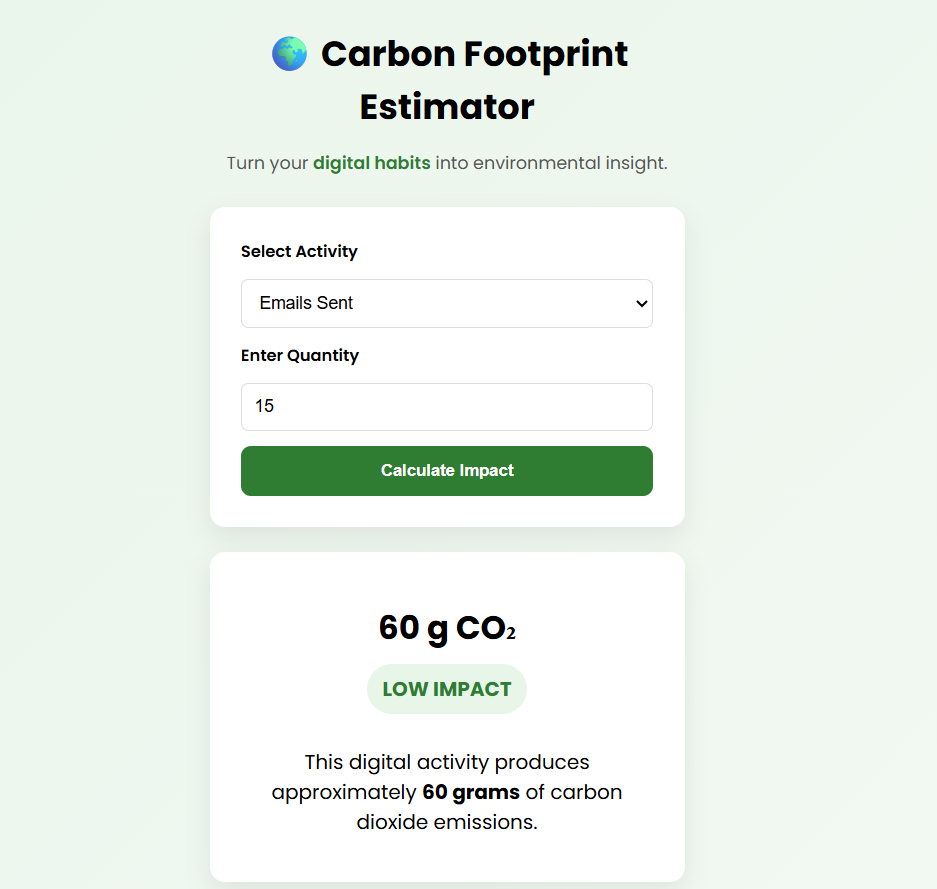
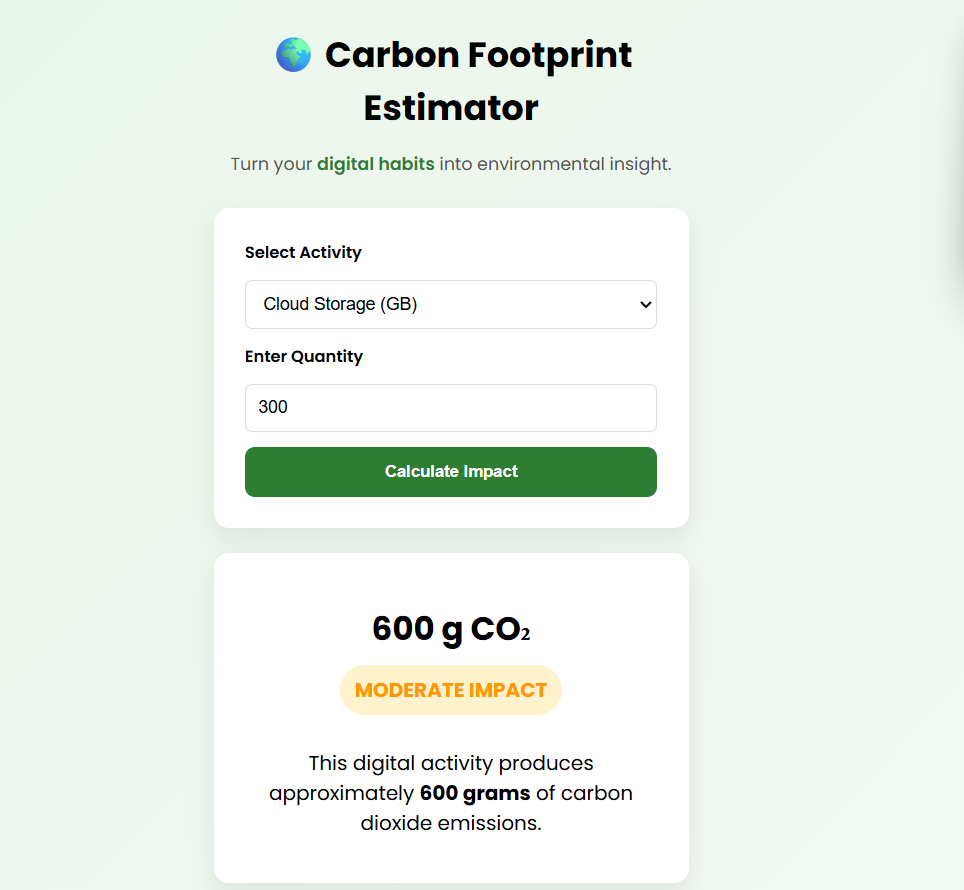
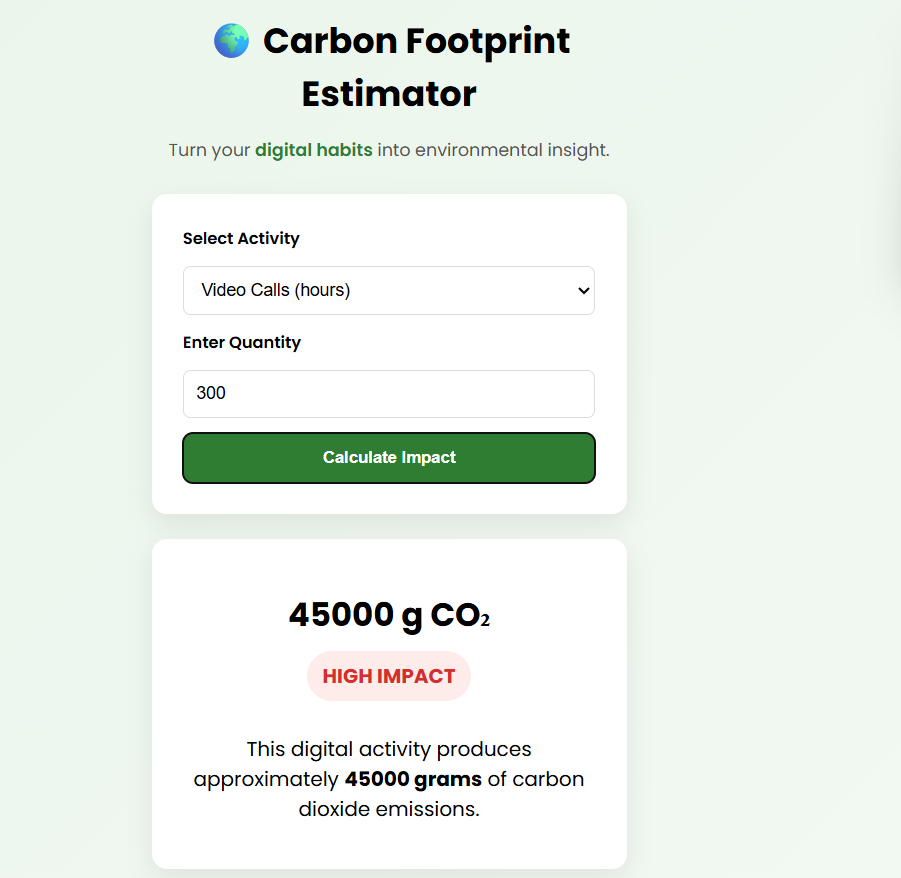
Inspiration We were inspired by the idea that everyday digital actions sending emails, streaming videos, storing files in the cloud all have hidden environmental costs. Most people don’t realize their online habits contribute to carbon emissions. We wanted to build a simple tool that makes this impact visible and easy to understand.
What it does Carbon Footprint Estimator Lite is a lightweight web app that calculates the carbon footprint of common digital activities. Users select an activity (like emails, streaming, or video calls), enter a quantity, and instantly see the estimated CO₂ emissions along with a risk level (Low, Medium, High).
How we built it
- Designed the UI with reusable React components (Header, InputForm, ResultCard).
- Stored emission factors in a JSON file (emissions.json).
- Implemented a calculator utility (calculator.js) to parse input and compute emissions.
- Connected everything through App.jsx and deployed using Vite for fast previews.
- Debugged and tested in VS Code, then prepared for GitHub submission. Challenges we ran into
- Parsing JSX correctly in Vite (fixing .js → .jsx extensions).
- Handling npm and package.json errors under tight deadlines.
- Balancing simplicity with accuracy — we had to keep the MVP lightweight but still meaningful.
- Managing time pressure during the hackathon while ensuring a clean, professional repo structure.
Accomplishments that we're proud of
- Built a fully functional MVP in a short timeframe.
- Created a clean, modular folder structure that judges can easily navigate.
- Delivered a working demo that clearly communicates environmental impact.
- Learned to troubleshoot npm/Vite issues quickly and effectively.
What we learned
- How to rapidly prototype with React + Vite.
- The importance of clear UI/UX in sustainability tools.
- How to simplify complex data into rule‑based calculations.
- Practical debugging skills under hackathon pressure.
What's next for Carbon Footprint Estimator Lite
- Add more activities and detailed emission factors.
- Support multilingual interfaces for broader accessibility.
- Integrate with real‑time APIs for more accurate data.
- Provide personalized recommendations to help users reduce their digital carbon footprint.
- Deploy on a public hosting platform so anyone can try it out.
Built With
- antigravity
- github
- javascript
- json
- react
- vite
- vscode

Log in or sign up for Devpost to join the conversation.