
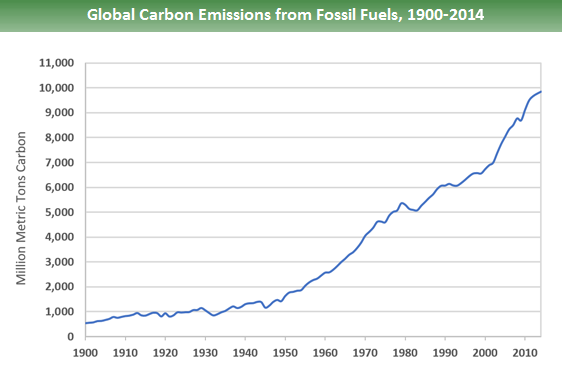
Carbon emission is the release of carbon into the atmosphere. To talk about carbon emissions is simply to talk of greenhouse gas emissions; the main contributors to climate change. Since greenhouse gas emissions are often calculated as carbon dioxide equivalents, they are often referred to as “carbon emissions” when discussing global warming or the greenhouse effect. Since the industrial revolution the burning of fossil fuels has increased, which directly correlates to the increase of carbon dioxide levels in our atmosphere and thus the rapid increase of global warming.
When we talk about carbon emissions, we’re focusing specifically on carbon dioxide, or CO2. Naturally, CO2 releases into the atmosphere in a ton of ways. The largest source of natural carbon emissions is from the exchange of carbon dioxide between the oceans and the atmosphere. Animals and plants also emit CO2 through the process of respiration (breathe in oxygen, breathe out CO2). And, when these plants and animals decompose, organisms within the soil respire to produce energy and emit more CO2 into the atmosphere.
Nature, as nature tends to do, keeps most of these emissions in balance. Plants absorb CO2 through photosynthesis, and oceans absorb just about as much carbon dioxide as they let off. Carbon cycles through our air, water, and soil in a continuous process that supports life on earth.
Don’t worry, we’re not going to go all “Bill Nye” on you. Long story short, CO2 is one of the greenhouse gases that absorbs radiation and prevents heat from escaping our atmosphere. This excess heat creates disrupted weather patterns, higher global temperature averages, and other ahem changes… in the climate.
Now, don’t be mistaken. There are other greenhouse gases (nitrogen, methane, and even water vapor) that we could spend time focusing on too, but let’s just stick to carbon right now.
t’s no secret that lowering levels of atmospheric carbon is a hot topic (pun intended). As with most things in life, there are two main ways to fix a problem. The first, and safest option, is to avoid the situations that cause it in the first place. The second is to revert what’s already been done. When you apply this thinking to carbon emissions, it means you can either lower your carbon footprint, or offset it.
How you can track your carbon footprint and help keep emissions low
Experts are estimating that global emissions this year will fall by 5.5 per cent of the global total in 2019—the largest ever fall in the last century—due to a drastic reduction in human activities as a result of the ongoing Covid-19 pandemic.
While the planetary breather is the largest ever fall in emission levels in the last century, it is still nowhere near getting us to the 2-degree Celsius target nations committed under the Paris Agreement on climate change.
But we don’t have to wait for a pandemic to take responsibility for our own carbon footprint.
In Singapore, a new carbon footprint calculator has been launched by SP Group, one of the largest energy utilities companies in Asia Pacific. The tool helps consumers build awareness of their carbon footprint and suggest ways that they can reduce it.
Called My Carbon Footprint, which can be accessed online or via the SP Utilities App, this calculator takes into account individuals’ utilities consumption (electricity, water and gas usage) and their lifestyle choices for a comprehensive overview of their carbon emissions.
- Cultivating easy energy-saving habits starts at home Over the past decade, Singapore’s household electricity consumption has increased by about 17 per cent, according to the National Environment Agency.
Households in Singapore consumed a total of 7,295 GWh (gigawatts hours) of electricity in 2018, which equates to each home spending around $1000 per year on their electricity bills.
Your monthly energy bill can be reduced with daily actions that go a long way and require little effort.
Opt for your fan and natural ventilation since air-conditioners are huge energy guzzlers. Replace old appliances with energy-efficient ones that don’t suck up unnecessary energy. The extra upfront costs will prove to be a good investment with a lower energy bill. Unplug your devices when not in use to avoid “vampire power”. Even if they’re turned off, electronic devices suck energy once they’re plugged into a socket. Take shorter showers and consider switching to a water-saving showerhead. This reduces both your energy and water consumption.
- Cutting down on travel and commute Pre- and post-Covid-19 days, reconsidering how much and how often you travel is one of the most effective ways to reducing your carbon footprint.
For many Singaporeans, flights may make up the biggest chunk of their carbon footprint. Flying emits 285g of carbon dioxide per kilometre, exceeding 158g by road and 14g by rail for each passenger.
Cut down on unnecessary flights. If you can’t avoid flying, choose to fly with companies that provide the option of offsetting your carbon footprint. Embrace a car-lite society and explore Singapore’s world class transportation system. Chalk up your Fitbit steps or try biking around!
- Rethinking food and other consumption The current pandemic presents an opportune time to rethink our consumption habits—both food and material goods. Food production accounts for about a quarter of total carbon emissions globally.
The World Resources Institute highlighted in a report that without limiting the global rise of meat consumption, the amount of carbon dioxide emitted would make keeping the increase in global warming to 1.5 degrees Celsius impossible.
On top of what you eat, what you buy could also be contributing to a high carbon footprint. Buying less or adopting a minimalist lifestyle is just the first step.
Reduce your meat consumption, especially red meat like beef, goat and lamb. Stay away from “fast fashion” and invest in quality products that last. While the items may be stylish and cheap, there are hidden environmental and social costs that aren’t taken into account. Vote with your dollar by purchasing from companies with low carbon footprints. Consider buying and selling preloved items. This helps reduce your overall waste, which contributes to your carbon footprint too
We learned about how to track carbon emission.

Log in or sign up for Devpost to join the conversation.