
The Problem
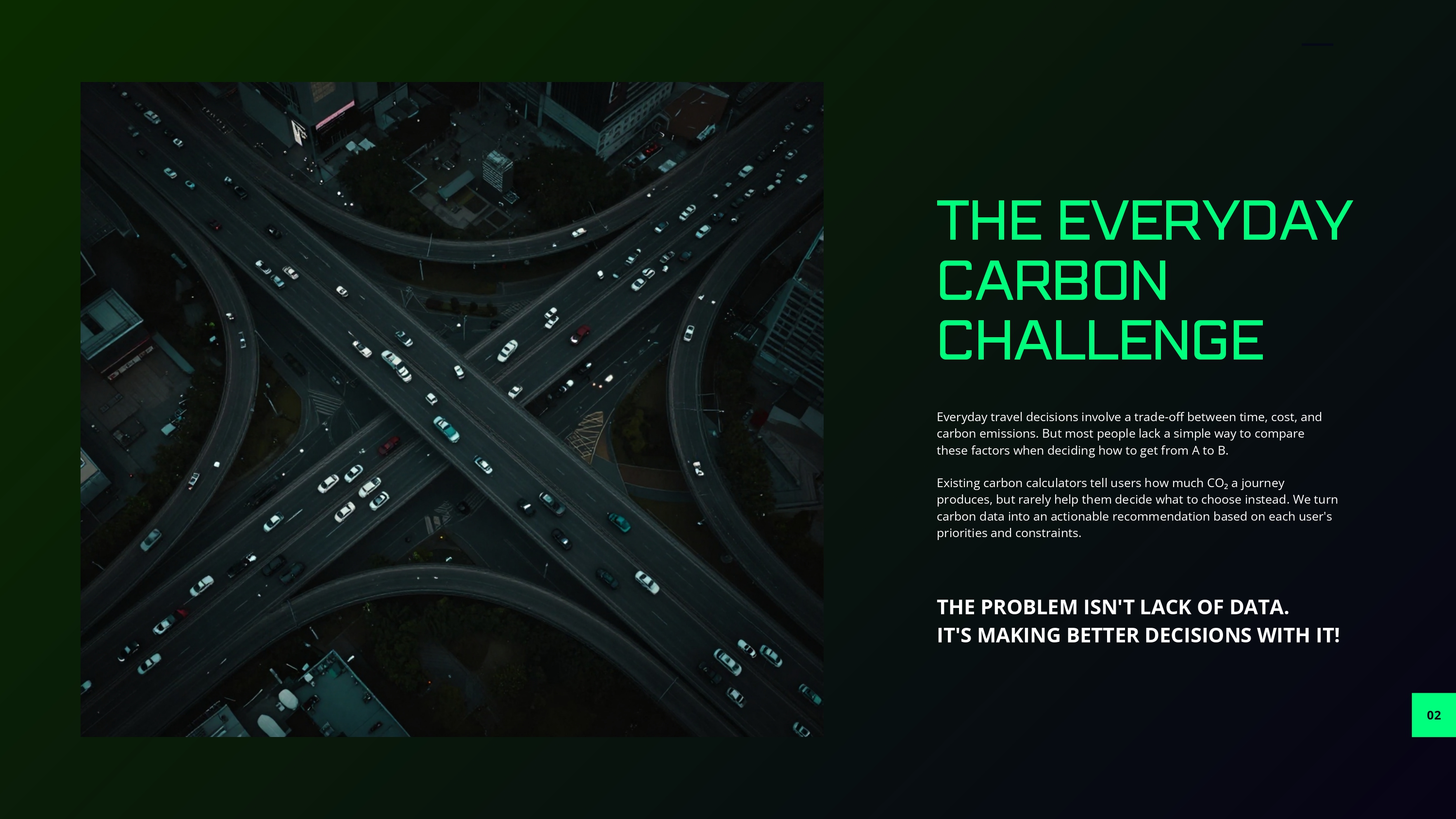
Everyday travel involves a trade-off between time, cost, and carbon emissions. While carbon calculators can estimate the emissions of a journey, they often stop there. They tell users what their footprint is, but not what they should choose instead.
We wanted to turn carbon information into an actual decision.
Our Solution
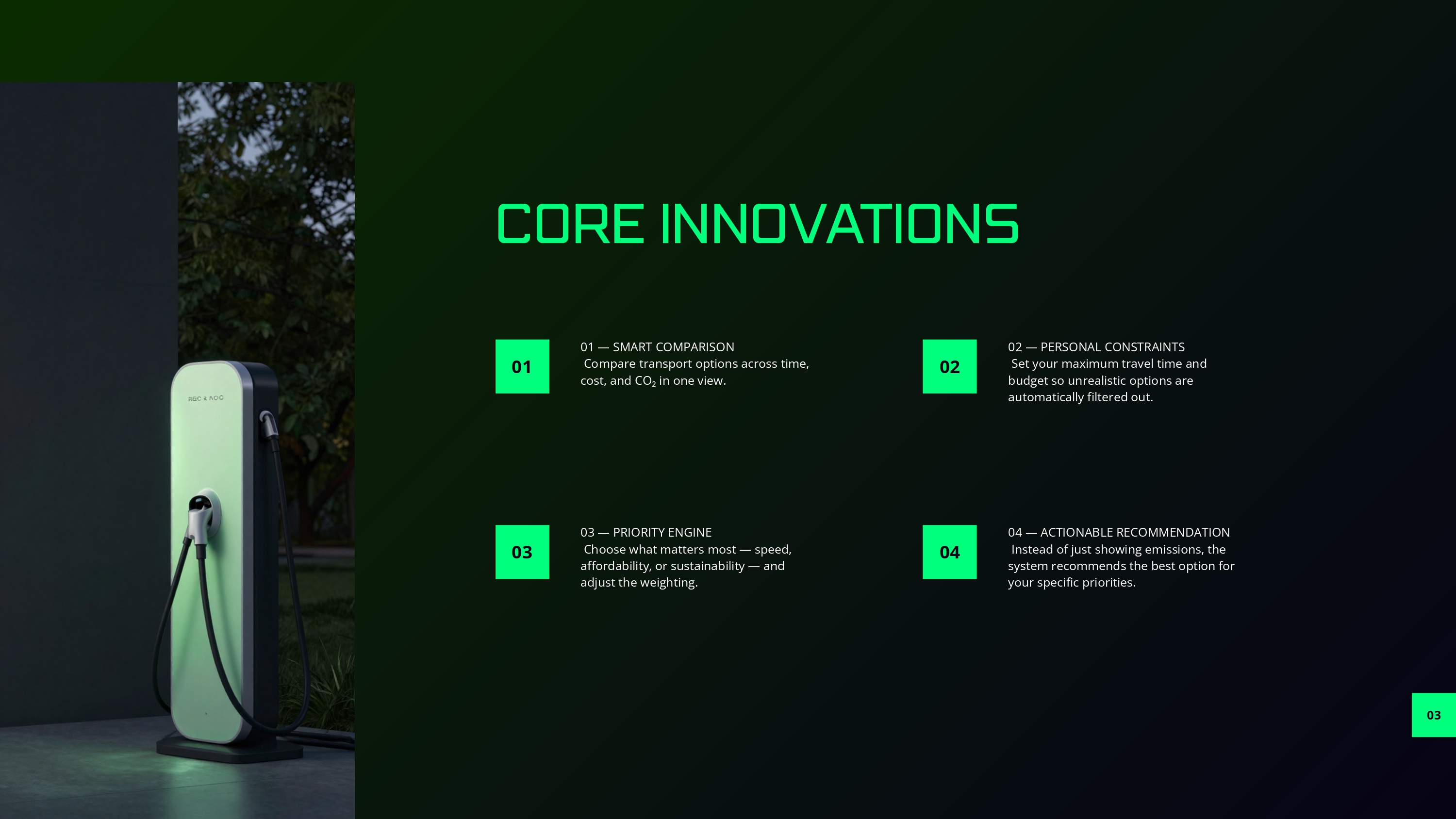
Carbon Decision Engine is a decision-support tool that compares different transport options and recommends the best choice based on the user's priorities and constraints.
Users enter:
- Their route and trip distance
- Maximum acceptable travel time
- Maximum acceptable cost
- How much they value speed, affordability, and sustainability
The engine then evaluates transport options across time, cost, and estimated CO₂ emissions, filters out options that violate the user's constraints, and produces a personalized recommendation.
Instead of simply saying:
"This journey produces 0.45 kg of CO₂."
Carbon Decision Engine answers:
"Which option should I take given what matters to me?"
How It Works
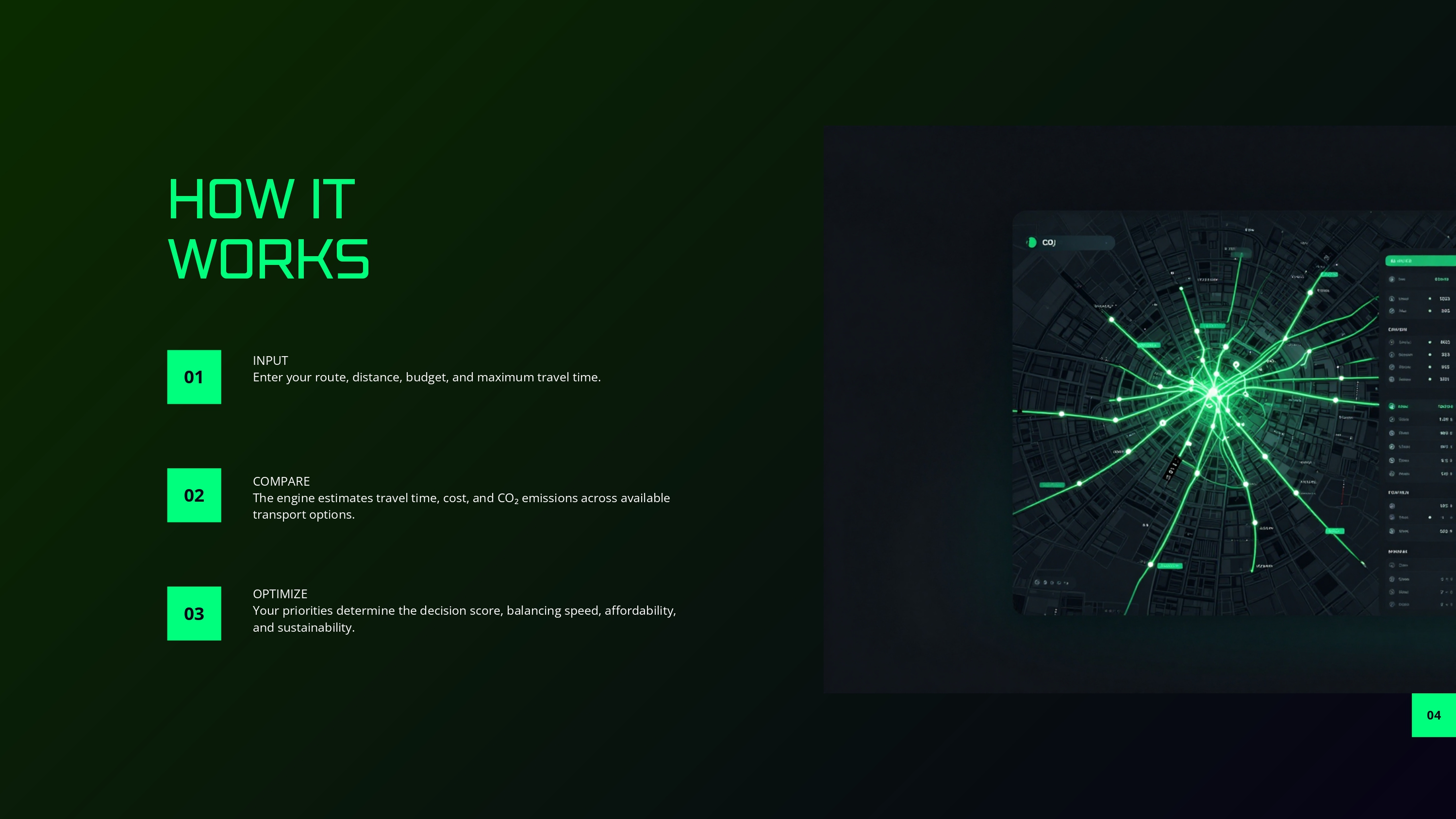
- Input — The user defines their journey, budget, time limit, and priorities.
- Compare — The system estimates travel time, cost, and CO₂ emissions for different transport modes.
- Optimize — Each factor is normalized and combined according to the user's selected priority weights.
- Recommend — The lowest-scoring feasible option becomes the recommendation.
The decision score is based on a weighted combination of normalized time, cost, and carbon impact:
$$ Score = w_tT + w_cC + w_eE $$
where (w_t), (w_c), and (w_e) represent the user's priorities.
What We Built
We built the prototype in Python and Streamlit, with Pandas handling the transport data and calculations. Transport assumptions are stored separately in a CSV file so they can be easily replaced with real-world datasets in future versions.
The current prototype demonstrates the complete decision-making pipeline through an interactive web interface.
Challenges
One challenge was designing a recommendation system that does not simply optimize for the lowest emissions. The "greenest" option may not always be practical for a user who has a strict time or budget constraint.
We therefore separated hard constraints from personal preferences: an option must first satisfy the user's limits, then the remaining options are ranked according to their priorities.
Another challenge was keeping the system transparent. Rather than hiding the recommendation behind a black-box model, the prototype shows users the underlying time, cost, and CO₂ trade-offs.
What We Learned
This project taught us that sustainability tools do not necessarily need to generate more information. They need to make existing information actionable.
We also learned how to turn a multi-objective optimization problem into a simple user-facing experience, while keeping the underlying calculations transparent and understandable.
What's Next
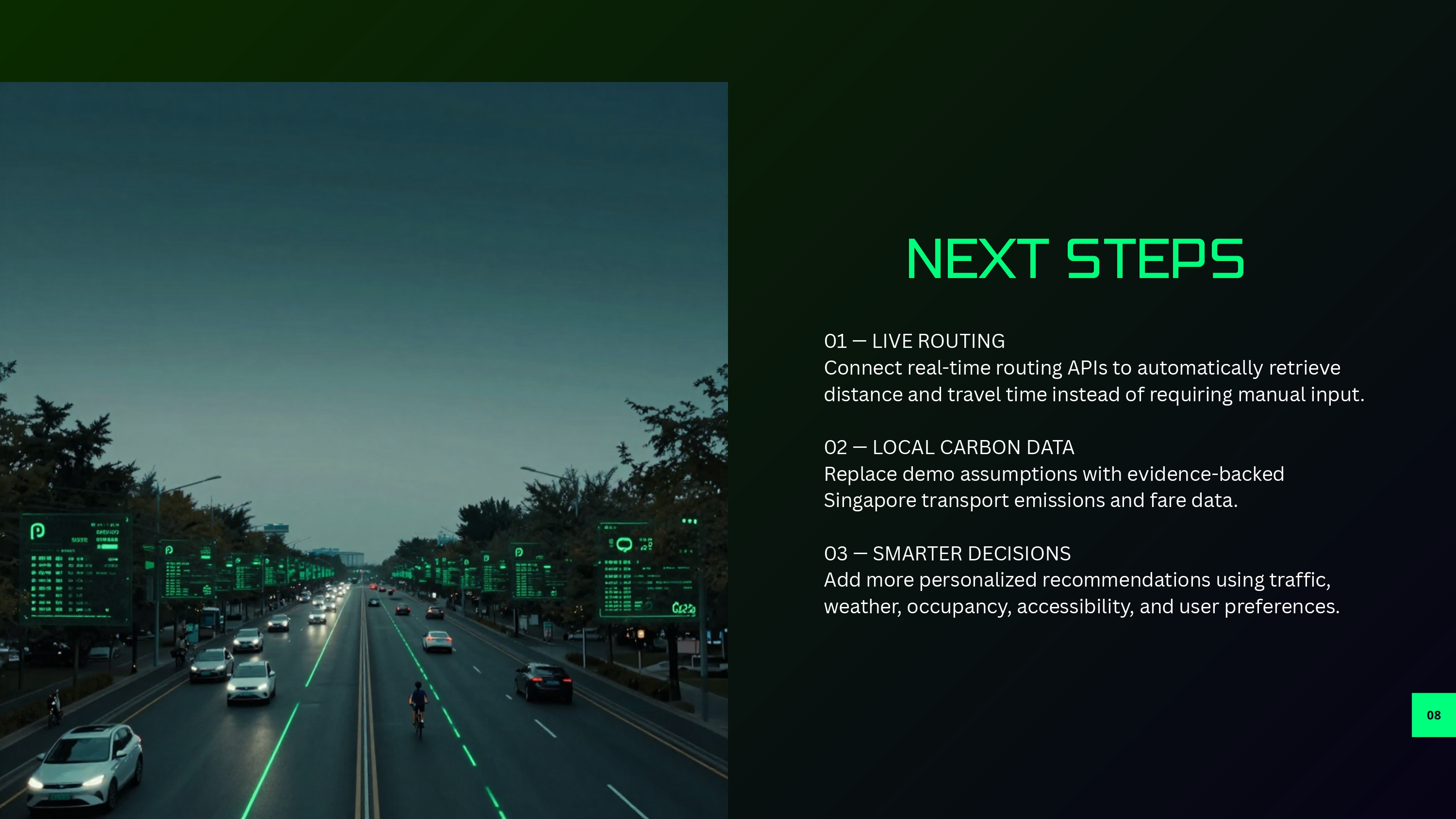
The current prototype uses demonstration transport assumptions. Our next steps are to:
- Integrate real-time routing and travel-time data
- Use evidence-backed local transport emissions factors
- Incorporate real-time traffic conditions
- Add more transport modes and accessibility considerations
- Improve personalization based on user preferences
Our goal is to evolve Carbon Decision Engine from a hackathon prototype into an everyday tool that helps people make practical, lower-carbon choices without sacrificing what matters to them.


Log in or sign up for Devpost to join the conversation.