-
-
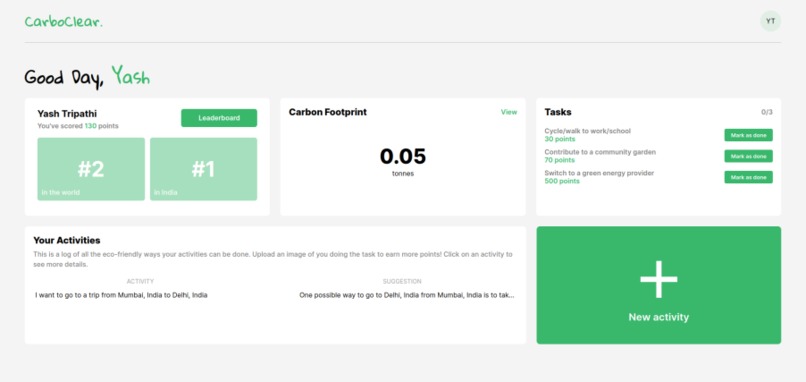
Home
-
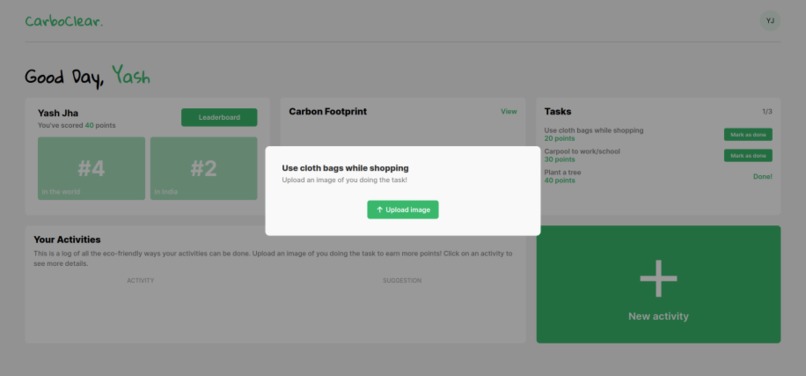
Task
Inspiration
People now understand the importance of climate change due to increased awareness and have started realizing the true significance of their small actions. They want to be a part of the solution to climate change. But there's a huge problem - they don't know how to start contributing towards it. Millions of statistics, "tips" on some website, boring conferences on climate change - that's not going to motivate them to start.
What it does
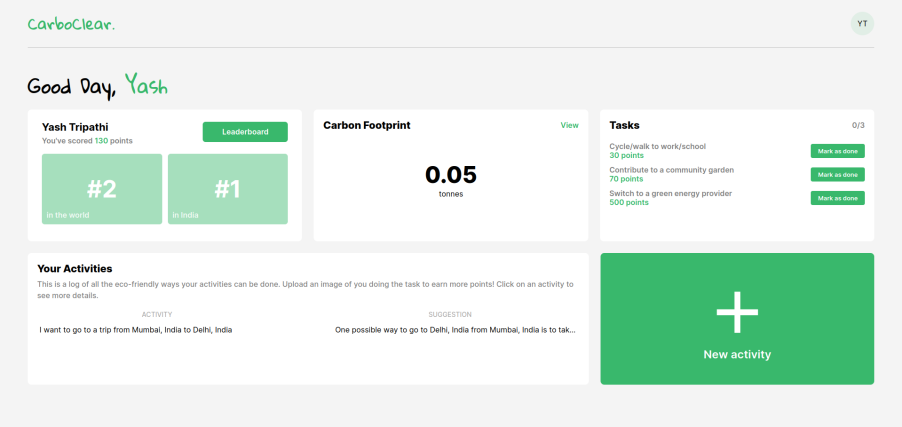
Enter, CarboClear, a web app that gamifies the entire process. Humans are social animals - it's proven that people tend to do tasks only when there's a social aspect (like a leaderboard) attached to it. CarboClear allows users to monitor their carbon footprint - manage their emissions and choose from some eco-friendly activities for their offsets. It also makes use of the social aspect by introducing a ranking system, which friends can compete for by completing daily tasks and activities which benefit the environment.
CarboClear also offers "EcoTask" - where you can enter tasks from your daily itinerary (like travelling etc.), and we'll provide you with more eco-friendly ways to achieve the same task.
How we built it
We first came up with the idea and designed We used the MERN (MongoDB, Express, React, Node.js) stack to develop the website and the server.
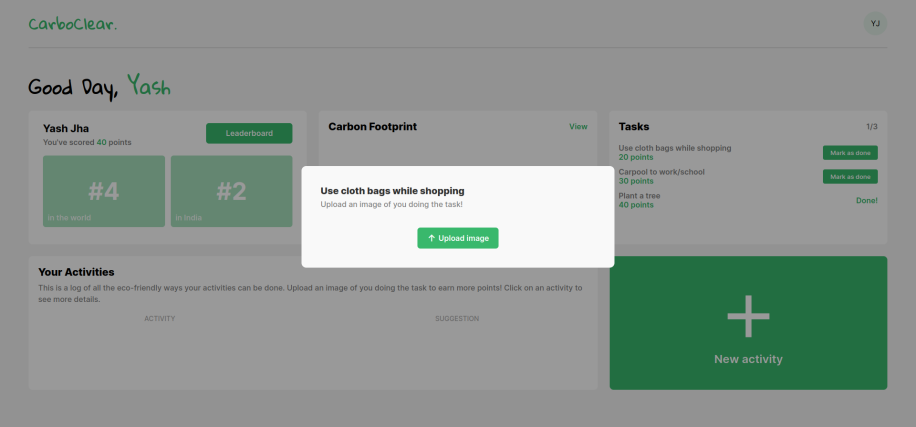
For verifying the images uploaded upon the completion of tasks, we used a Tensorflow object detection model trained on the coco dataset. For suggesting eco-friendly ways to do tasks, we used OpenAI's Ada model.
Challenges we ran into
Ensuring that the tasks were completed legitimately by a user were one of the biggest problems we faced along with some imperfections in our model. Along with this, we also had some problems with the point system not working sometimes. But in the end, we persevered and built something we're proud of.
Accomplishments that we're proud of
We're really proud of the EcoTask system that we implemented, along with the leaderboard, tasks and the carbon footprint system, and how we were able to detect objects in an image. We're also proud that we were able to implement all the features that we ideated even as beginners.
What we learned
We learnt how to work with MongoDB efficiently and how to detect objects inside an image using ML for task verification. We also learnt how to make a GPT-wrapper and also learned a lot about creating custom components and hooks in React.
What's next for CarboClear
We'll fine-tune our existing features and image-detection models, along with implementing a lot of other utilities, such as using real-world data for providing options for eco-friendly hotels and restaurants.


Log in or sign up for Devpost to join the conversation.