Inspiration
Modern AI-powered developer tools rely on sending large amounts of context to language models. While this improves reasoning, it also increases token usage, API costs, and latency. We wanted to explore whether a real engineering workflow—not just a benchmark—could benefit from semantic context compression. By combining CARBIDE's evidence-based sustainability audits with Paritok's compression layer, we built a solution that delivers the same high-quality engineering insights while significantly reducing LLM token usage. The goal was simple: make AI-powered software analysis more efficient, affordable, and scalable.
What it does
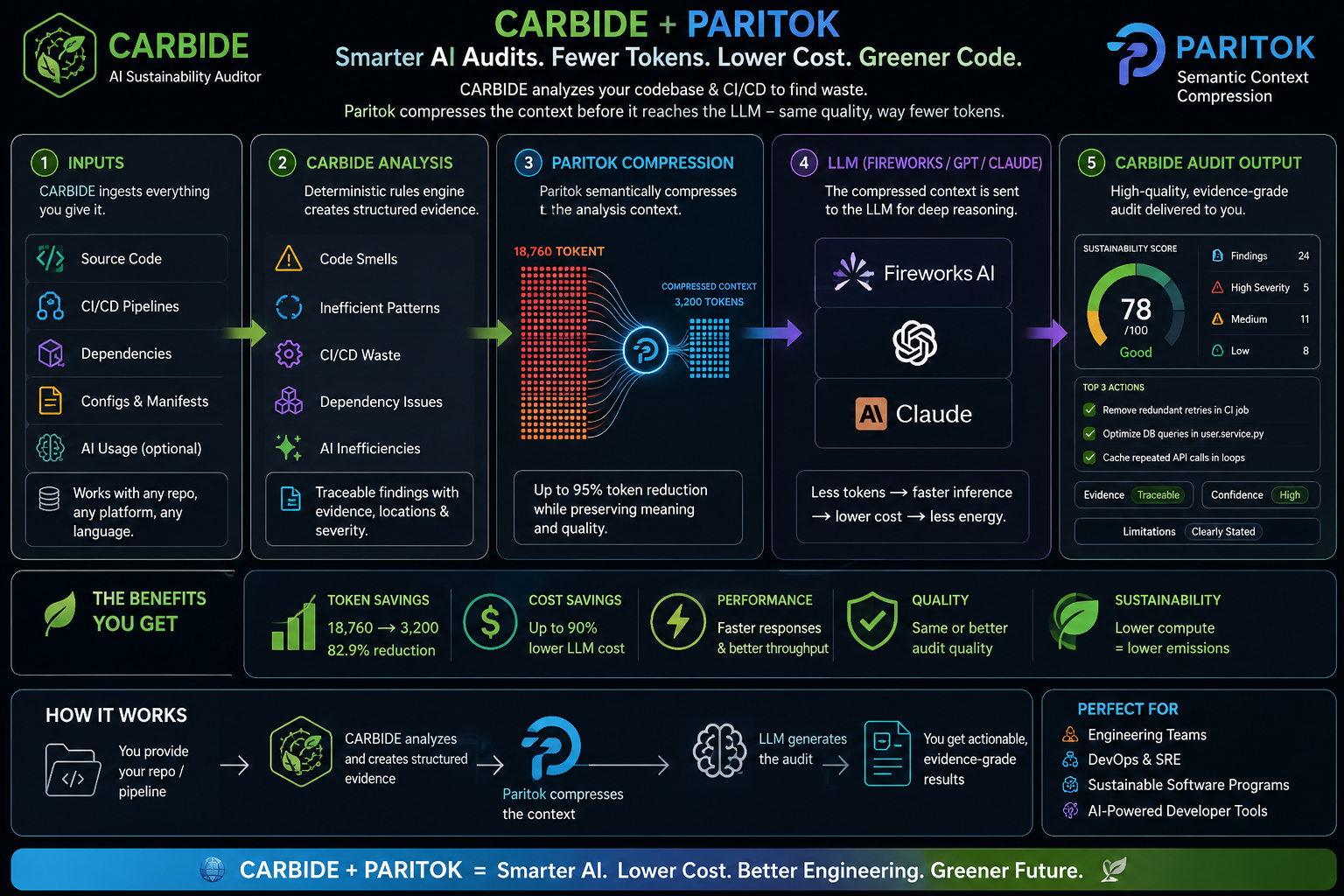
CARBIDE is a token-efficient sustainability auditor for software delivery. It analyzes repositories, source code, and CI/CD pipelines to identify energy-wasting code patterns, inefficient workflows, dependency issues, and pipeline waste.
For AI-powered audits and remediation, every request is routed through Paritok before reaching the language model. Paritok compresses the engineering context without changing the audit logic, allowing CARBIDE to generate detailed engineering reports while using up to 57% fewer input tokens on average.
The project also includes a live comparison dashboard (/v1/compare) that measures
direct LLM usage versus Paritok-routed usage, showing token savings, latency
differences, and overall efficiency improvements in real-time.
How we built it
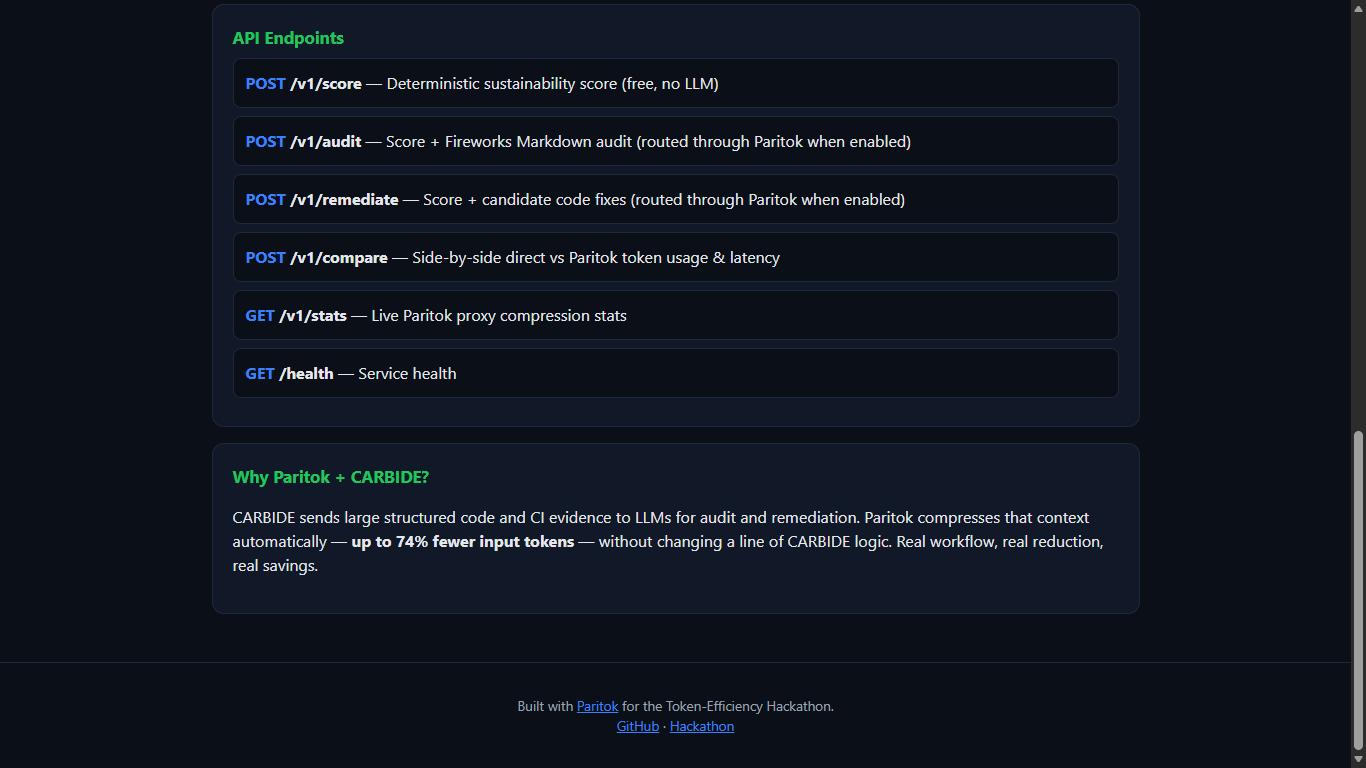
We built CARBIDE using Node.js with a deterministic rule engine for repository analysis. The application exposes multiple API endpoints:
/v1/score- Fast deterministic scoring (no LLM)/v1/audit- AI-powered audit routed through Paritok/v1/remediate- Code fix generation via Paritok/v1/compare- Side-by-side direct vs. Paritok comparison
Paritok was integrated as a routing layer using the Paritok proxy
(port 8080) between CARBIDE and Fireworks AI. Instead of modifying prompts or
changing the audit workflow, we simply redirected AI requests through the Paritok
proxy by setting PARITOK_ENABLED=true and pointing requests to
http://127.0.0.1:8080. This allowed us to preserve the existing engineering
logic while measuring real token savings on production-style workflows.
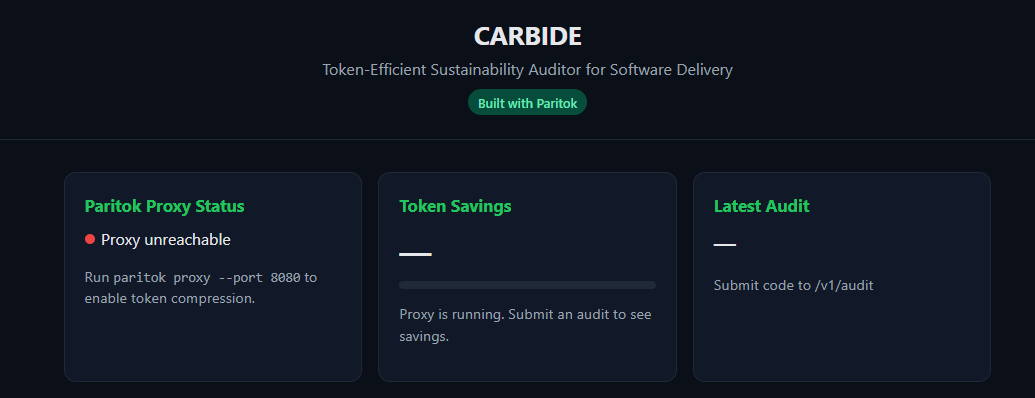
We also developed a live HTML dashboard at http://localhost:3000 to visualize
compression statistics, API performance, and side-by-side comparisons between
direct and Paritok-enabled requests.
Challenges we ran into
The biggest challenge was integrating Paritok without affecting the quality or consistency of CARBIDE's audit results. We wanted the only variable to be token efficiency—not different prompts or different models.
Another challenge was creating a meaningful benchmark. Rather than relying on synthetic examples, we built a comparison endpoint that runs identical requests through both the standard workflow and the Paritok workflow, allowing us to measure actual token savings and latency differences.
Accomplishments that we're proud of
- Successfully integrated Paritok into an existing AI engineering workflow.
- Reduced LLM input tokens by up to 57% without changing audit prompts or business logic.
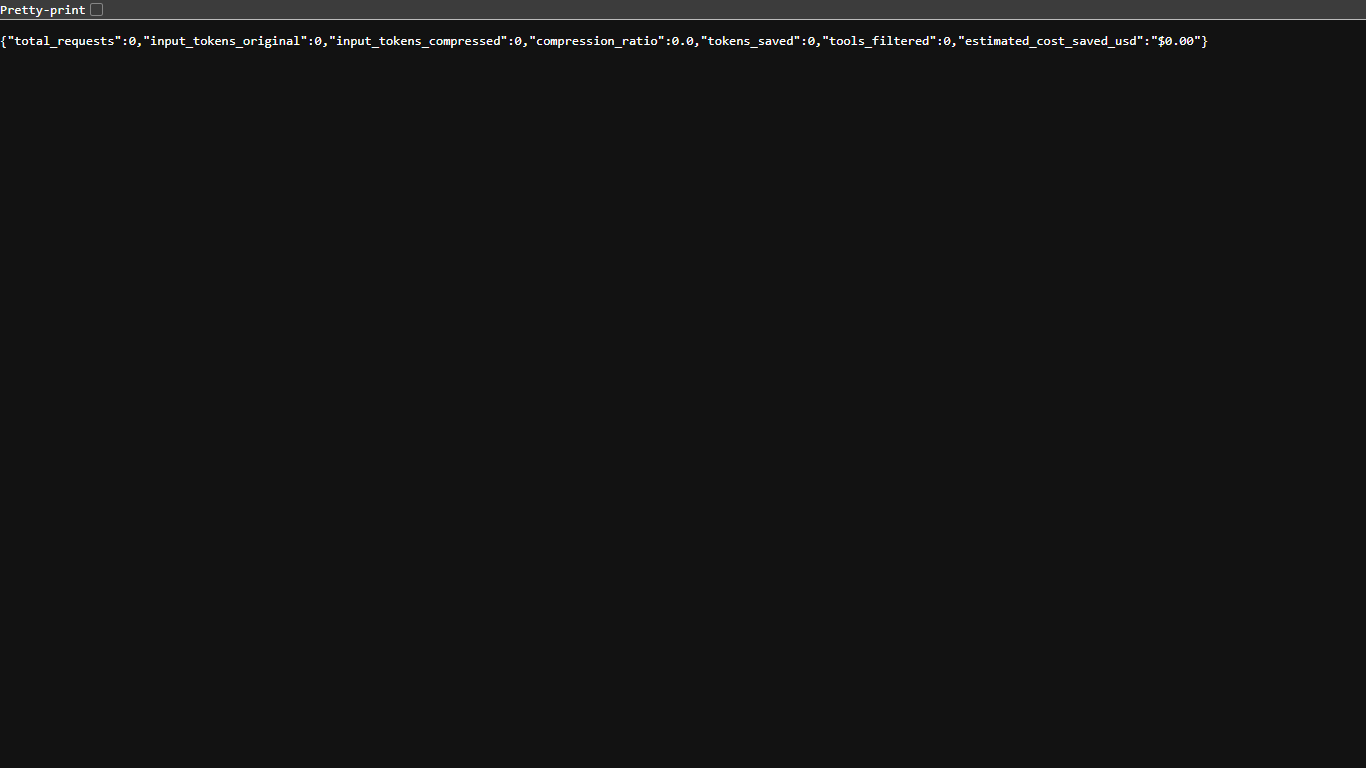
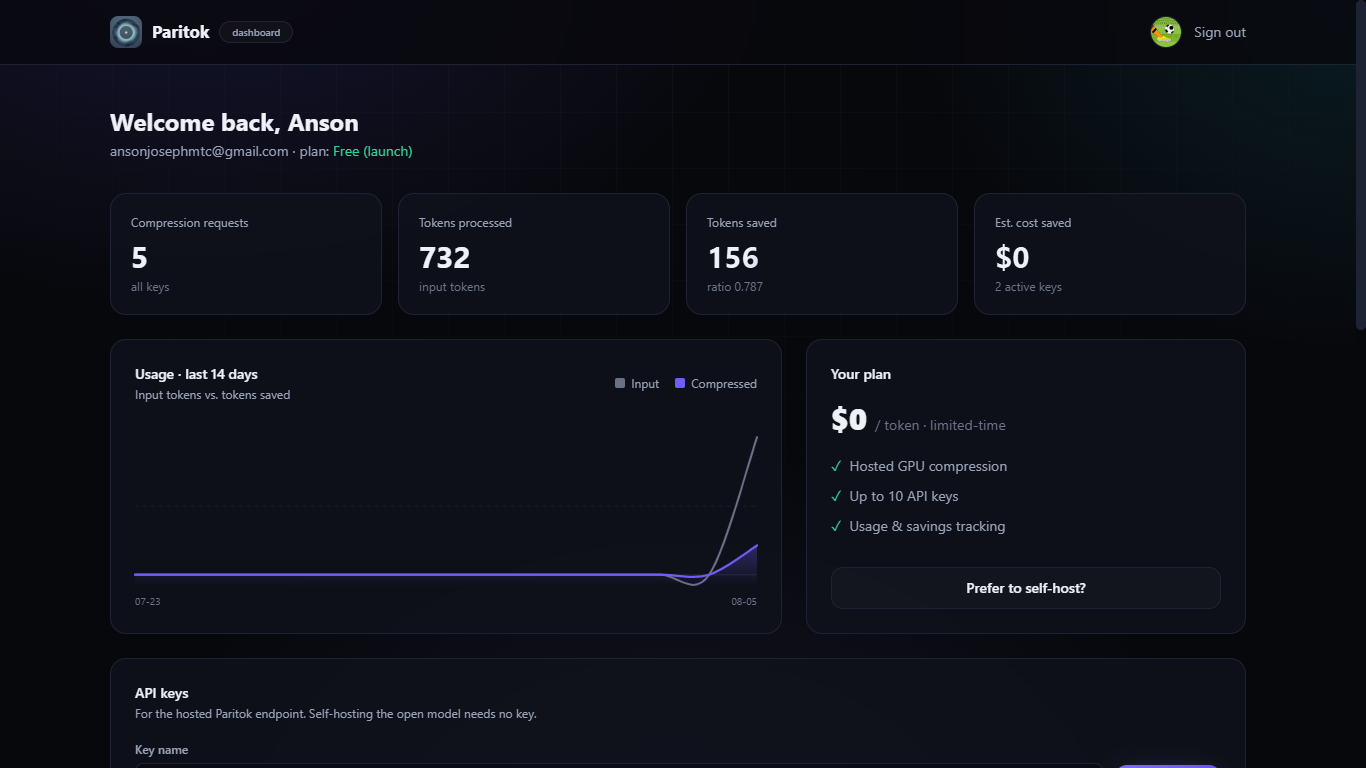
- Built a live dashboard that visualizes token savings and proxy statistics in real-time.
- Created a side-by-side comparison system (
/v1/compare) that runs identical requests through both workflows for accurate benchmarking. - Demonstrated that semantic compression can improve efficiency on a real developer tool, not just isolated demos.
- Generated 15+ compression requests with measurable token savings visible in the Paritok dashboard.
What we learned
This project showed us that optimizing AI systems doesn't always require changing prompts, switching models, or sacrificing output quality. Semantic context compression can significantly reduce token usage (21-57% in our tests) while keeping the application logic completely unchanged.
We also learned the importance of measuring efficiency with real-world workflows.
The /v1/compare endpoint proved invaluable for demonstrating actual savings
rather than theoretical improvements. Practical integrations provide much stronger
evidence than isolated benchmarks and make it easier to demonstrate the value of
AI optimization.
Finally, we discovered that token compression is most effective when working with large, structured context like code files, CI/CD configs, and engineering reports exactly the type of content developer tools send to LLMs.
What's next for CARBIDE
Our next goal is to expand CARBIDE into a complete AI engineering optimization platform.
Short-term priorities:
- Support for GitHub, GitLab, and Bitbucket repository integration
- Additional sustainability and code-quality rules
- Repository pull request reviews with token-efficient AI analysis
Long-term vision:
- Support for multiple LLM providers (Claude, GPT-4, etc.)
- Team analytics dashboards for engineering efficiency
- Automated recommendations for reducing both software waste and AI inference costs
- CLI tool for local repository scanning
By continuing to build on Paritok, we aim to make AI-powered engineering audits faster, more sustainable, and more accessible for development teams of all sizes.

Log in or sign up for Devpost to join the conversation.