-
-
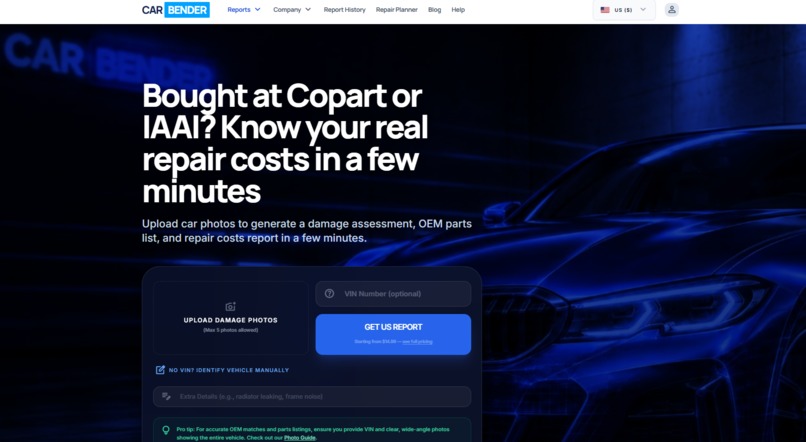
-
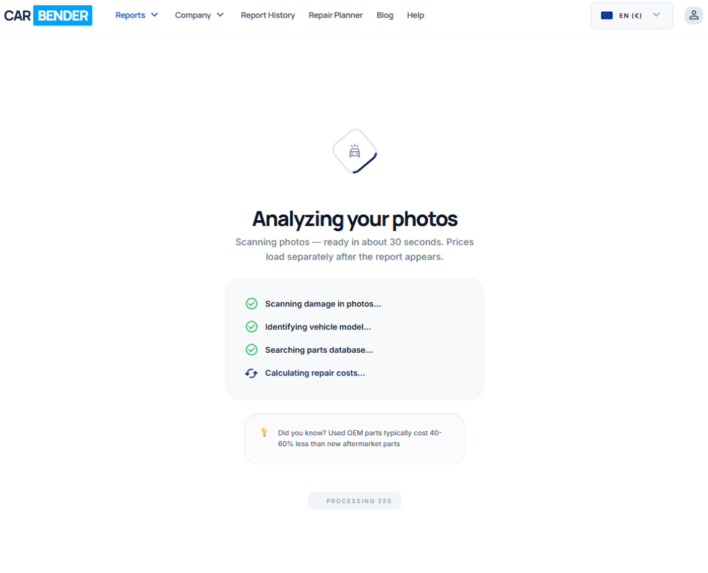
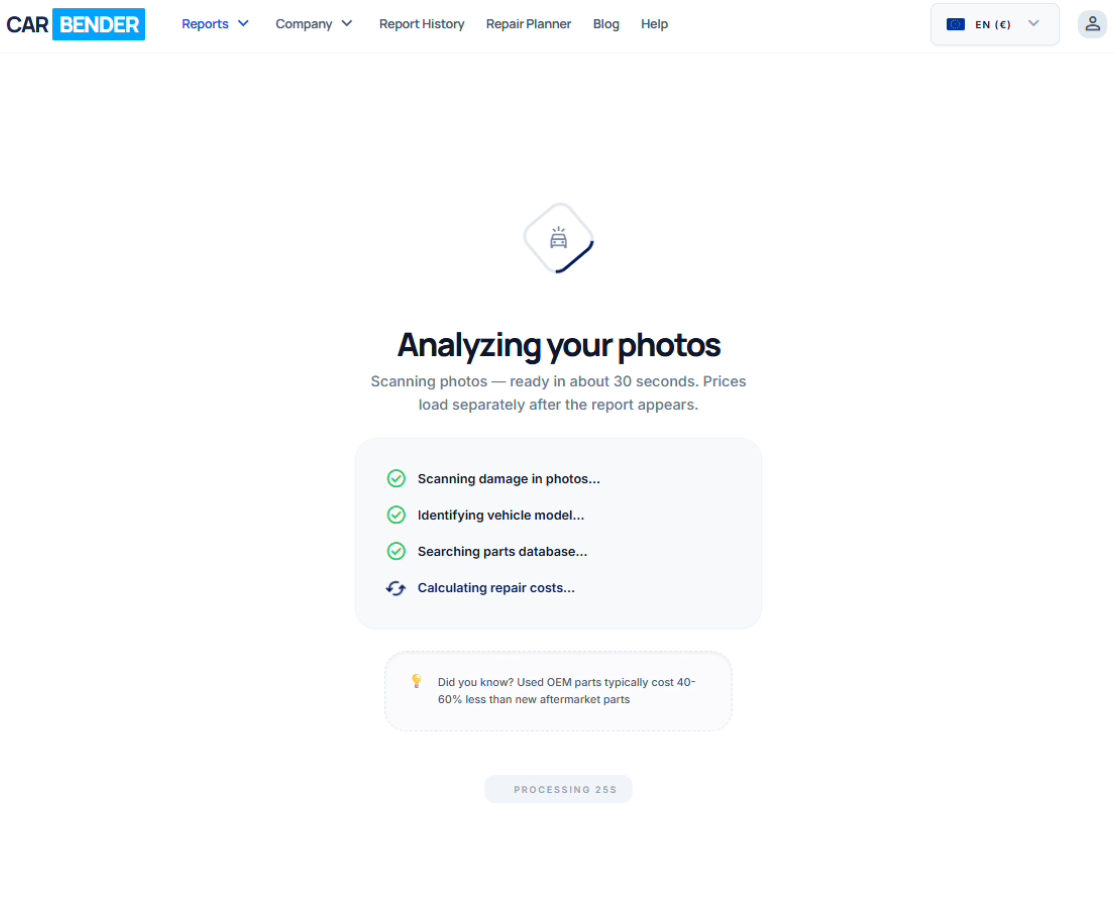
Loading screen
-
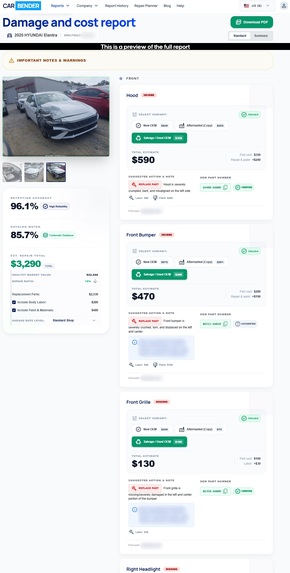
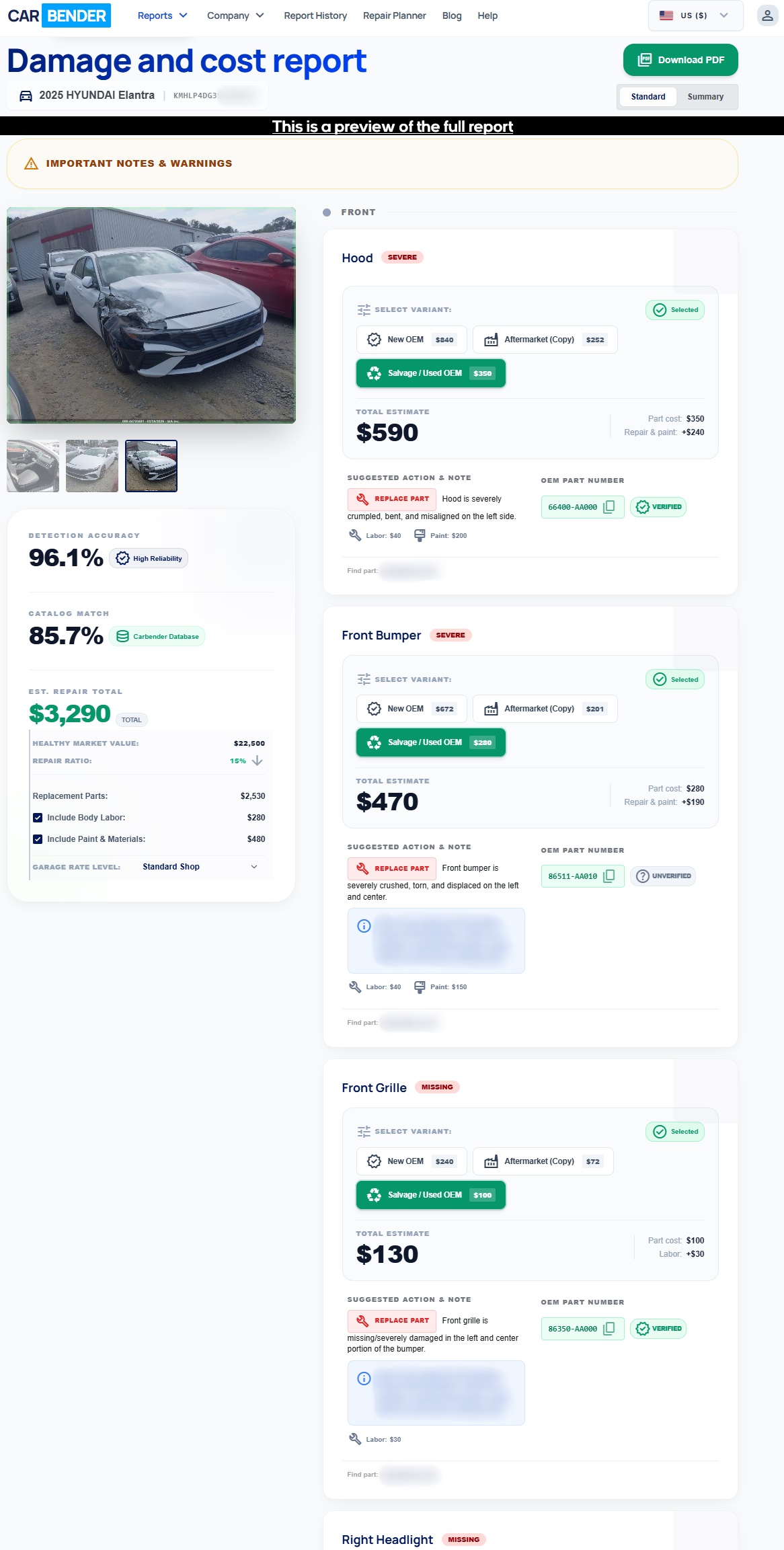
A preview of Carbender's damage report
-
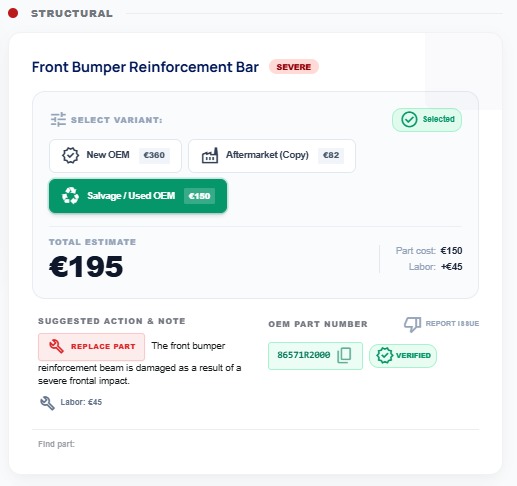
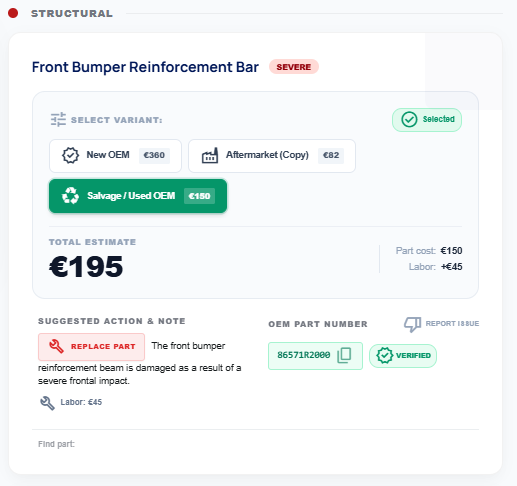
Damaged part box
-
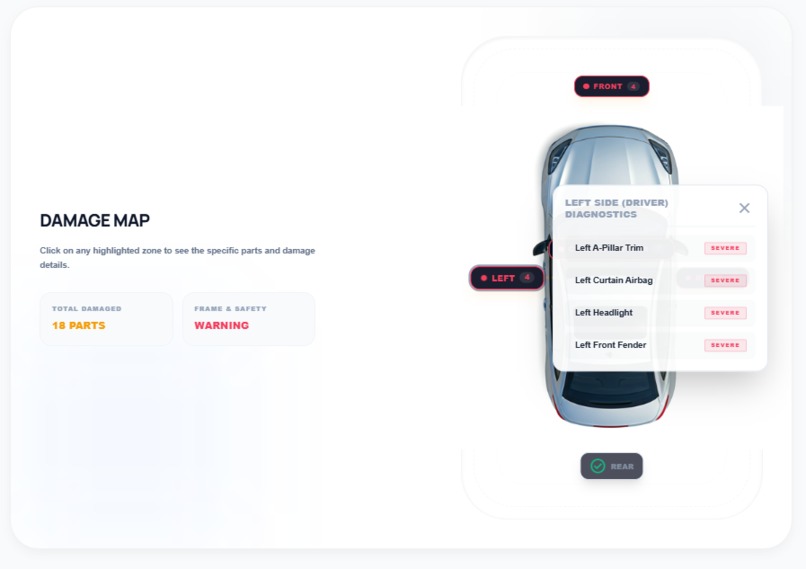
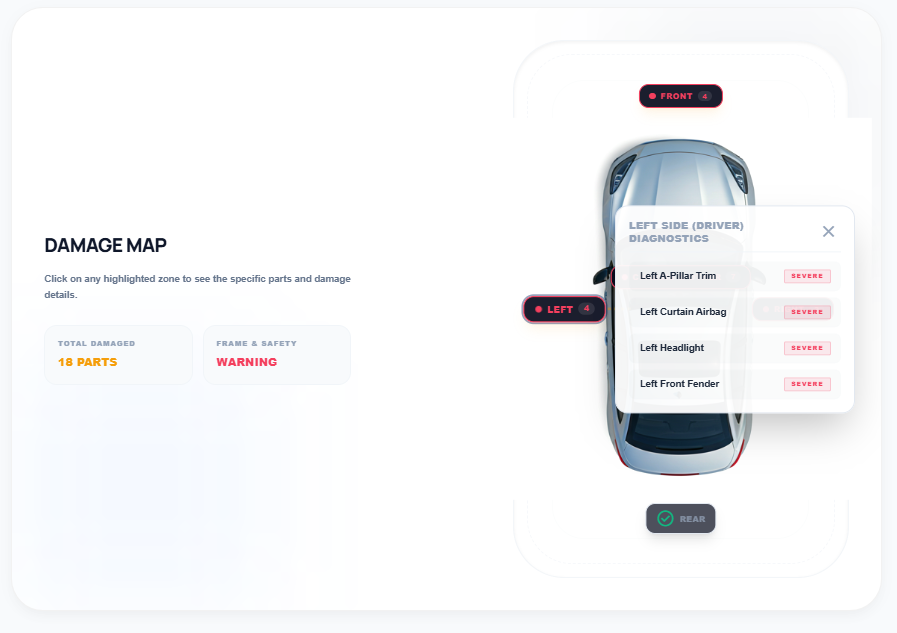
Damage map
-
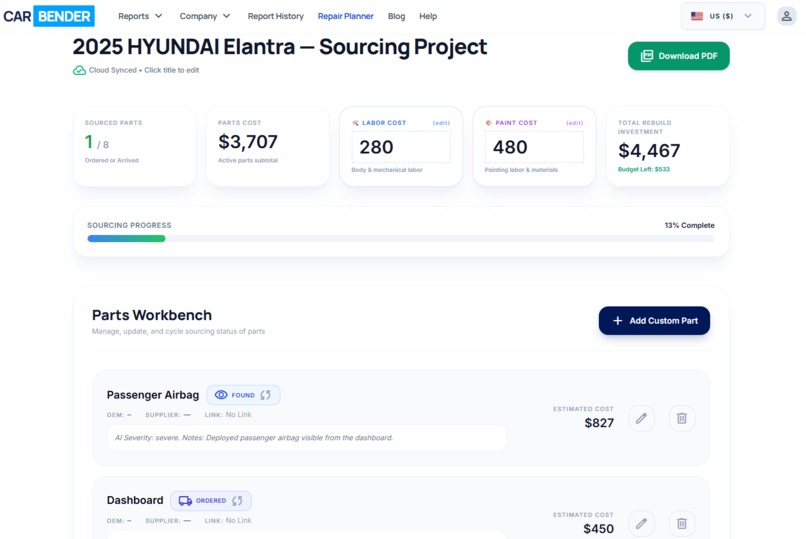
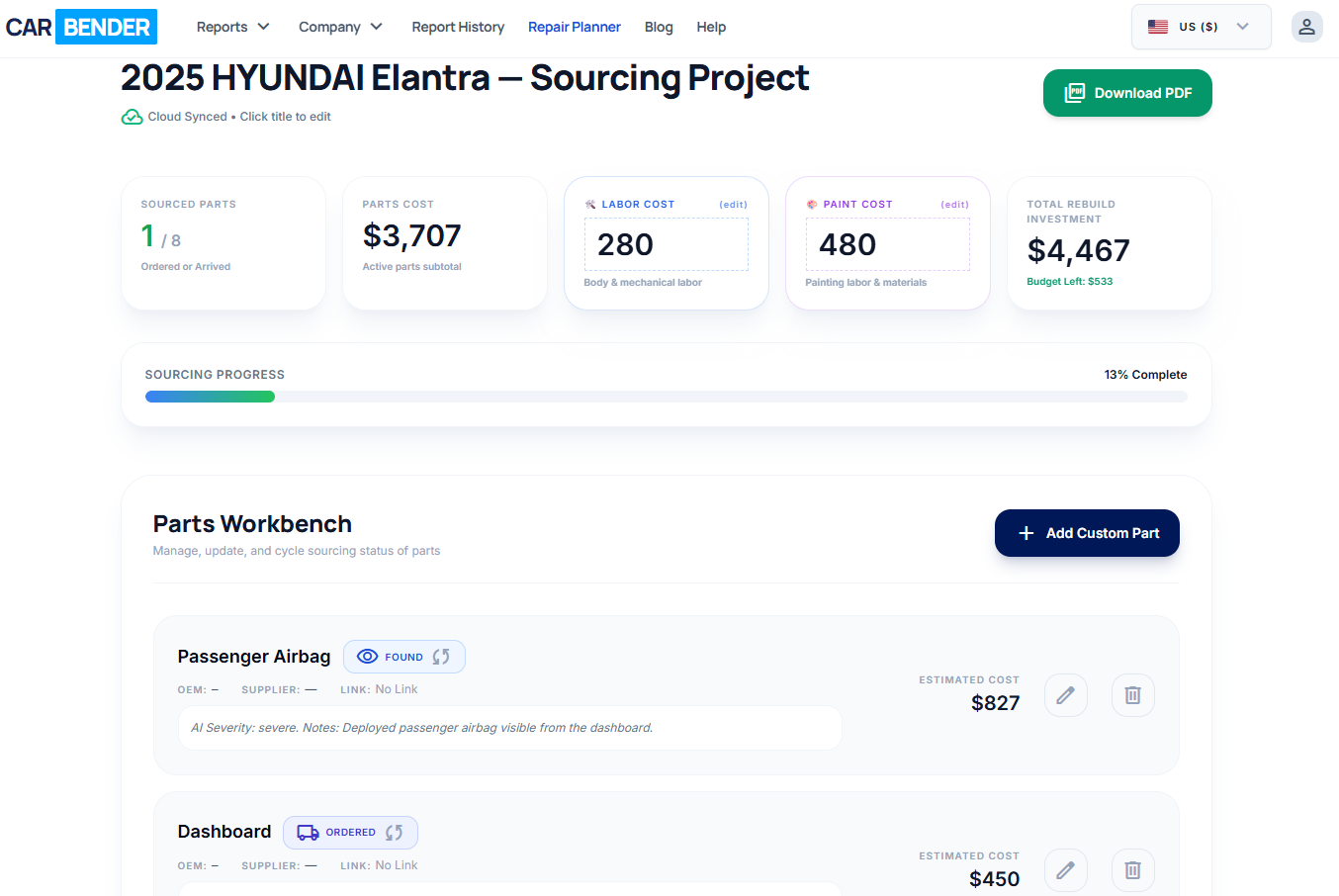
A preview of Carbender's repair planner
-
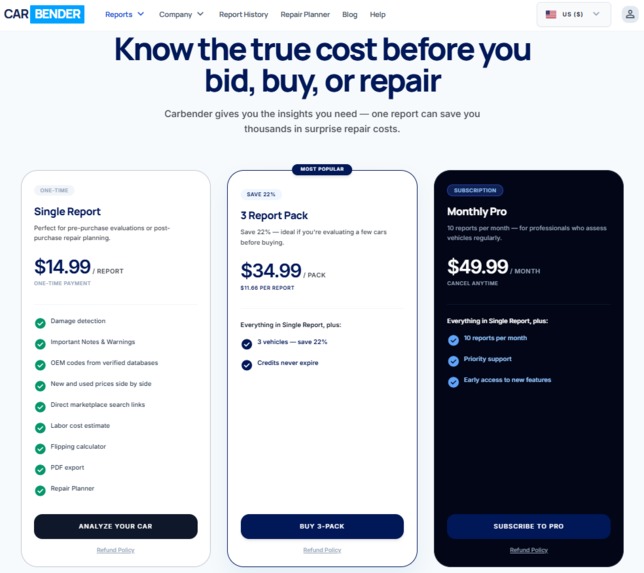
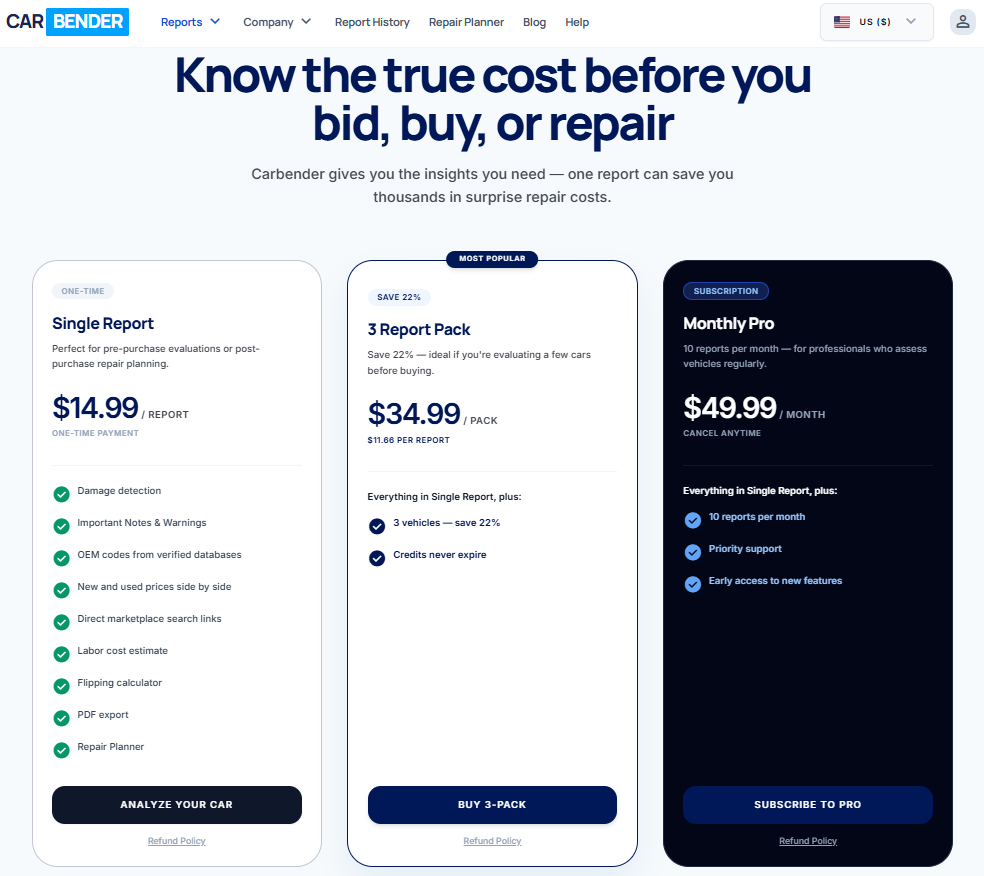
Pricing page
-
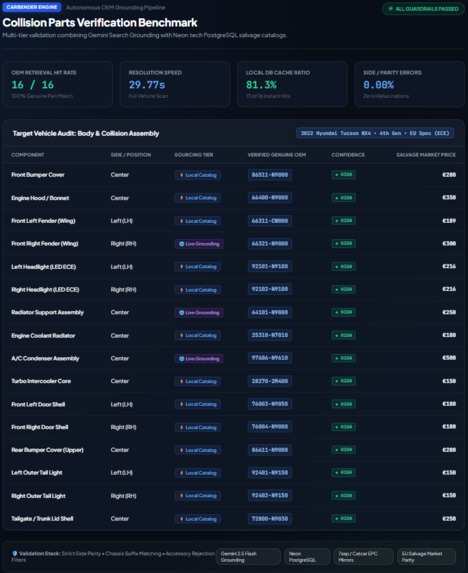
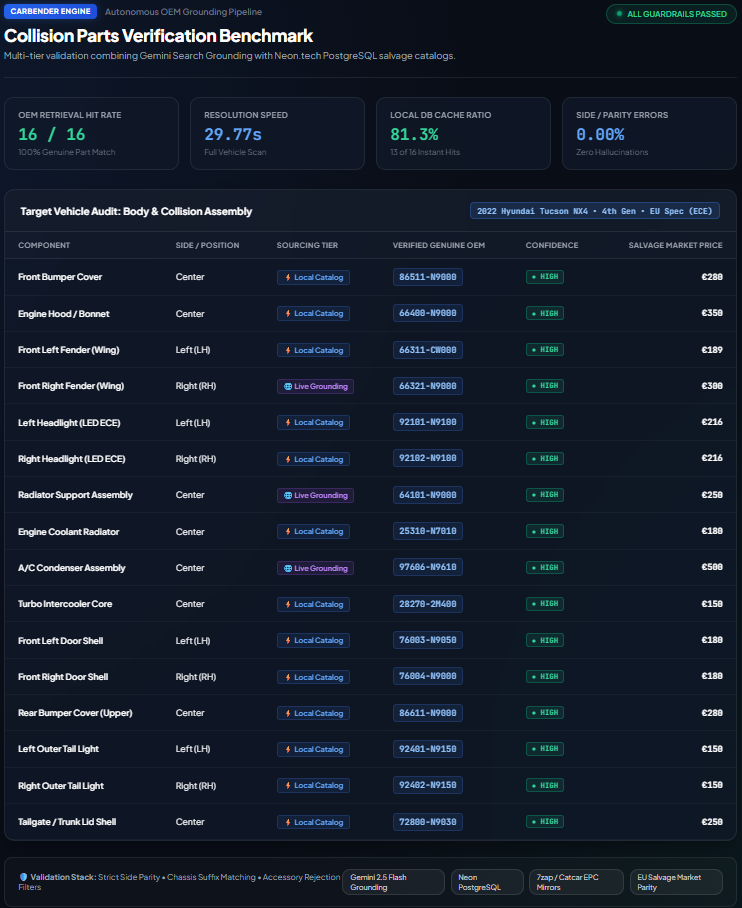
OEM benchmark showcase
-

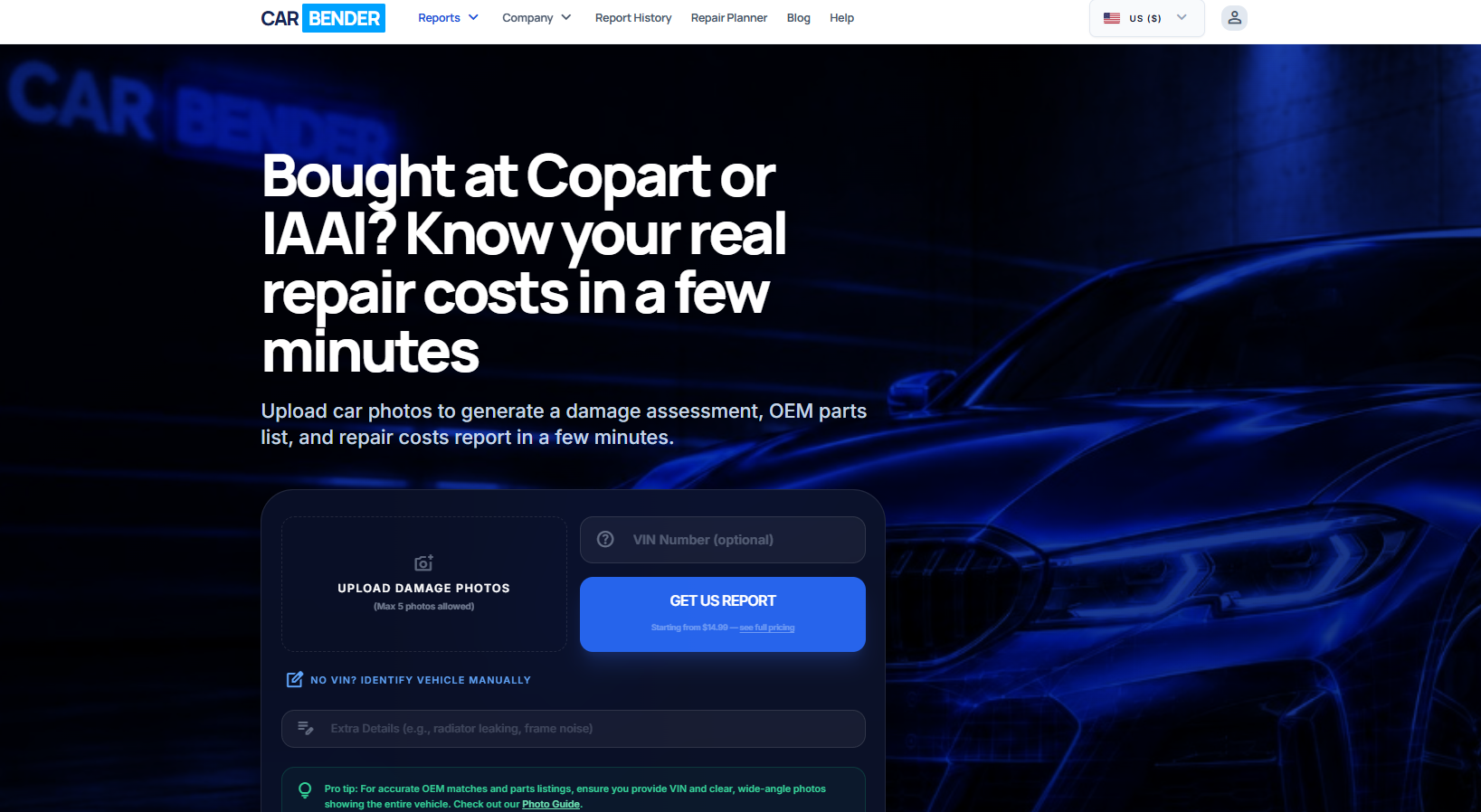
Carbender hero page. PWA on mobile Chrome browser
-
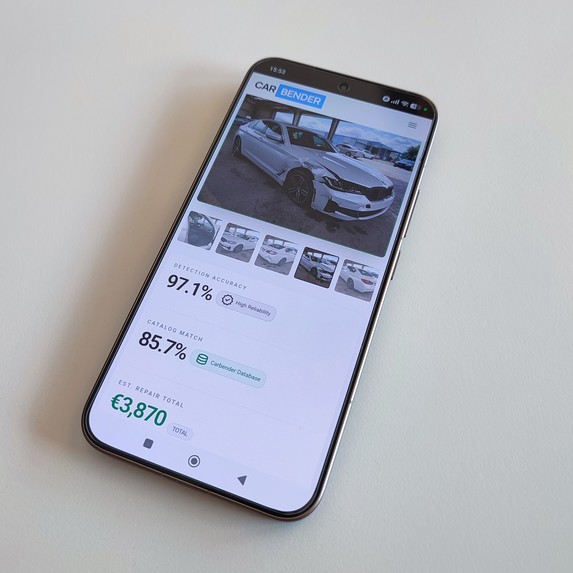
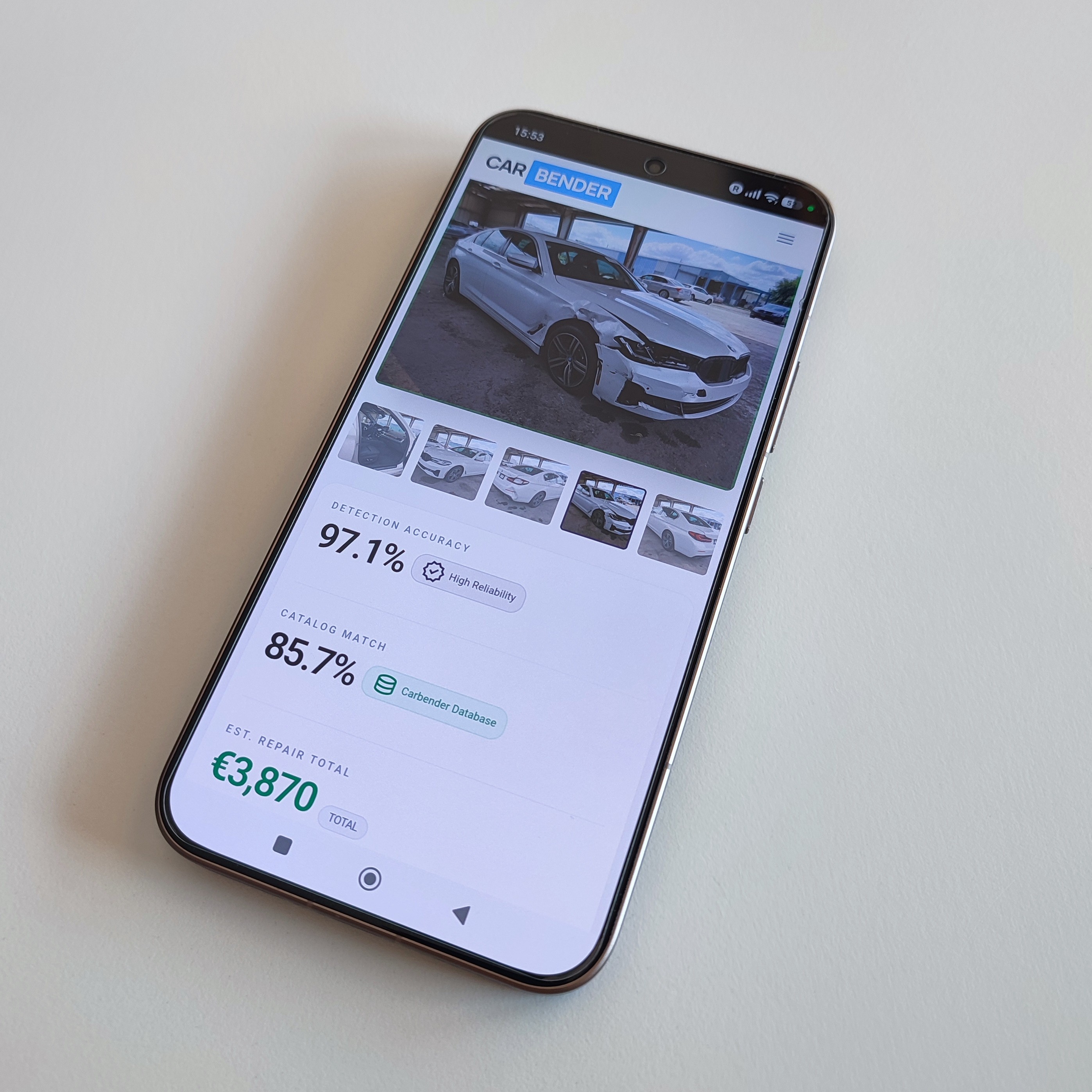
Carbender report preview. PWA on mobile Chrome browser

Inspiration
Every year, millions of vehicles are totalled in accidents and sold at salvage auctions for a fraction of their value. Estimating what it really costs to bring them back to the road is notoriously painful — buyers, body shops, and car flippers spend hours manually searching catalog numbers, pricing parts, and guessing labour costs.
Carbender was built to solve this — born out of personal frustration while purchasing and repairing a salvage vehicle. By combining Multimodal Vision AI with Real-Time Web Search Grounding, Carbender turns collision photos into itemized repair estimates and precise OEM part procurement lists in under 2 minutes — giving buyers and body shops a strong, data-backed starting point for evaluating and repairing a salvage vehicle.
What it does
Carbender is an AI-powered automotive damage estimator and parts procurement engine:
Visual Damage Assessment: Automatically detects damaged components, assesses severity (Severe, Moderate, Cosmetic), and normalizes 3D spatial camera angles to identify exactly which parts are affected and on which side of the vehicle.
Region-Aware Parts Sourcing: Identifies manufacturer-official OEM part numbers and generates procurement lists adapted to regional standards — US vehicles with DOT/SAE specifications and USD pricing, European vehicles with ECE specifications and EUR pricing.
Repair Planner: An integrated project management tool allowing users to track part procurement status, costs, and supplier links across all detected damaged components — with PDF export for sharing with mechanics or body shops.
Country-Aware Import and Rebuild Warnings: Every report includes a tailored warnings section generated for the detected vehicle and its country of origin. It surfaces critical obstacles buyers commonly overlook when purchasing and rebuilding salvage vehicles — including import restrictions, title regulations, emissions compliance, mandatory inspection requirements, and model-specific rebuild considerations.
Financial Risk Assessment: Beyond damage detection, Carbender calculates a real-time Loss Ratio — comparing estimated repair costs against the vehicle's clean market resale value — and issues a Total Loss verdict. Buyers instantly know whether a car is worth repairing or should be written off.
Factory Window Sticker Generator: Enter any US VIN and Carbender instantly reconstructs the vehicle's original factory Monroney build sheet — equipment, EPA ratings, NHTSA crash scores, and original MSRP — revealing exactly what the car was before any modifications or strip-outs. Exports as a print-ready PDF.
Who it's built for: Carbender serves two distinct use cases — remote salvage buyers and car flippers evaluating auction listings before placing a bid, and body shop staff using it as an on-site mobile intake tool to generate catalog-backed estimates directly from the lot.
How we built it
Core AI Engine: Gemini 2.5 Flash, Gemini 2.5 Pro, and Gemini 2.5 Flash-Lite via @google/genai for multi-modal visual inspection, spatial bounding box detection, and Google Search Grounding for real-time OEM part sourcing and live price verification. Frontend: Next.js (App Router), TypeScript, and TailwindCSS with multi-language localization (English, US, Lithuanian, Polish). Data & Processing: Prisma ORM with PostgreSQL, a proprietary 700,000+ record OEM parts catalog database, and Inngest for asynchronous procurement pipelines. Media & Storage: Sharp image optimization with Cloudflare R2 / Supabase for privacy-compliant photo processing. Payments: Stripe Checkout with dynamic multi-currency support (USD and EUR). User Experience Blueprint (Design & UX): To ensure seamless adoption without friction, Carbender is engineered as a zero-download Mobile Web App following an industry-validated 5-step flow: Vehicle VIN Identification → Area & Panel Mapping → Guided Multi-Angle Capture → OEM & Financial Report
Challenges we ran into
Spatial Camera Angle Confusion: AI vision models frequently confuse image canvas left/right with actual vehicle driver/passenger sides. We built a spatial geometry pipeline that checks front-to-rear part positioning across all detected components to significantly improve 3D side accuracy.
Generation and Facelift Ambiguity: Automotive parts catalogs are riddled with generation ambiguity — the same model name can span multiple body generations and mid-cycle facelifts, each with physically incompatible part numbers. A front bumper for a pre-facelift model will not fit a post-facelift version, yet both are listed under the same model name across most databases. We engineered a multi-stage validation workflow combining chassis code detection, production year range filtering, and cross-referenced OEM catalog verification to reliably identify generation-specific part numbers and filter out mismatched data.
New and Recently Facelifted Models: 2024/2025/2026 model year parts often have zero secondhand listings available. We implemented scarcity detection and automatic advisory banners to honestly communicate coverage limitations to users rather than returning empty or misleading results.
Accomplishments that we're proud of
Built as a solo founder during the hackathon — taking Carbender from concept to a fully functional, live production platform at carbender.com. At its core is a proprietary parts database spanning 60+ vehicle makes across EU and US markets, filling a gap that no existing public data source covers.
Resilient AI Pipeline: Automated failover architecture between Gemini models maintains seamless availability during API quota spikes or demand surges without human intervention.
Dual-Market Support: Seamlessly serving both North American auction buyers and European salvage repairers with localized OEM specifications, pricing, and import guidance.
What we learned
Real-Time Data Integration: Combining computer vision with real-time web retrieval is essential for automotive damage estimation — static databases alone cannot keep pace with fast-changing market prices, new model releases, and catalog discrepancies.
Accuracy as a Core Product Requirement: In domain-specific applications where users make real financial decisions, layering validation guardrails on top of generative AI outputs is not optional. A wrong OEM code shown with false confidence is worse than showing no result at all.
The Nuances of Global vs. Regional Auto Markets: Automotive architectures are global, but repair and parts ecosystems are deeply regional. Bridging North American auction imports with European salvage platforms (such as ECE lighting regulations, regional platform sharing, and hidden mounting brackets) requires domain-specific business logic, not just generic vision models.
What's next for Carbender
Secondary Damage Prediction (Hidden Damage): Extending detection to parts photos cannot reveal — teardown hardware (bumper trim moldings, headlight mounting brackets, fender guide retainers, tow hook covers) and suspension components (control arms, tie rods, steering knuckle damage from wheel impact). These are discovered only during disassembly, yet cause the biggest repair delays and surprise costs for buyers.
US Market Expansion: Dedicated US-market routing is live in early access, targeting North American Copart and IAAI buyers with USD pricing, US-spec OEM sourcing, and US import advisory content.
1-Click Chrome Extension: Instant repair estimates embedded directly into Copart (com, de, fi) and IAAI auction listings — letting buyers assess rebuild costs without ever leaving the listing page.
Body Shop & Fleet Dashboard: Multi-user team accounts, direct 1-click part ordering, and a public API for integration into existing shop management and fleet maintenance workflows.
Live Inspection Mode (Guided 5-Angle Capture): A real-time, step-by-step camera wizard that guides buyers standing next to a vehicle through exactly which angles and details to photograph — eliminating blurry, unhelpful shots and maximising AI diagnostic accuracy. Designed for auction lots, private sales, and roadside assessments. Beta in development.
Built With
- antigravity
- cloudflare-r2
- gemini-api
- google-genai
- google-search-grounding
- inngest
- neon.tech
- next.js
- node.js
- postgresql
- prisma
- react
- sharp
- stripe
- supabase
- tailwind-css
- typescript



Log in or sign up for Devpost to join the conversation.