-
-
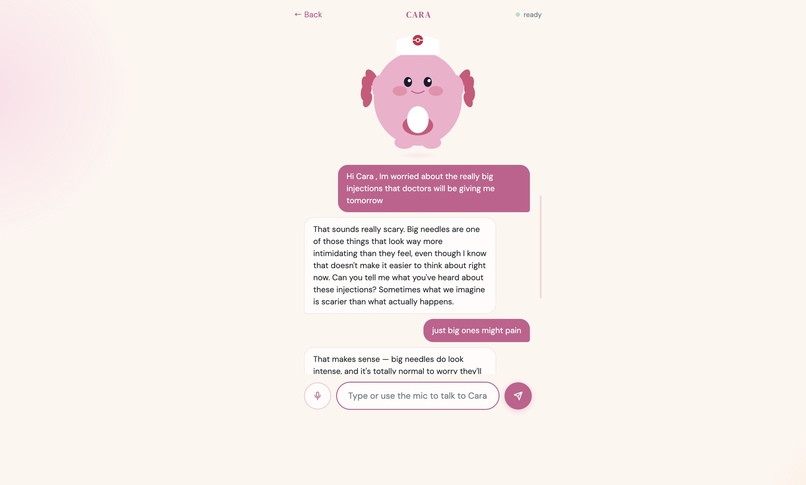
A real conversation with Cara, a child worried about injections before treatment.
-
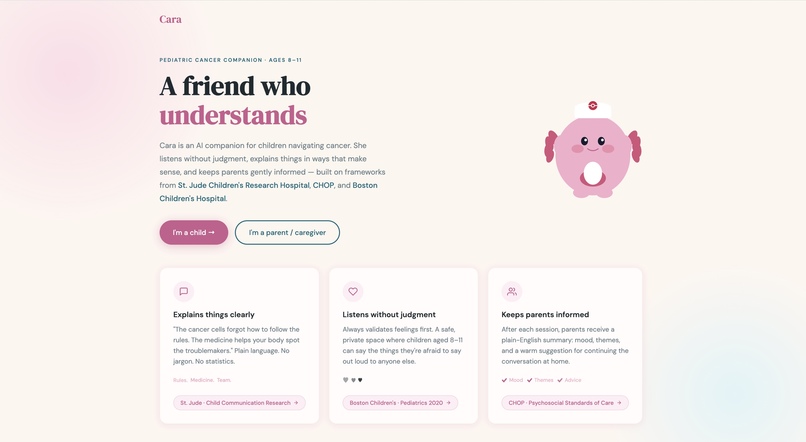
Cara's landing page, designed for both child and parent.
-
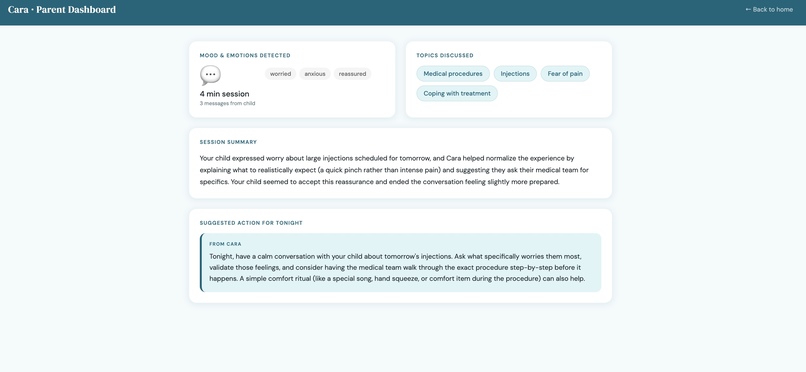
The parent dashboard after the same injection conversation.
-
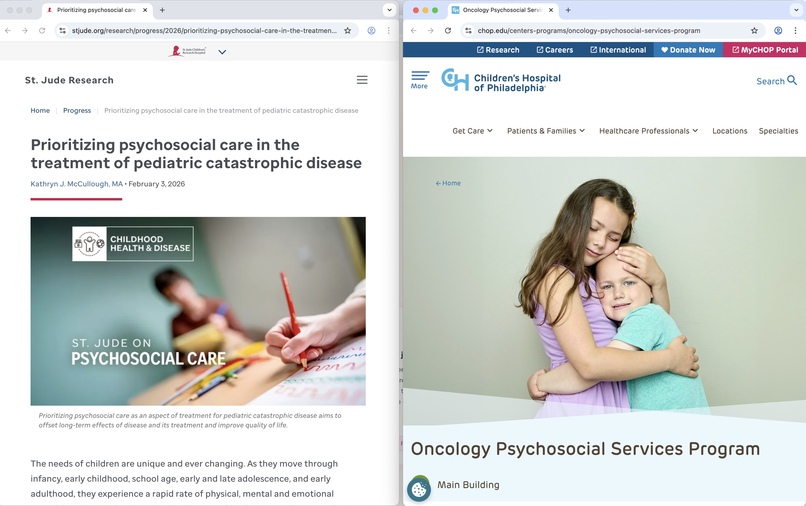
The published research behind Cara, St. Jude's psychosocial care framework and CHOP's Oncology Psychosocial Services Program
-
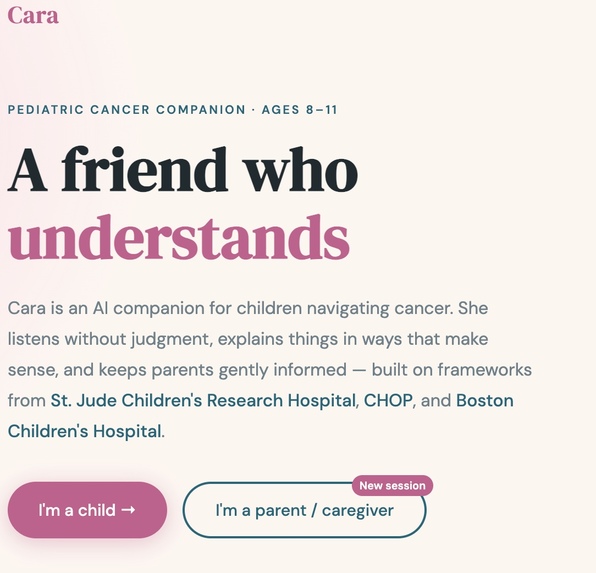
After a session ends, the parent CTA shows a 'New session' badge.


Cara — A Friend Who Understands
Inspiration
It started not with a product idea, but with confusion.
My teammate from ETH Zurich and I were both working on computational pathology projects at the time, specifically whole slide image analysis of cancer tissue. We would meet and talk through the oncology side of things, and neither of us, coming from pure computer science backgrounds, could fully grasp the terminology. The histology, the staging, the treatment implications. It took us weeks to develop even a basic intuition for what we were looking at.
And then one conversation shifted everything.
We were speaking with a cancer patient from Tata Memorial Hospital in Mumbai, one of Asia's largest cancer centers. She was articulate, educated, and completely lost. Not because she lacked intelligence, but because nobody had explained her own diagnosis to her in a way that made sense. She knew words like "HER2 positive" and "adjuvant chemotherapy" but had no real understanding of what was happening inside her body or why.
If that was true for an adult, we kept asking ourselves, what does it feel like for a child?
And just as importantly: what does it feel like to be the parent sitting next to that child, watching them be scared and not knowing what to say?
From the very beginning, Cara was never just about the child. We always wanted parents to be part of it. Not watching over the child's shoulder, not reading every word, but gently informed. Present without being intrusive. That dual design, a private space for the child and a summary layer for the parent, was the first decision we made and the one we never changed.
What We Learned
Digging into the research changed how we saw the problem entirely.
We had already heard of Stanford's Psychosocial Cancer Care Program. But when we went deeper we found something more specific and more urgent.
St. Jude Children's Research Hospital was the institution that truly shaped how we thought about this problem. Their Department of Psychology and Biobehavioral Sciences established why ages 8 to 11 represent the most critical communication window: children this age are cognitively aware that something serious is happening, but are not emotionally mature enough to process it alone. Their proactive approach of meeting every newly diagnosed child within the first months to provide psychological support showed us what the bar should look like. Without honest, age-appropriate support, children fill the gaps with fear and imagination, almost always worse than reality.
Children's Hospital of Philadelphia helped develop the 15 international Psychosocial Standards of Care, the global benchmark for pediatric cancer support, and has been actively researching technology-based interventions to improve psychosocial outcomes in pediatric patients.
Boston Children's Hospital and Dana-Farber co-authored a functional model of communication in pediatric oncology published in Pediatrics in 2020, identifying six functions every meaningful conversation with a child about cancer must serve: building relationships, promoting engagement, addressing emotions, exchanging information, managing uncertainty, and fostering hope.
That framework became the backbone of Cara.
How We Built It
Cara is a web application with three surfaces: a landing page, a child-facing chat interface, and a parent dashboard.
The child talks to Cara through text or voice. The response is generated through an LLM guided by a system prompt that encodes the St. Jude, CHOP, and Boston Children's communication frameworks explicitly. Voice output uses a custom warm, calm voice designed specifically for Cara. The avatar is an original hand-coded SVG character, fully ownable as intellectual property.
When the child says goodbye, Cara detects the farewell naturally, responds warmly, and silently generates a structured parent summary: plain-English narrative, detected emotions, topics discussed, and one specific recommendation for that evening. The parent sees mood and themes but not the transcript. The child gets privacy. The family stays connected.
Challenges
The hardest challenge was not technical. It was knowing when to stop.
When you are building something for a scared nine-year-old asking whether they are going to die, every word in the system prompt matters. Too clinical and Cara sounds like a medical brochure. Too casual and she sounds like she does not take the question seriously. The frameworks from St. Jude and CHOP gave us guardrails, but the tone still had to be found through iteration.
On the technical side, getting the avatar animation, voice output, and text display to feel cohesive required rethinking the rendering pipeline several times. We ultimately landed on speaking first and displaying text after voice completes, which feels more natural for a character-driven interface.
The other challenge was trust. Cara is not endorsed by St. Jude, CHOP, or Boston Children's Hospital. She is built on their published research. Communicating that distinction clearly, in a way that is honest but still compelling, required careful thought in how we surfaced citations and framed the product.
We built this in one sprint. But the research behind it represents decades of work by some of the most dedicated people in pediatric medicine. Cara is our attempt to put that work in the hands of the children who need it most, at 11pm, when nobody else is available.
Built With
- claude-api-(anthropic)
- css
- elevenlabs-tts-api
- html
- javascript
- svg
- web-speech-api
