-
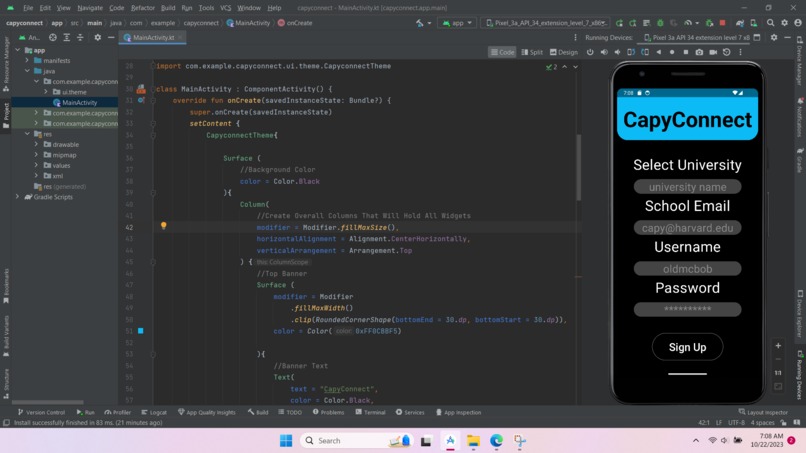
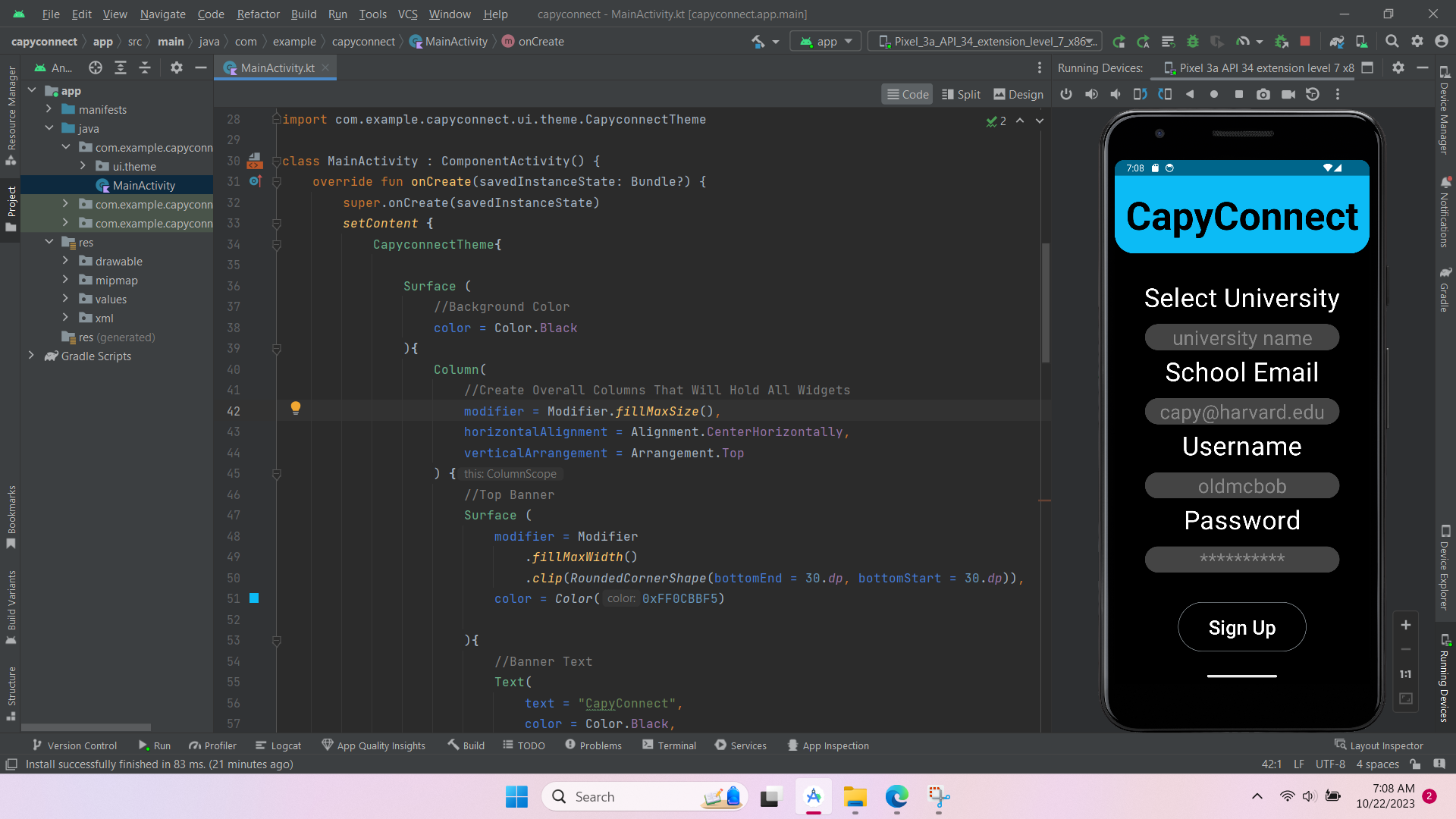
Screenshot of App in Android-Studio
Inspiration
We wanted to make a social media platform that actually makes users social. This involves getting users to connect with new people spontaneously in the real world and then using the app whenever they want to connect with a broad audience. This app would be helpful for musicians that would like to do a pop-up piano concert, an athlete who wants to start a pick-up soccer match, or even an artist looking to paint outside. Whenever a user creates a pop-up event, other users who share that interest would get a notification delivered by the app.
What it does
Sign-Up / Verification - When signing up users must sign up with their UCONN school emails and our backend relational database will store encrypted user data. While signing up users can share what genres of events they are most interested in, so they control what notifications they receive so they don’t get bombarded with endless lists of events. Event-Feed - Users would be able to swipe through current events sorted by their tastes and they would be able to choose a recommended (algorithm-based), or chronological viewing order. The interface would be similar to the dating app Tinder. This design would allow users to have an entire screen dedicated to events so unique events don’t get lost in the shuffle. Event Sharing Service - In order to post an event, users must get verified for security reasons. Once they are verified they can simply post the following information : (Event Category, Time, Location, Description of Event). To establish our niche, we can experiment with having events only being able to be created within x-number of days in order to maintain the spontaneity and freshness. The uncertainty of what someone will be hosting would likely boost engagement and allow more people to hang out and check out events. Notifications - In a very busy world, the last thing someone needs is to have a gazillion notifications. Users can opt-in to select categories. If the user’s feed is low, we can encourage people to try new genres that they may not otherwise be exposed to. Monetization- This social media platform would be monetized through paid advertisements. In the future we can explore the freemium business model where users could pay a subscription or one-time-fee to boost post visibility, remove-ads, and receive a special facilitator verification.
How we built it
We built it using Android Studio. We started by getting mock-ups of different screens we would have, and then broke up and worked on different parts of the app. This included learning how to use Android Studio and Kotlin, which is the preferred language in the design space. We chose to work on the sign in/up screen, the create event screen, and a notification module. There were lots of tutorials on how to do different things in Kotlin, which helped us understand what we were making. However, because of Android Studio having Java as well, it did feel as though there were big debugging phases during the learning process. This definitely slowed down our pace, but we wanted to make sure that what we were making was functional.
Challenges we ran into
Learning to use tools we were not familiar with proved challenging to learn in a short amount of time. Time management was also a big challenge of knowing when to work and take a break so both are equally managed.
Accomplishments that we're proud of
We are proud of the flow of ideas, coming together, and identifying our skills to work as a team to create the best result. This hackathon pushed our team to try new languages and learn skills in a fast paced environment. The process of debugging was challenging but very rewarding when they were overcome.
What we learned
Learning to come up with a viable product that can be beneficial to the future. Learning and adopting new tools to accomplish our goal such as android studious. Also, learning to enhance technology in a positive aspect to impact our lives.
What's next for CapyConnect
Our road map: Roll out app on a large college campus like the University of Connecticut in the first year Expand to Colleges across the northeast in 2-5 years Have CapyConnect in colleges across the US in 5-8 years Move to other countries including the UK, Australia, and Canada in 8-11 years
Built With
- android-studio
- canva
- chat-gpt
- figma
- google-drive
- google-slides
- jetpack-compose
- kotlin
- microsoft
- xml


Log in or sign up for Devpost to join the conversation.