Inspiration
Online payments can fail in ways that are difficult to reason about. A customer may approve a payment, but the application might time out before receiving the result. Retrying blindly can create uncertainty about whether the original transaction succeeded, potentially leading to duplicate operations, inconsistent records, or a poor customer experience.
We built CaptureGuard around one central question: How can an application recover from uncertain payment outcomes without blindly repeating a financial operation?
Our goal is to build a payment reliability layer around PayPal that prioritizes correctness, traceability, and safe recovery over simply retrying failed requests.
What It Does
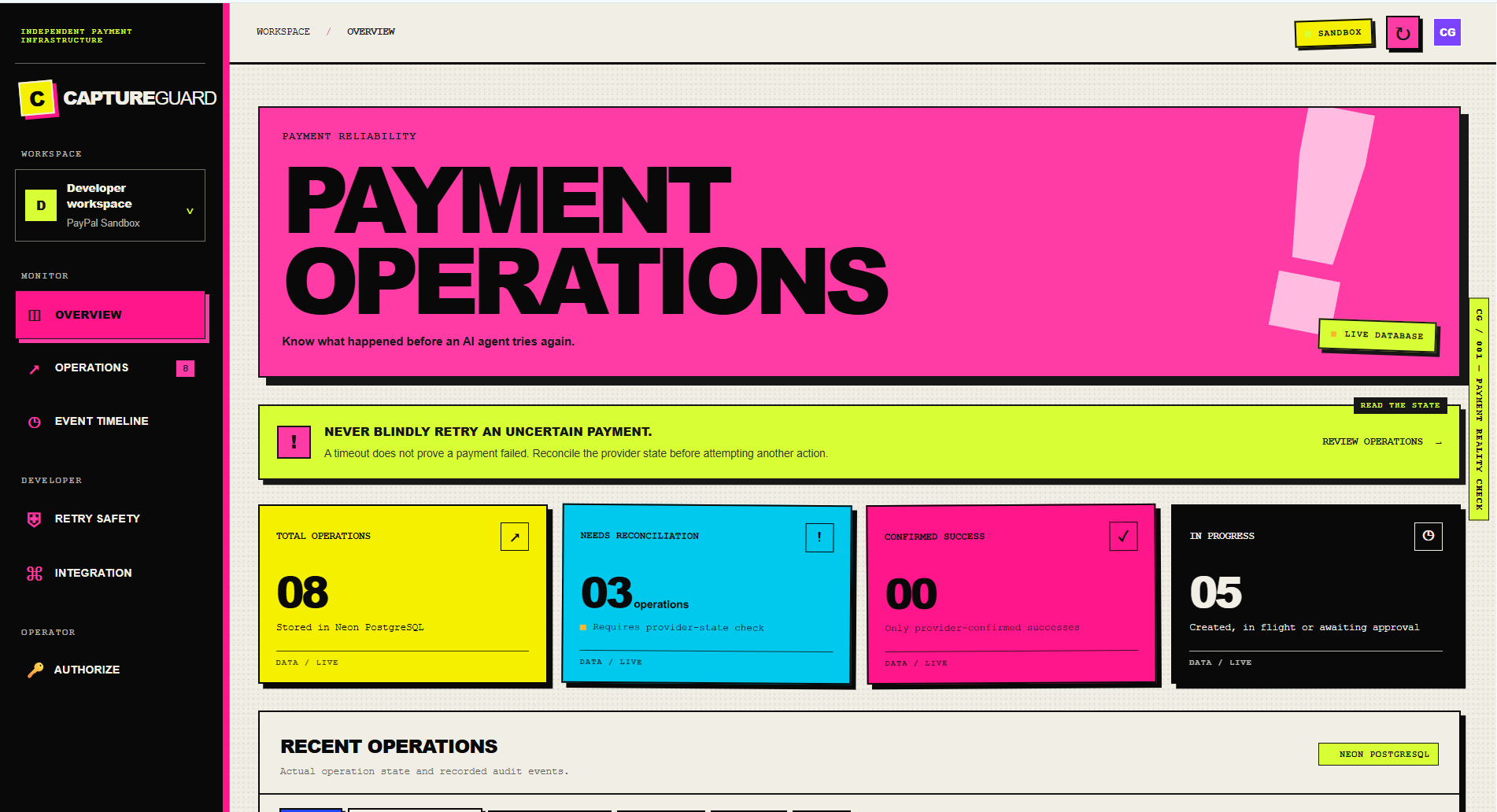
CaptureGuard provides a foundation for managing payment operations and their lifecycle through PayPal's REST APIs.
Key capabilities include:
- PayPal integration: Authenticates with PayPal Sandbox and supports the order creation, approval, and capture workflow.
- Idempotency-aware operations: Uses request identifiers to help prevent duplicate execution when requests are retried.
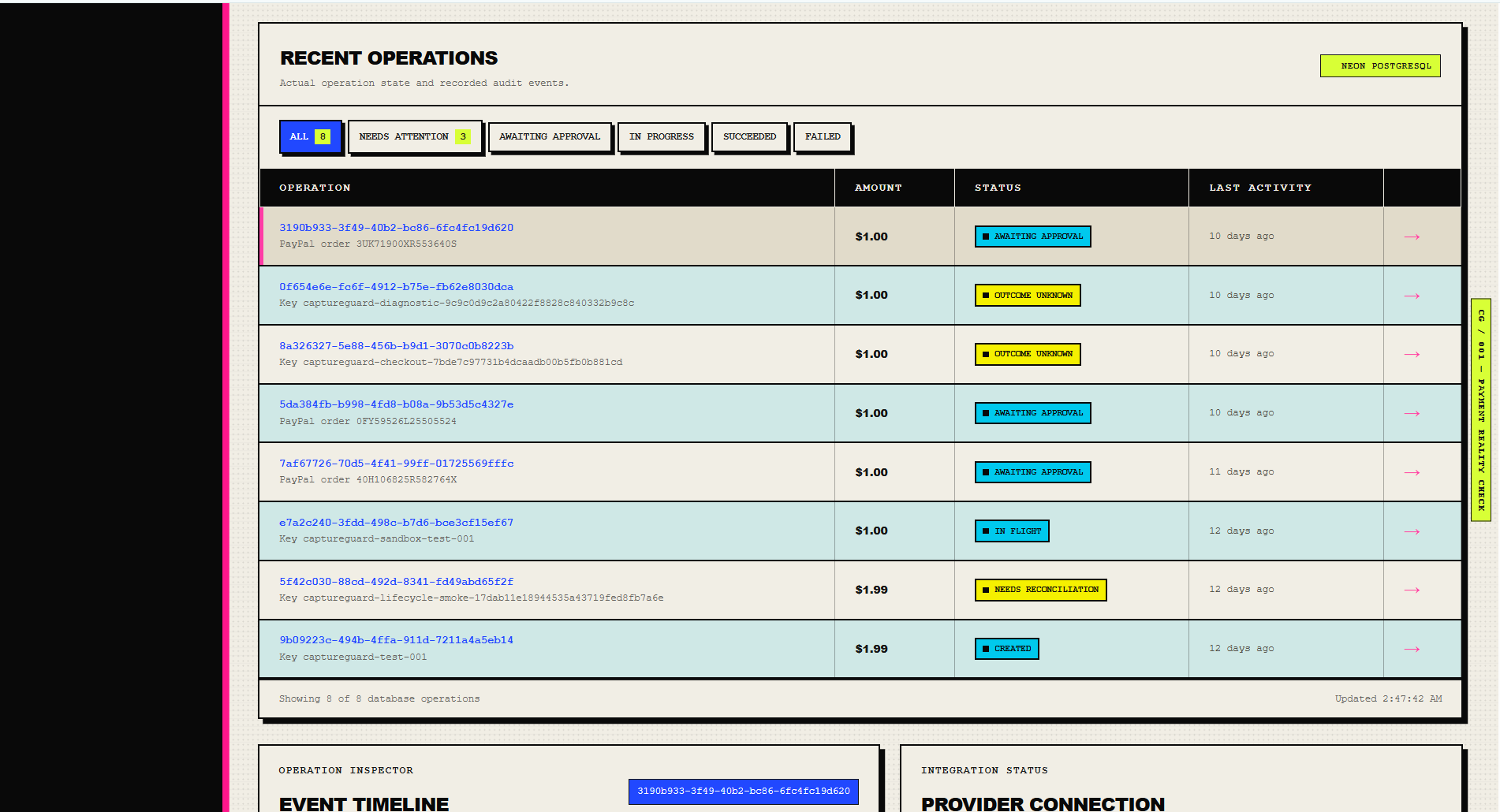
- Durable operation tracking: Uses PostgreSQL to persist operation and idempotency information.
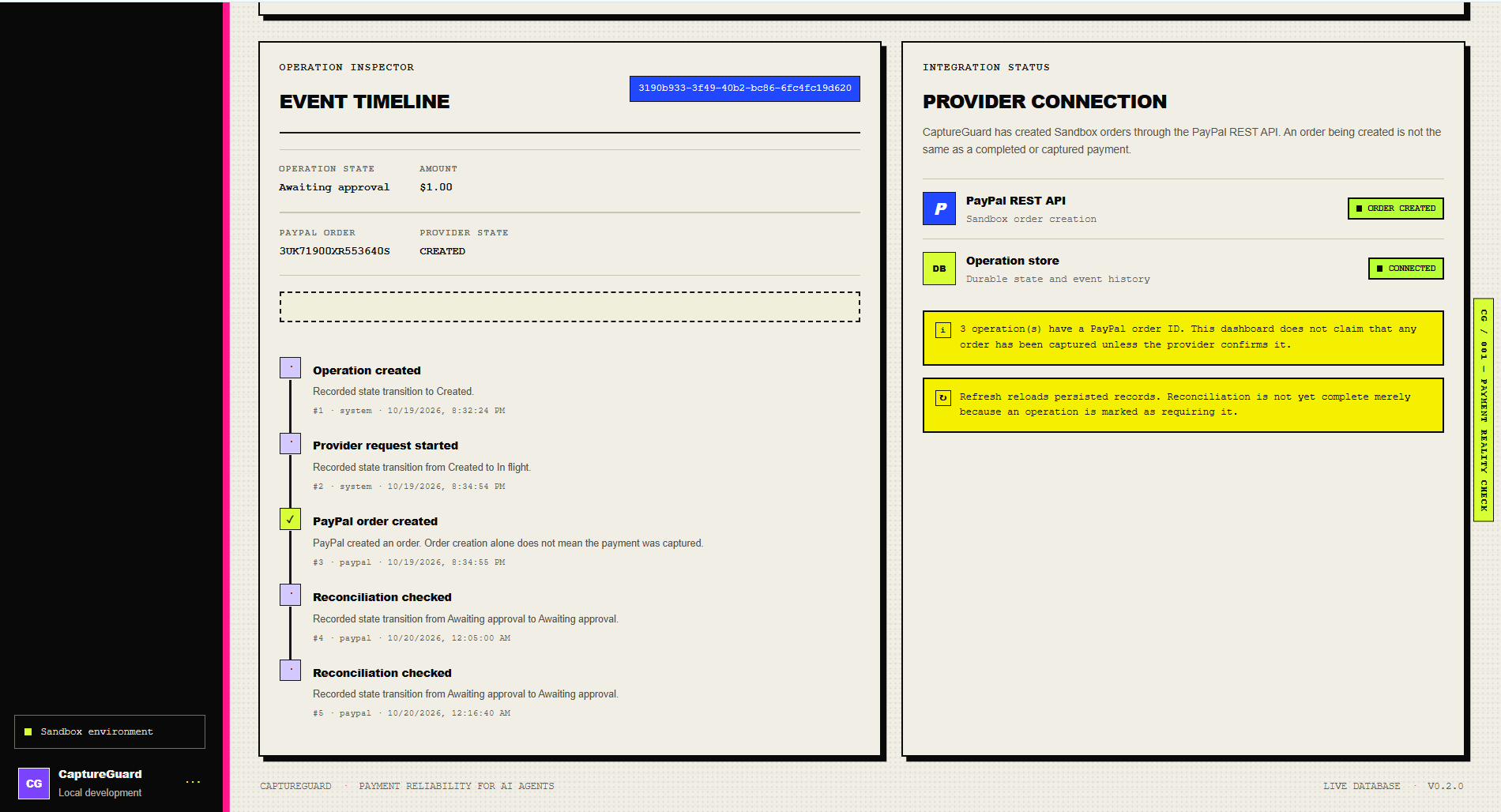
- Outcome verification: Includes order lookup and reconciliation workflows to investigate uncertain payment outcomes.
- Safe failure handling: Avoids treating an ambiguous result as proof of failure. Uncertain operations should be verified before another potentially consequential action is attempted.
- Lifecycle management: Organizes payment operations around explicit states and recovery paths instead of relying on a single request-response cycle.
The central principle is simple: a timeout is not proof that a payment failed.
How We Built It
We built CaptureGuard using Next.js and TypeScript, with PostgreSQL hosted on Neon for persistent storage and PayPal's REST APIs for payment operations.
The application includes API routes for PayPal health checks, checkout, order creation, capture, reconciliation, and operation lifecycle management. It also includes return and cancellation paths for the checkout flow.
We integrated PayPal Sandbox authentication and connected the application to the database. We designed the payment workflow to track operations, use idempotency identifiers, and distinguish uncertain outcomes from confirmed results.
Rather than treating payment recovery as a simple retry loop, the architecture emphasizes explicit operation tracking and verification. This provides a foundation for building more reliable recovery workflows as the system evolves.
Challenges We Faced
One of the main engineering challenges was designing for uncertain outcomes. A network timeout can occur after a remote service has processed a request but before the application receives confirmation. Repeating the request without checking its status can be unsafe.
Another challenge was separating application state from the actual state of a payment provider. Persisted records are important for recovery, but they must not automatically be treated as definitive evidence that a remote payment succeeded or failed.
We approached these problems by incorporating idempotency-aware requests, persistent operation tracking, PayPal order lookup, and reconciliation pathways. We also had to account for configuration and integration boundaries between the application, the database, and PayPal Sandbox.
What We Learned
This project reinforced an important lesson about financial software: reliability is not just about making requests succeed. It is about knowing what happened when requests fail, preserving enough evidence to investigate the outcome, and avoiding unsafe assumptions during recovery.
We also learned how payment APIs, persistent state, idempotency, and reconciliation fit together in a real application architecture.
What's Next
Our next priorities are to validate the complete Sandbox checkout, approval, capture, and reconciliation flow; strengthen recovery behavior through failure-injection testing; and expand automated tests for duplicate requests and ambiguous outcomes.
We also see opportunities to introduce an AI-assisted analysis layer that explains payment failures, summarizes operation histories, and recommends evidence-based recovery actions while keeping consequential payment operations behind deterministic safeguards.
CaptureGuard's long-term goal is to make payment integrations easier to operate, safer to recover, and more trustworthy for developers and customers.
Built With
- devlopment
- fintech
- neon
- next.js
- payment-processing
- paypal
- postgresql
- rest-api
- typescript
- web

Log in or sign up for Devpost to join the conversation.