-
-
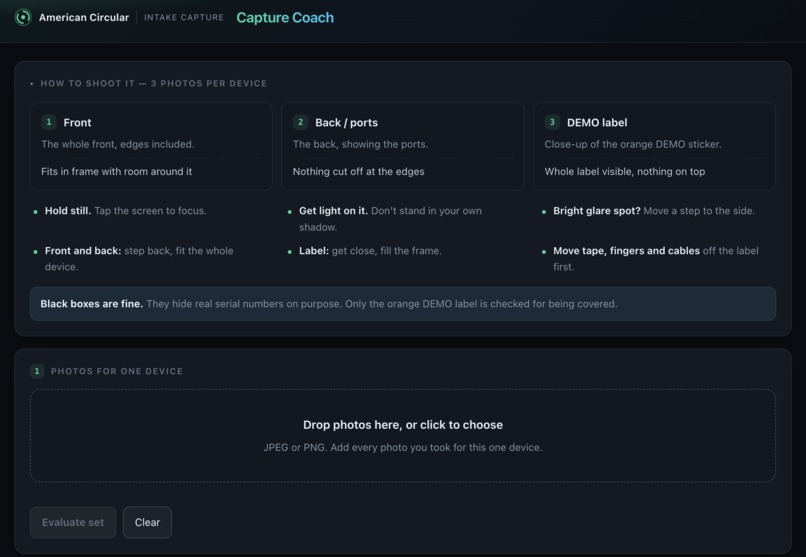
Landing Page
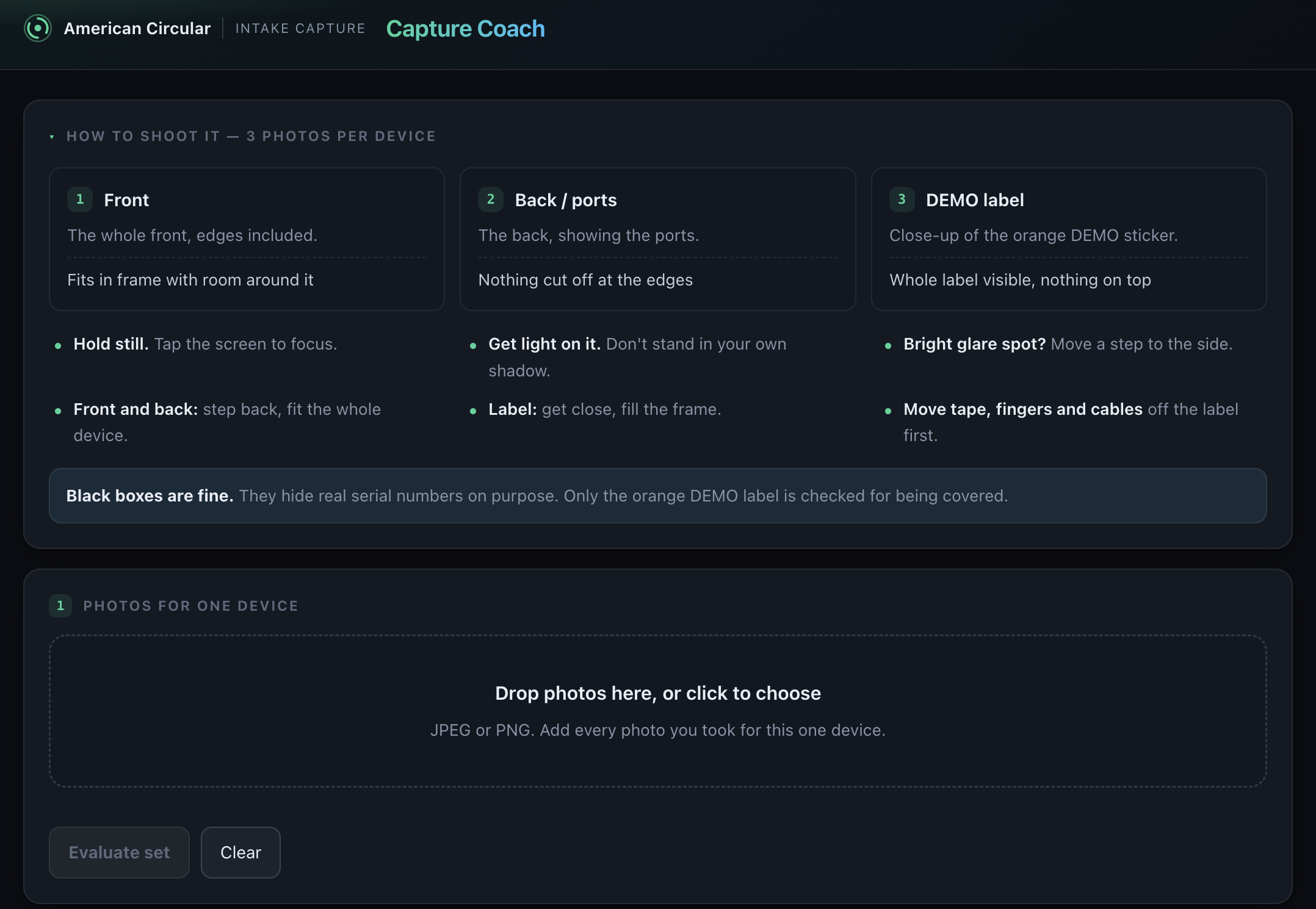
Inspiration
American Circular photographs every unit that comes through the door. That photo set is the first record tied to the device's serial, and it's what the unit gets graded on later. That fix has to happen while the deviceis still in your hands.
What it does
You upload the photos you took of one device and tag each one front, rear/ports, or demo label. It tells you whether each photo is usable, needs a retake, or needs a human to look at it, explains why and gives you something you can actually do eg: Add light or move somewhere brighter. Then it checks the set and cells you which required views you haven't shot at all. Missing and bad are different problems, so we keep them separate.
How we built it
The rule we stuck to: measure anything that can be measured, and only ask the model what a Laplacian can't answer. Blur, brightness, glare and whether the device fits in the frame are all OpenCV. We used claude to determine which view it is and is something covering the DEMO label. It does not overturn a measurement, and it never sees a threshold.
Challenges we ran into
Tape across a label is only a few dozen pixels wide, and we were shrinking photos to 1024px before the model ever saw them. Obstruction detection sat at 3 out of 5 and the problem was that the pipeline shrank the image for the OpenCV maths and then handed the model that same small copy, so raising the model's own resolution limit changed nothing. Once they each got their own copy it went to 5 out of 5.
Accomplishments that we're proud of
The one we're most pleased with is zero false alarms. Not a single good photo got sent back. Telling someone to re-shoot a photo that was already fine is the what we wanted to limit the most which we could.

Log in or sign up for Devpost to join the conversation.