[Inspiration] We're no strangers to alt text
Over 7 million people in the United States live with uncorrectable vision loss. Consequently, in an image-saturated world — with over 100 million photos being uploaded daily to Instagram alone — alternative (alt) text is essential for these populations to access visual information online. Yet, there is a major deficit in the implementation of alt text across all platforms as in 2019, only 0.1% of posts on Twitter contained alt text.
Gen Z with their digitally-integrated lifestyle, heightened concern towards social issues, and imminent entrance in the workforce are posed to shake up the way we interact with technology. Therefore, they hold the most potential in making alt text a mainstream occurrence, which raises a key question: how can we introduce alt text guidelines to Gen Z and apply it to their daily lives?
[Implementation] You know the rules and so do I
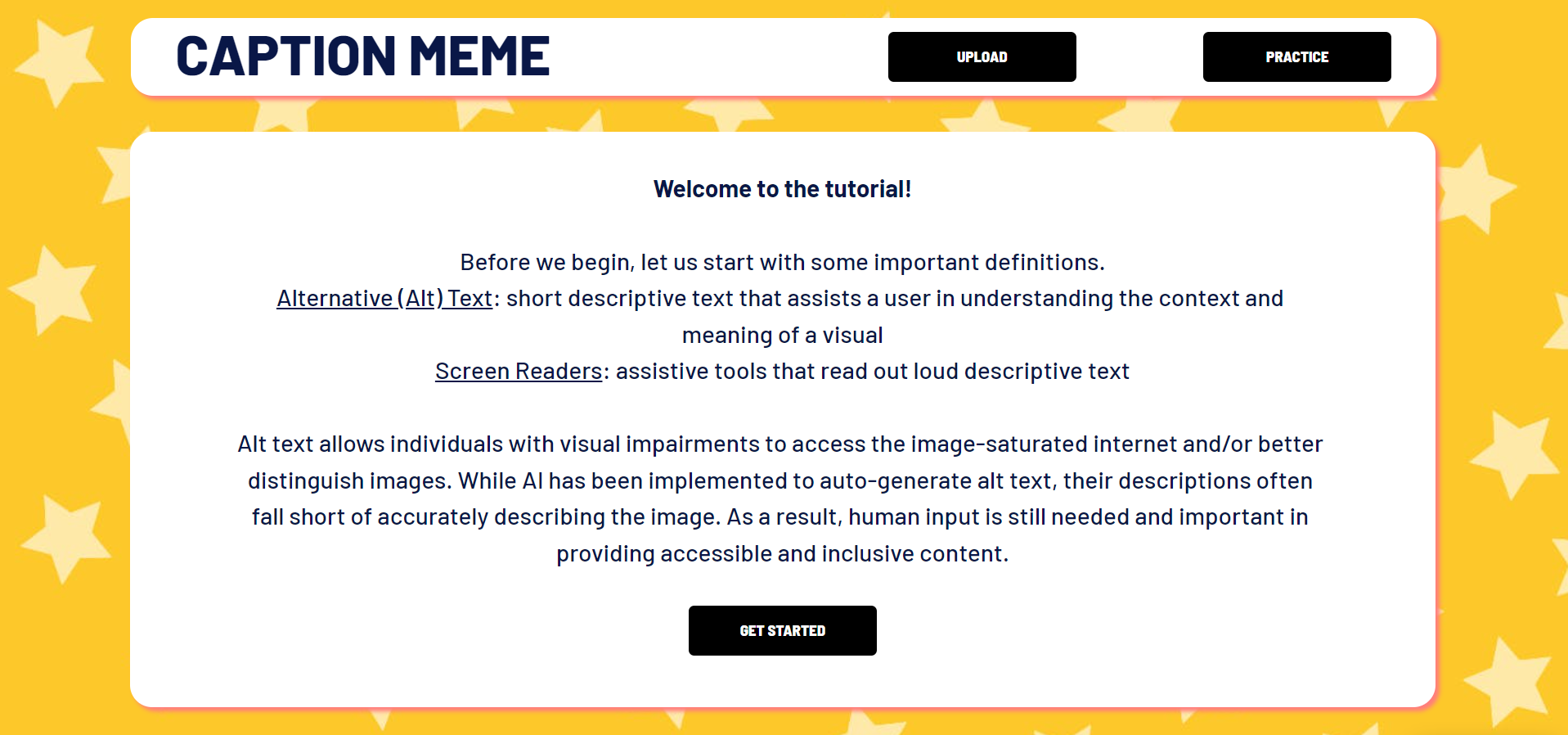
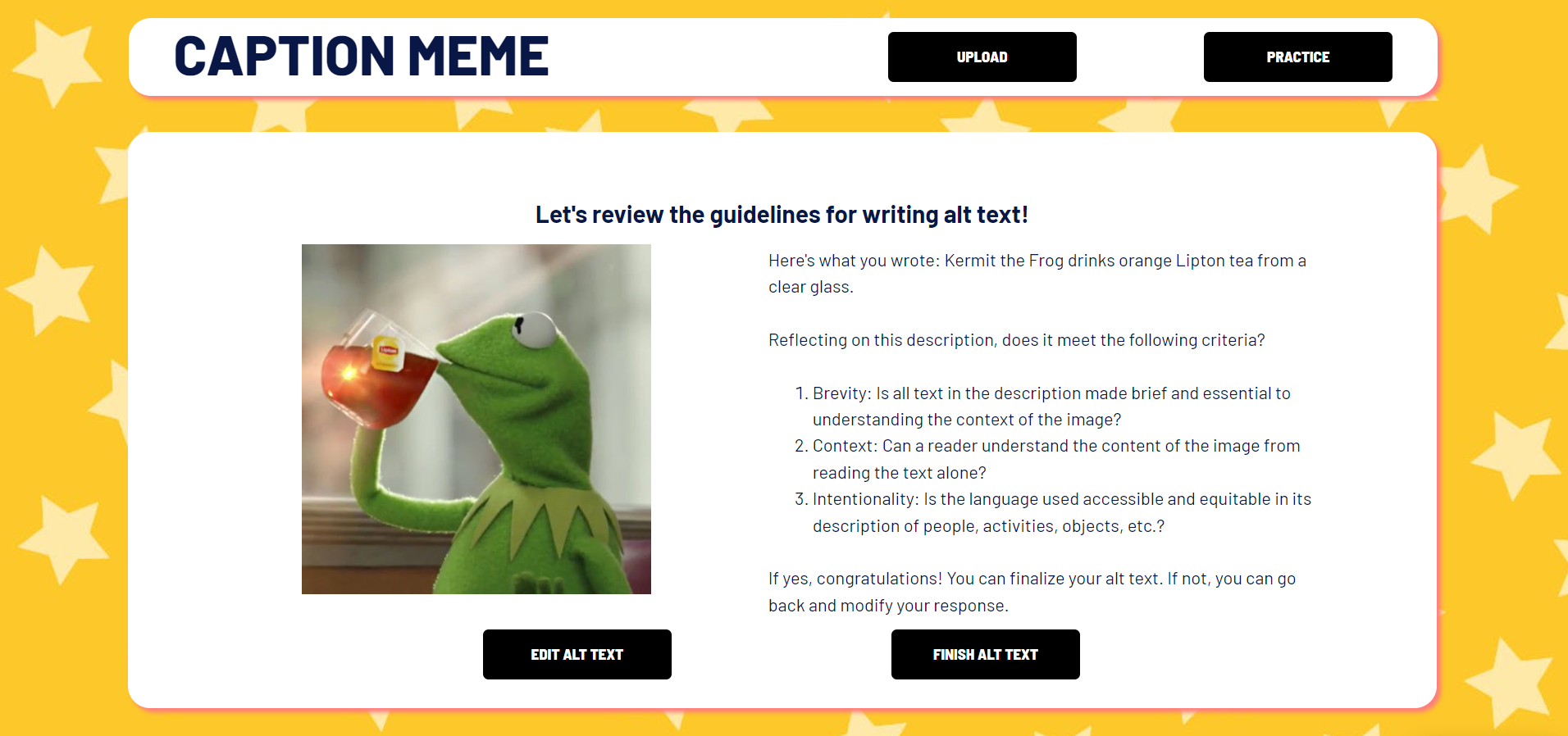
CAPTION MEME is an alt text education web application that teaches users how to implement best practices through memes and user submitted images.
UPLOAD your own images. Users can upload personal or professional images that they want to write alt text for. After uploading their desired images, they will be given a set of prompts to answer around the image's context, which informs what information is necessary to include in the alt text. Once the user writes alt text that they are satisfied with and aligns with all suggested guidelines, they can copy-paste the description for their personal use.
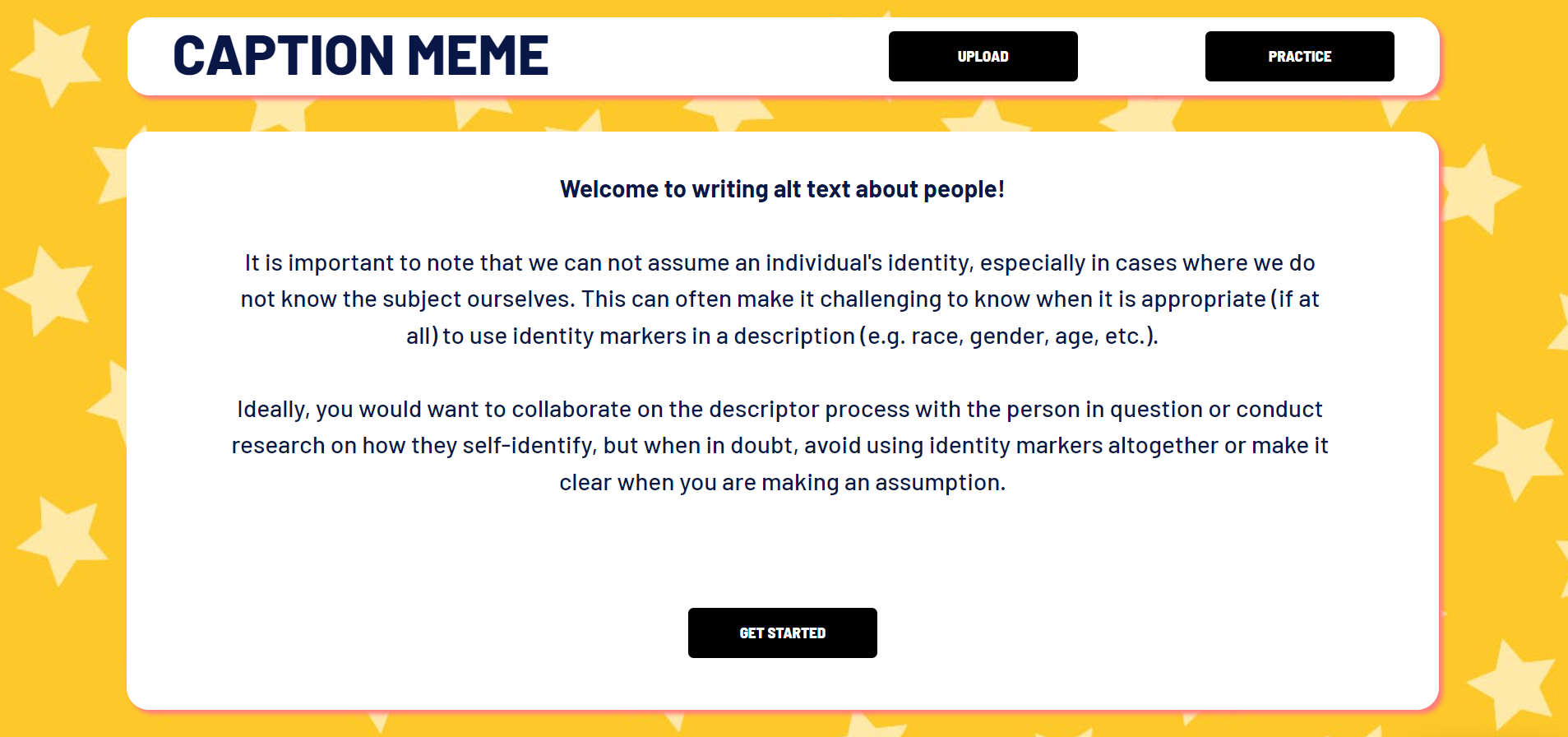
PRACTICE with other images. Users can practice writing alt text through a sample pool of memes. Given the diversity of content, they will be able to choose what topic they want to practice writing about the most (e.g. people, landscapes, objects, etc.) and learn about what specific considerations must be made throughout the process.
[Development] A full commitment's what I'm thinking of
First, research was conducted to better understand how alt text is created and distributed across the internet, which allowed for a focused problem statement. Afterwards, this application was built entirely within bubble.io after a few rough wireframes were drawn out.
[Challenges] You wouldn't get this from any other girl
Personally, I am pursuing Business major with a Writing minor, which means that this hackathon posed a significant technical challenge given my lack of coding experience. As a result, a lot of my time early on in the hackathon was spent familiarizing myself with the capabilities of the bubble.io platform as well as conducting research on alt text guidelines and what disability activists in the space were saying to make sure that I wasn't replicating past work or spreading misinformation.
[Accomplishments] I just wanna tell you how I'm feeling
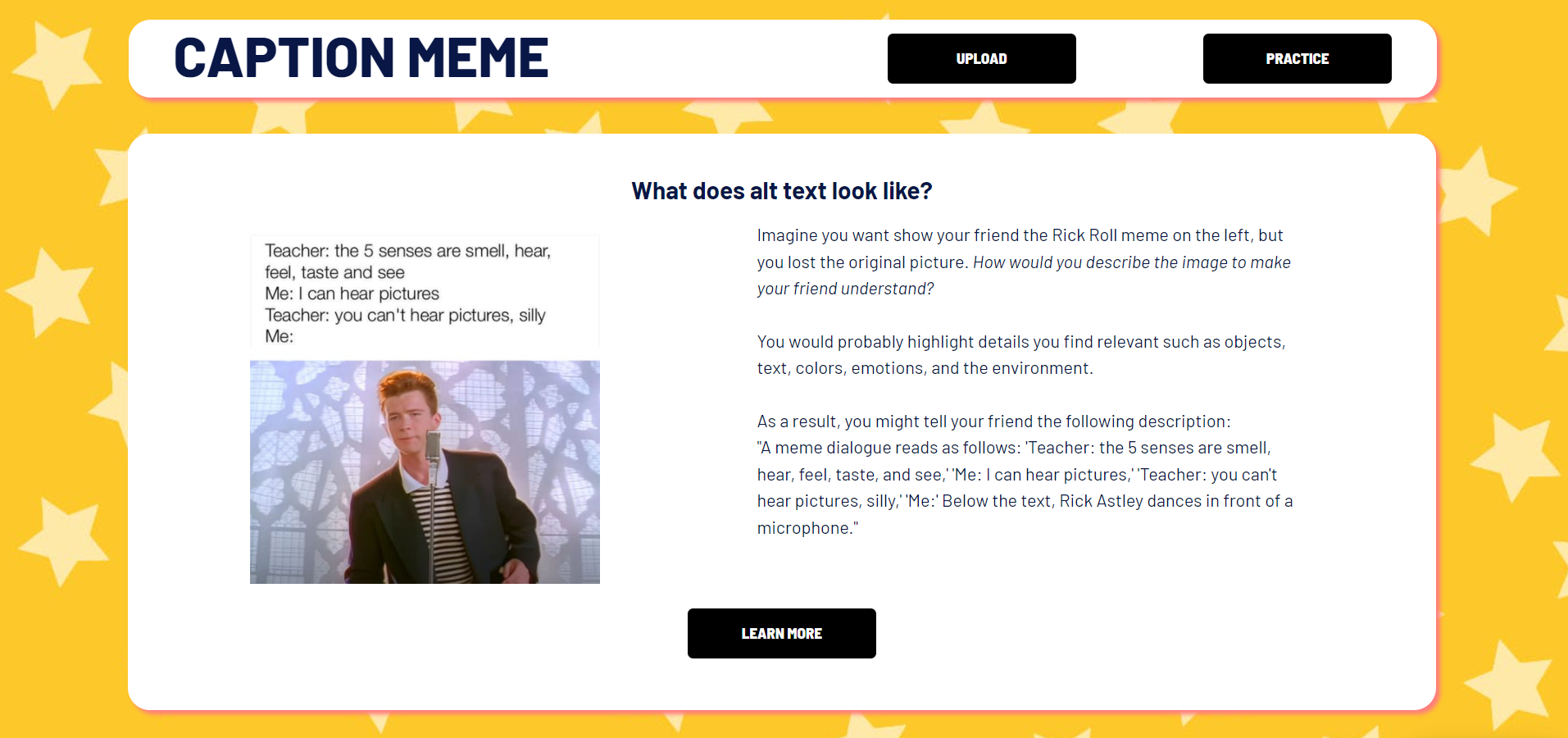
Honestly, I'm really happy that I was able to create a functional prototype and challenge my understanding of what I'm actually capable of creating over the course of a weekend. Reading about work being done with disability rights has also been really enlightening and has motivated me to become more informed moving forward. Plus, the Rick Roll is a nice bonus!
[Lessons] Gotta make you understand
This hackathon, I learned how to execute an idea from concept to prototype while learning to enjoy the process by taking some creative liberties in my project. It has really opened my eyes on what I can contribute with a fairly limited technical background, which is exciting to think about what I can create on my own (and with a team) in the future.
[Future] Never gonna give you up
Of course, the first thing I'm going to do is never let you down. But, here are some next steps:
- Add more topics to practice and increase the meme example pool with randomization feature
- Implement a rating system or quality checker for user generated alt text
- Develop an interactive crowdsourcing system around user submitted content
- Create a resource tab highlighting relevant resources, individuals, and organizations
[Ethics] Never gonna run around and desert you
Currently, 7 million people in the United States live with uncorrectable vision loss, of which 1.6 million are under the age of 40. In order to navigate our increasingly online world, these people rely on screen readers or other assistive technologies to make technology more accessible to them. However, implementing a fully accessible digital framework is often a forethought as accessibility is commonly viewed as needing to be accommodated for on a case-by-case basis instead. This forethought creates access inequalities not only for blind and low vision users but also for everyone else, even when they don’t report having a disability, given that accessible digital resources allow everyone to freely participate in a conversation without having to seek accommodations in the process.
While making technology fully accessible requires a sizable amount of capital up front, which can adversely affect smaller organizations at the start, intermediate actions can still be taken to bridge the gap in digital access through providing close captioning and alt text to visual artifacts.
Through CAPTION MEME, promoting awareness of alt text and encouraging its implementation in daily life allows blind and low vision users to better navigate the internet and understand contextual information. Furthermore, through exposure to descriptions containing various cultural elements written by people within those communities, a nation’s cultural sensitivity can be greatly heightened given the viral reach of social media content.
However, there is no right way to create alt text, which places quality control on the creator. In some instances, alt text has the potential to become weaponized given a writer’s internal biases and interpretations of events, creating a misleading image for readers. Furthermore, general laxness on writing accurate alt text can lead to instances where it would be more favorable to have not had alt text at all.
To avoid these sub-par alt text descriptions, CAPTION MEME users go through an interactive revisionary process where guidelines and sample alt texts are used to question and clarify the purpose of a description. There is also an awareness on what examples are being shown to users during their practice writing sessions and a move to diversify the images to represent a variety of experiences and scenarios (e.g. Rick Astley, Simu Liu, Kermit the Frog).
Moving forward, further exploration needs to be made in verifying the accuracy of the sample alt texts by giving the descriptions to individuals who have not seen the original image. Additionally, given that the current prototype is self-directed, a false sense of security could be generated within a user about their abilities to write effective alt text. Given that the nature of alt text varies person to person, a quality checker or crowdsourcing pool could provide an additional level of verification to ensure the quality of an individual’s writings.
Overall, ethical considerations were a large part of the design process and can be perceived by users when they read the alt text guidelines they should follow and keep in mind, but further considerations can be communicated through resource tabs and hyperlinks to supporting research that provides credentials to back up best practices.
Built With
- bubble.io

Log in or sign up for Devpost to join the conversation.