-
-
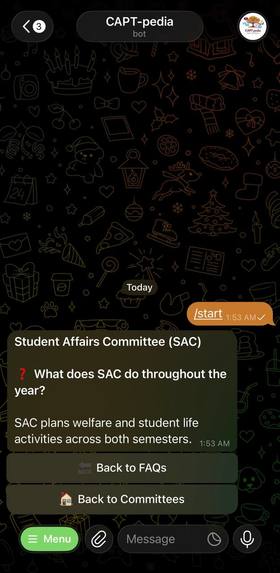
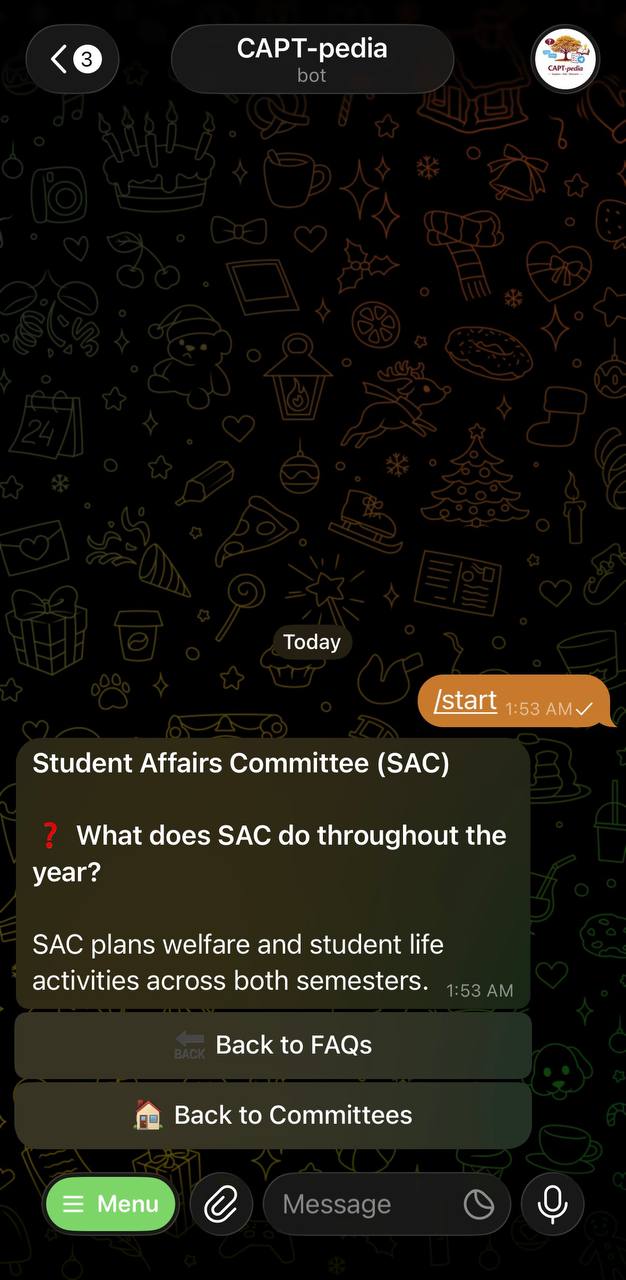
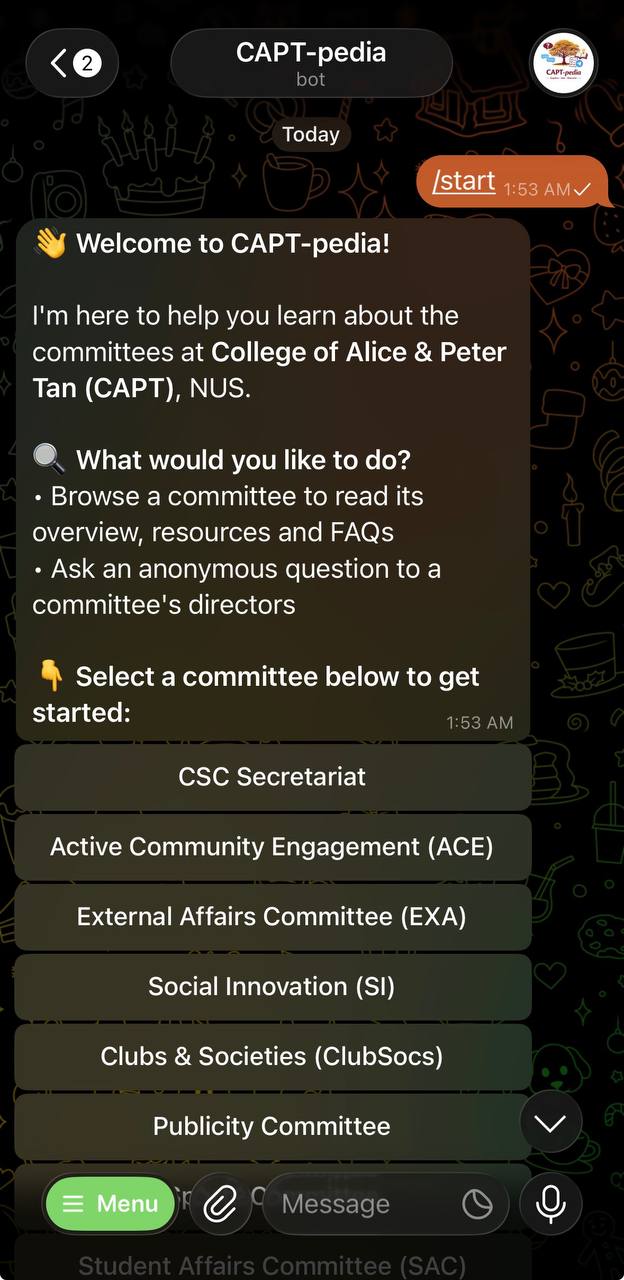
/start to start CAPT-pedia
-
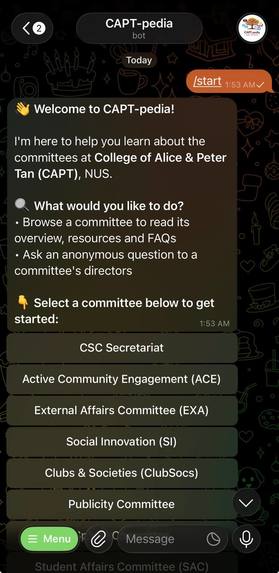
Select a Committee to view more information on
-
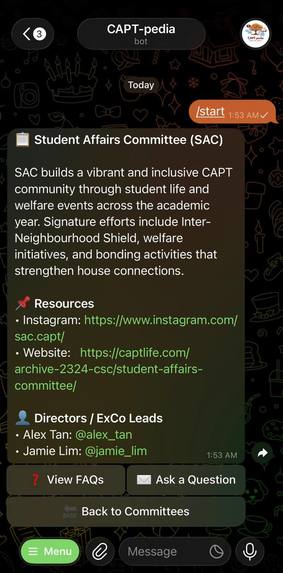
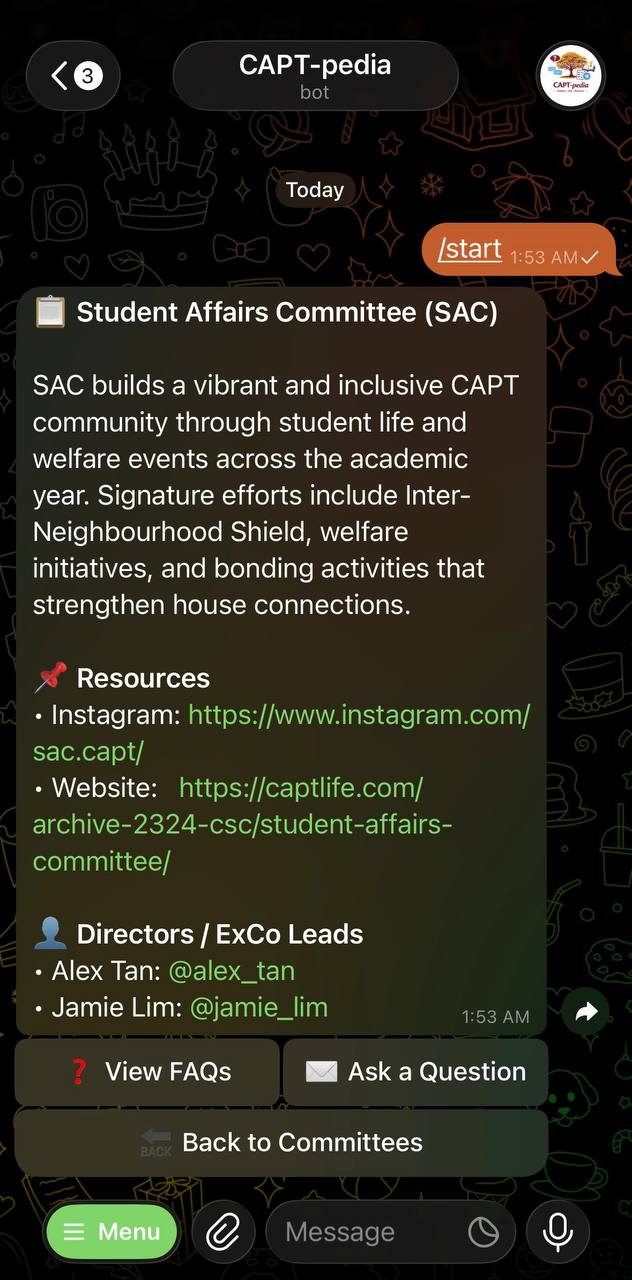
Information for Committees
-
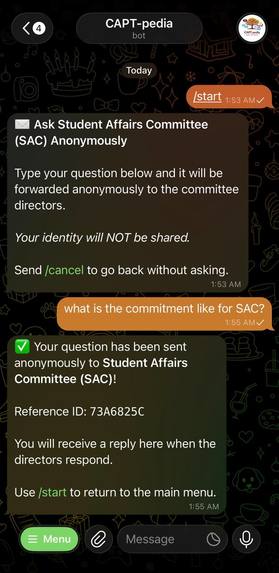
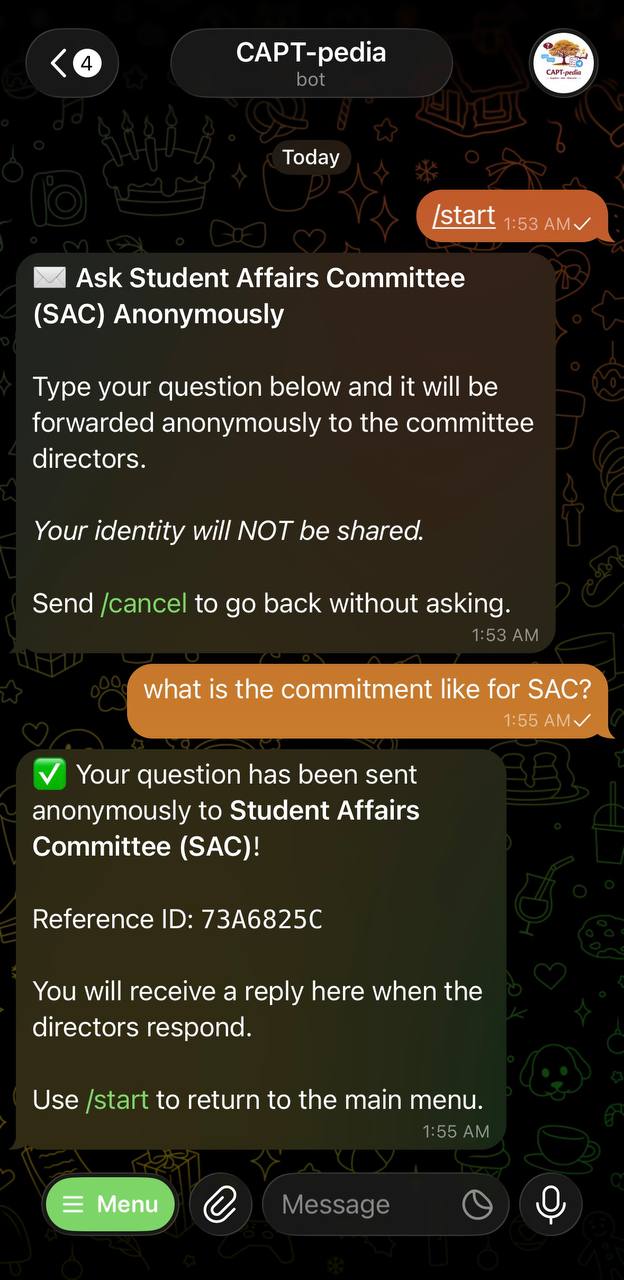
Asking questions anonymously to Directors of Committees
-
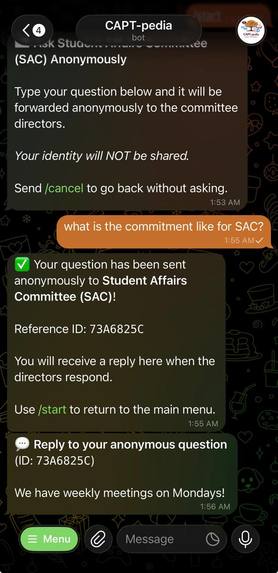
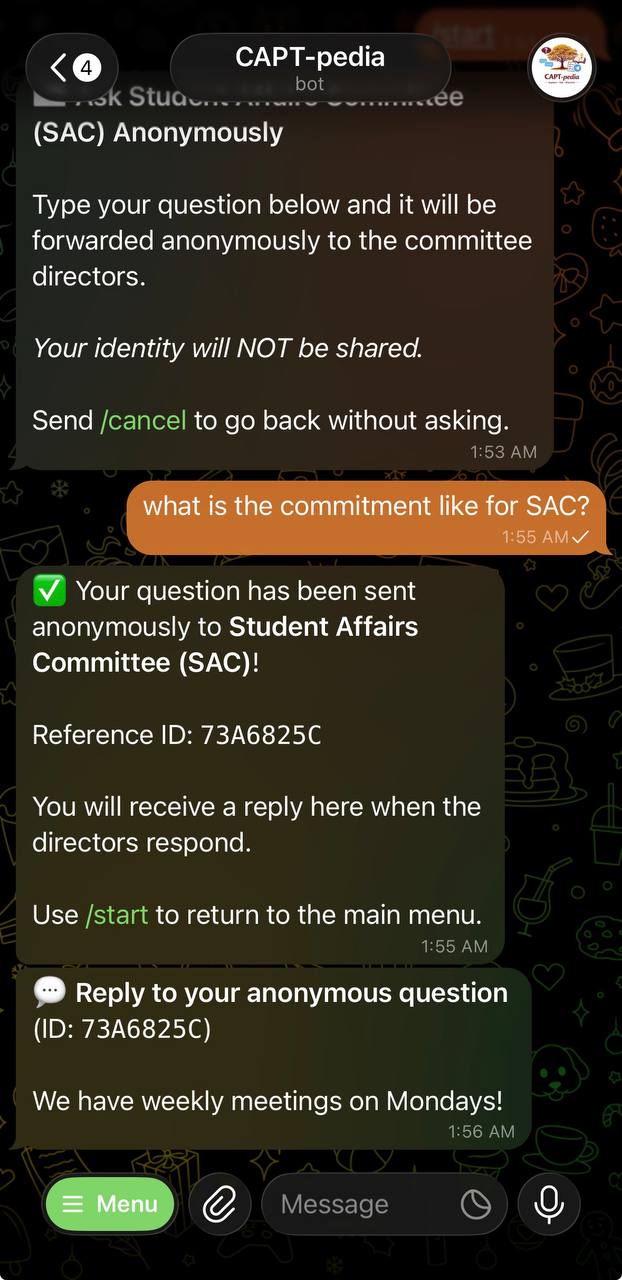
Receiving answers from the Directors
-
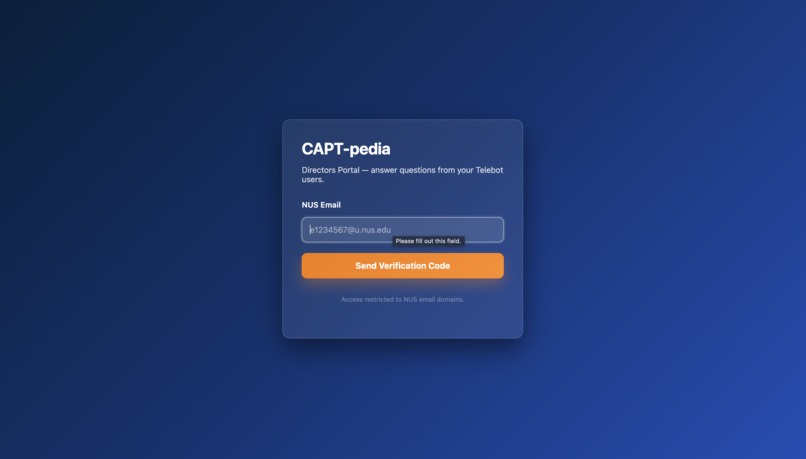
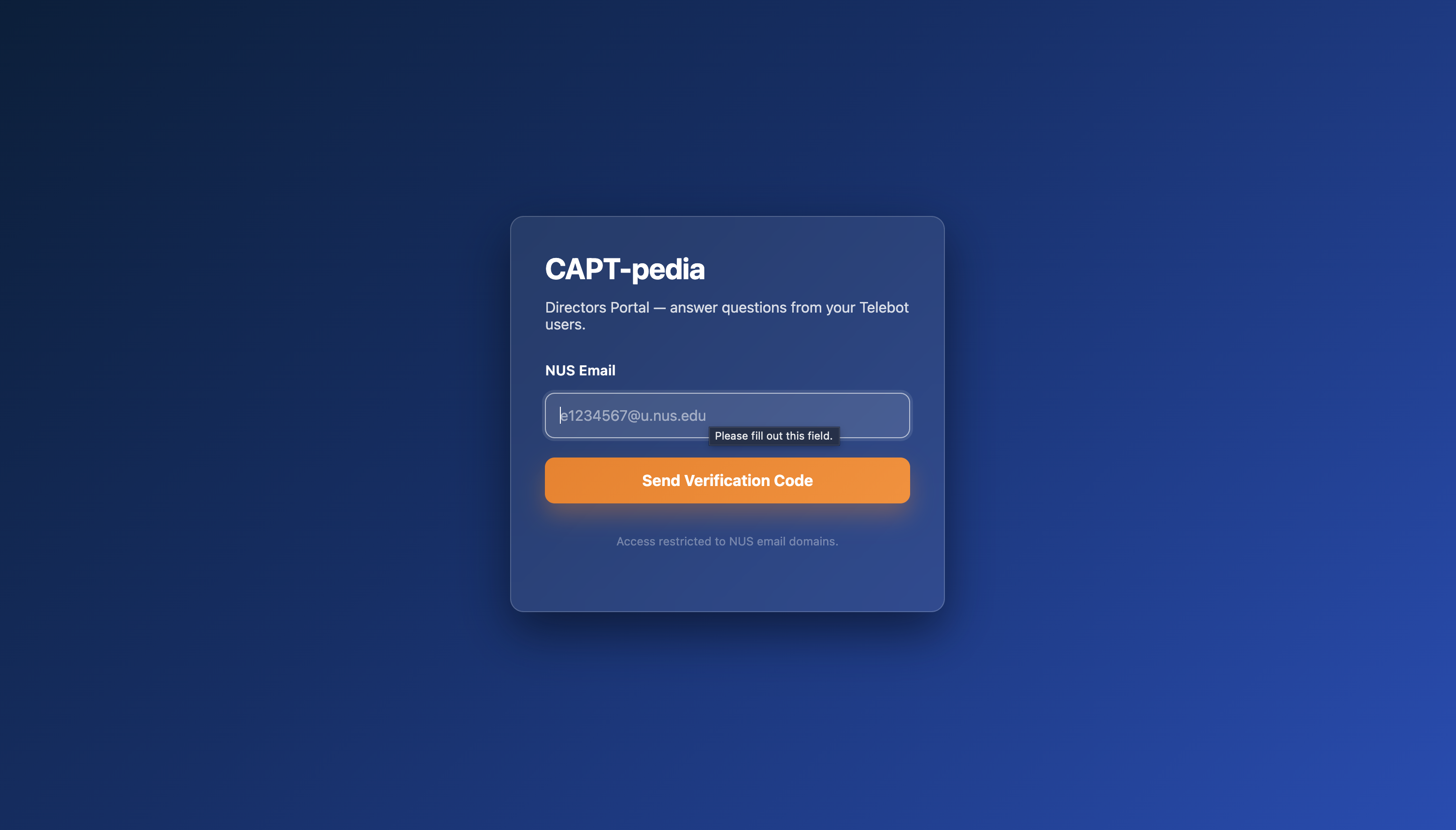
Log in page for directors
-
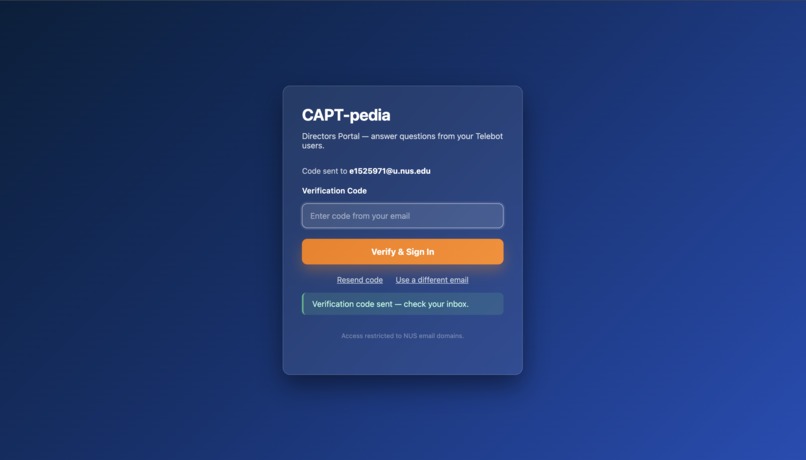
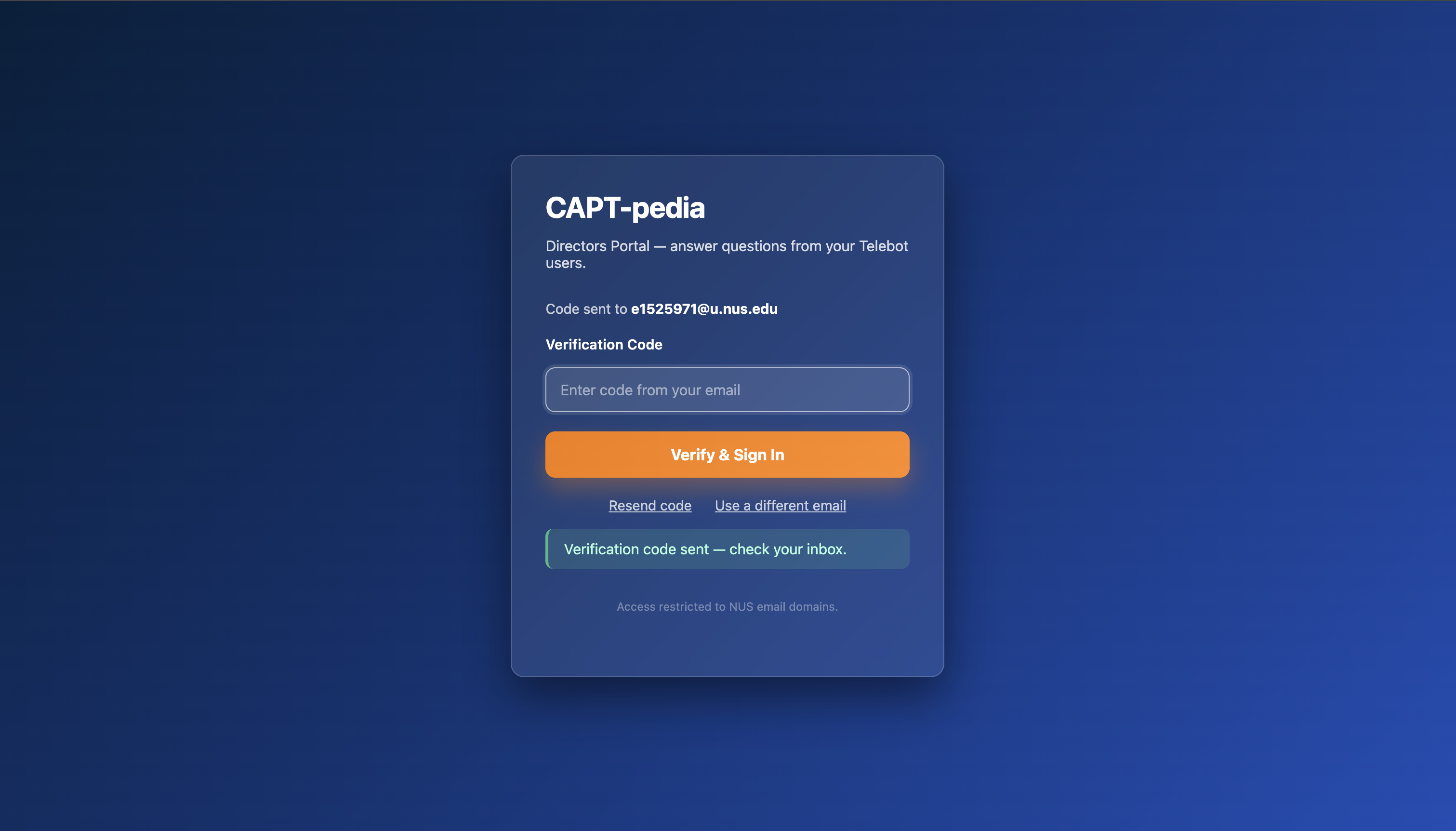
OTP page
-
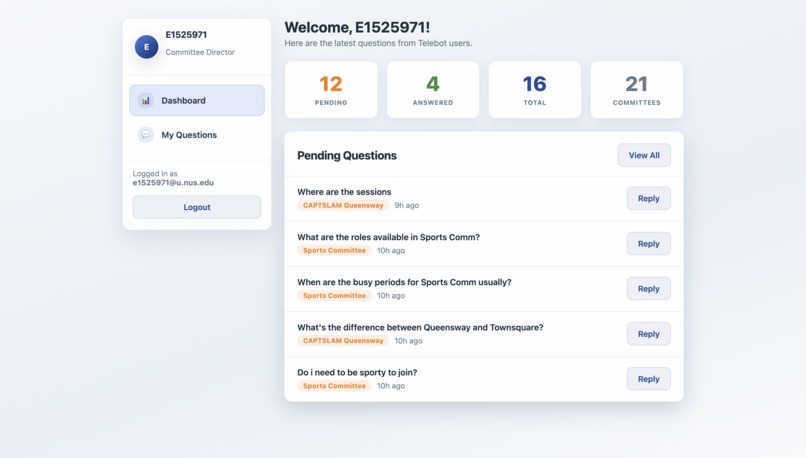
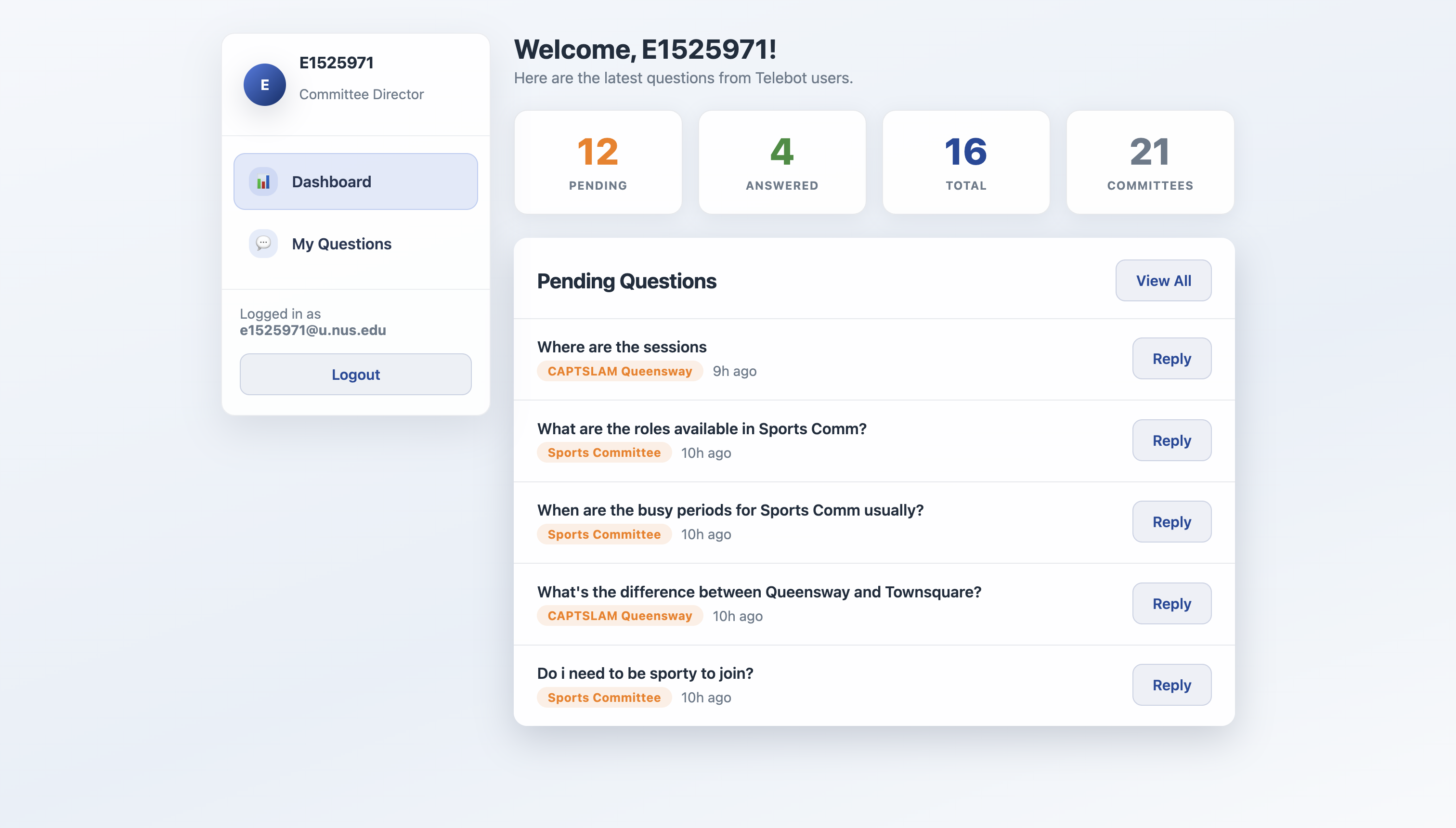
Dashboard to view basic statistics such as number of answered and unanswered questions
-
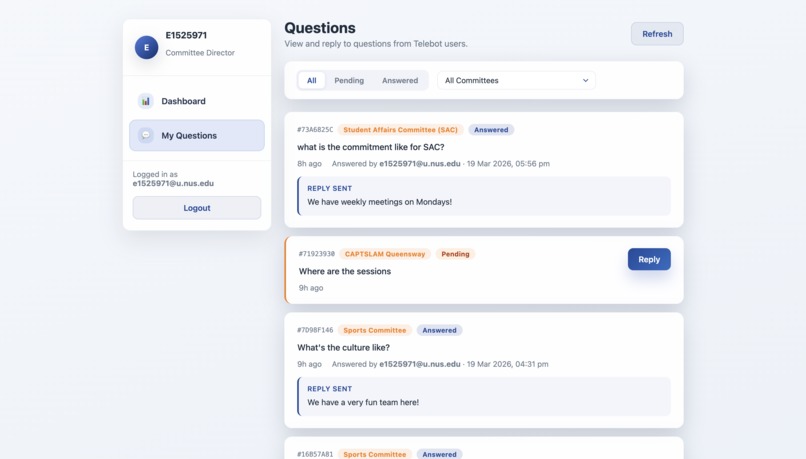
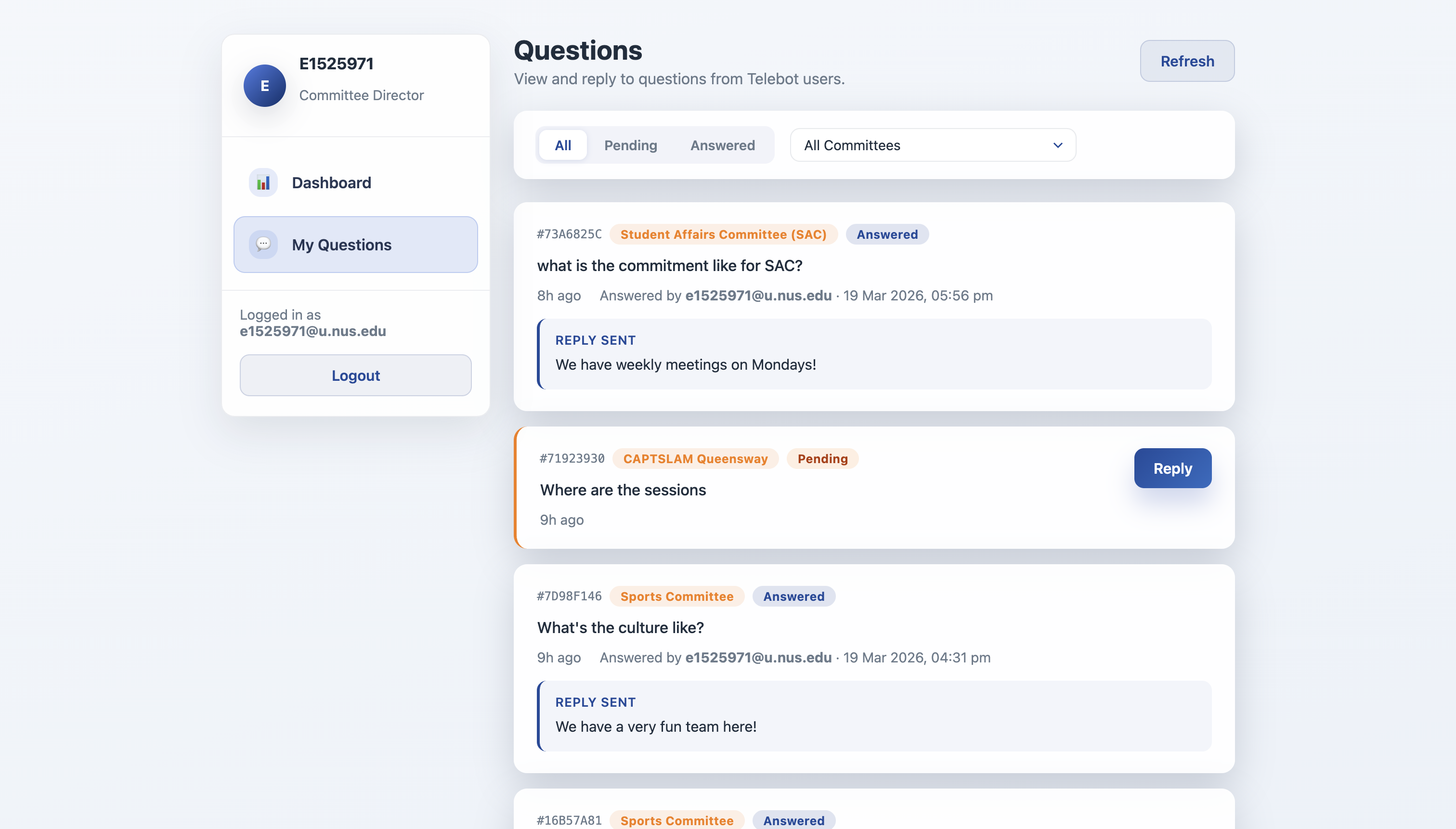
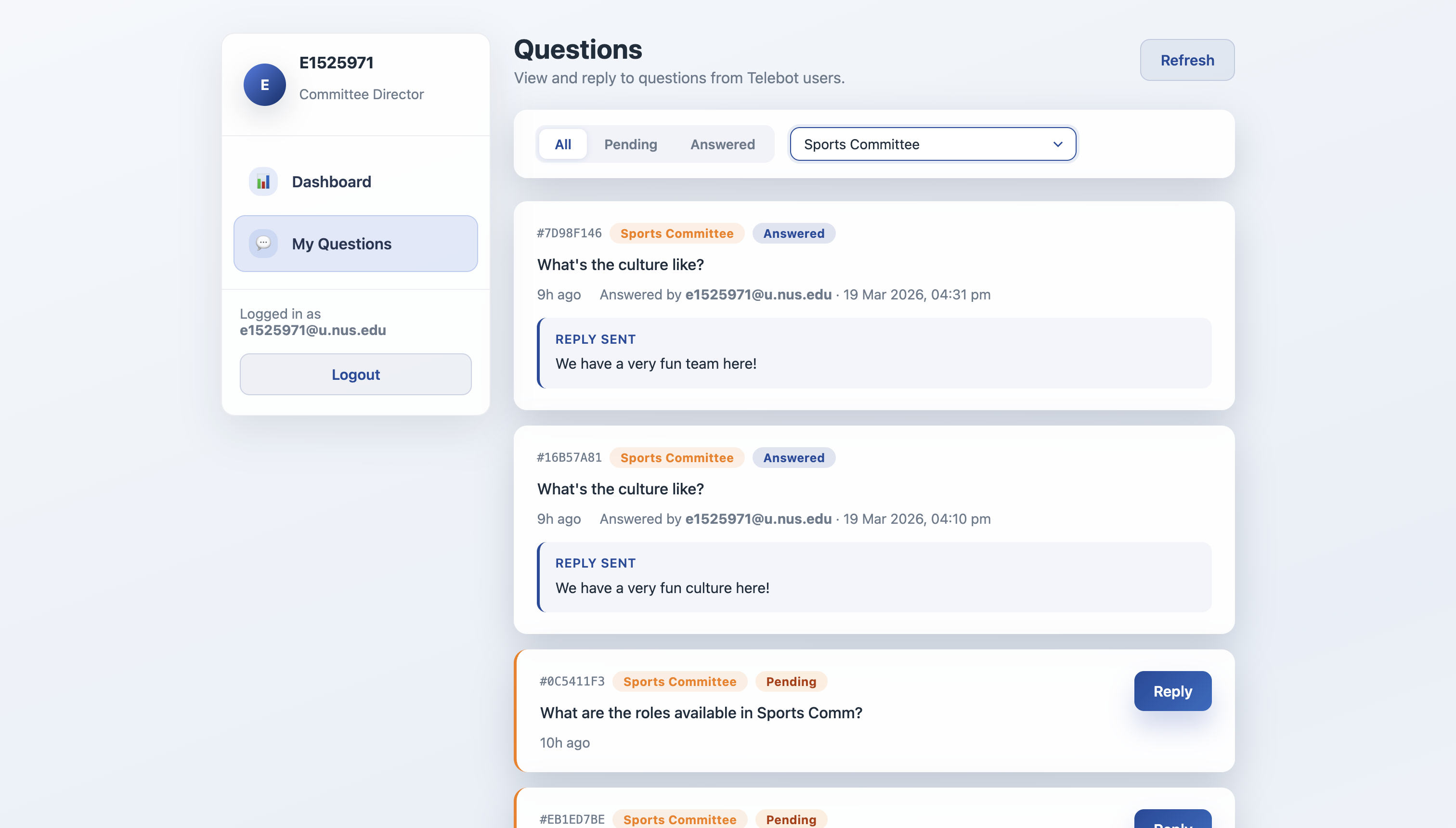
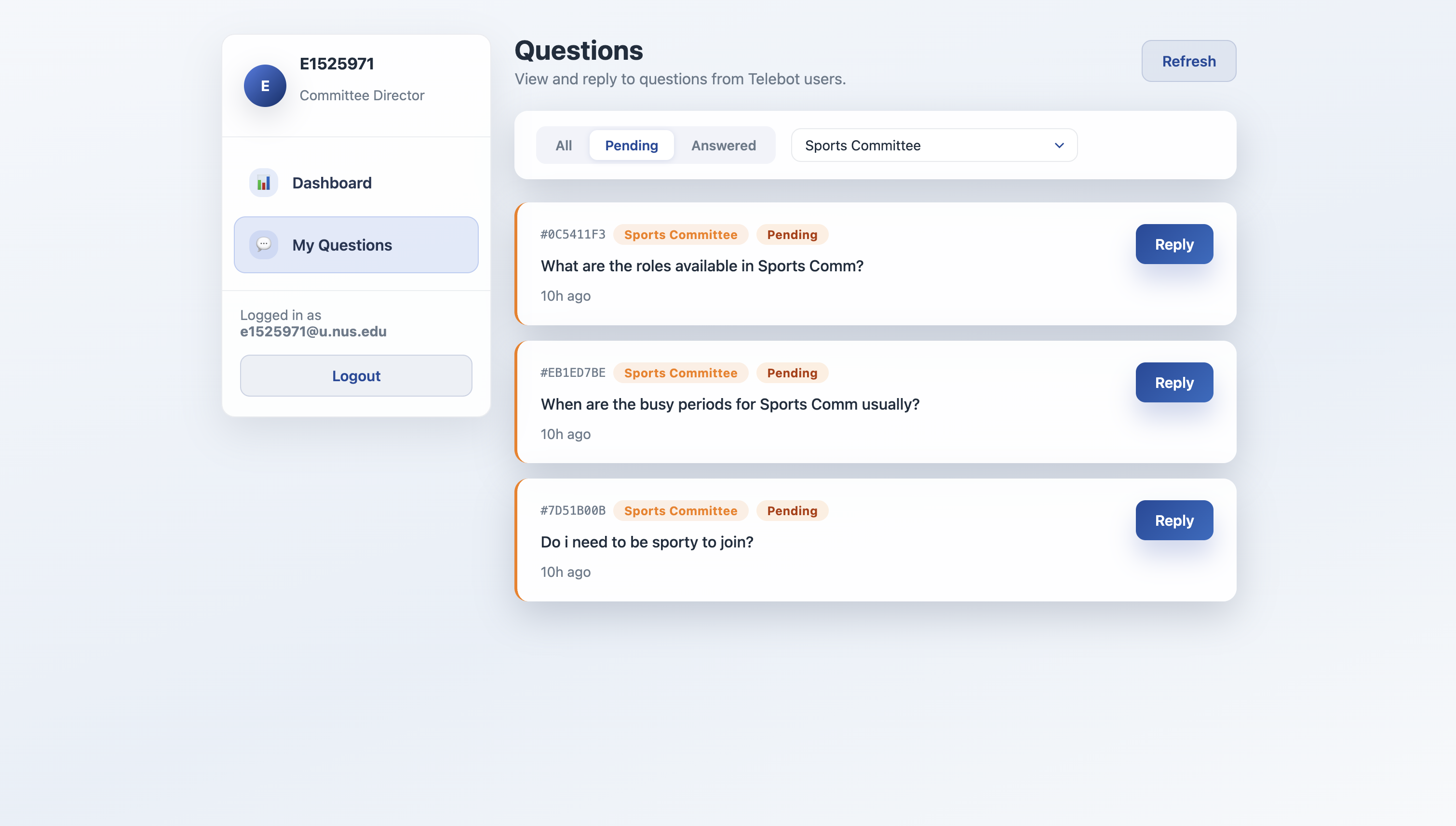
Page to view all questions
-
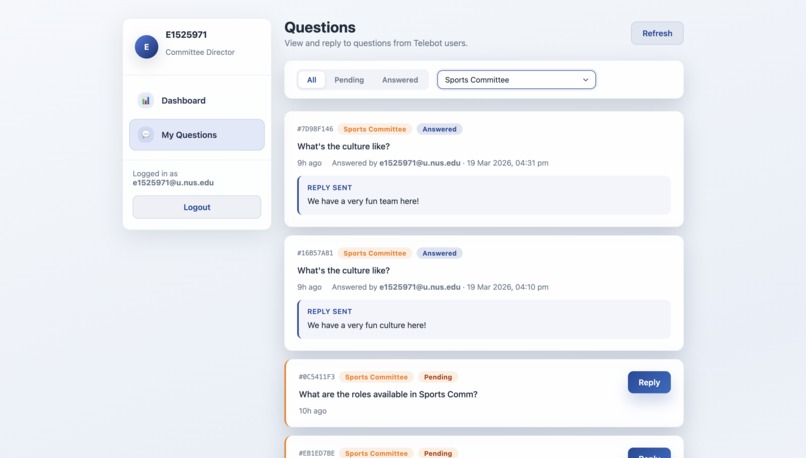
Option to sort questions by committees
-
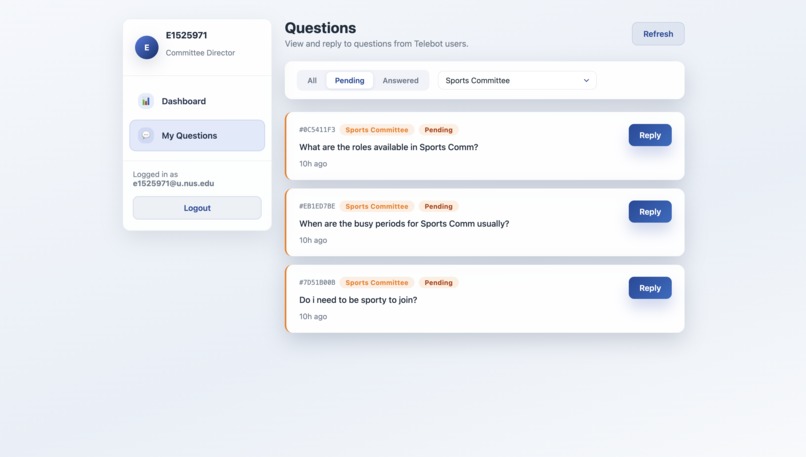
Option to sort questions by answered and unanswered
Inspiration
Having experienced our first semester in RCs, we recall feeling overwhelmed by the sheer number of committees and opportunities available. While there was no shortage of information, it was scattered across multiple platforms—such as Instagram pages, word-of-mouth, and Telegram chats—making it difficult to navigate and piece together a clear understanding of each committee. At times, the information felt inconsistent or outdated, and comparing different options was both time-consuming and confusing.
We believe there is a need for a more structured, accessible, and student-friendly way to discover and engage with RC committees. Additionally, asking questions can feel intimidating, which limits their perspectives.
Together, we came up with a solution with our incoming freshmen in mind, where they can navigate the transition into CAPT student life with greater clarity and confidence.
What it does
We propose a Telegram bot-based platform (built on Telegram) that centralises information about all Residential College (RC) committees and provides an intuitive, chat-based interface for freshmen to explore their options.
Upon starting the bot, users are presented with a menu of available committees. By selecting a specific committee, the bot sends a structured message containing a concise overview of the committee, including its roles and responsibilities, expected commitment level, and application details. This message also includes relevant links such as the committee’s Instagram page, Telegram channel, and contact details of project directors. Users can further navigate through interactive prompts to view frequently asked questions (FAQs) about the selected committee, allowing them to quickly access common information without needing to search across multiple platforms.
For queries that go beyond the provided FAQs, the bot includes a feature that allows users to submit personalised questions anonymously. These questions are routed to a centralised web-based dashboard accessible by committee project directors, where they can view and respond to incoming queries. Responses are then relayed back to the user through the bot, ensuring a seamless and private communication channel. This anonymity feature helps to lower social barriers, encouraging freshmen—especially those who may feel shy or hesitant—to ask questions more freely.
Overall, the bot functions as a single, organised touchpoint within Telegram, reducing information fragmentation and providing freshmen with a convenient, accessible, and user-friendly way to explore and engage with RC committees.
How we built it
CAPT-pedia is a full-stack Telegram-to-web Q&A platform built for CAPT committees. It combines a Python Telegram bot (python-telegram-bot) with a FastAPI directors portal, backed by a shared SQLite/SQLAlchemy database. Freshmen browse committee info and submit anonymous questions through Telegram, while directors authenticate via email OTP (SMTP + JWT cookie session), view pending questions in a React/Vite dashboard, and send replies that are delivered back to users through the Telegram Bot API. The architecture is modular and lightweight, with secure OTP controls, domain restrictions, hashed verification codes, and a clean pending→answered workflow across bot and portal interfaces.
Challenges we ran into
One of our biggest challenges was collaboration workflow. Most of us were still new to using GitHub in a team setting, so we ran into some merge conflicts when multiple people edited the same files at the same time. At first, we were unsure how to resolve conflicts cleanly, and we occasionally overwrote each other’s work by mistake. This slowed us down, but it also pushed us to learn better branching habits, commit hygiene, and how to review pull requests before merging.
Another challenge was picking up unfamiliar technologies quickly. For example, implementing email OTP login required us to learn SMTP configuration, secure credential handling with environment variables, and OTP expiry/validation logic. It was our first time wiring these authentication pieces end-to-end, and debugging email delivery issues took significant trial and error.
Accomplishments that we're proud of
We are proud that we were able to overcome real development challenges, especially resolving merge conflicts while collaboratively working on the same codebase. Through trial, error, and extensive research, we learnt how to properly use GitHub as a team and adapt our workflow to avoid future conflicts.
Beyond the technical aspects, we are especially proud of our idea itself. CAPT-pedia is not just a project we built for a hackathon, it is something directly relevant and useful to our residential college. By creating a centralised platform for freshmen and EXCO members, we are contributing back to a community that we feel a strong sense of belonging to.
What we learned
Throughout this project, we gained hands-on experience with tools and concepts that we had not fully explored before. This includes using GitHub effectively for collaboration, building and deploying a Telegram telebot, and developing a web platform with authentication that integrates seamlessly with the bot.
We also learned how to debug real-world issues such as merge conflicts, and more importantly, how to work as a team under time pressure and amidst our busy schedules while continuously iterating on our solution.
What's next for CAPT-pedia
If given the opportunity, we plan to roll out CAPT-pedia to CAPT in the next academic year for incoming freshmen. This will allow us to gather real user feedback and iteratively refine the platform based on actual usage patterns and needs.
In the next phase, we aim to enhance the overall user experience by improving UI/UX for smoother navigation, expanding the breadth and depth of committee information, and strengthening the technical infrastructure to ensure scalability and reliability as adoption grows.
We also plan to introduce an AI-powered response system to handle anonymous questions. The AI will provide instant answers based on available information, reducing response time and improving accessibility. In cases where sufficient information is not available, the system will automatically escalate the query with a message such as: “We currently do not have enough information to answer your question, your query has been forwarded to the relevant EXCO.” The question will then be routed to the web dashboard for manual follow-up.
Additionally, we will implement a more refined question-routing and filtering system. Currently, all EXCO members can view all submitted questions, even if they are not relevant to their committee. We plan to restrict visibility so that each EXCO only receives and manages questions directed to their specific committee, improving efficiency, privacy, and clarity in handling queries.
Ultimately, we envision CAPT-pedia as a long-term, evolving platform that supports both freshmen and EXCO members, streamlining communication and strengthening the college community.


Log in or sign up for Devpost to join the conversation.