-
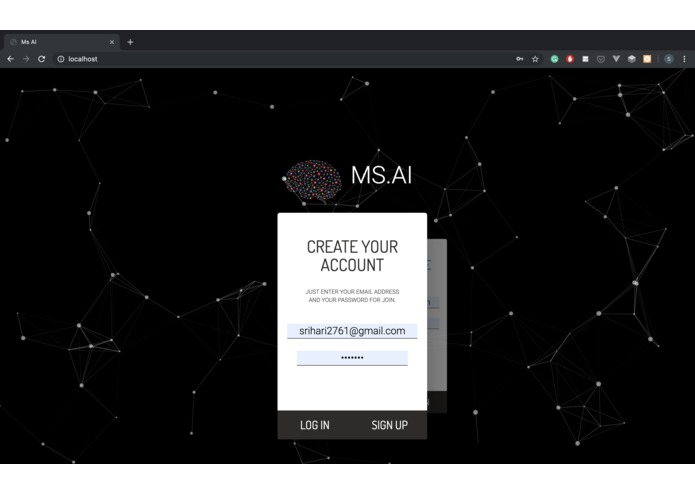
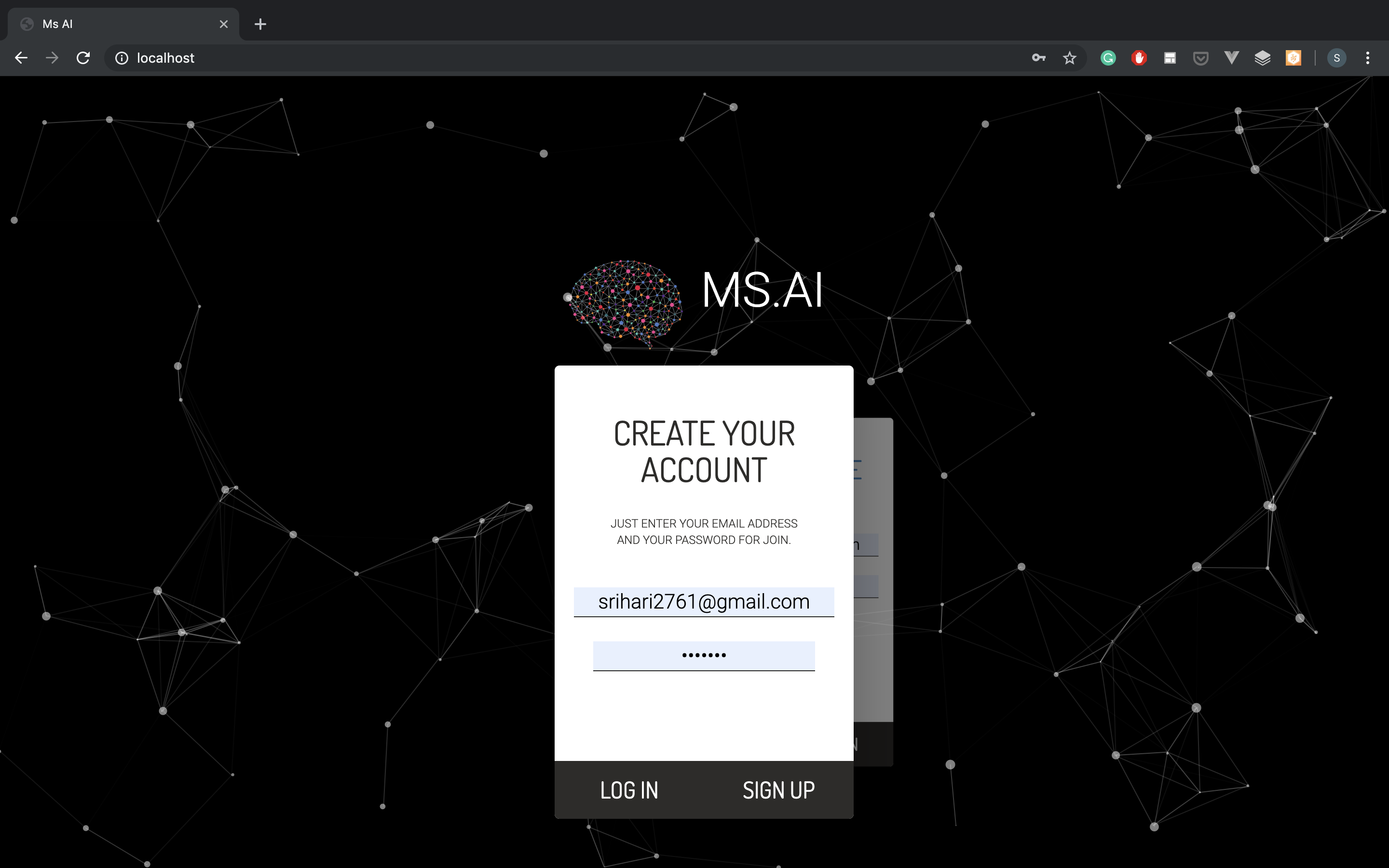
Signup
-
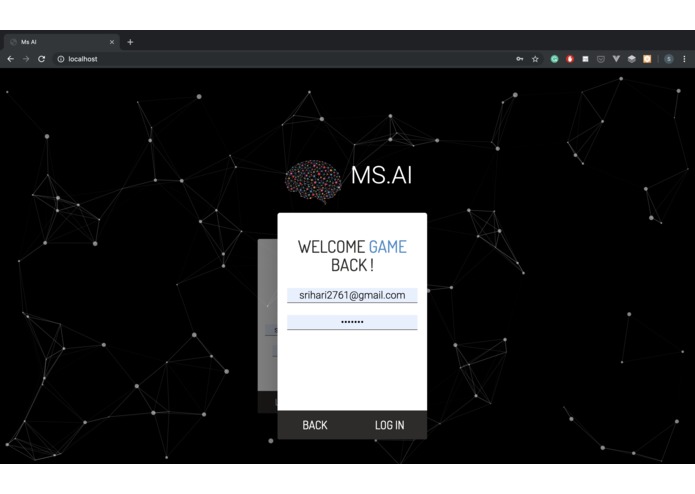
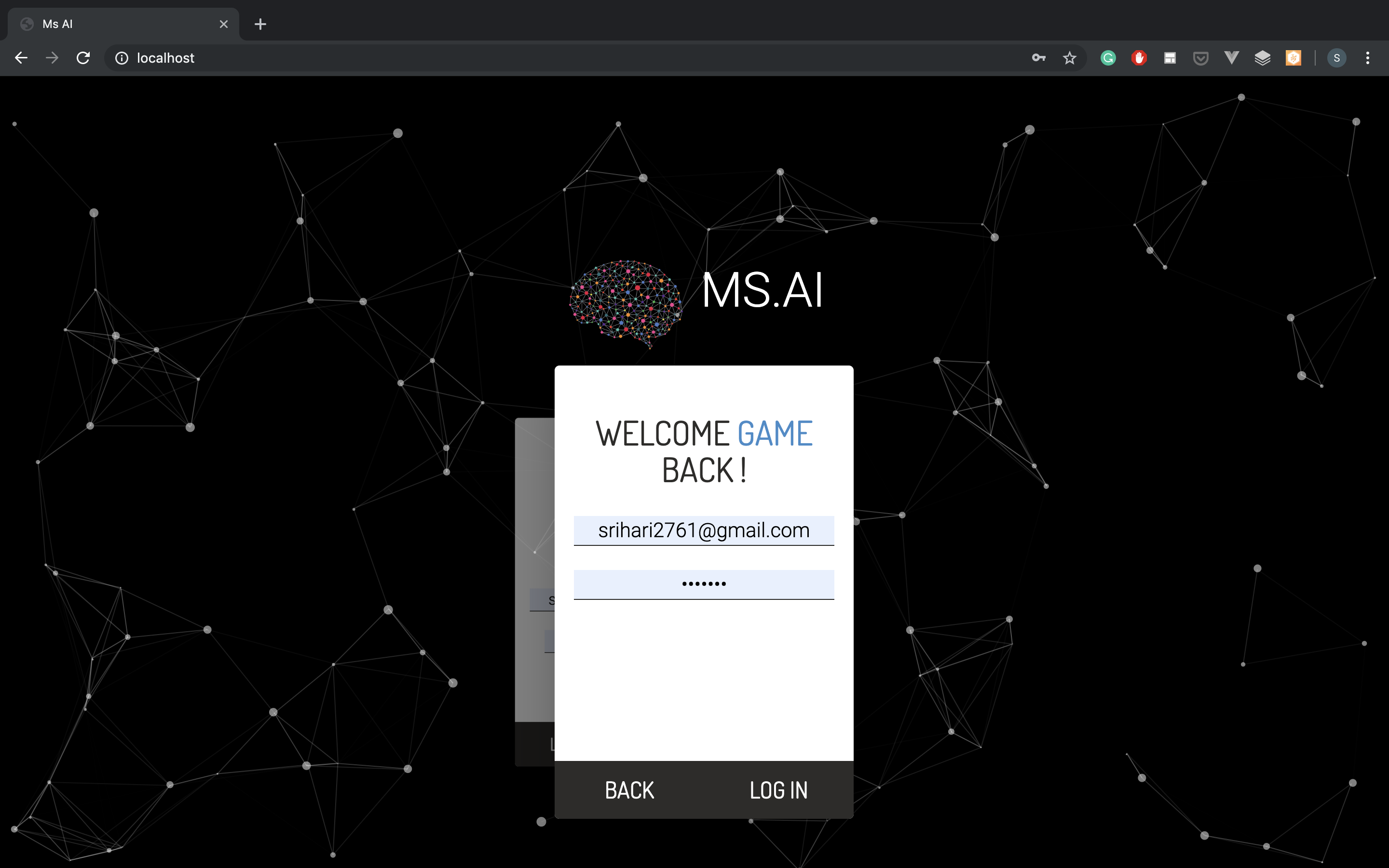
Login
-
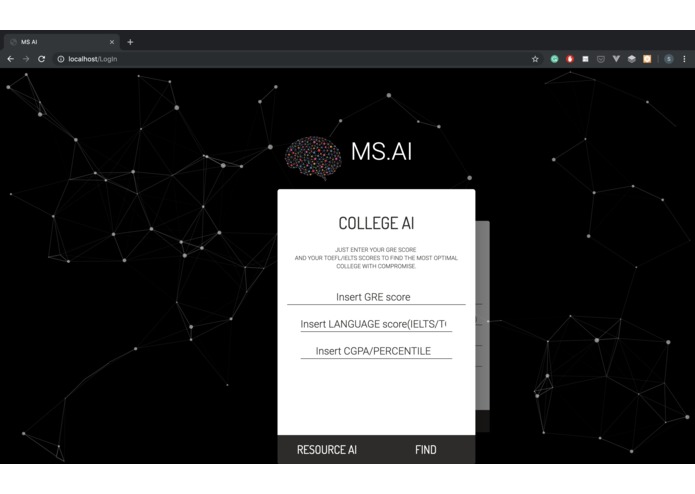
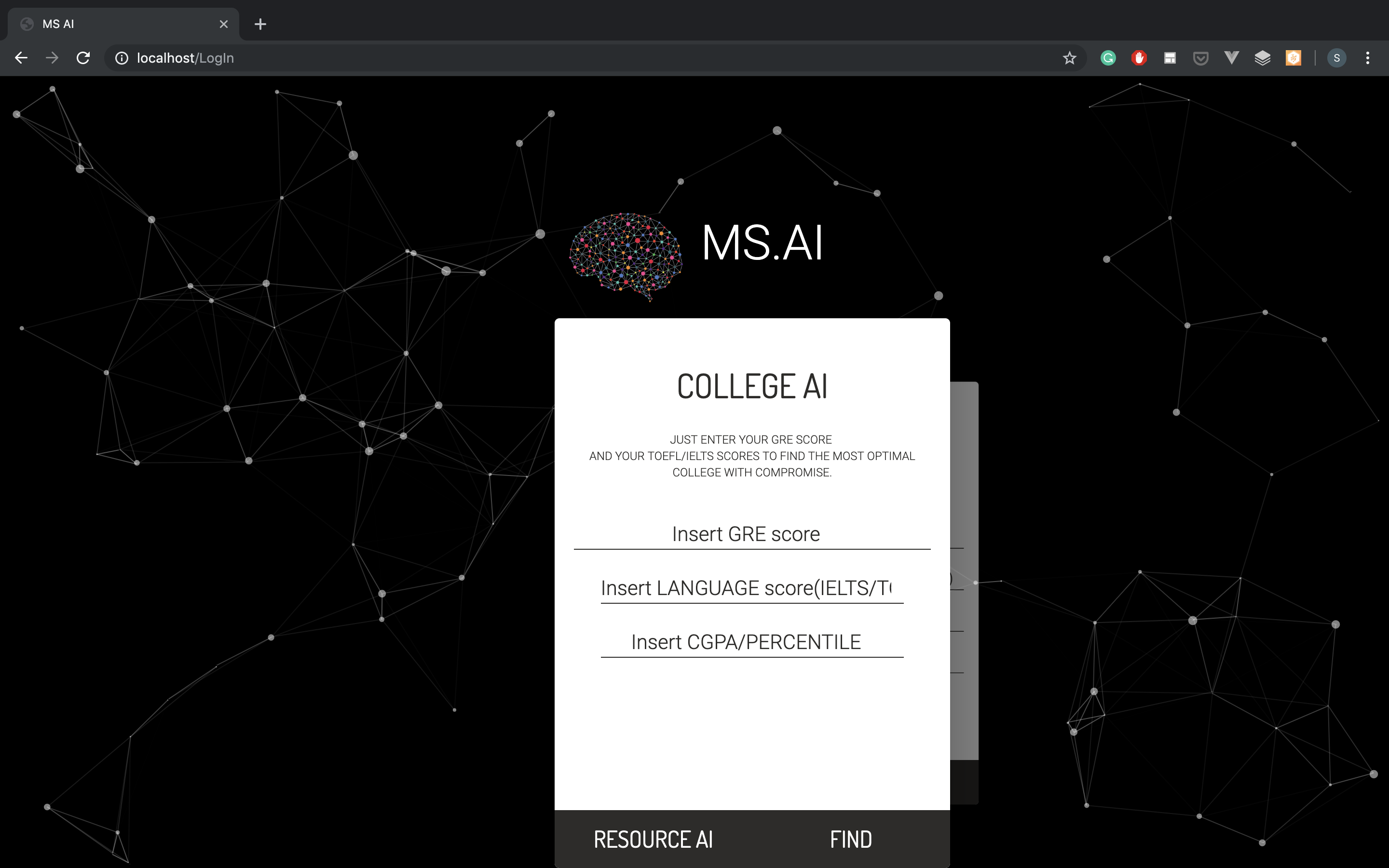
Entering personal information
-
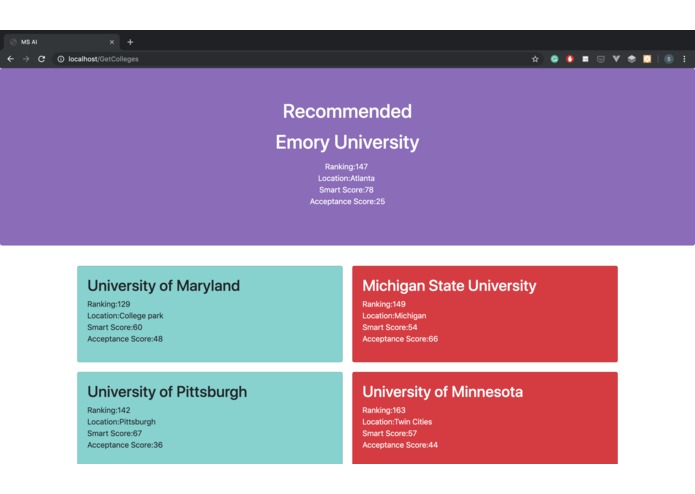
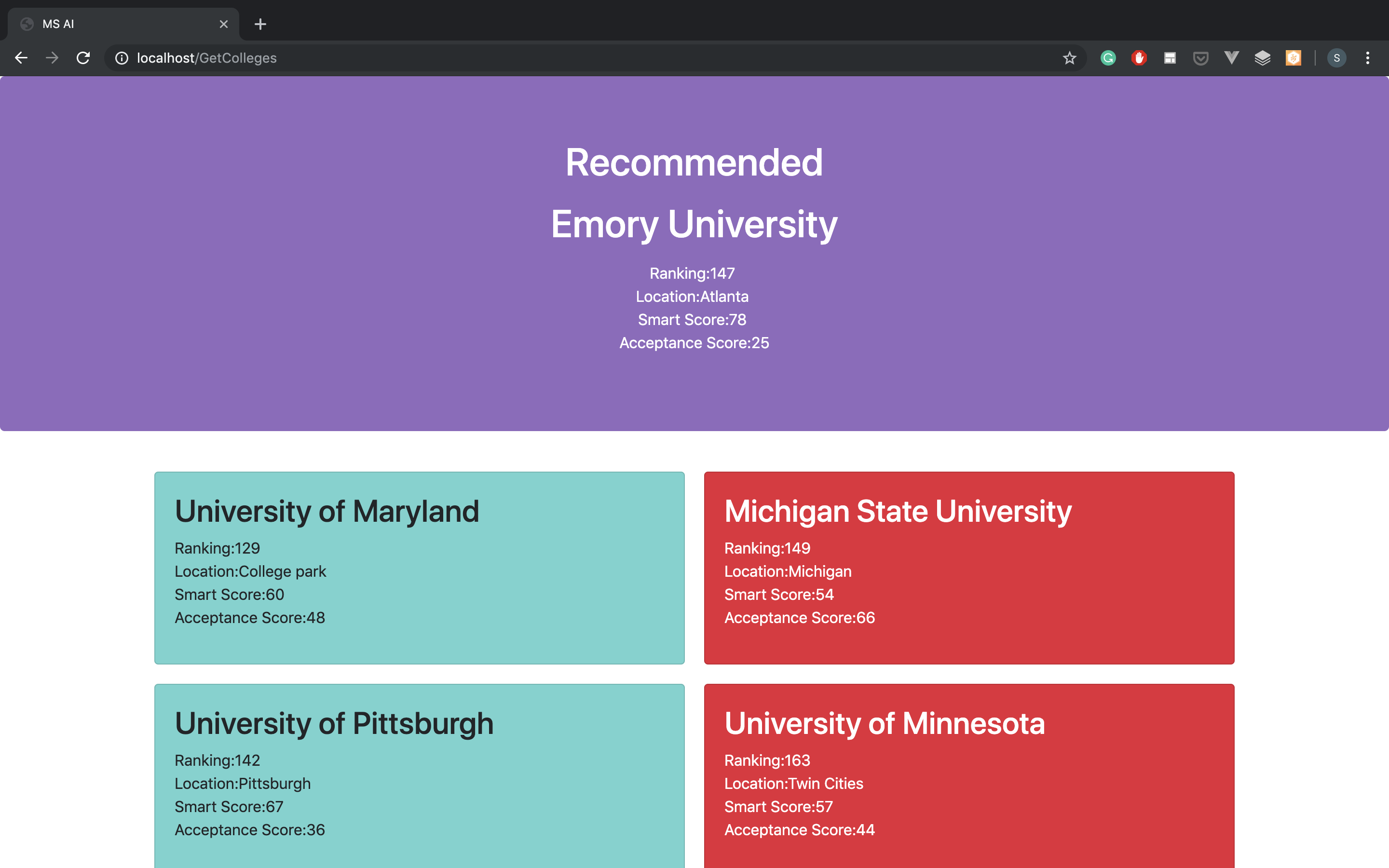
suggested universities
-
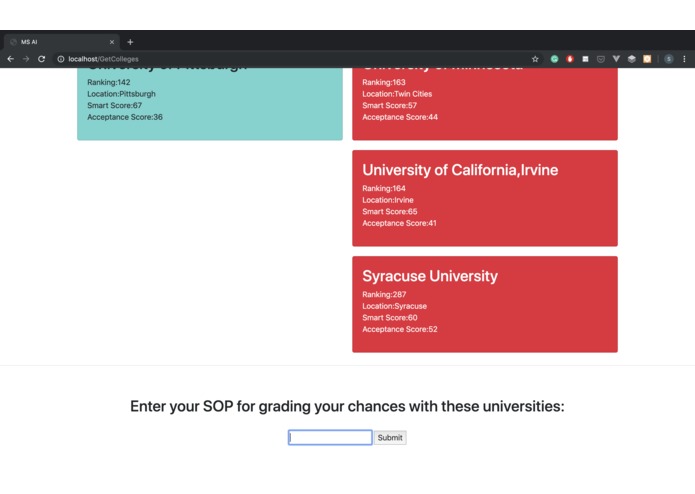
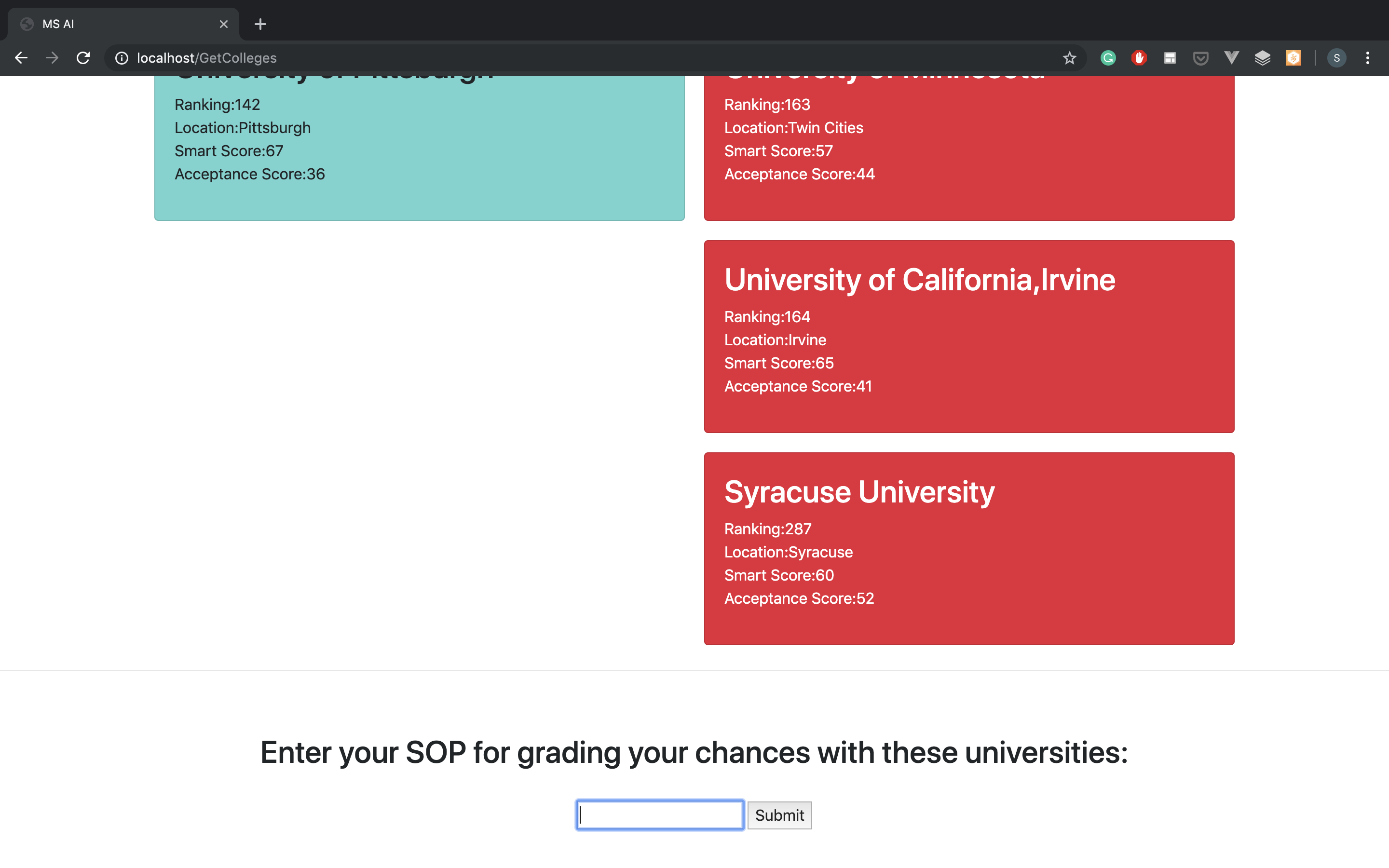
SoP evaluation
Inspiration
Inspired by the struggles we went through to make it to ASU, three grad students from India got together to solve a problem which everyone faces, yet wouldn't consider to put in efforts to invent a solution. Every aspiring college student has to go through the painful process of application at many stages. First, they have to ace GRE and TOEFL. Then they spend significant time on SoP and end up applying to 3-8 universities. But how do they choose these universities? Either, it is done based on previous research online or you have to pay consultancies to do the job for you with the help of experienced people. Searching and making decisions using online resources is a nightmare and usually end up bad due to the fact that every person would want to open up a blog and write a guide/tutorial. Thus, you are pressured into opting for consultancies like Kaplan, Princeton and many more.
What it does and how it works.
We provide MS.ai aka Masters.ai, a modern solution which uses AI to suggest colleges to students, taking GRE, TOEFL, GPA and SoP into consideration.
Users first login into the interface and then provide details about their profile. The users first input GRE, TOEFL and GPA. These three scores are fed into our 1 to 1 classifier to provide a probability/ percentile, which indicates the chances for the student to get into the college.
This score is further improved by providing an option for the user to submit his SoP, which is evaluated using an automated system. The SoP is evaluated using an GloVe based LSTM deep learning model with the help of a tokenizer. The sequential model is trained with historical data obtained from the internet. The SoP is also run into sentiment analysis model by using the API from Transposit. Both of these scores are then combined into the classifier's scores to provide a new percentile.
All these evaluations are done in the backend using Google Cloud, while the data is periodically stored and retrieved in the Atlas MongoDB database. The frontend runs on HTML, CSS and JS while the local backend server runs on python, utilizing Flask to retrieve, send and process data to and fro from the server.
How we built it
We first developed and tested the ML and deep learning predictive models on google cloud. Then, we scraped data from an educational website called yocket and used it to fine tune the models. Once the models were ready, we shifted the data storage from file storage to MongoDB. Throttled by the storage restrictions of MacBook, we integrated Atlas to python. Atlas is a cloud based cluster storage for MongoDB, running on google cloud. Thus, the entire data is fed into database.
We then developed the web application using HTML, CSS, JS and Flask. The HTML, CSS and JS provides the front-end while python based flask fetches data from MongoDB, sends it to google cloud for training and testing the ML model and provides output to the website, hence making it dynamic.
A quick demo of our web application can be observed in the pictures above.
Tech stack and platforms used: 1) Google Cloud - for training and testing ML models, for Atlas 2) MongoDB on Atlas - for storage and processing of data 3) Flask - backend 4) Javascript - backend 5) Tensorflow and Keras - deep learning
Challenges we ran into
We had issues with various databases. We started with MySQL and ended up trying to fix a big, specific for Mac and then realized the entire database is not compatible for MacOS Mojave. We then had to migrate our entire schema and queries to MongoDb. It was much easier, being no SQL, but we still spent a significant amount of time on it.
We also faced an issue while trying to integrate the frontend with the database and dynamically updating the HTML/JS files. Similar to every Hackathon, the short amount of time made this learning process a lot worse.
Accomplishments that we're proud of
We are proud of learning and implementing an entire MongoDB based stack in two days. Also, another big achievement would be the integration and evaluation of an automated NLP-based grading for Statement of Purpose. We are also proud of the sleepless coding sprints which helped us fix semicolons and other major bugs in the development phase.
What we learned
MongoDB, Flask, slideshow karaoke, making paper aeroplanes and a lot more.
What's next for Caplan (with a k) ain't got nothing on us
We are looking forward to bring this to deployment phase and making it available to students around the globe before next Fall semester application process. This deployment would also help us collect more data from the students and thus improve the recommendations. We also plan to slowly expand our idea from B2C to B2B and thus would work on an effective business model to accommodate both.


Log in or sign up for Devpost to join the conversation.