-
-
-
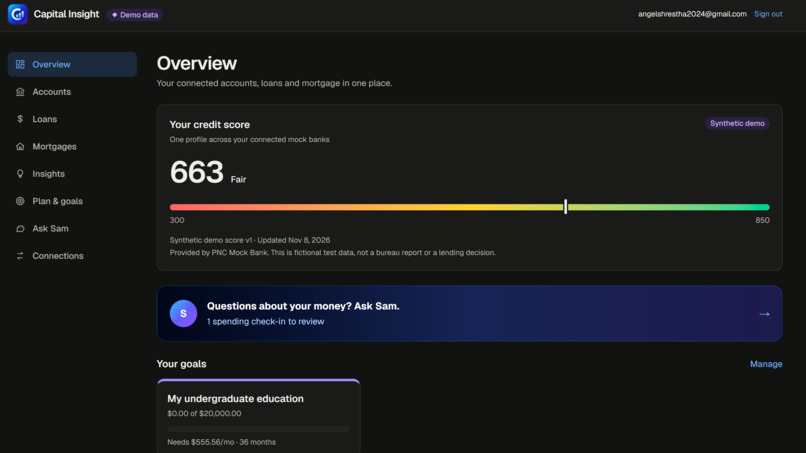
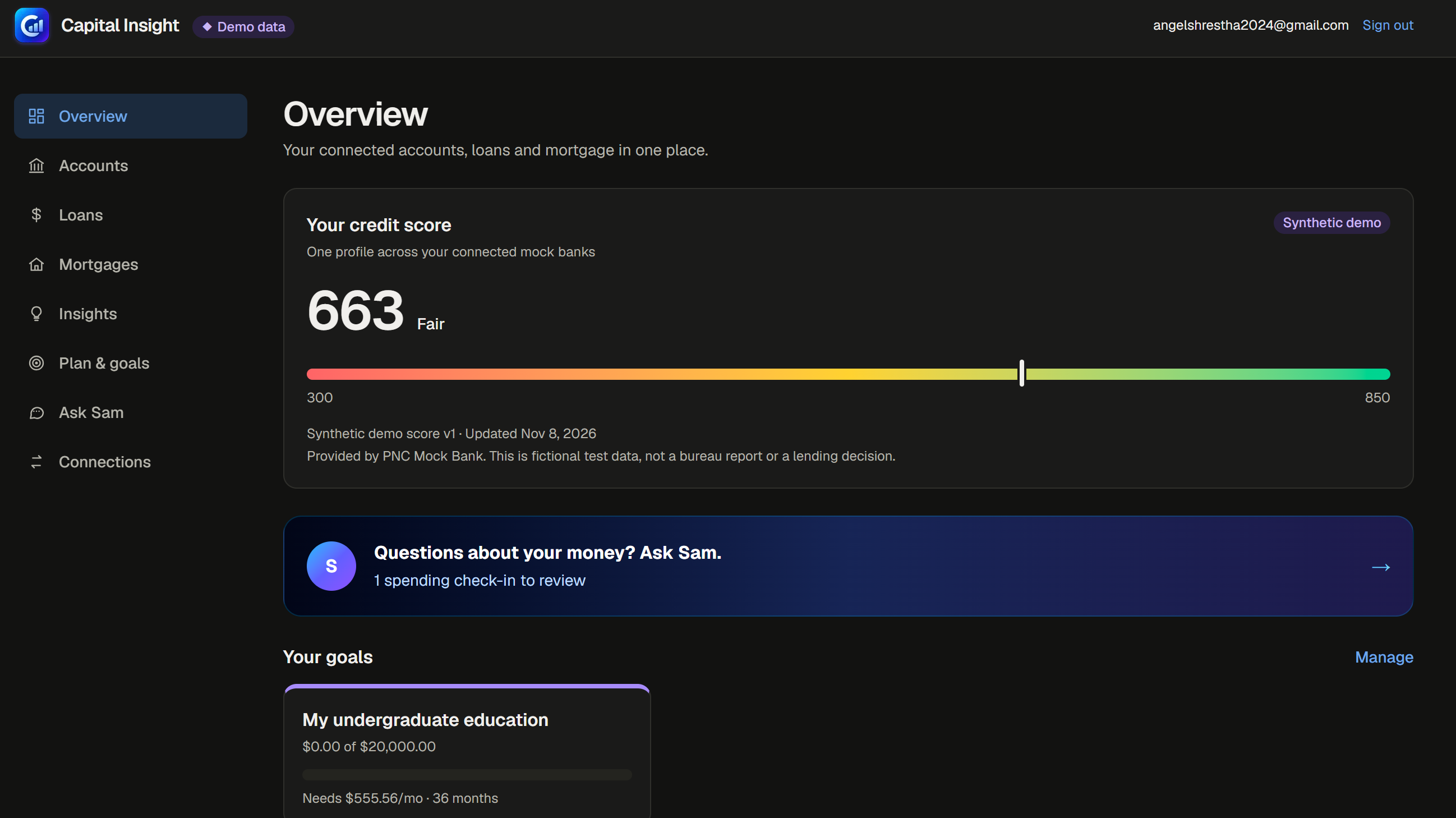
Overview Interface
-
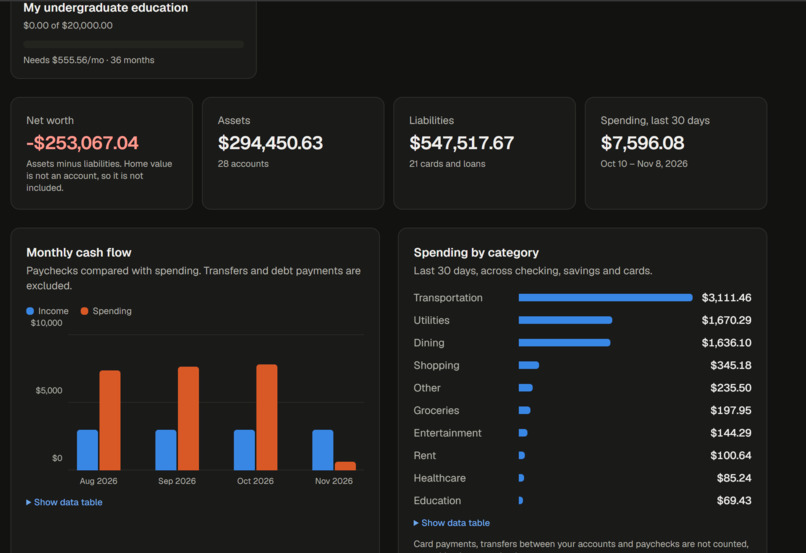
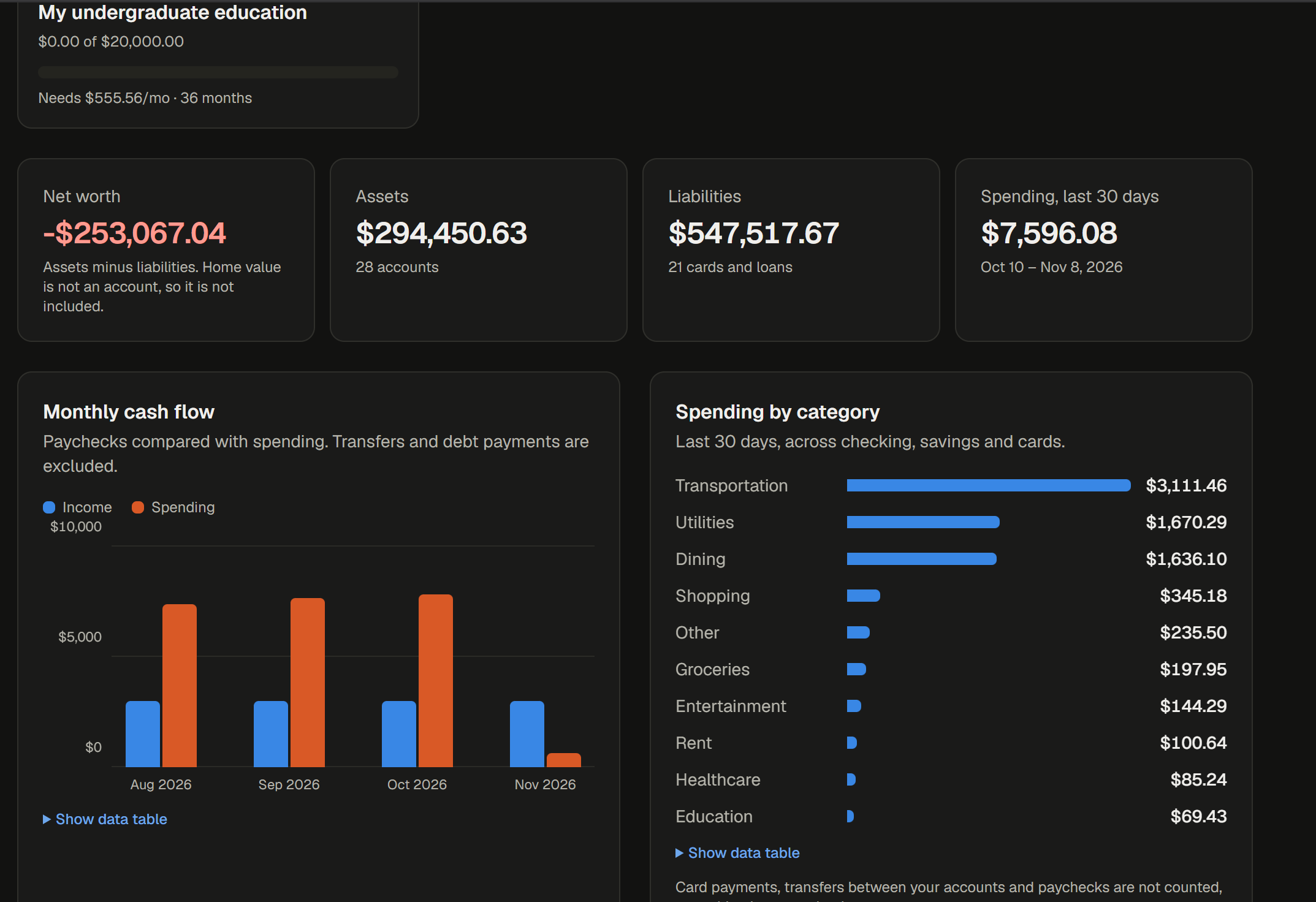
Income and Spending Breakdown
-
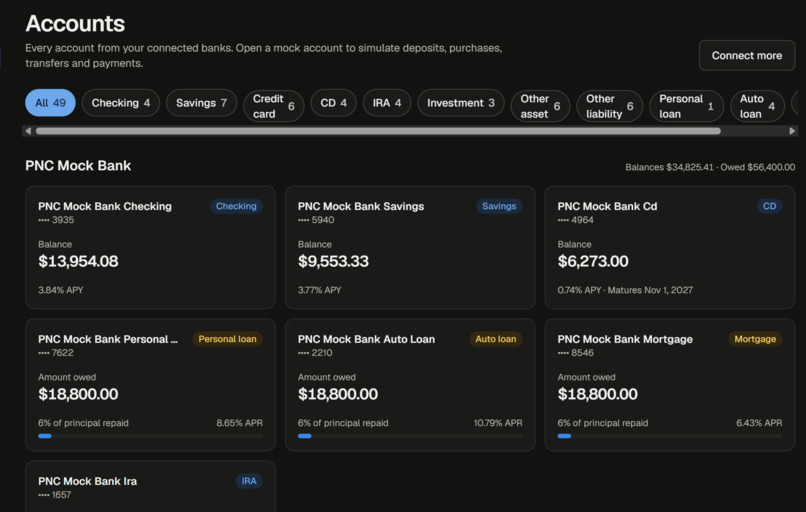
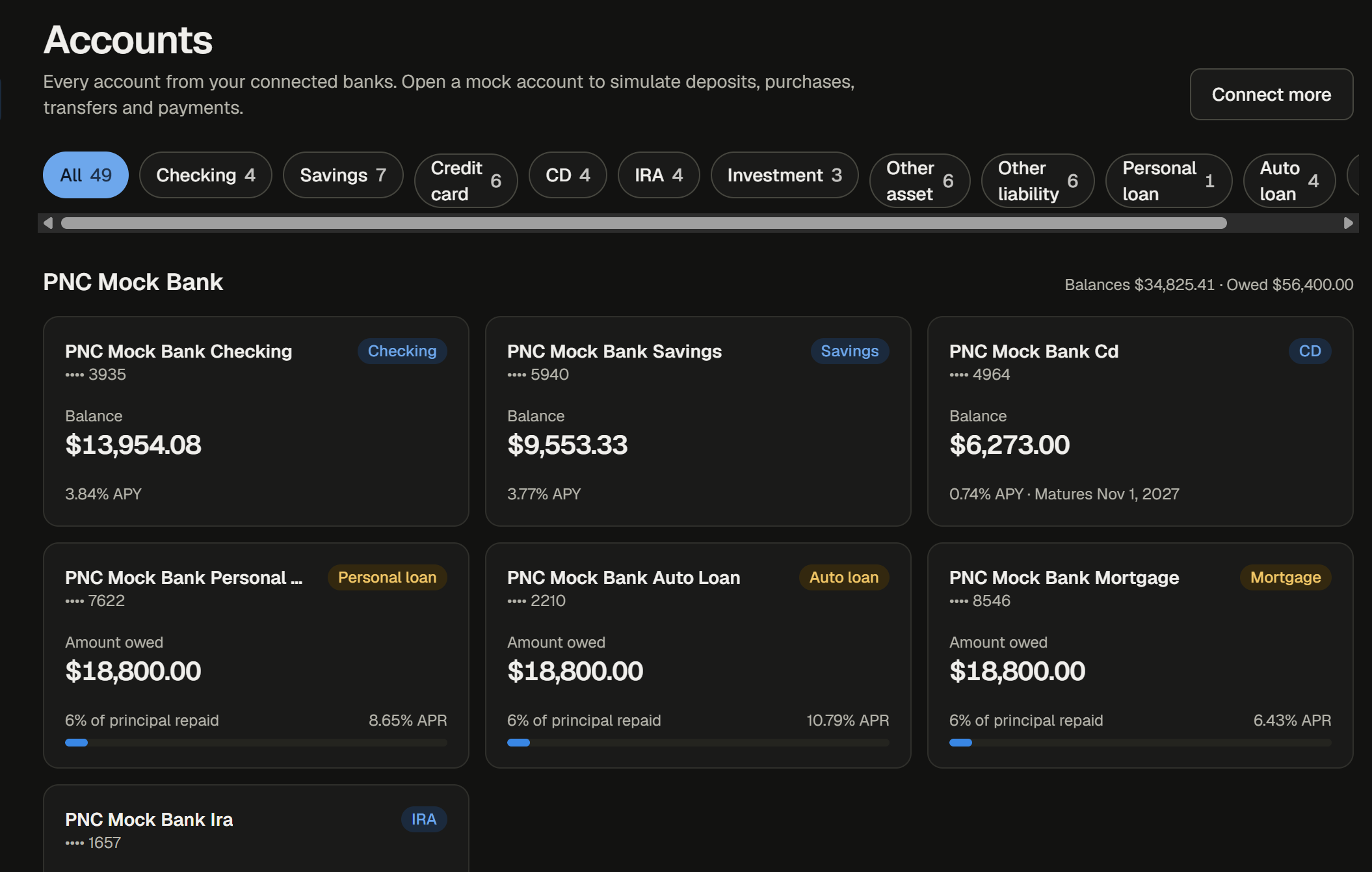
Aggregation of Accounts
-
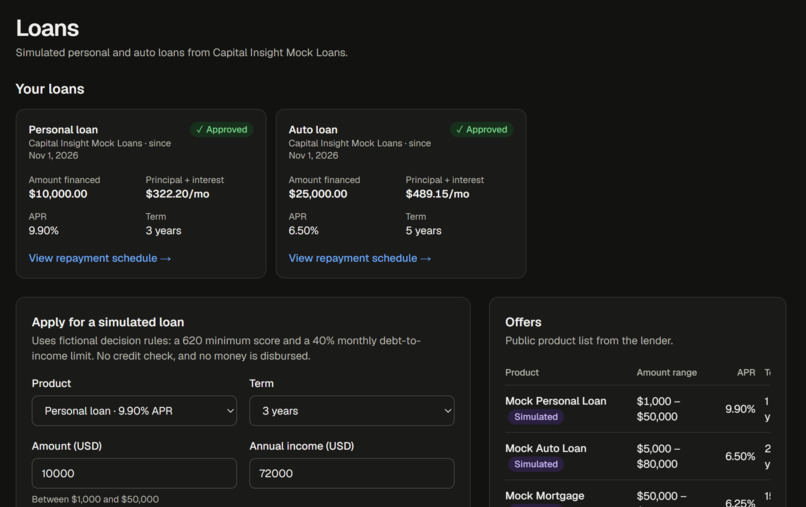
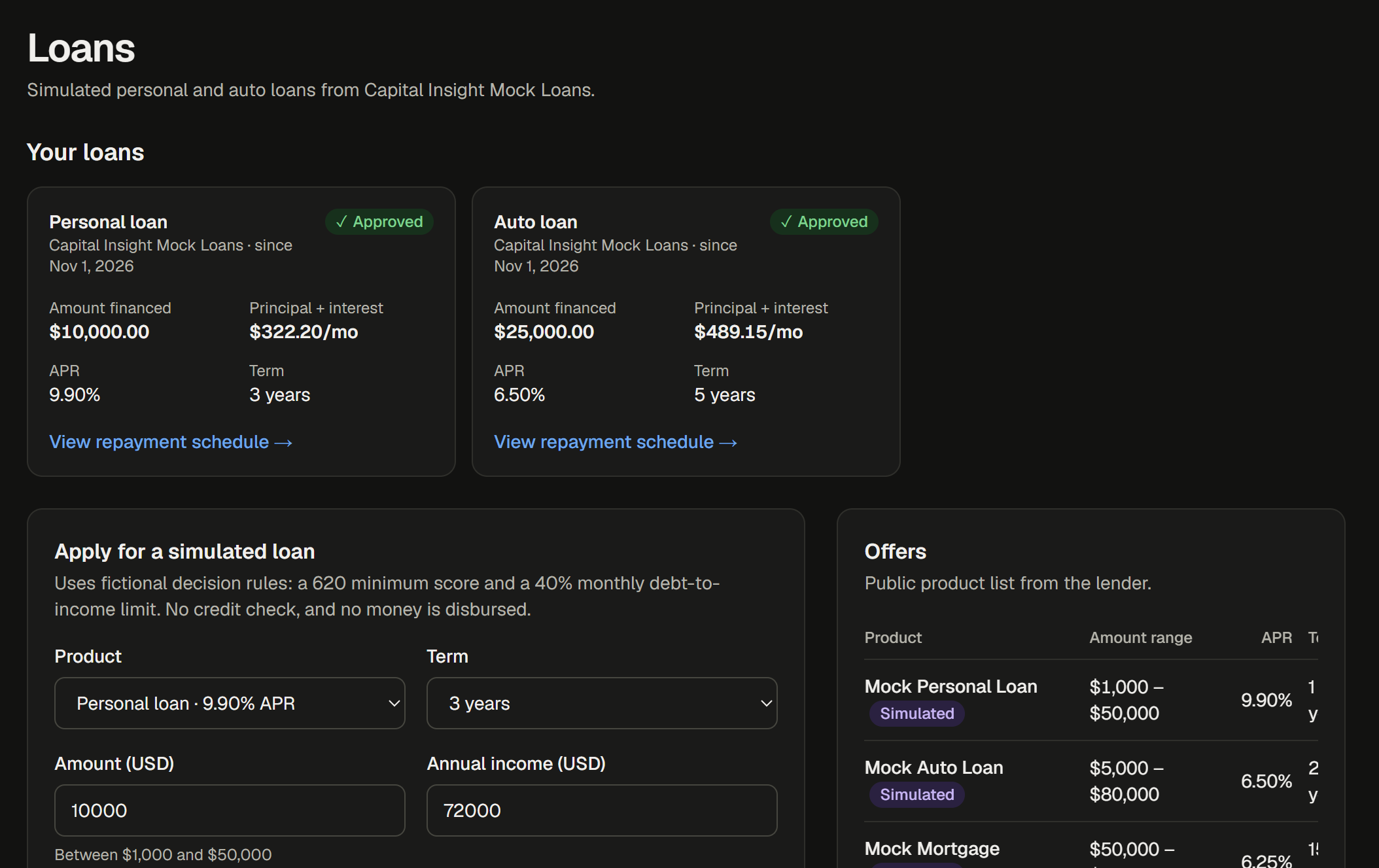
Loan Management Interface
-
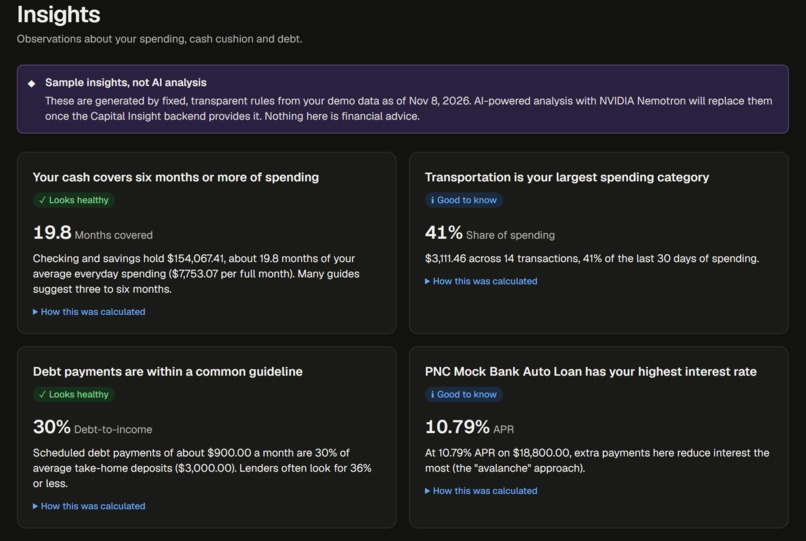
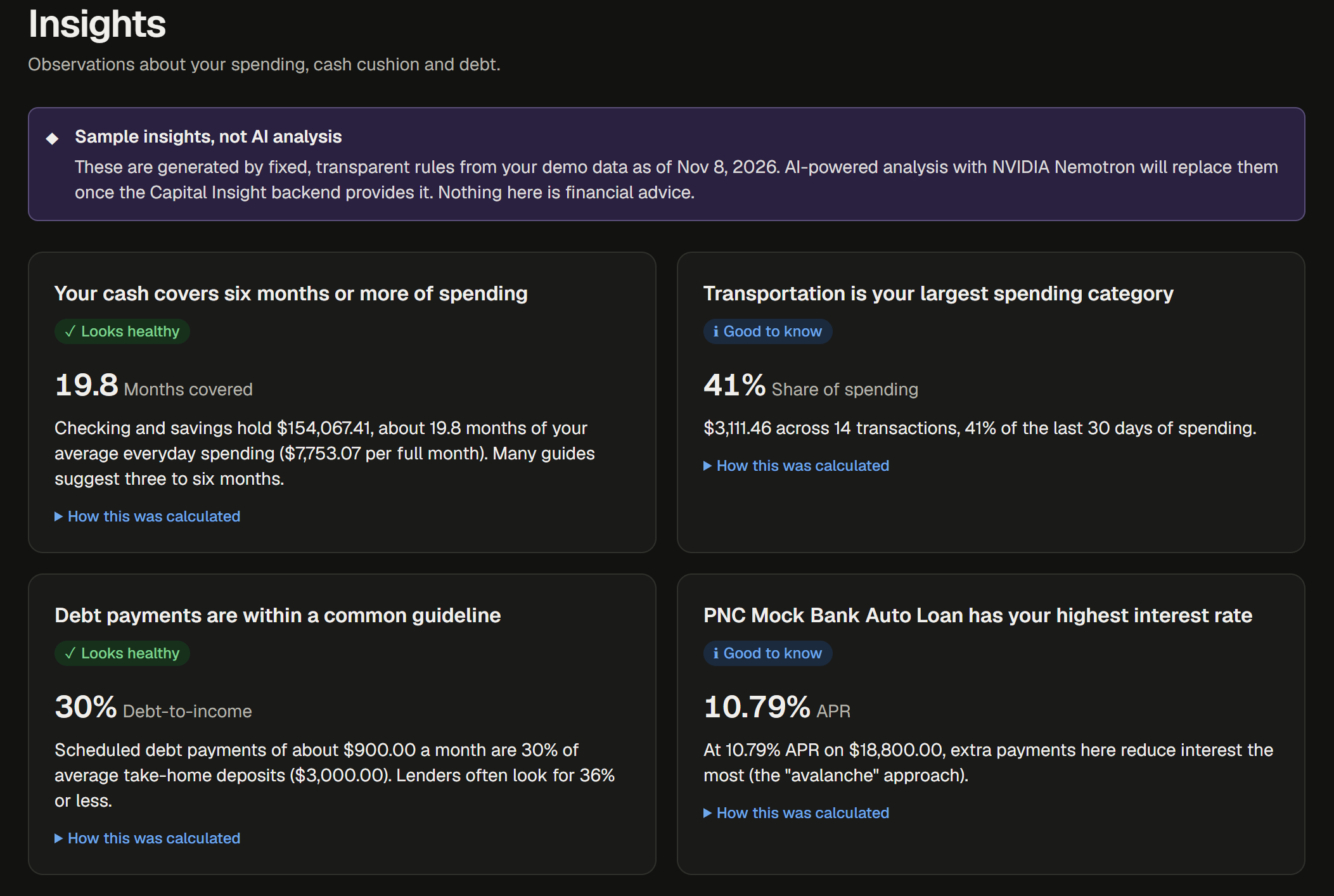
Insights Interface
-
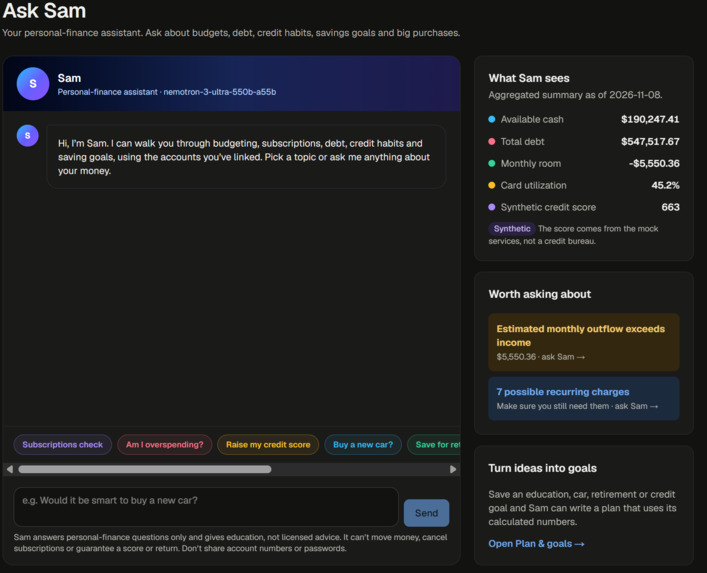
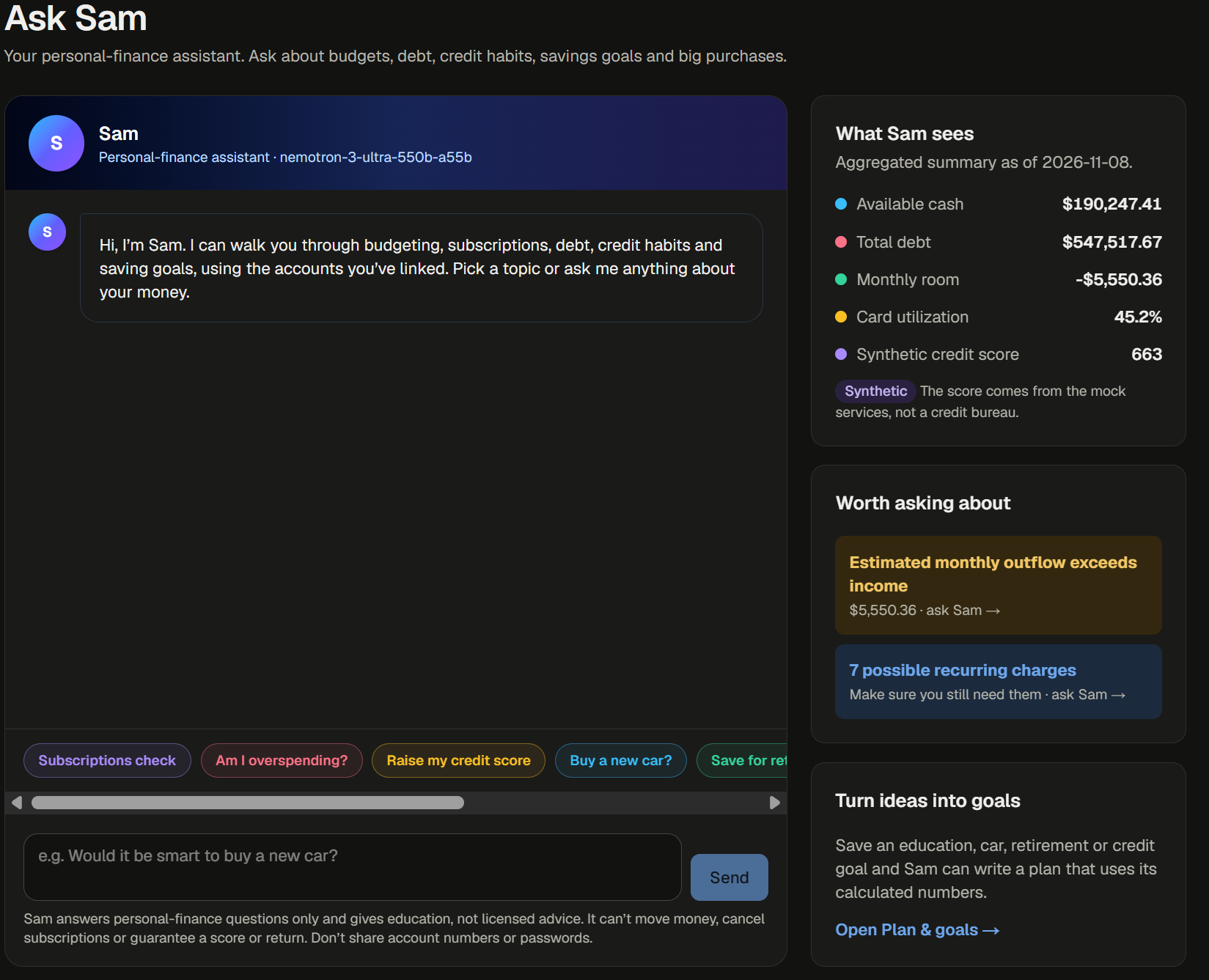
AI Assisted Finance Advisor Sam
-
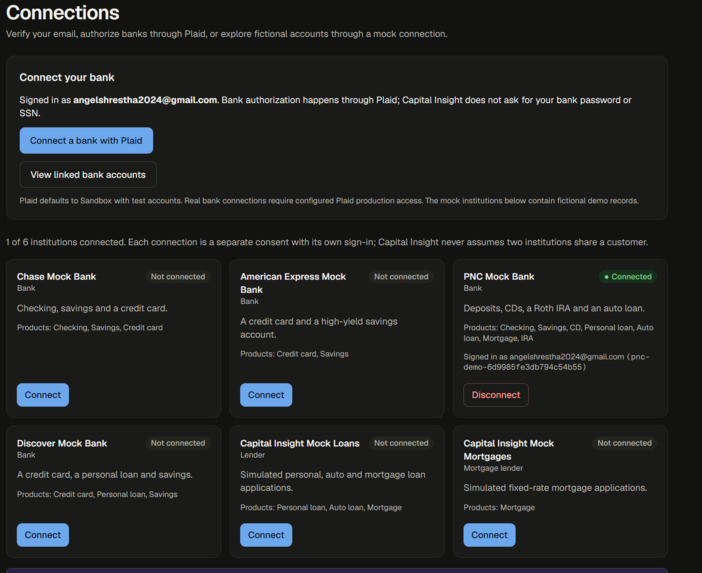
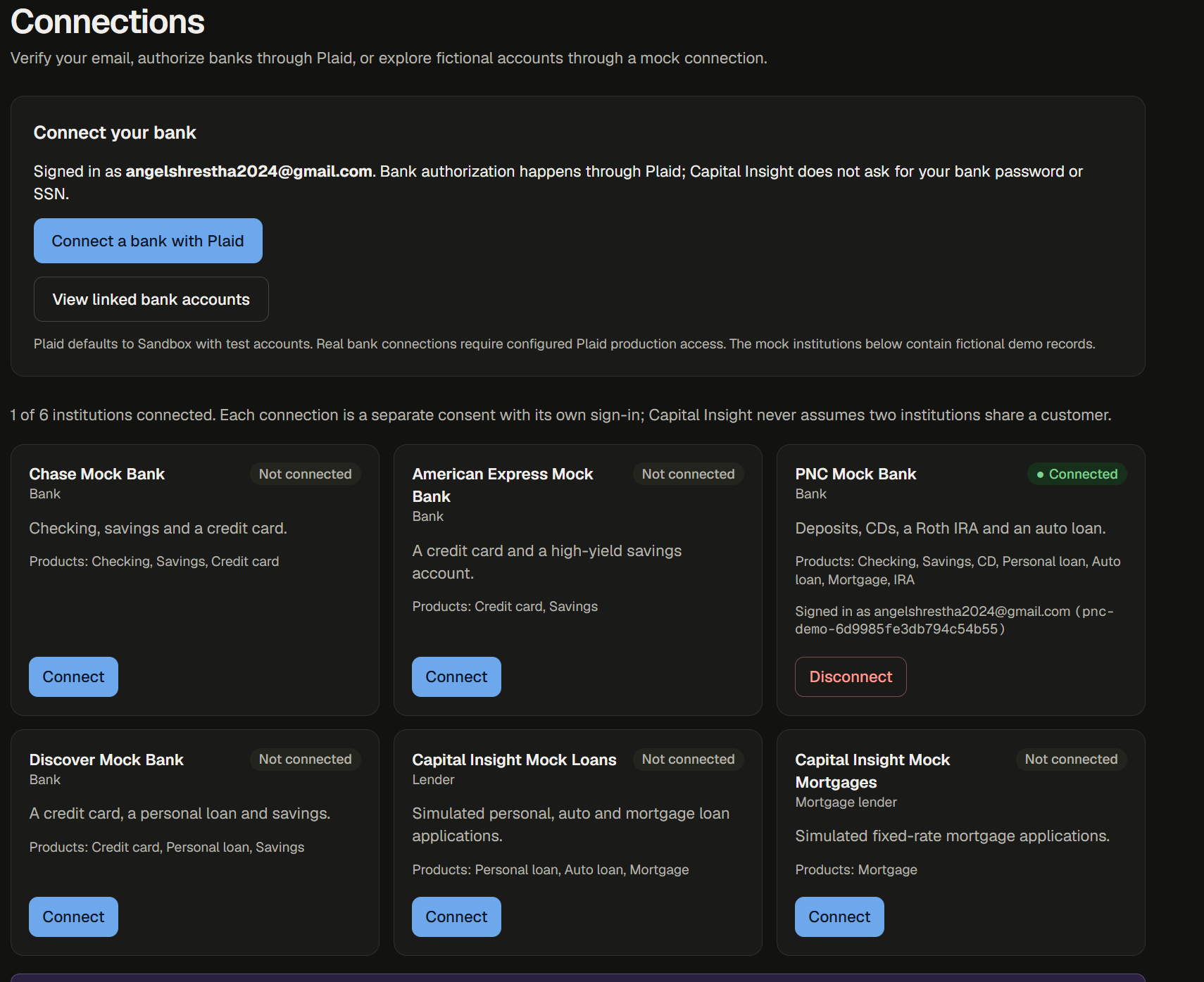
Interface to Connect Accounts
Inspiration
Most of us have money scattered across a checking account at one bank, a credit card at another, a student or car loan somewhere else, and maybe a mortgage. Each app shows its own balance, but none of them answer the questions we actually have: Am I overspending? Can I afford a new car? How do I get my credit score up before I apply for an apartment? Am I saving enough for college or retirement?
Banking apps like Chase have started adding goals and savings tools, but they only see their own accounts. We wanted one place that sees everything, does the math correctly, and then explains it in plain English, without the AI ever making up numbers or promising outcomes it can't guarantee.
Use It
Demo email: [email protected] Demo Verification Code: 453117
What it does
Capital Insight is a financial-wellness app that aggregates accounts across institutions and helps you act on them.
- One dashboard for every institution. Link Chase, American Express, PNC and Discover (simulated banks), plus a loan provider and a mortgage lender. See net worth, assets vs. liabilities, monthly cash flow, spending by category and upcoming payments. Real banks can also be linked through Plaid Sandbox.
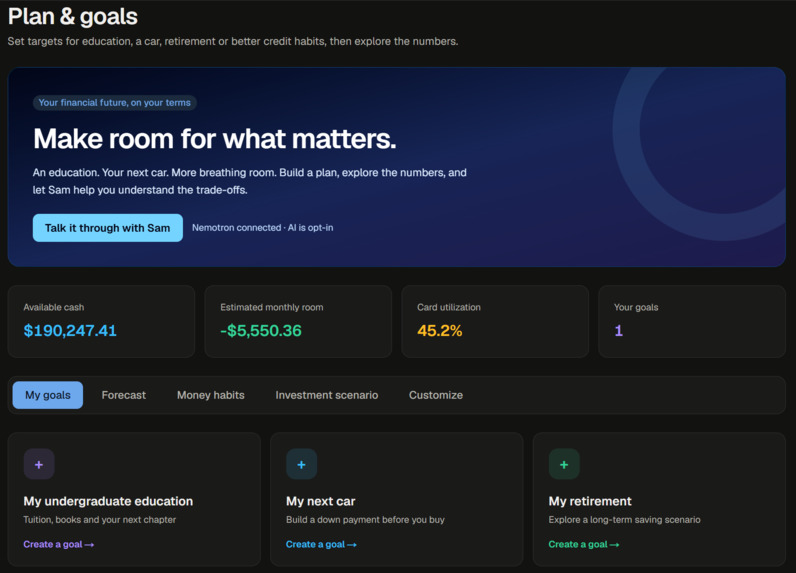
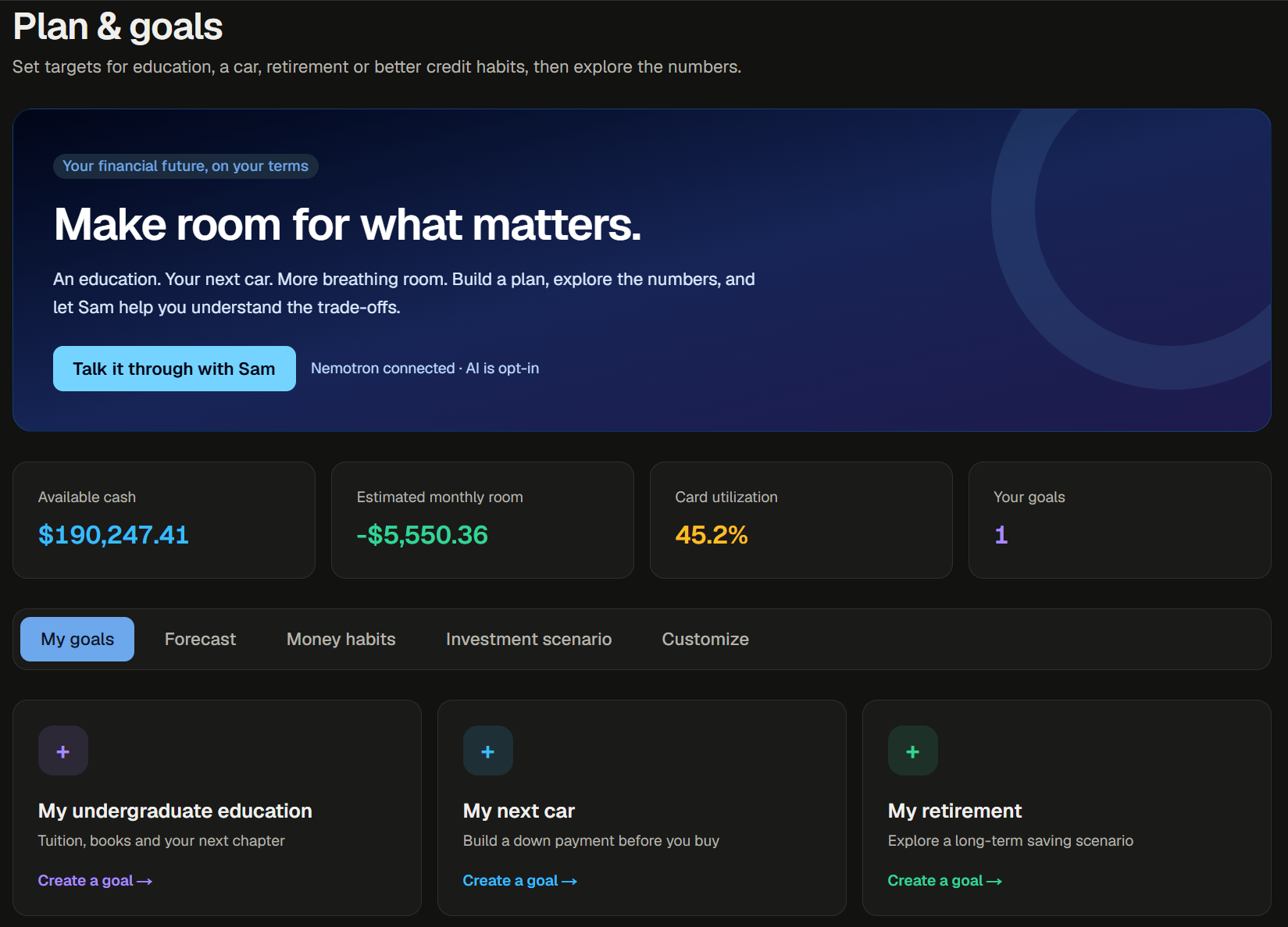
- Goals you can see. Undergraduate education, your next car, an emergency fund, retirement or an investment fund. Drag sliders for amount, timeline and assumed return, and watch the projection chart update. You can pin any goal to your dashboard.
- A path to a better credit score. Choose a target ("734 → 760 in 8 months") and Capital Insight calculates the card-utilization target and the exact monthly payment per card to get there, accounting for APR. It frames the score as an aspiration, never a guarantee.
- Subscriptions and overspending detection. Recurring, similarly priced charges are flagged ("still using it?"). You get alerts when spending exceeds your budget, jumps versus last month, or when outflow exceeds income.
- Cash-flow forecast. A 3–24 month projection of unallocated cash after your goal contributions, with every assumption listed.
- Investment scenario. Sliders for a hypothetical stocks/bonds/cash split, kept separate from everyday spending.
- Sam, your AI money coach. Ask "Would it be smart to buy a new car?" or "How do I raise my score?" Sam (NVIDIA Nemotron) reads a private, minimal summary of your finances and answers with clear steps and follow-up questions. Sam can also write a step-by-step plan for any saved goal.
- Customizable. Every feature is optional; turn on the ones you want and they appear on your dashboard. Preferences and chat history are saved to your account.
- Simulated banking actions. Deposits, transfers, card payments and loan payments on the mock banks, with double-entry ledgers that always reconcile (no real money ever moves).
How we built it
- Frontend: Next.js 16 (App Router, Server Components, Server Actions, Partial Prerendering), React 19, TypeScript and Tailwind CSS 4. A replaceable data layer lets the same pages run on deterministic demo fixtures or on the live backend.
- Core API: Python FastAPI with SQLAlchemy and Pydantic, on AWS RDS for PostgreSQL with verified TLS. It handles email-code sign-in, per-user encrypted institution tokens (Fernet), aggregation across providers, credit profiles, goals, preferences and Sam.
- Six mock institutions: independent FastAPI services, each with its own SQLite database and synthetic customers, accounts, transactions, loan/mortgage offers and amortization schedules. Each one runs its own consent flow: it emails a one-time code to its customer and issues scoped bearer tokens, just like a real data-sharing API.
- AI: NVIDIA Nemotron (
nvidia/nemotron-3-ultra-550b-a55b) through NVIDIA's OpenAI-compatible API, called only from the backend. - Plaid Sandbox for real-world-style bank linking; Gmail SMTP for sign-in and consent codes.
- Docker Compose runs the whole stack (frontend, API and six institutions) with one command; Cloudflare Tunnel shares the demo.
- Testing: 146 automated backend tests, including tests that run against the real RDS PostgreSQL, and end-to-end browser tests of the judge sign-in flow.
The design rule we cared about most: the model never does the math. Every payment, projection and forecast is computed deterministically with decimal arithmetic (Python Decimal, integer cents in TypeScript). Sam receives those results and explains them; it is instructed not to change them.
Challenges we ran into
- Making an LLM safe for money. We built three layers of guardrails: a pre-filter that refuses off-topic requests and prompt-injection or jailbreak attempts before any API call; a system prompt that makes the model refuse anything outside personal finance; and a lockout that pauses Sam after repeated misuse. The model only receives an allowlisted aggregate. Account numbers, emails, merchant names and tokens never leave our server, and we scrub identifiers from both input and output.
- Getting money math exactly right. Floating-point errors are unacceptable in finance, so balances travel as decimal strings and every calculation uses decimal-safe arithmetic. Debts and assets have opposite debit/credit semantics, and we had to avoid double-counting loans that appear at both a bank and a lender.
- Realistic, independent institutions. Each mock bank is its own service with its own customers, consent codes and token scope. Linking an institution needs a separate authorization, just like real open-banking flows.
- Moving to managed PostgreSQL mid-hackathon. We migrated from SQLite to AWS RDS with certificate-verified TLS, wrote a migration script that copies data and verifies row counts, and ran the full test suite against RDS.
- Next.js 16 rendering subtleties. Partial Prerendering froze one page into demo mode at build time inside Docker. We fixed it by keeping build-time and runtime configuration identical.
Accomplishments that we're proud of
- A complete product, not just a chatbot: aggregation, goals, credit planning, alerts, a forecast and an AI coach, all in one coherent, responsive UI with light and dark mode.
- An AI assistant that is useful and responsible. It explains real numbers, refuses misuse, and never promises scores, returns or approvals.
- Production-minded engineering: encrypted tokens, TLS to the database, verified email identity, idempotent requests, rate limits, 146 backend tests, and a one-command Docker deployment.
- Seven independently running services that behave like a real financial-data ecosystem.
What we learned
- The most valuable part of an AI feature is often the structure around the model: deterministic calculations, strict context and clear refusals.
- Financial software lives or dies on details such as cents, signs, time zones and idempotency.
- How much easier judging, demos and deployment become once everything runs in one
docker compose up.
What's next for Capital Insight
- Real bank connections through Plaid production and transaction categorization at scale
- Multiple Sam conversations, saved plans and progress check-ins over time
- Notifications for bills, unusual spending and goal milestones
- Bank-grade compliance work (auth hardening, audit logging, data-retention controls) before handling real customer data
Built With
- nextjs
- postgresql
- python
- sqlite

