Inspiration
What it does
How we built it
Challenges we ran into
Accomplishments that we're proud of
What we learned
What's next for CAPA Keeper
Inspiration
In medical devices, pharma and regulated manufacturing, every complaint, nonconformity and audit finding becomes a CAPA, a corrective and preventive action (ISO 13485 §8.5.2, 21 CFR 820.100). CAPA handling is one of the most frequently cited weaknesses in regulatory inspections, and the questions are always the same: where is the root cause, were the actions done, and who verified that the fix actually worked, and when? Many teams already track CAPAs as Jira work items, but Jira doesn't know what a complete CAPA looks like, so the answers end up in spreadsheets the week before the audit.
What it does
CAPA Keeper makes every CAPA in Jira audit-ready:
- Stage from evidence, not from status. A CAPA's stage is worked out from what is recorded on it: a documented root cause (a line starting with "Root cause:"), linked corrective action items, all of them done, and an effectiveness check ("Effectiveness check: …") after a waiting period. Stages: Investigation → Action plan → Implementation → Effectiveness check → Ready to close. It works on any workflow, with no custom fields to set up.
- Findings an auditor would raise: closed without complete evidence, effectiveness verified by the CAPA owner (verification must be independent), verified too early (before the configured waiting period), verified before the actions were done, and past its target date (target days per priority).
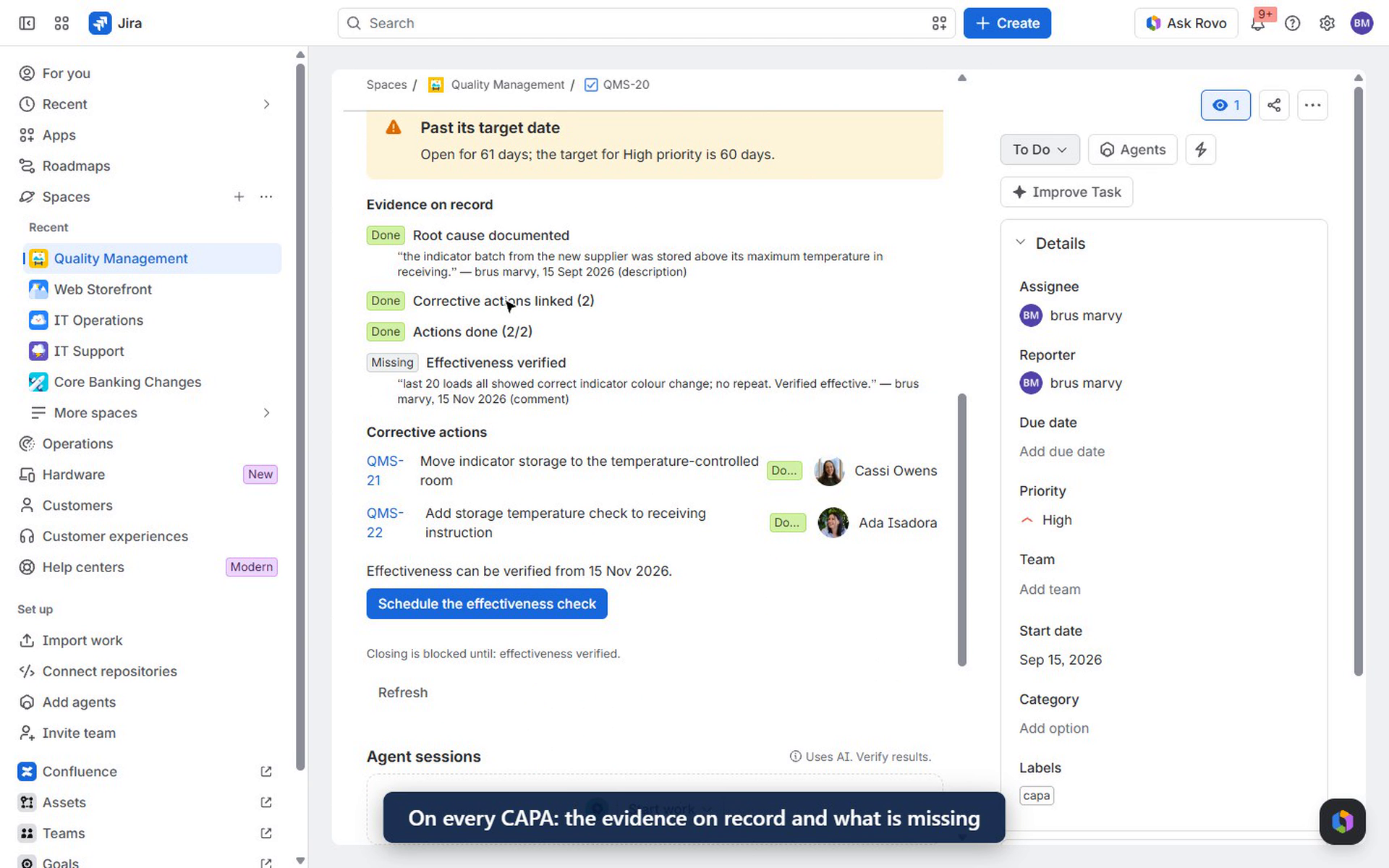
- Issue panel on every CAPA: a progress tracker, the evidence quoted with who wrote it and when, the corrective actions with their status, the clock against the target, what is missing, and a button that schedules the effectiveness check as a linked task due when the waiting period ends.
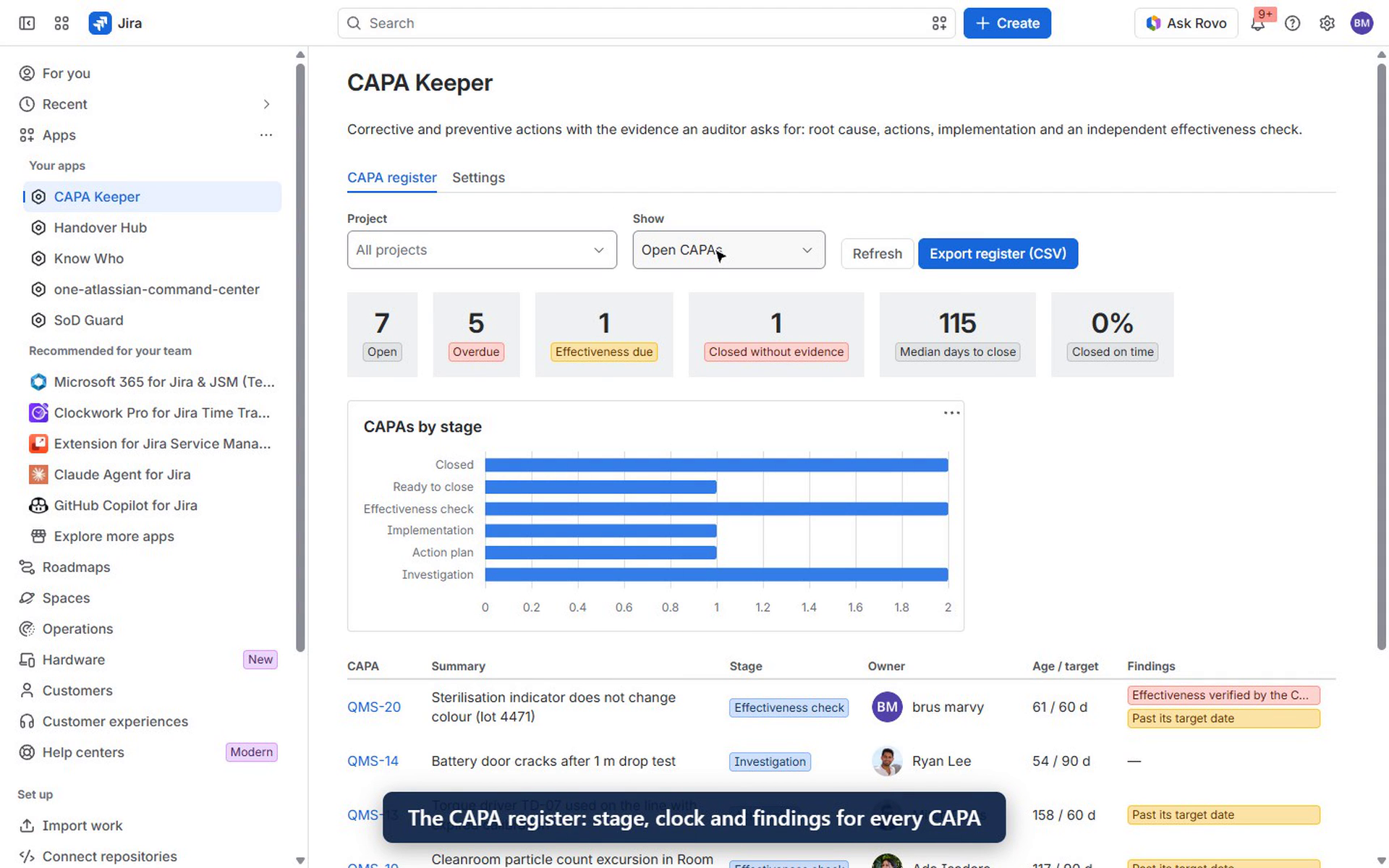
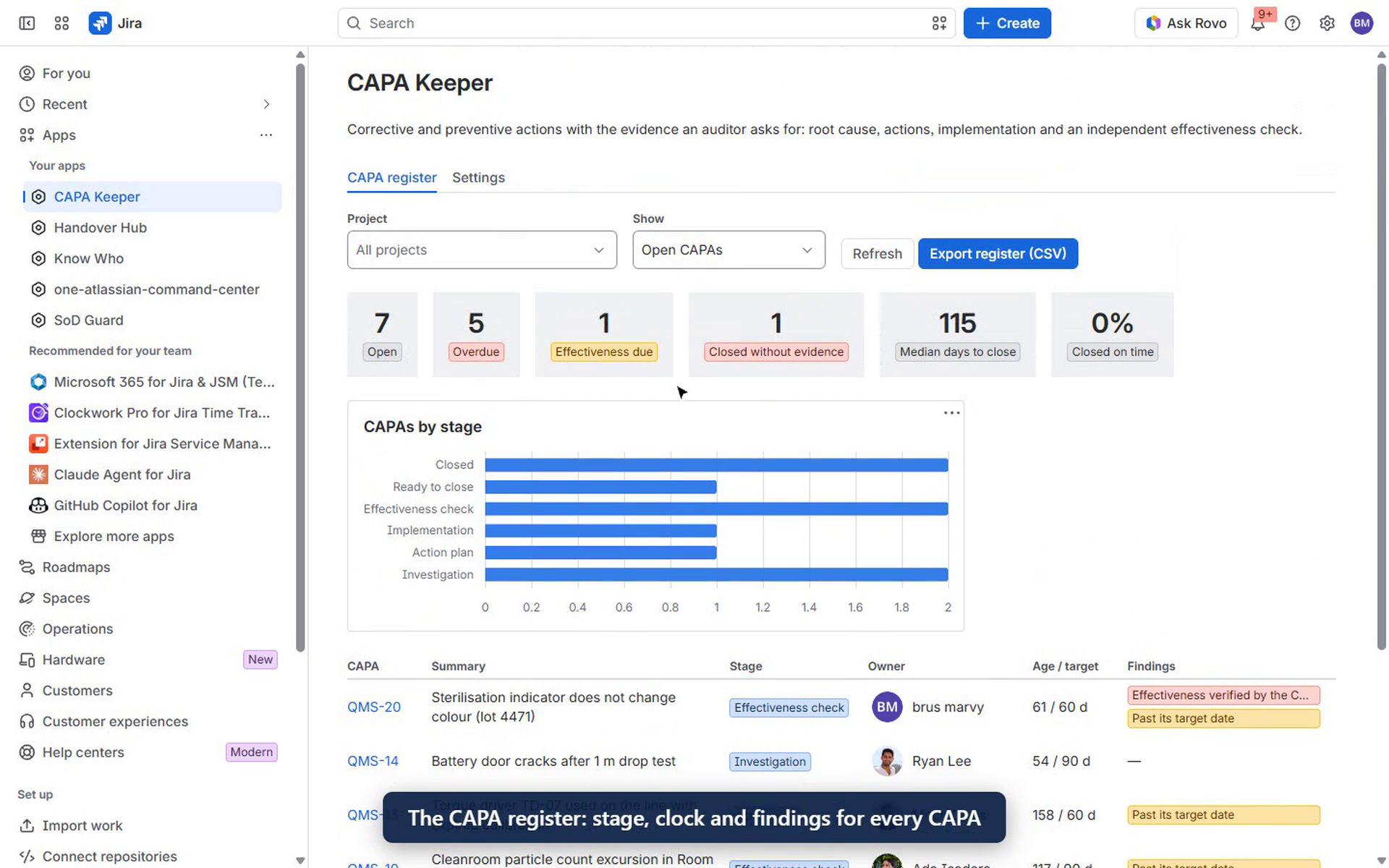
- CAPA register: open, overdue, effectiveness checks due, closed without evidence, median days to close, on-time closure rate, a chart by stage, every CAPA with its findings, and a CSV export for the audit file.
- Evidence before closure: a workflow validator. Add it to the closing transition and Jira refuses to close a CAPA until the evidence is there, and says exactly what is missing.
- Daily reminder: when an effectiveness check falls due, the CAPA gets one comment asking for independent verification.
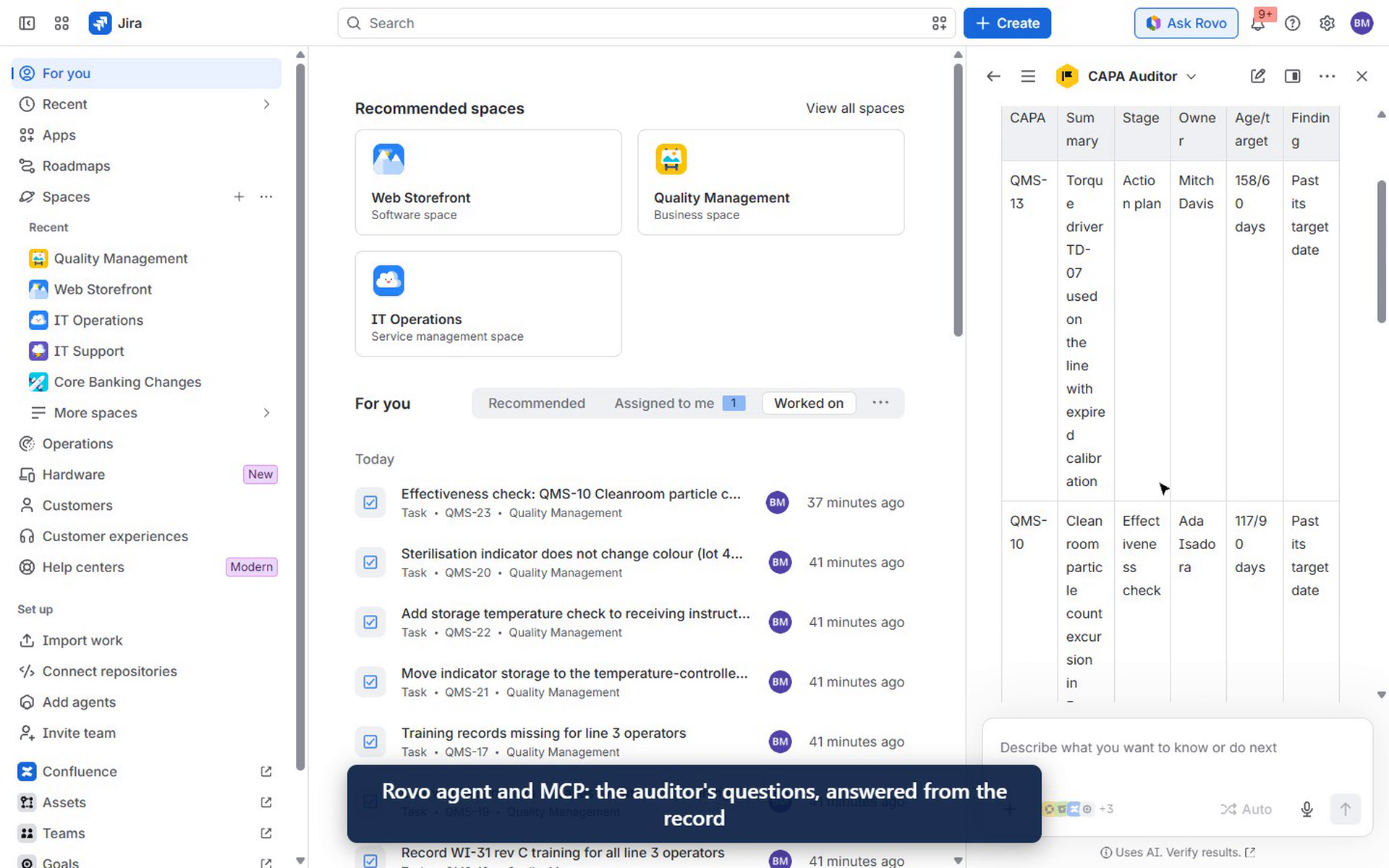
- Rovo agent "CAPA Auditor" and the same tools through MCP: "Which CAPAs are overdue?", "What is missing before QMS-20 can be closed?", "Was any CAPA closed without evidence?"
- Settings: which work items are CAPAs (any JQL, default
labels = capa), an optional opened-on date field for CAPAs migrated from another QMS, target days per priority, the waiting period, and whether independent verification is required.
How we built it
- Forge, Runs on Atlassian: no egress, no remote backend, no external model.
jira:issuePanelandjira:globalPage(UI Kit: ProgressTracker, DynamicTable, HorizontalBarChart)jira:workflowValidator(fails open on errors, so an outage never freezes the quality workflow)scheduledTriggerfor the daily reminderrovo:agentwith three read-onlyactions, exposed to external agents throughrovo:mcp
- Jira REST: JQL search with description, comments, links and subtasks; linked items' status and resolution dates; issue creation and linking for the effectiveness task; JQL validation before saving settings.
- Pure, unit-tested core (
src/capa.js): evidence markers (case-insensitive, list bullets, text on the next line, Atlassian Document Format), stage derivation, findings, clock, register summary and CSV.
Challenges we ran into
- Status is not evidence. Every QMS workflow is different, and a CAPA moved to "Done" proves nothing. Deriving the stage from evidence made the app workflow-agnostic and made "closed without evidence" detectable.
- Independent verification. The rule that the CAPA owner can't verify their own fix had to be explicit, with the verifier taken from the comment author.
- Migrated records. CAPAs imported from older systems carry their real opening date in a date field, not in Created; an optional opened-on field handles that (the demo uses it, because the sample records were imported the same day).
Accomplishments that we're proud of
Try to close a CAPA without a root cause and Jira says: "QMS-14 cannot be closed yet. Missing evidence: root cause documented, corrective actions linked, actions done, effectiveness verified." That one message is what quality teams spend audit weeks chasing by hand.
What we learned
The structure regulators expect is already latent in how engineers write in Jira ("Root cause:", linked fixes, a verification comment). Reading it is more useful than adding forms nobody fills in.
What's next
- A Confluence page per closed CAPA as the formal record, with the timeline.
- Trend analysis: recurring root causes across CAPAs.
- Electronic signature integration for 21 CFR Part 11 environments.
Built With
- forge
- javascript
- jira
- mcp
- node.js
- rovo
- ui-kit
