-
-
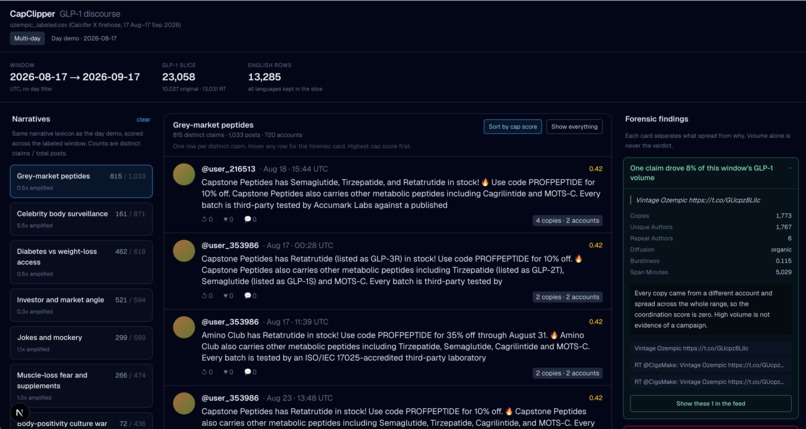
CapClipper Multi-day View
-
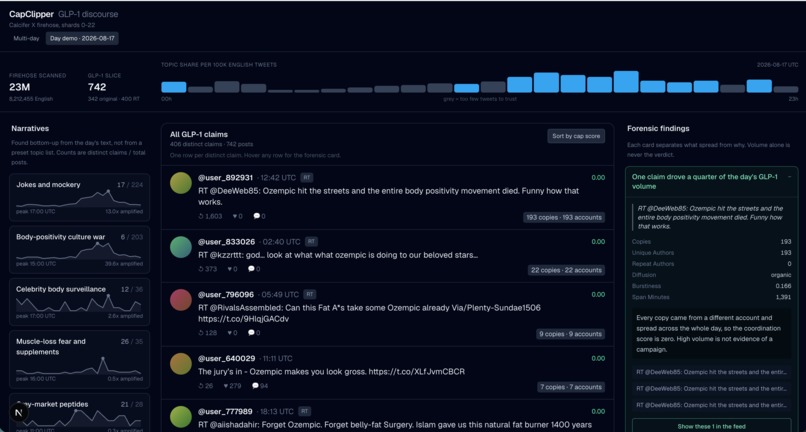
CapClipper Daily View
Inspiration
Our interests in misinformation, social network theory, and botting led us to look at weight-loss drug trends on social media
What it does
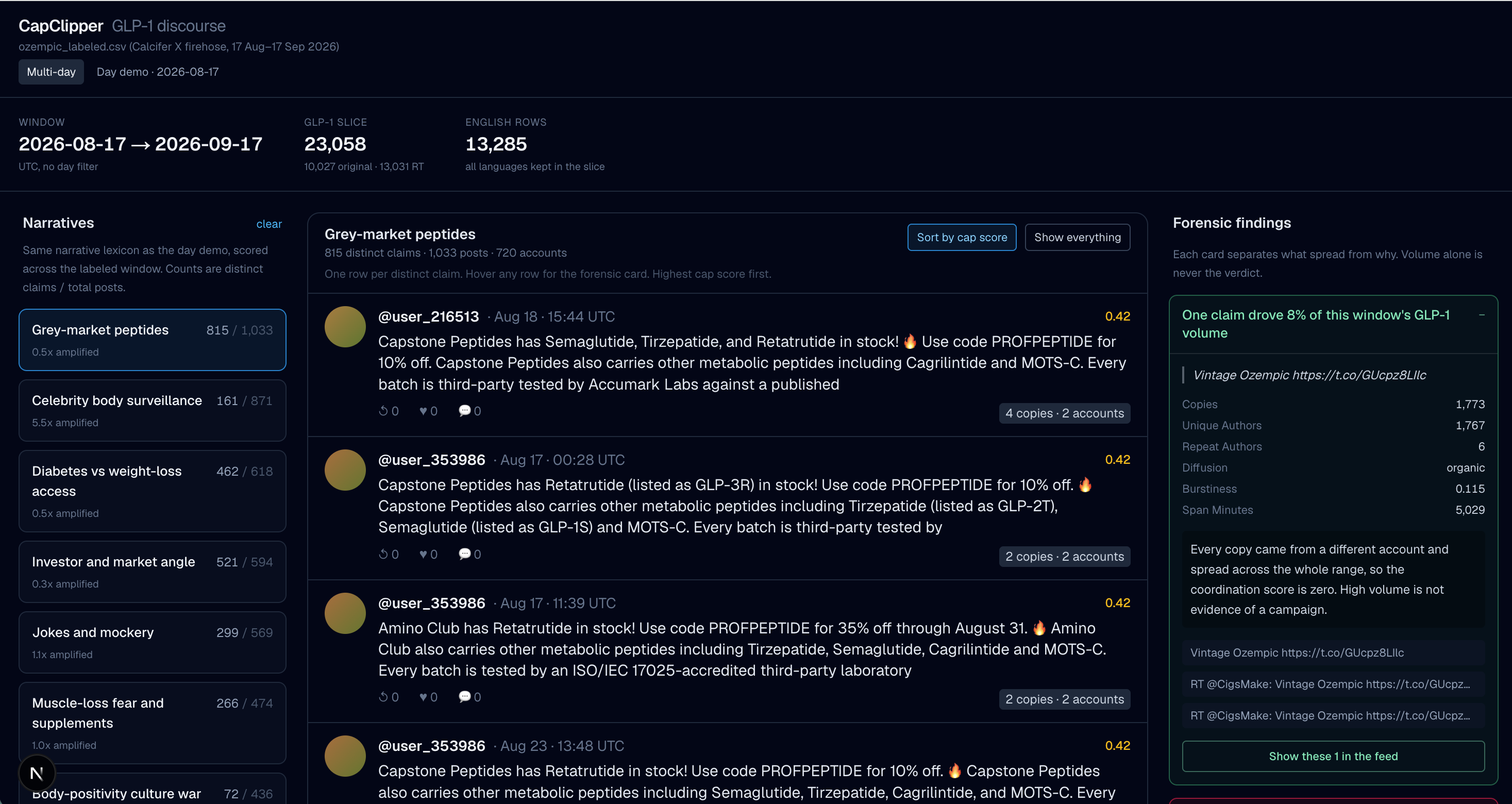
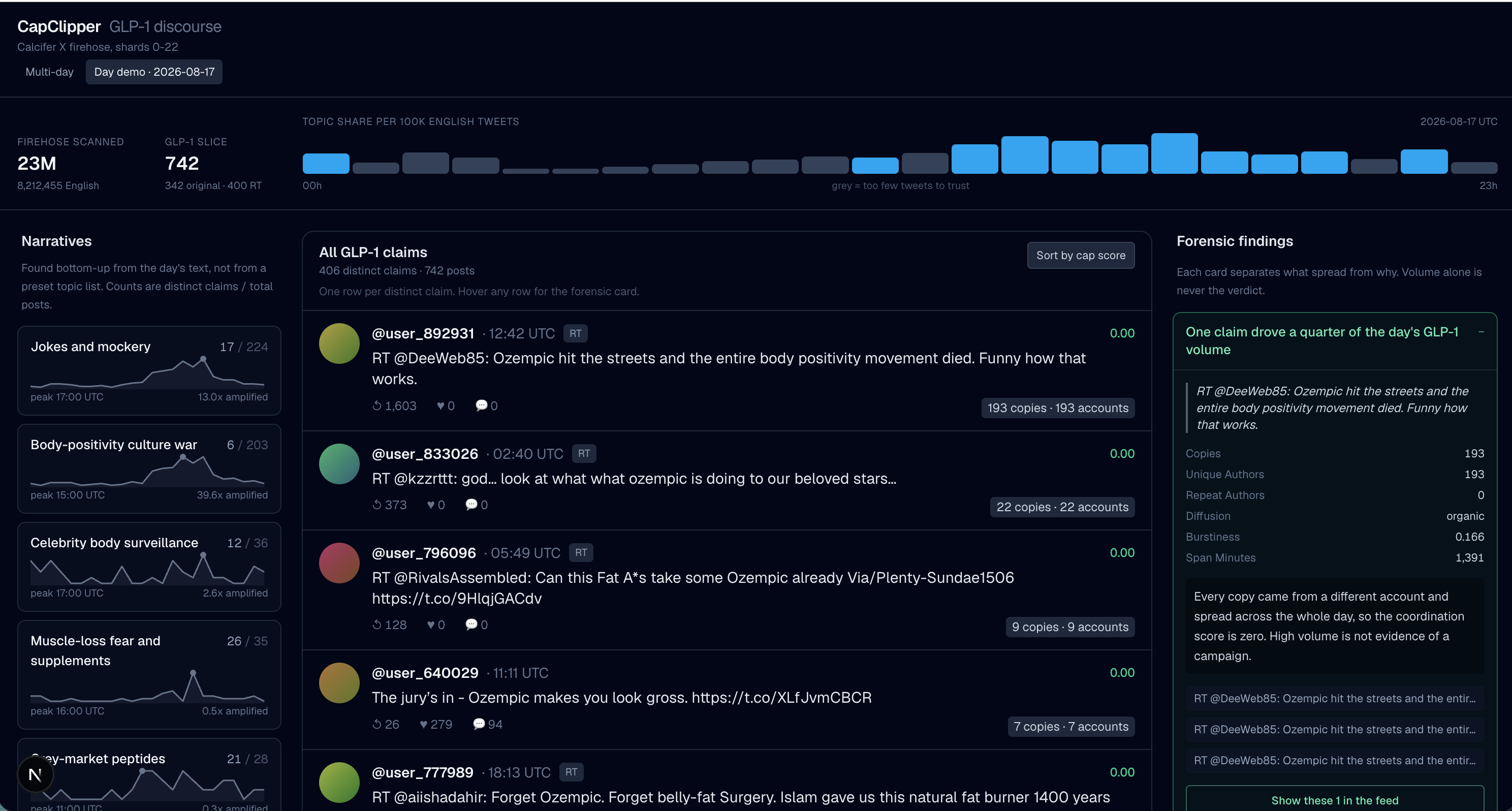
CapClipper analyzes social media data to track trends, including exposing fake hype and hidden ads. It provides insights on social media trends based on sentiment analysis over massive real-life X post data.
How we built it
The interactive application runs on Python, FastAPI, and Next.js, while Gemini and Grok handle offline batch data processing, labeling, and sentiment analysis.
Challenges we ran into
Work wth 395 million raw tweets; LLM Latency: we decided to pre-process the heavy sentiment and labeling work offline using Gemini and Grok; Defining "Cap" Mathematically: we want to build a more mathematically rigorous algorithm using advanced time-series modeling to detect coordinated bot swarms with higher precision.
Accomplishments that we're proud of
While investigating GLP-1 drug trends across a massive dataset of X posts, we discovered an unexpected pattern: the grey-market dealing of peptides. We built an interactive, user-facing application that turns noisy social media data into actionable insights.
What we learned
This project bridges computer science, interpretable AI, and social network theory. By investigating network data (e.g. how posts relate to one another) we analyze emerging social trends surrounding GLP-1. From a development standpoint, it offers a hands-on opportunity to collaborate with AI agents and implement human-in-the-loop decision-making.
What's next for Cap Clipper
Twitter location, account activity, and network metadata Scaling compute to cover new categories (crypto, politics, etc.) Improving pre-processing efficiency and LLM cross validation Build a more mathematically rigorous algorithm to quantify "cap"
Built With
- cursos
- gemini
- grok
- next.js
- node.js
- python
- typescript

Log in or sign up for Devpost to join the conversation.