-
-
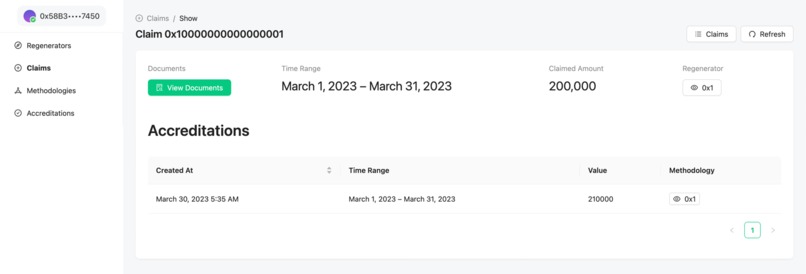
Dashboard Screenshot

Inspiration
- Impact certificate infrastructure can enable capital flows.
- The way ReFi is going to win against TradFi long-term is to enable greater amounts of innovation in the ecosystem.
- The right programmable abstractions unlock engineering velocity.
- The ReFi primitive of 2022 was the carbon credit token, which brought off-chain credits on-chain.
- Before credits come on-chain, they are accredited by an evaluating body according to a methodology — a system of scientific methods.
- CAP lets builders express this type of climate impact directly on EVMs.
What it does
CAP enables new workflows with two new decentralized impact legos.
- "Saying you did something" — Claims
- "Getting it checked" — Accreditations
- "Getting credit for what you did" — Credits
- "Being a patron of of regeneration" — Certificates
This creates the environment for the development of trust through on-chain reputation. I could imagine someone building an impact score that factors in the accuracy of your estimated vs. evaluated impact amounts, the number of accreditations it has, and the variability of the evaluated amounts.
How we built it
For this hackathon, I did two sprints.
First, I developed a custom build pipeline to convert my Foundry Diamond contracts into a TypeScript SDK that exposes React hooks, async functions, and a GraphQL API.
Then, I learned how to use the refine Next.js framework to build the administrative dashboard.
Challenges we ran into
Working with Graph Protocol was a challenge due to the slow rate of iteration — changes require redeployment and re-indexing, which can take a few minutes.
Working with Refine was also challenging because it expects you to do things in a certain way, and doesn't include adapters for Web3, so I had to crawl through source code and build my own adapters to make things work.
Accomplishments that we're proud of
I'm proud to have developed a demo for a protocol that brings the accreditation process on-chain. Unlike existing carbon credit protocols, which are permissioned (by their teams, i.e. Toucan, Flow) and centralized (i.e. you're only allowed to mint credits from a real-world registry), CAP allows anyone to claim impact, get it accredited, and then receive credits for their work.
Existing ReFi SDKs don't let you tokenize carbon credits, they let you work with the tokenized carbon credits that that organization bridged.
CAP, instead, gives every builder access to a protocol that streamlines the carbon tokenization process and has a system for built-in trust.
Applicable Prizes
- Best use of Filecoin and/or CO2.Storage
- I'd say this is the best project in terms of market impact because it would enable native issuance with a verification system, which would allow permissionless minting of carbon (and other) credits,
- User Flows:
- Carbon Project Developers "claim" impact amount in T tCO2e
- On-chain Registries "accredit" impact amount T' tCO2e
- Carbon Project received Credits (NFTs) they can compose with the rest of the ecosystem
- Bonus: Public verifiability in sustainability
- CAP primitives enable evaluating bodies to verify sustainable action of any quantifiable vector, i.e. tCO2e emitted, tCO2e removed, # of trees reported, etc.
- Climate Collective Bounty — cross-referencing data for under or over-reporting
- CAP allows multiple accreditations, so multiple auditors can cross-reference claimed disclosures in an auditable way. Over time, companies develop reputation.
- User Flows:
- Companies "claim" emissions amount E tCO2e
- Auditors "accredit" emissions amount E' tCO2e
- This can also work for carbon project developers to develop a "credit score" over time as we can publicly verify whether they have a tendency to under or over-claim impact.
What's next for CAP: Climate Attestation Protocol
Prize funds will be used to design and develop optimized application flows for key jobs to be done as prioritized in research and customer discovery.
Built With
- foundry
- next.js
- refine
- typescript
- wagmi



Log in or sign up for Devpost to join the conversation.