-
-
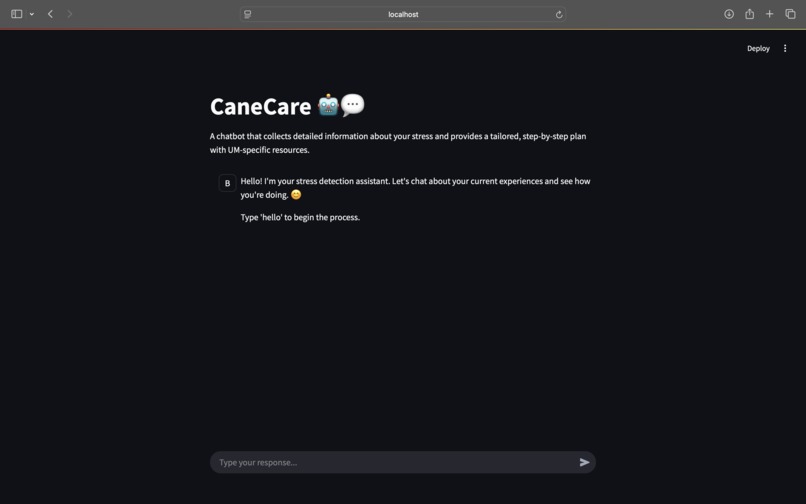
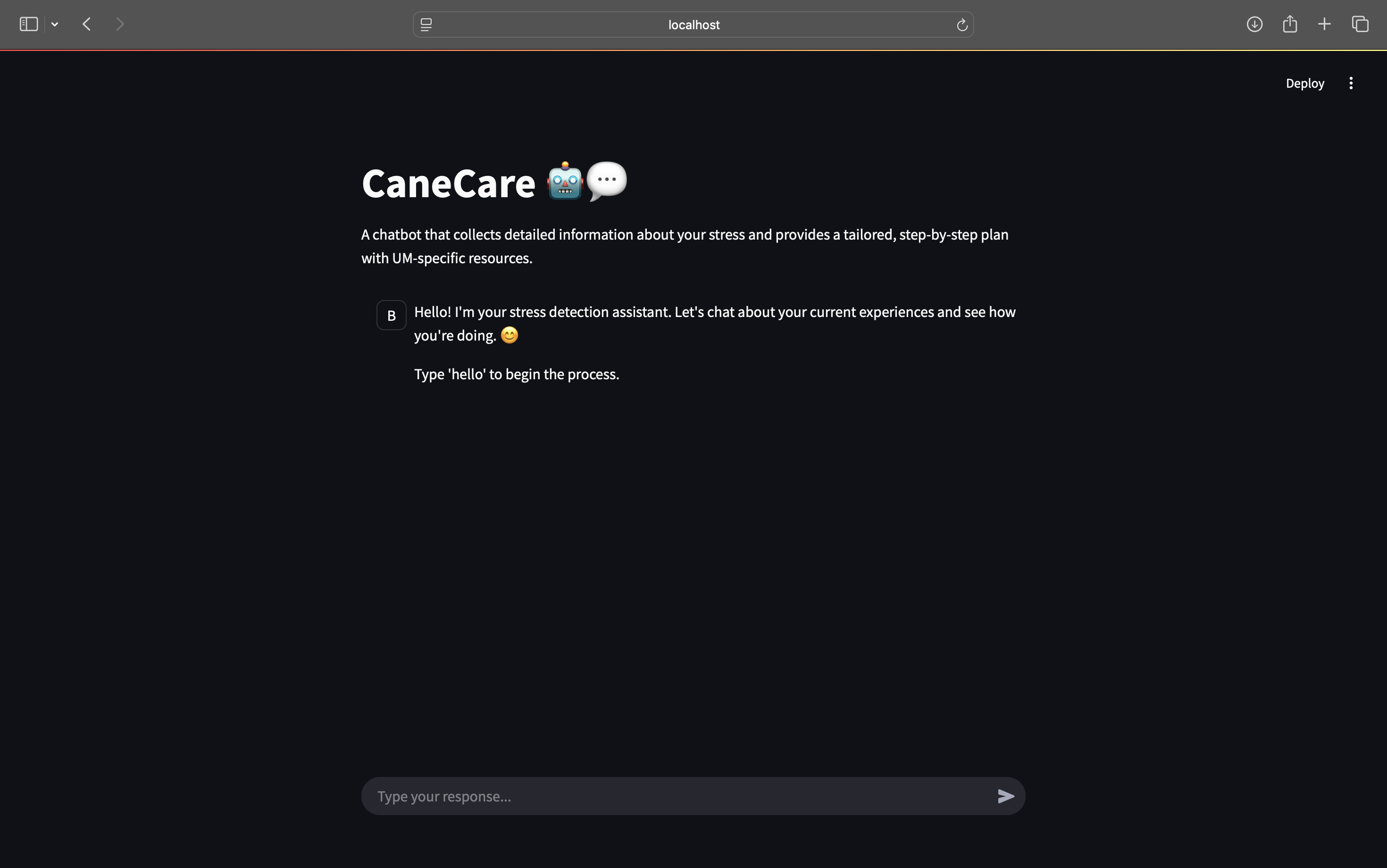
The starting page
Inspiration We were inspired by the growing need for accessible mental health and stress management tools for university students. Observing how UM students face pressures from academics, social life, career planning, and personal wellbeing, we wanted to create a solution that provides timely, personalized support and connects students with campus resources—all in an engaging, conversational format.
What It Does CaneCare is an AI-powered chatbot that:
Engages in Conversation: Asks a series of carefully designed, domain-specific questions to subtly assess a student’s stress triggers across Academics, Mental Wellbeing, Physical Health, Social Life, and Career Tension. Provides Personalized Advice: Uses the responses to generate a detailed, step-by-step wellness plan with actionable recommendations and direct links to UM-specific resources (e.g., Academic Resources, the Counseling Center, Herbert Wellness Center, Student Life Office, and the Career Center). Offers an Interactive Dashboard: Includes a meeting calendar for booking campus resource sessions and a stress tracker that allows users to monitor their wellbeing over time. How We Built It Backend: Developed using Flask with Flask-Session to maintain conversation state. We integrated OpenAI’s GPT-3.5-turbo model to generate tailored advice based on user responses. Frontend: Built with Streamlit to provide an intuitive, responsive chat interface and a feature-rich dashboard. The dashboard includes a meeting scheduler and a dynamic stress tracking chart. Integration: The backend and frontend communicate via a REST API, ensuring a seamless conversational experience with persistent state management. Challenges We Ran Into Session Management: Keeping the conversation state consistent between Flask (backend) and Streamlit (frontend) was challenging. Question Design: Crafting questions that subtly extract meaningful insights without making users feel interrogated. Resource Accuracy: Ensuring that the recommendations pointed directly to UM’s resources required careful research and mapping. UI/UX Balance: Designing an interface that feels natural like a chatbot while incorporating dashboard elements such as calendars and trackers. Accomplishments We’re Proud Of Successfully integrating OpenAI’s language model to produce personalized, actionable mental wellness plans. Developing a stateful chatbot that maintains conversation context across multiple interactions. Creating an interactive dashboard that not only supports the chat but also empowers users to track their progress and schedule appointments. Delivering a comprehensive solution addressing real-world stress issues faced by UM students. What We Learned Technical Integration: We deepened our understanding of combining Flask and Streamlit for a seamless full-stack application. Conversational Design: We learned the art of crafting engaging, non-intrusive questions to extract sensitive personal insights. API Reliability: Managing external API calls (OpenAI) and ensuring quick, reliable responses is crucial for user satisfaction. User-Centered Design: Iterative design and user feedback are essential for developing a tool that is both useful and approachable for students. What’s Next for CaneCare Looking forward, we plan to:
Enhance Real-Time Data: Integrate live campus event feeds and real-time resource availability to keep advice up-to-date. Expand Multimedia Content: Add guided meditation videos, audio relaxation sessions, and interactive wellness workshops. Improve Analytics: Enhance the dashboard with richer analytics to provide deeper insights into user stress trends. Broaden Support Features: Explore features like peer support, anonymous group chats, and direct access to campus counselors. Refine the UI/UX: Continuously gather user feedback to polish the interface and ensure that CaneCare remains a comforting, intuitive resource for UM students.

Log in or sign up for Devpost to join the conversation.