Inspiration
Imagine you are a singer and you have turned your songs into NFT and you want to sell the copyrights of that song or you are a game designer and in your game the items are NFTs and you want the players to be able to rent the rights to use that item to another player or you have that one piece of NFT art that everybody wants to use but nobody wants to pay the full price for. It would be really nice to make a passive income with that right.
What it does
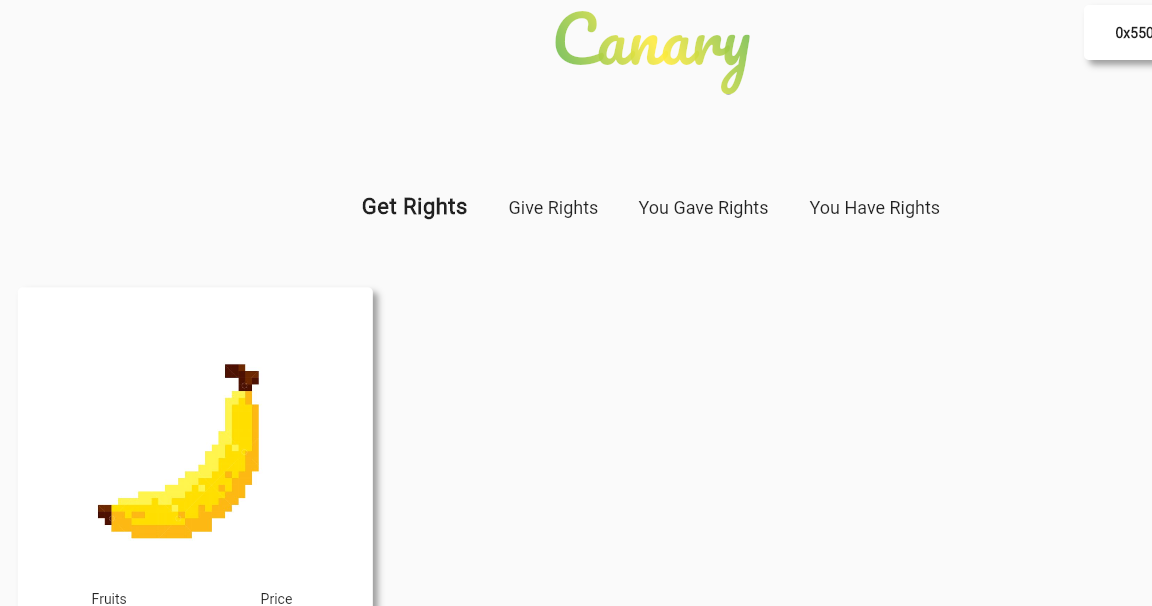
Canary is a rights protocol, with canary you can sell the rights to use your NFT to other people just by setting a small daily fee, max number of right hoders and max holding time. "But why would anyone want to buy rights to an NFT?" imagine you are a game developer and the items in that game are NFTs, it would be great if players could sell the rights of their items to other players temporarily or you want to use that cool design in your profile picture on social networks, so instead of paying full price for the NFT, why not just pay a small amount for temporary rights? this protocol could also have a big impact on the music copyright industry and many other applications. "but what happens to the owner of the NFT?" The owner of the NFT will receive the daily rate he has set, i.e. the owner of the NFT will earn from the daily rates and from the appreciation of his item because the more an item sells, the more it will be desired by other collectors. The NFT owner can also define a total number of rights holders and thus create scarcity for the rights to his NFT and of course we will support a parallel rights market where rights holders will be able to sell their rights to other collectors. that way the NFT owners will promote our platform for free because they will earn from the valuation and royalty fees on their NFT.
How it works?
The NFT Owner:
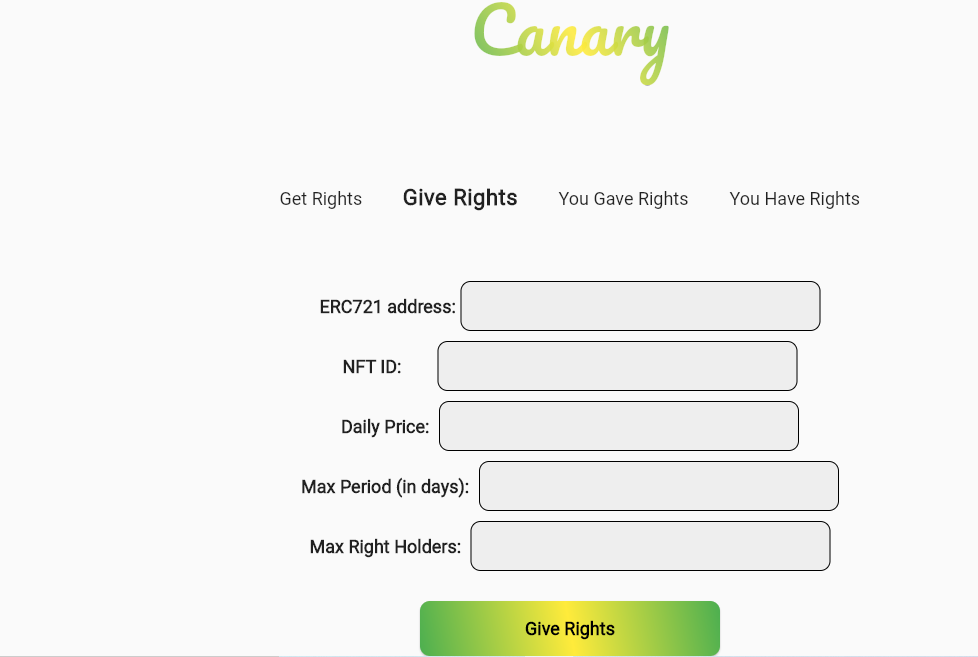
Deposits his Token in the Canary protocol defining the daily price of the right on that NFT, the maximum amount that any holder can hold an NFT right and the maximum number of holders that the NFT can have (to create scarcity).
Canary Protcol:
Hold the NFT and generate an amount of rights token based on the maximum number of holders that the NFT can have, selling each rights token with a value based on the daily price that the NFT owner has set and the amount of days the right holder has set (Cannot exceed the maximum number of days that the NFT owner has set).
Right Holder:
Has a rights token that can be used as a proof that he has the right to use the data of that NFT for a certain period of time, for that he needs to define the number of days he wants to use the rights token and pay the respective fee.
Challenges we ran into
The first challenge was to find use cases for the protocol and we managed to find use cases in the areas of games, music and arts. The second challenge was to try to generate more value for the rights tokens and this was solved by inserting a way to control the emission of rights tokens and this way generating a scarcity and making it more valuable.
Accomplishments that we're proud of
we are proud to develop a protocol that can bring more liquidity, value and different usages to the NFT ecosystem
What's next for Canary
in the second stage of the Canary when the price of our governance token (CAT) is registered in the price feed we intend to pass the ownership of the Canary protocol to our governance protocol, our governance protocol is an incentive based protocol in which all those eligible to vote have equal voting power thus preventing only those with more resources from centralizing power within the governance. "But if everyone has the same voting power why would I buy more governance tokens?", our incentive system will benefit you if you have more tokens. More details about our protocol read our readme on our github repository .

Log in or sign up for Devpost to join the conversation.