-
-
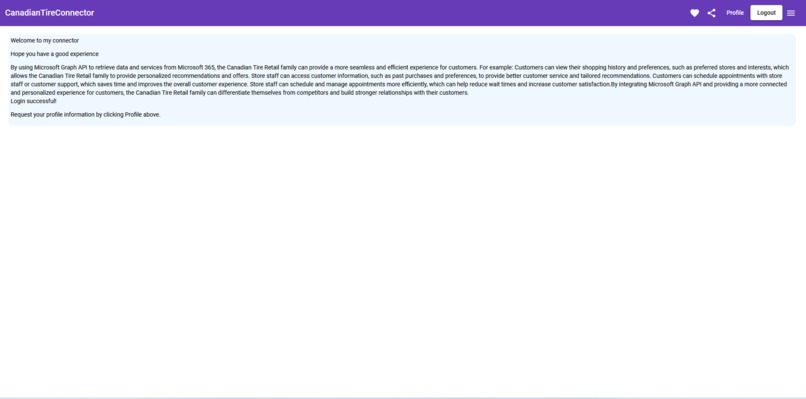
Homepage
-
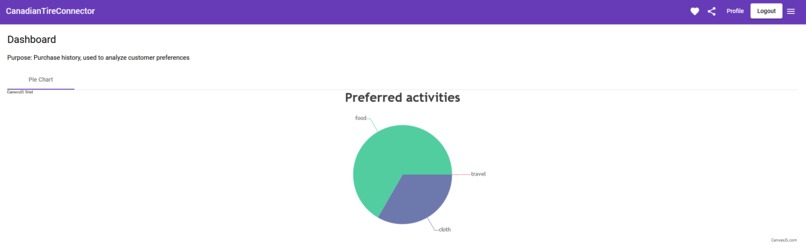
Dashboard
-
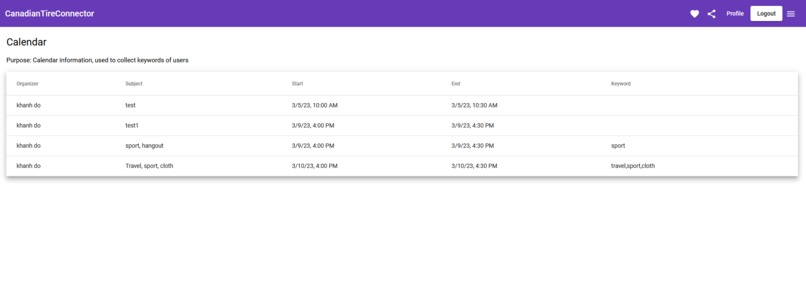
Calendar activities


To connect Canadian experiences with Canadian customers with the Canadian Tire Retail family using connectivity technologies, the following steps can be taken:
- Create a unified platform for the Canadian Tire Retail family that integrates all its services and products in one place. This will include Canadian Tire, Sport Chek, Atmosphere, Mark’s, Part Source, Party City, Gas+, and any other services that are part of the Canadian Tire family. The platform can be built using a modern technology stack that is scalable and flexible.
- The platform will provide a personalized experience to customers by leveraging customer data and preferences. The platform will gather data such as shopping history, preferences, and interests, and use it to offer personalized product recommendations, promotions, and discounts. This will enhance the customer shopping experience and make it more efficient.
- Finally, the platform will be built with the latest security standards to protect customer data. This will include encryption, access control, and data backups. The platform will also comply with all relevant privacy laws and regulations.
Key people involved in this platform will include:
- Customers
- Store staff
- Canadian Tire employees outside the store, including customer support and other corporate office roles
Building a proof of concept will involve developing a prototype of the platform with a subset of features to demonstrate its feasibility. This can be done by building a Minimum Viable Product (MVP) and testing it with a small group of customers and store staff.
Some of the high-level benefits of this platform include:
- Enhanced customer experience and satisfaction
- Increased efficiency and productivity for store staff and Canadian Tire employees
- Improved collaboration and communication between different departments and people
- Increased revenue through personalized product recommendations and promotions
- Improved security and compliance with privacy laws and regulations.
The costs of building and maintaining this platform will depend on the technology stack used, the size of the team involved, and other factors. However, the benefits of the platform are likely to outweigh the costs in the long run.
To build an MVP for a unified platform using Angular and Microsoft Graph, developers can follow these steps:
- Set up an Angular development environment on a local machine.
- Create an Angular application with the necessary components, services, and routing.
- Integrate Microsoft Graph API into the Angular application.
- Use Microsoft Graph API to retrieve data and services from Microsoft 365: Microsoft Graph API allows you to access data and services from various Microsoft 365 applications, including email, calendar events, contacts, OneDrive, SharePoint, and more. For example, you can use the API to retrieve a user's emails, calendar events, or contacts.
- Use the retrieved data and services to enhance the user experience: Once you have retrieved the data and services from Microsoft 365, you can use them to enhance the user experience in your application. For example, you can display a user's upcoming calendar events within your application, allowing them to quickly see what they have planned for the day.
- Implement features that allow users to interact with the retrieved data and services: With the data and services retrieved from Microsoft 365, you can implement features that allow users to interact with them. For example, you can allow users to schedule a meeting directly from your application by accessing their calendar events and adding a new event. You can also allow users to send an email from within your application by accessing their email data.
- Test and refine the application to ensure it provides a seamless and efficient experience for users.
Built With
- angular.js
- api
- azure
- graphapi
- microsoft

Log in or sign up for Devpost to join the conversation.