-
-
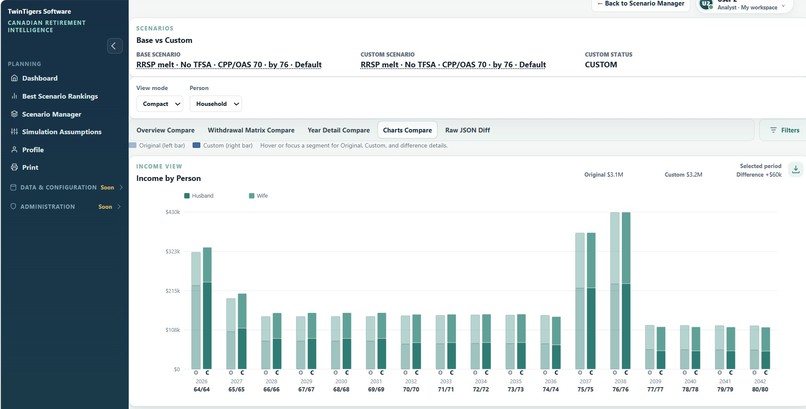
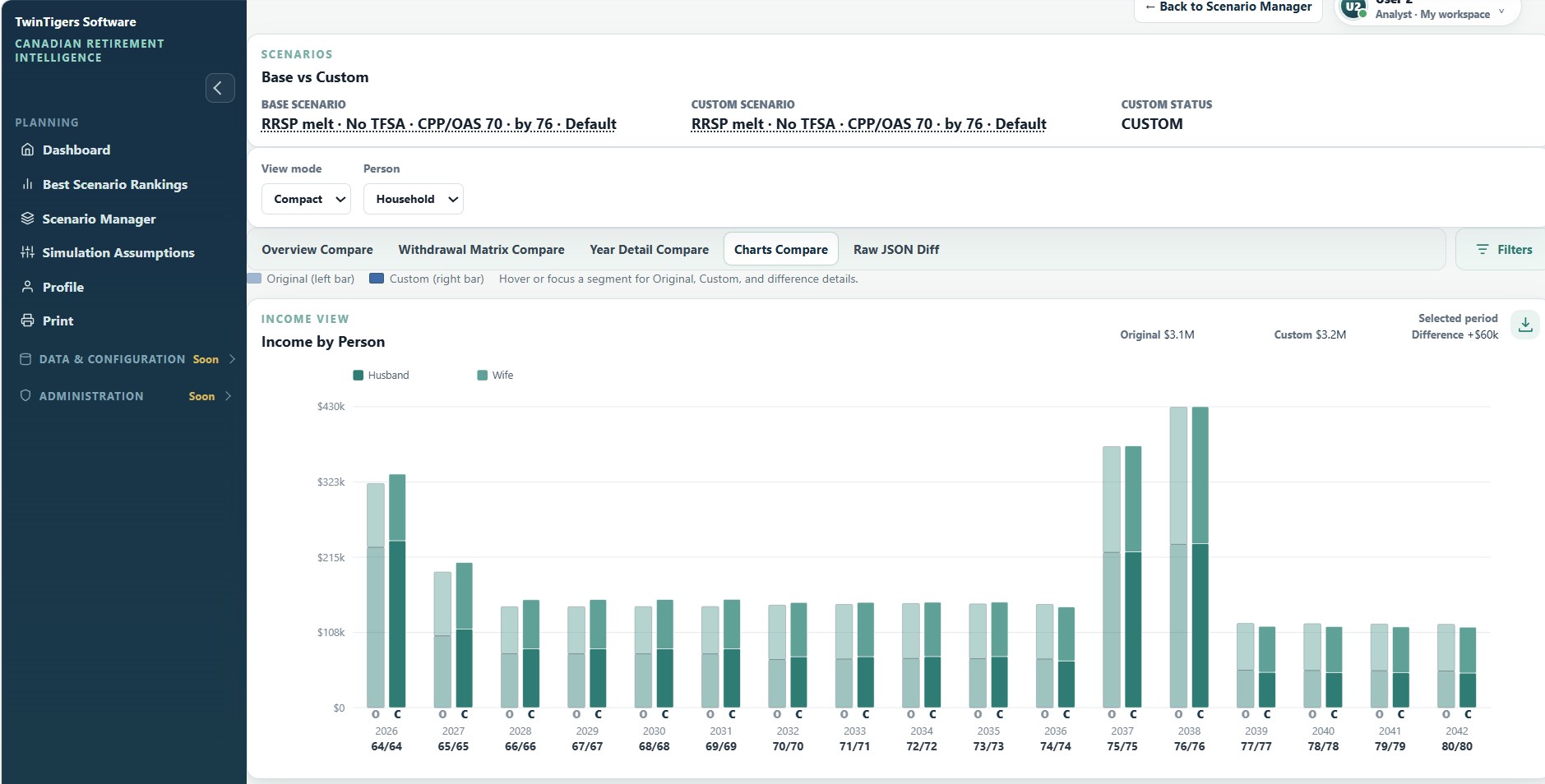
Scenario Comparison
-
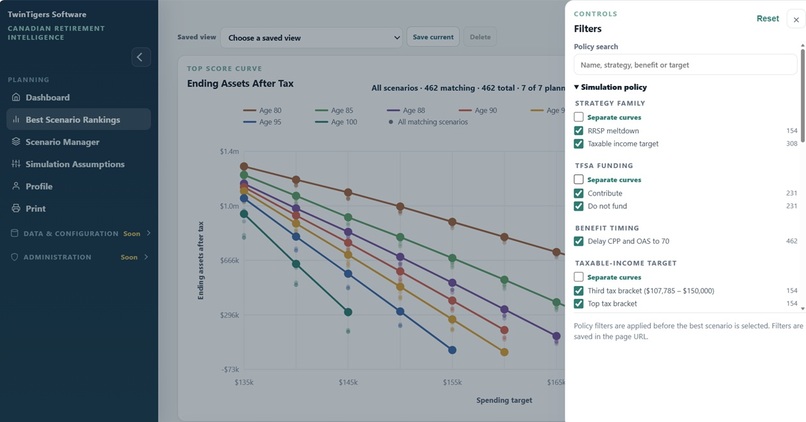
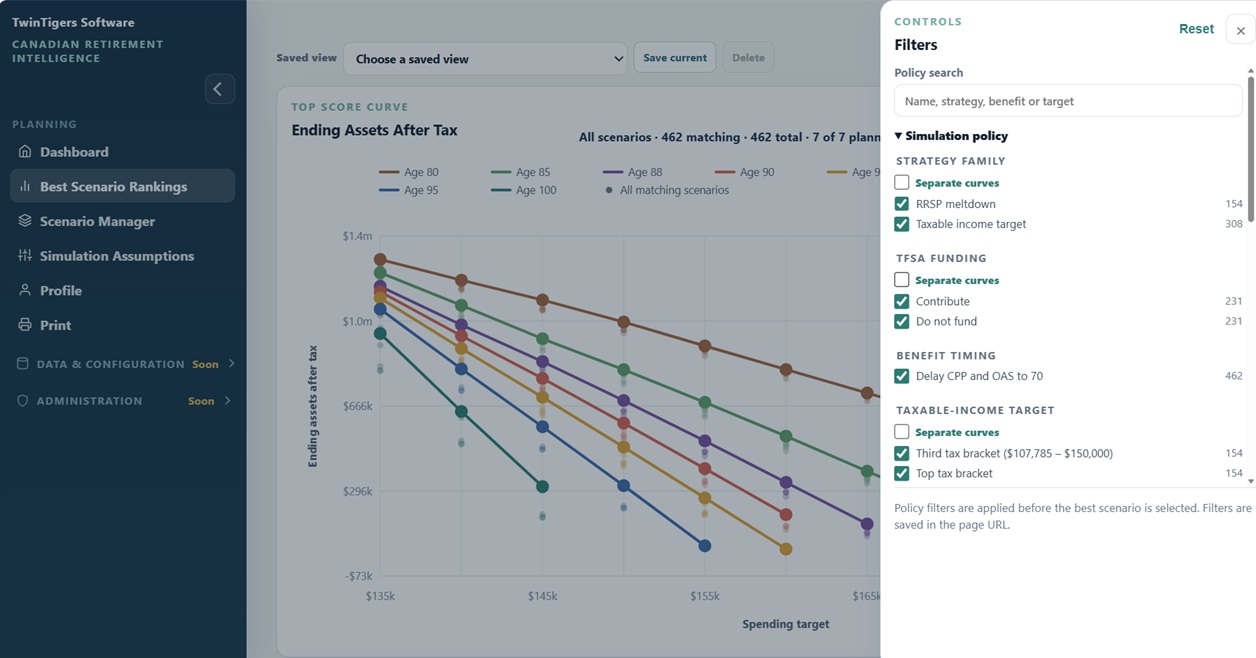
Best Scenario Ranking
-
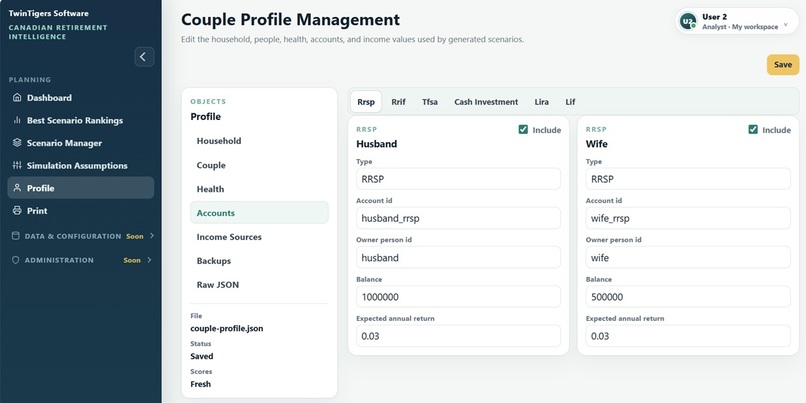
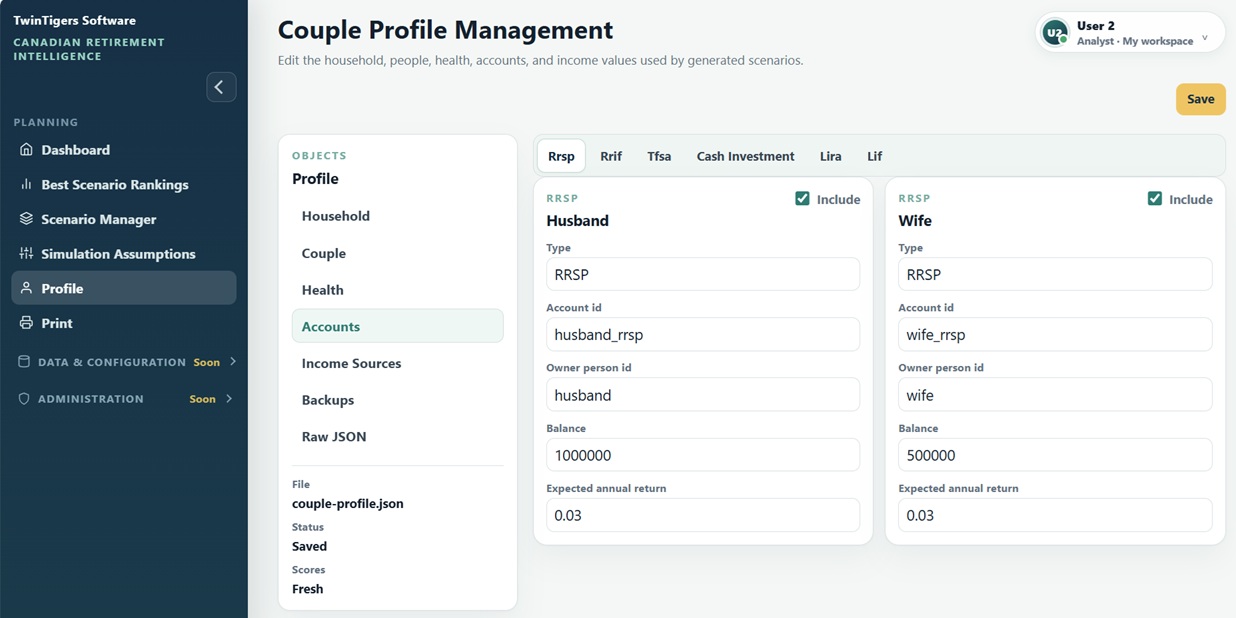
Client Profile - accounts
-
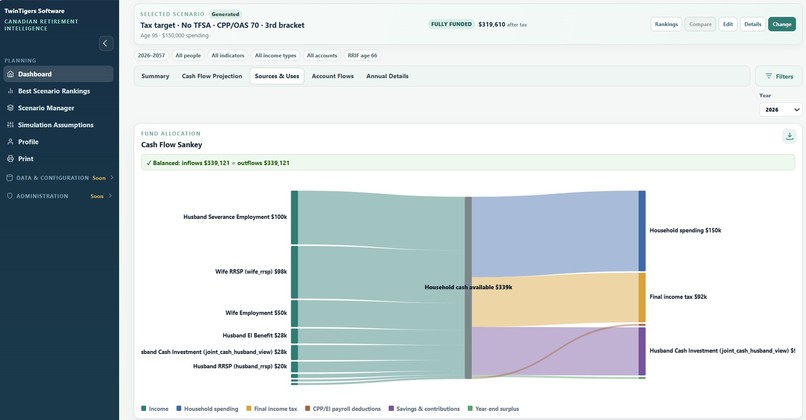
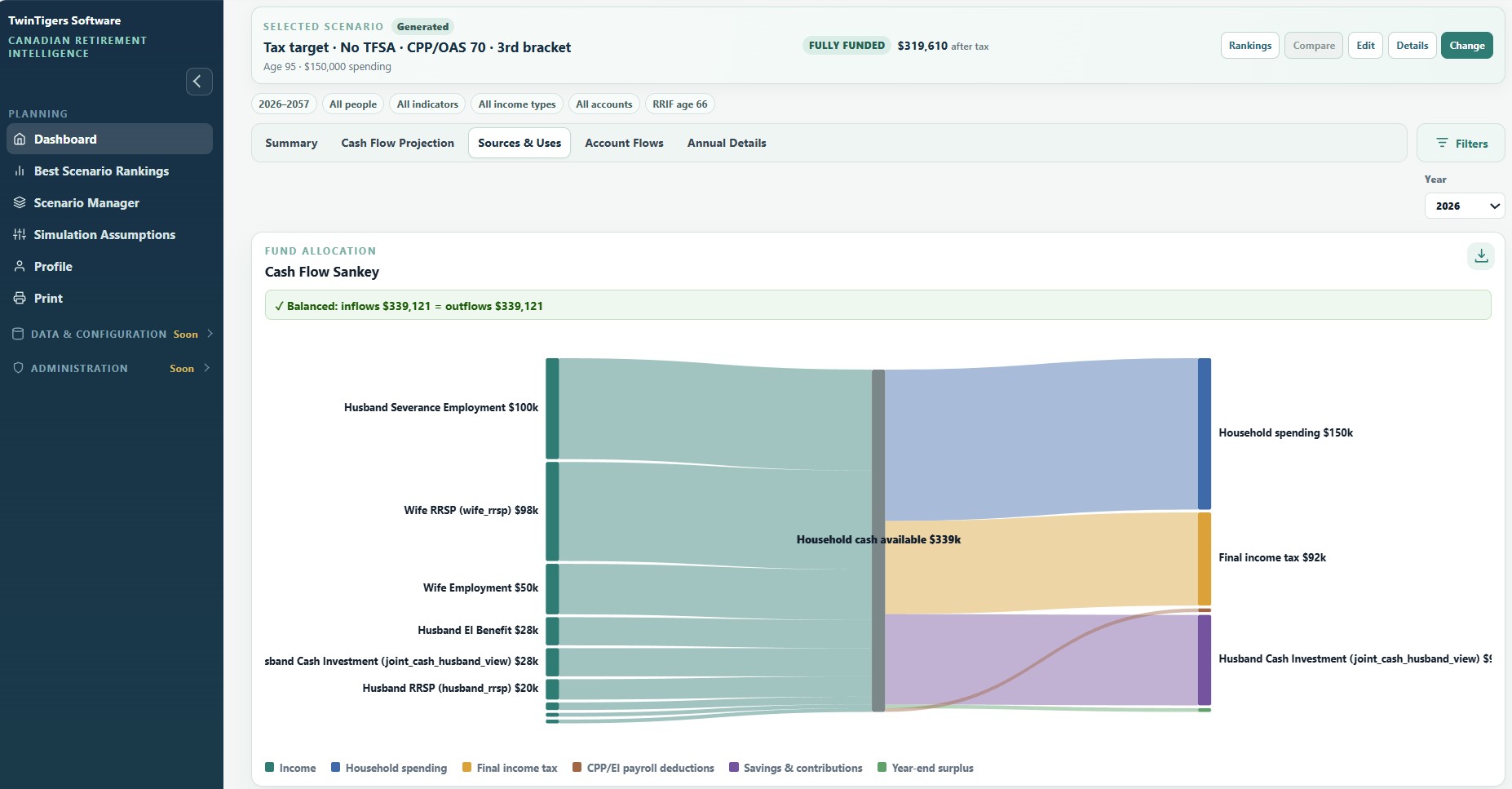
Source and Uses - audit tracing
-
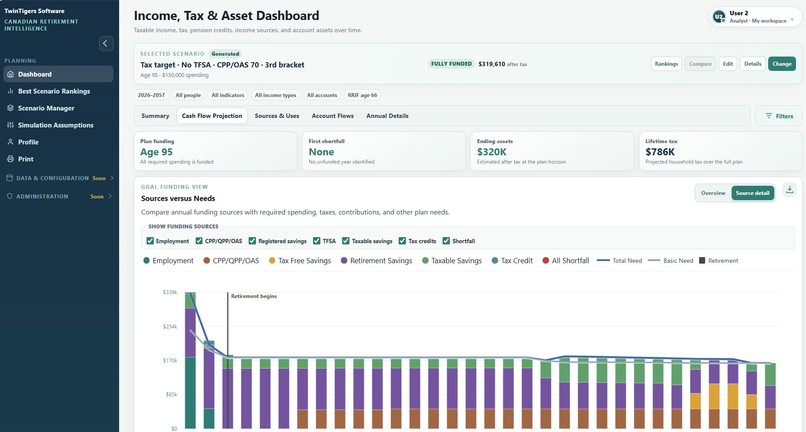
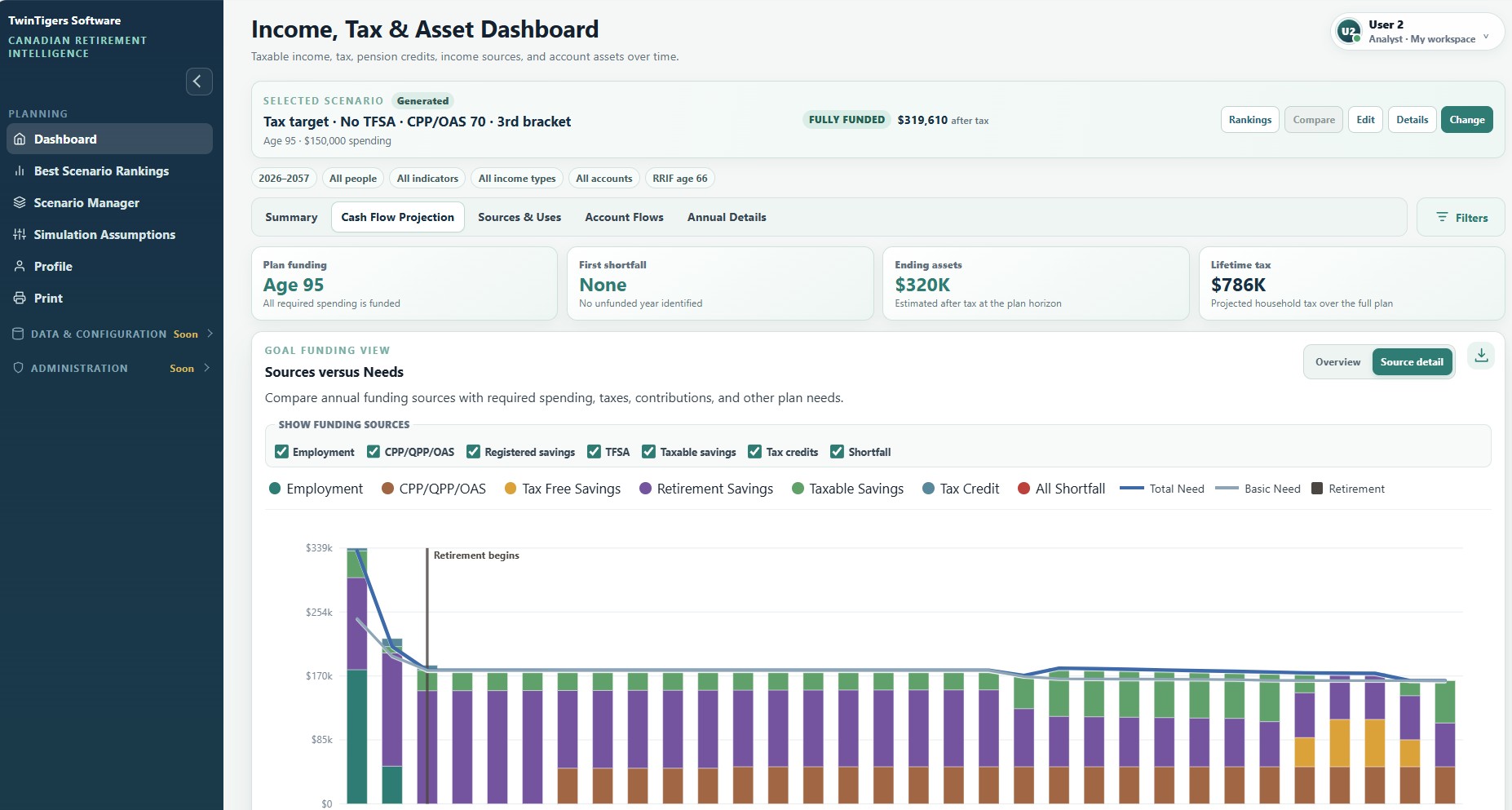
Cash flow over planning years
-
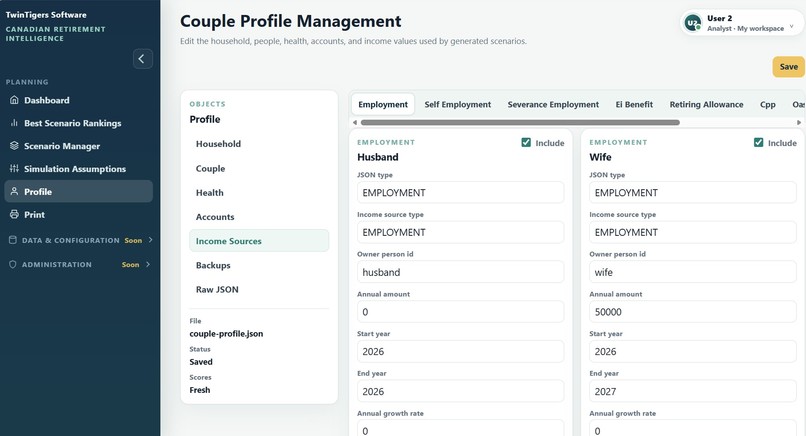
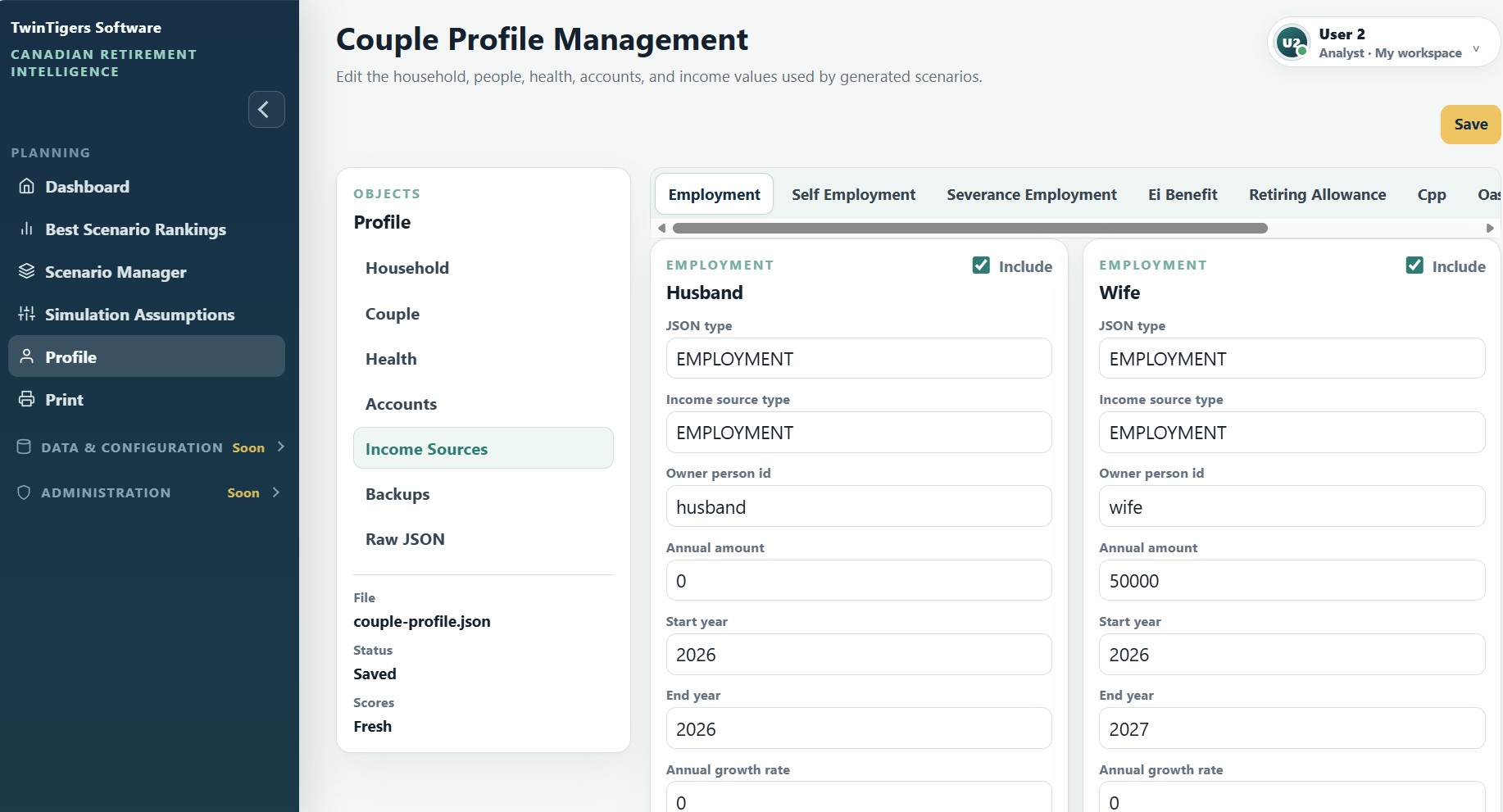
Client Profile - Incomes
-
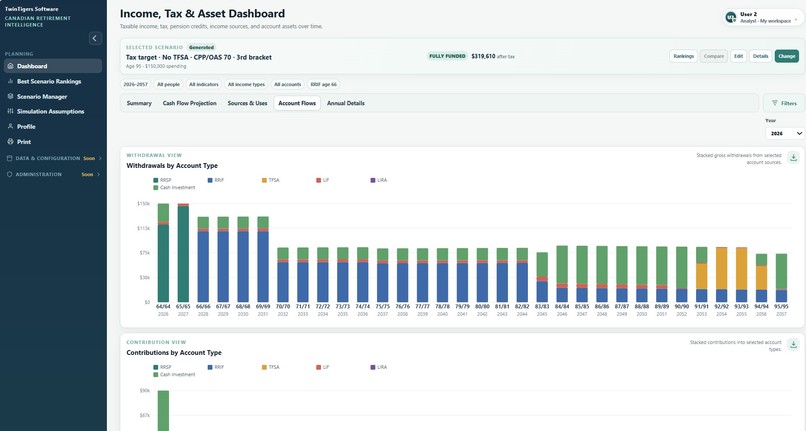
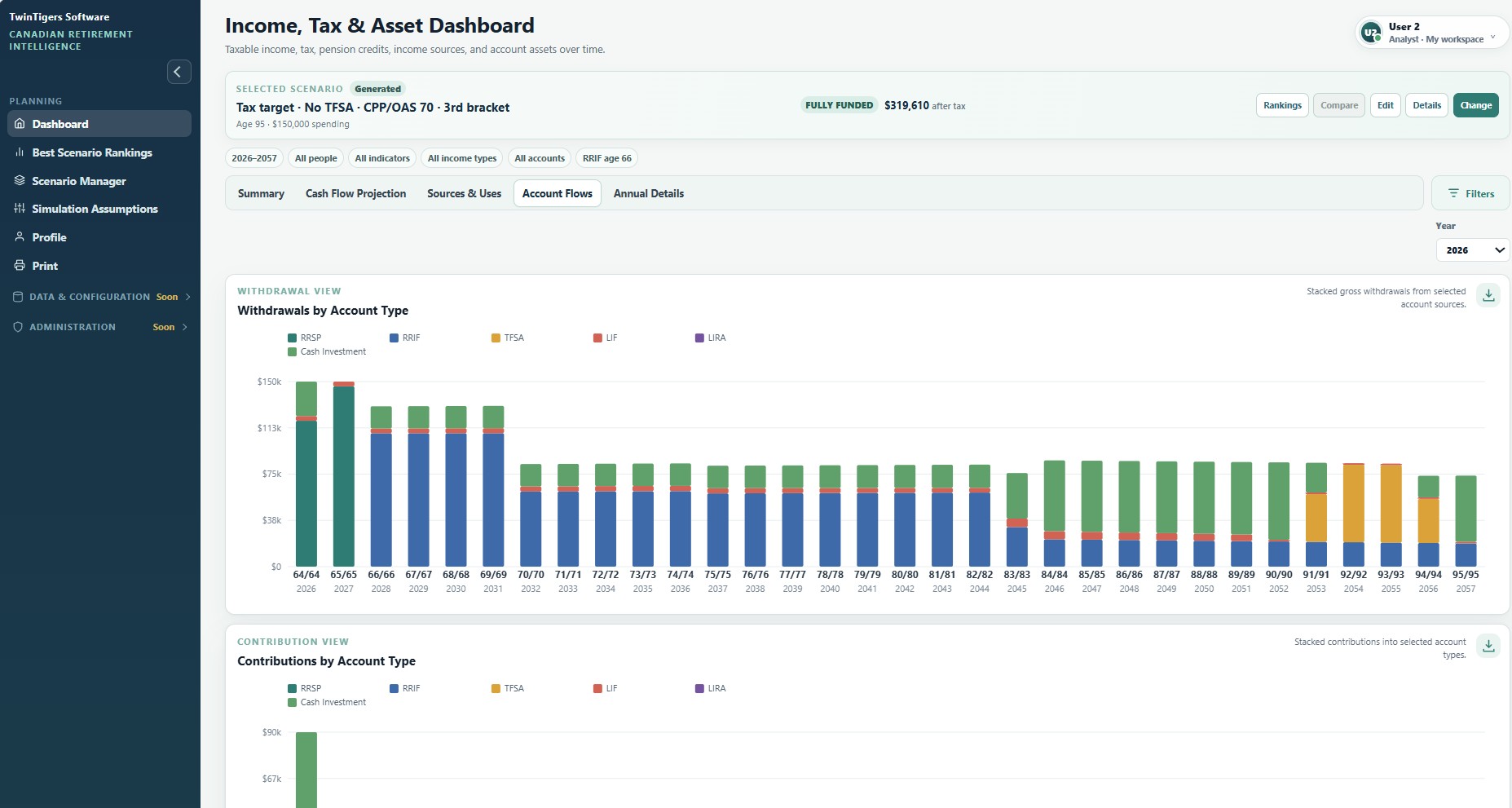
Dashboard - contribution
-
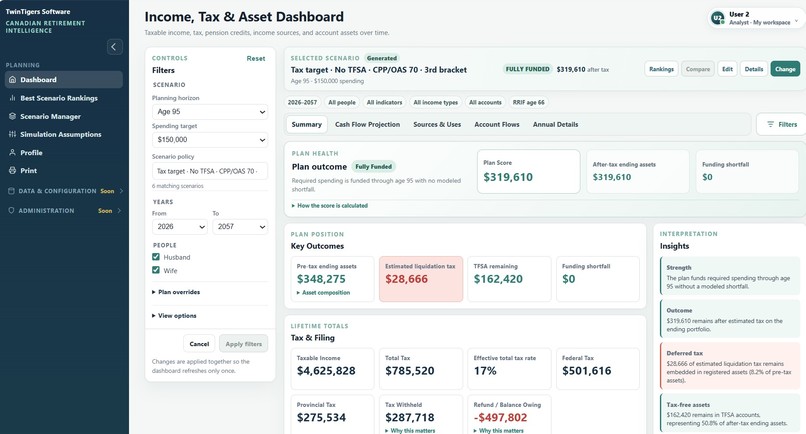
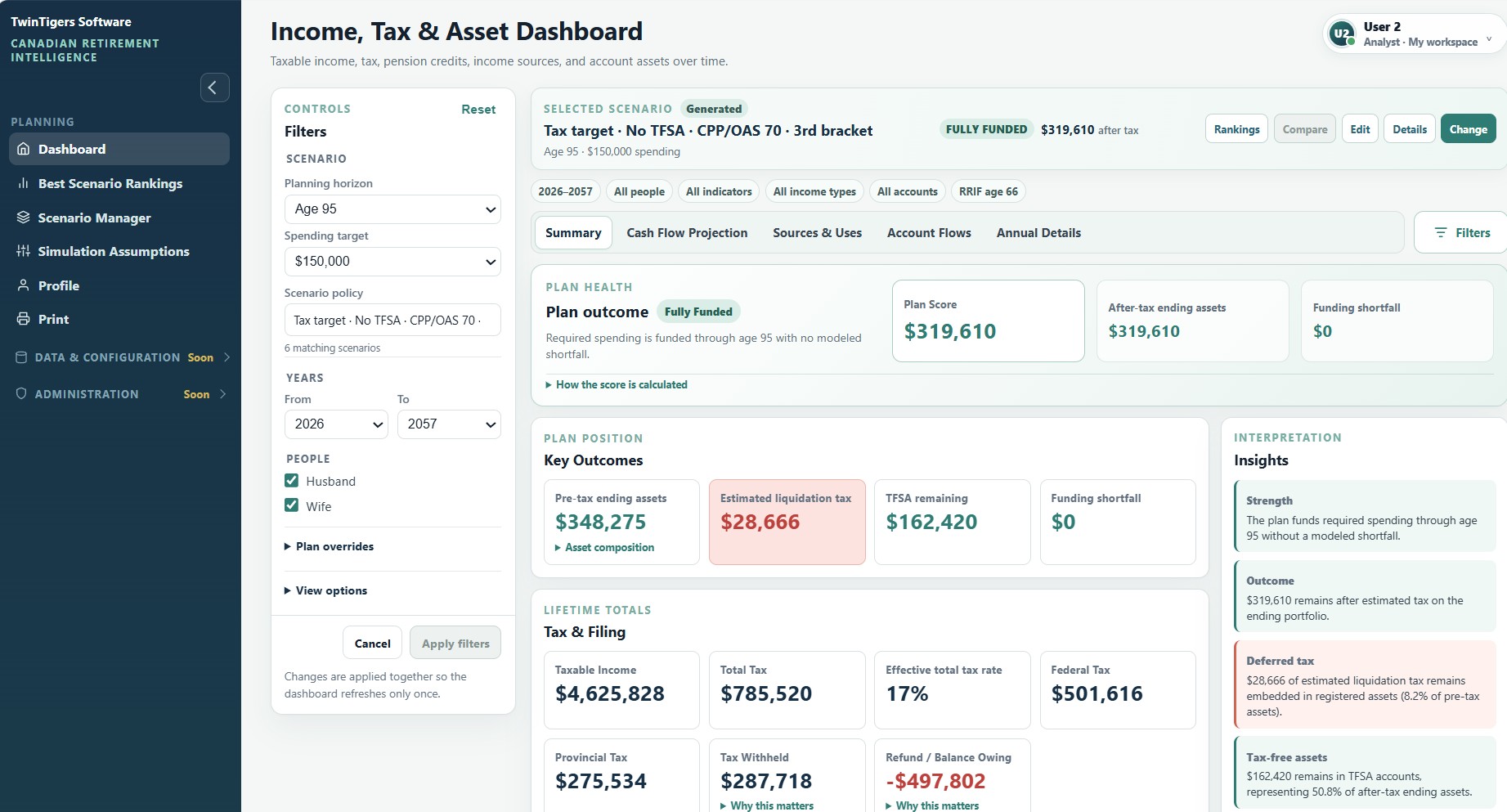
Dashboard - insight & actions
-
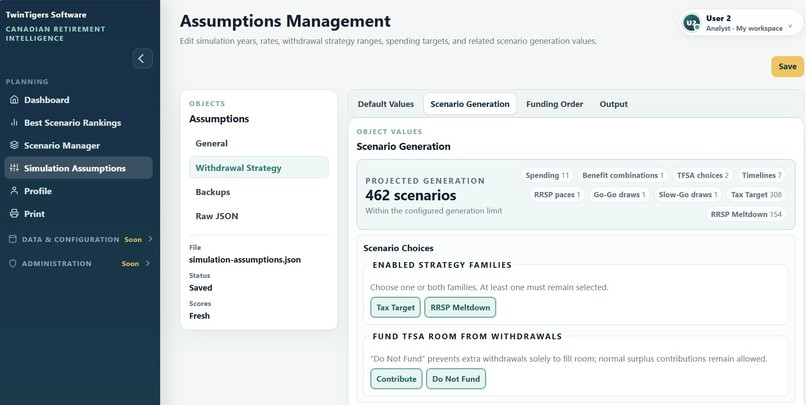
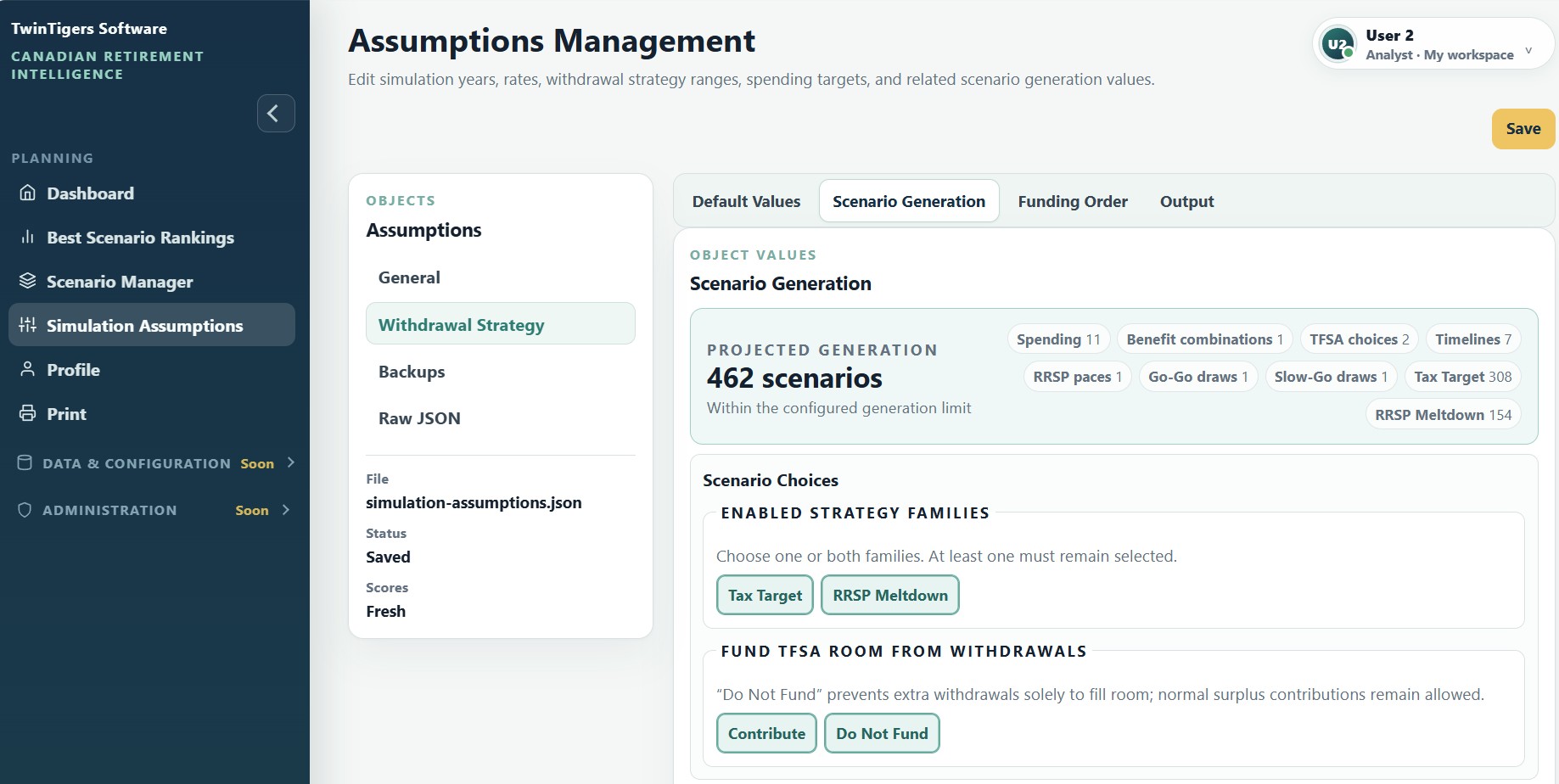
Simulation Parameter Management
-
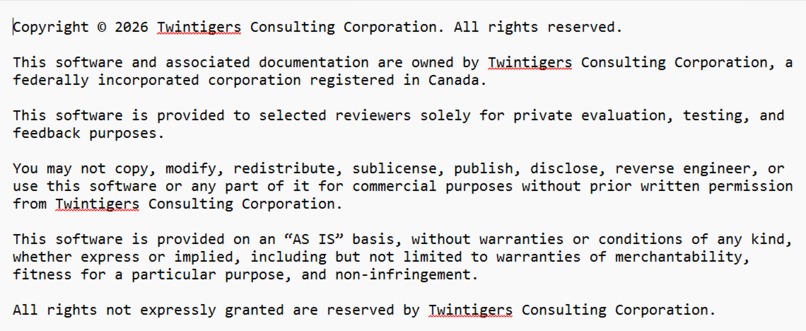
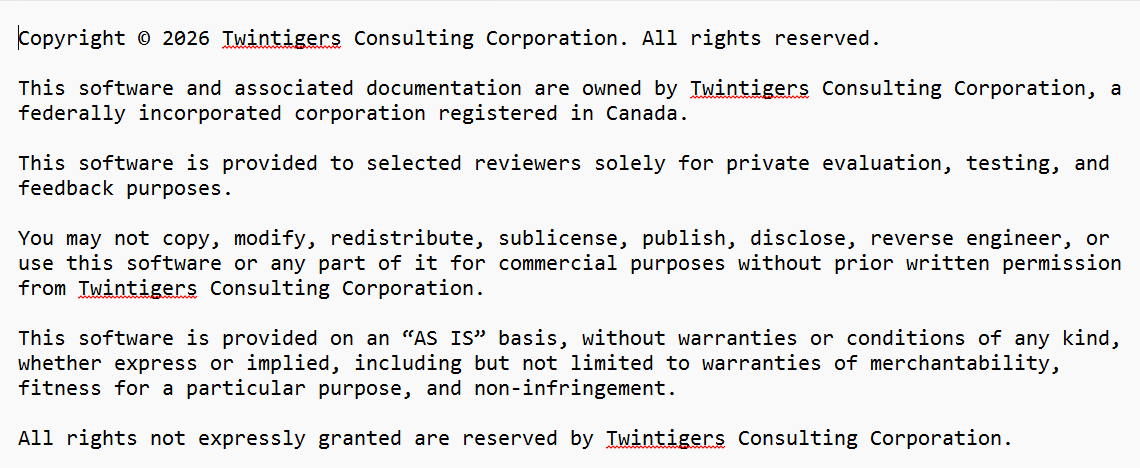
License
Inspiration
Retirement planning is one of the most important financial decisions people make, yet many tools provide static projections instead of optimized, understandable strategies.
The one-person team set out to build a platform that could answer the questions retirees care about most: Can I retire? How much can I safely spend? Will my money last? How much tax will I pay? What will my family inherit? What options are available if my goal changes, And what should I do now?
What it does
Canadian Retirement Intelligence evaluates thousands of retirement strategies across spending, RRSP and RRIF withdrawals, CPP and OAS timing, taxes, investment growth, government-benefit claw backs, and estate goals.
It compares alternatives, identifies stronger strategies, and explains the results in plain language. Users can review yearly cash flow, taxes, account balances, assumptions, risks, and recommended actions.
Explainability is built into the platform. Recommendations can be traced back to yearly income, withdrawals, taxes, benefits, spending, and account balances.
The platform also includes a tax test-case generator. It converts retirement scenarios into structured tax cases that can be compared with independent Canadian tax software, calculators, or manual worksheets. This allows differences to be isolated by taxpayer, year, income type, deduction, credit, tax bracket, benefit, or claw back.
The platform supports three user roles:
- Administrators manage users and planning templates.
- Financial advisers manage client workspaces and plans.
- Clients have read-only access to their results.
How we built it
Canadian Retirement Intelligence was created by a one-person team in approximately three months, with about 95% of the software developed using OpenAI Codex.
The one-person team is a former IBM Senior Technical Staff Member (STSM) and senior software architect with more than two decades of experience in enterprise architecture, performance engineering, troubleshooting, automation, root-cause analysis, databases, security, infrastructure, and deployment.
The one-person team provided the product vision, architecture, retirement-planning knowledge, financial rules, validation approach, testing strategy, performance requirements, and quality standards. Codex/chatGPT (gpt 5.6) helped turn those requirements into a working Java-based platform with a calculation engine, strategy optimizer, scenario generation/management, dashboards, reports, tax-validation tools, user management, testing, configuration, and deployment.
Large-scale performance and fine grained access control were considered throughout development. Algorithms, data structures, locking boundaries, workspace isolation, scenario processing, persistence, caching opportunities, and user-interface payloads were reviewed for correctness and scalability.
One successful example was a role-based authentication and authorization module. A single detailed prompt asked Codex to support administrators, financial advisers, and clients with the correct permissions. After a few small iterations, we need end-to-end module was working in one morning. The detail conversation message id is msg_019f7597-6f53-7c02-a8e5-1430ef9185bb started at 2026-07-18T14:18:06.547Z.
A second example addressed concurrent user access. The application required narrowly scoped locking when critical accounts, templates, or shared resources were changed. Codex implemented the major concurrency and locking mechanisms from a detailed design prompt, followed by a few targeted refinements. The detail conversation message id is msg_019f76f4-dd81-7ff3-bb28-07d318d647ab started at 2026-07-18T20:41:52.907Z.
These two substantial backend capabilities were completed in approximately in the same morning - a great job done codex.
In a traditional development model, the design, implementation, integration, testing, and review could have taken a multi-developer team weeks if not months.
The project reflects broad technical experience, complex problem-solving ability, and a slightly unreasonable determination to deliver quickly without sacrificing quality.
Challenges we ran into
Canadian retirement planning involves many interconnected, time-dependent rules. CPP, OAS, RRSPs, RRIFs, LIRAs, LIFs, taxes, income splitting, claw backs, inflation, investment returns, and changing spending patterns must be modelled consistently over several decades.
Each strategy may require year-by-year calculations for two spouses across many account types, repeated over thousands of combinations. The system therefore had to be both accurate and efficient.
Tax calculation was especially challenging because a small error in one income source, deduction, credit, or claw back can affect future years. The tax test-case module was created to make external validation repeatable and transparent.
Building a multi-user platform with a one-person team also meant handling architecture, financial modelling, security, concurrency, performance, testing, user-interface design, reporting, and deployment within one continuous workflow.
Accomplishments that we're proud of
The biggest accomplishment is turning a complex retirement-planning concept into a functional, multi-user platform in approximately three months with a one-person team.
The system can generate and compare thousands of strategies, model lifetime cash flow, identify tax-efficient withdrawal approaches, compare many different benefit timing, and translate detailed calculations into practical recommendations.
The platform also provides an auditable testcases through its tax simulation engine, and final recommendations through independently comparable tax test cases.
The project demonstrates how Codex can amplify an experienced IBM STSM and software architect, allowing one person to perform work that would traditionally require developers, analysts, testers, designers, security specialists, performance engineers, financial-modelling specialists, and technical writers.
What we learned
Codex is most powerful when paired with clear requirements, strong architecture, domain expertise, performance awareness, and continuous validation.
A detailed prompt can produce substantial capabilities across multiple layers of an existing/new application. The most effective workflow was to define the objective clearly, review the result from architectural, correctness, security, and performance perspectives, and then use focused follow-up prompts to refine it.
We also learned that explainability is more than plain-language output. A trustworthy system should allow its calculations to be reconstructed, exported, tested, and independently verified.
Codex greatly accelerated implementation, debugging, refactoring, testing, performance improvements, user-interface development, and documentation. Human judgement remained essential for defining the problem, validating results, identifying risks, and deciding whether the software was production-ready.
What's next for CANADIAN RETIREMENT INTELLIGENCE
The next phase is to strengthen tax policy update and expansion, automated tax-rule change and validation. Given all data are now available, we expect an fully automated scenario based recommendation /insight and an conversational UI - chatbot.
Using AI to guide scenario generation to save CPU/resources. We are looking into new math/ML models to incorporate to further improve the platform intelligence.
The long-term vision is to make sophisticated Canadian retirement optimization accessible to individuals and financial advisers as an intelligent, transparent, explainable, independently verifiable, and scalable decision-support platform.
Canadian Retirement Intelligence also demonstrates a broader idea: with deep experience, strong problem-solving skills, performance-focused architecture, determination, and Codex, a one-person team can build serious enterprise software quickly and with high quality.

Log in or sign up for Devpost to join the conversation.