-
-
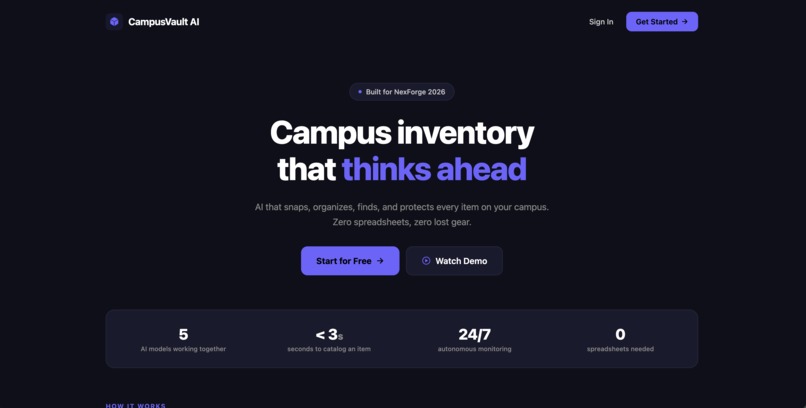
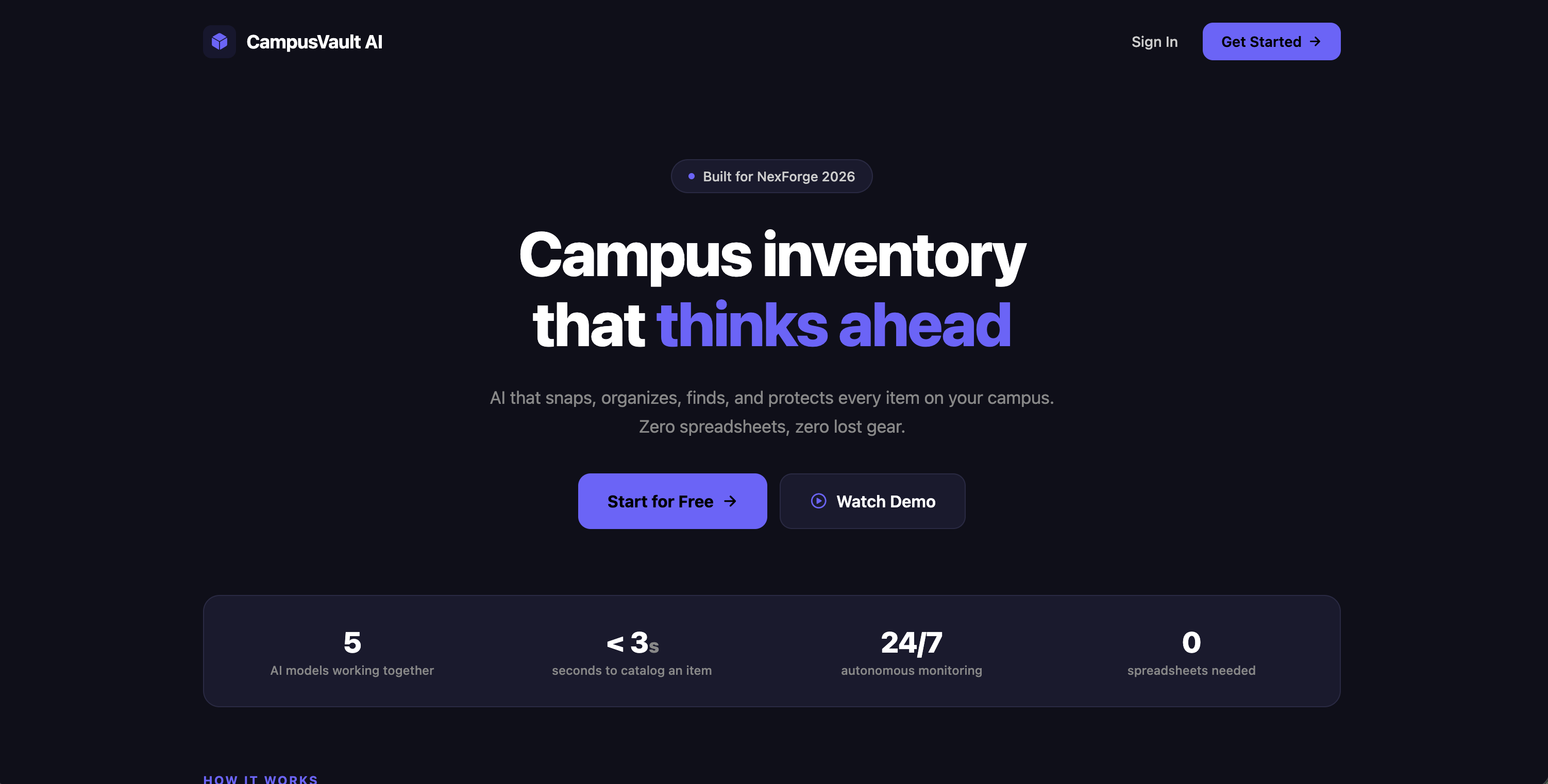
Landing Page
-
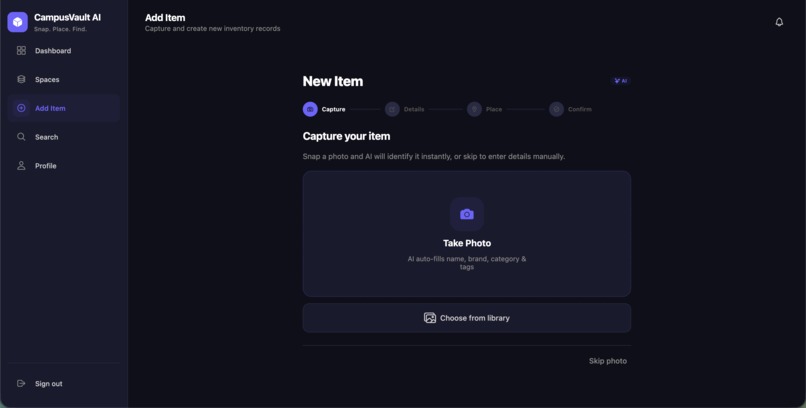
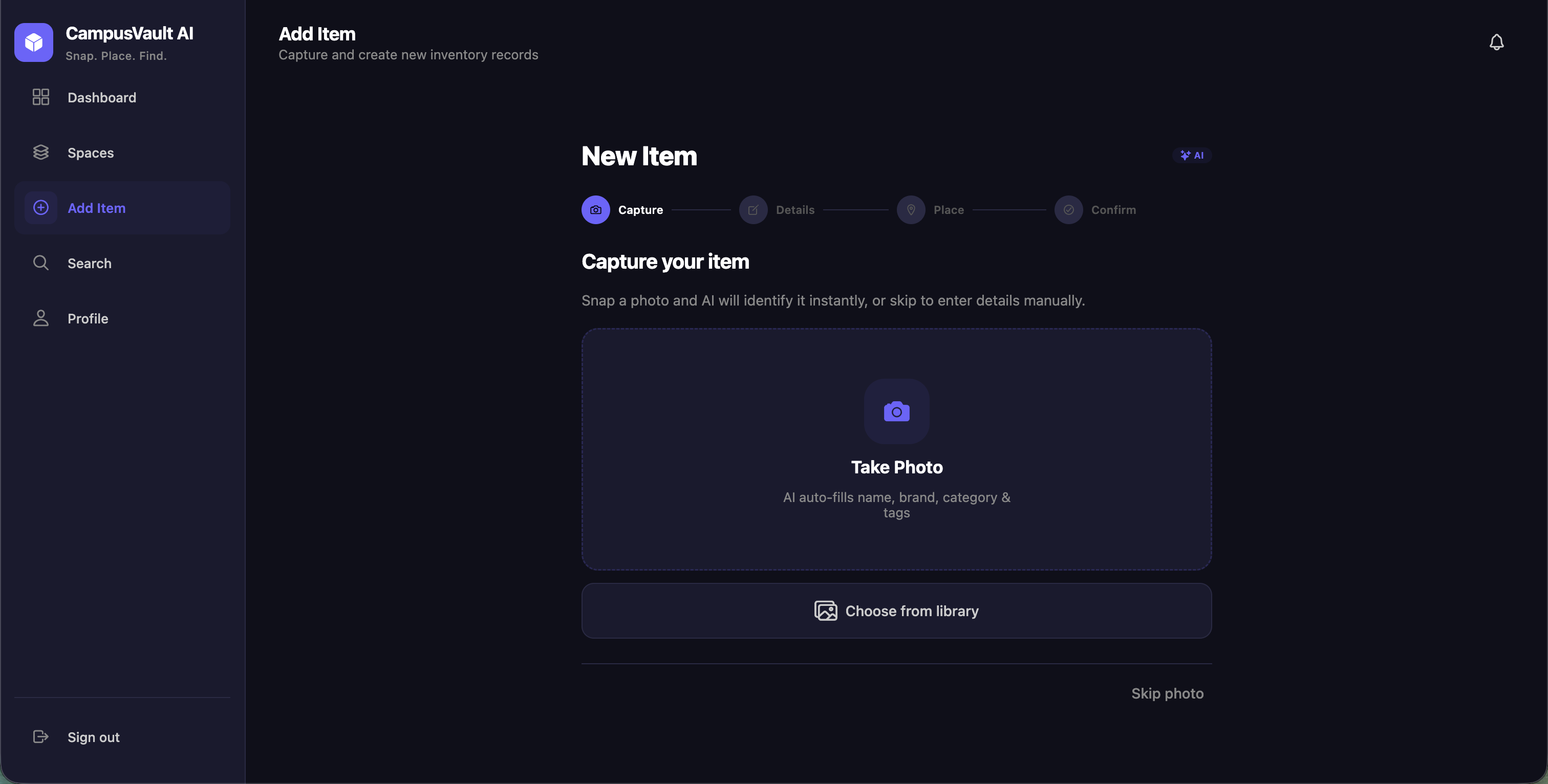
Upload Image
-
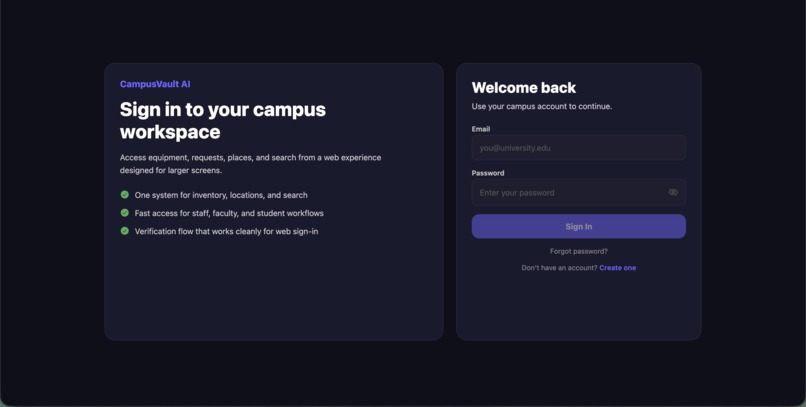
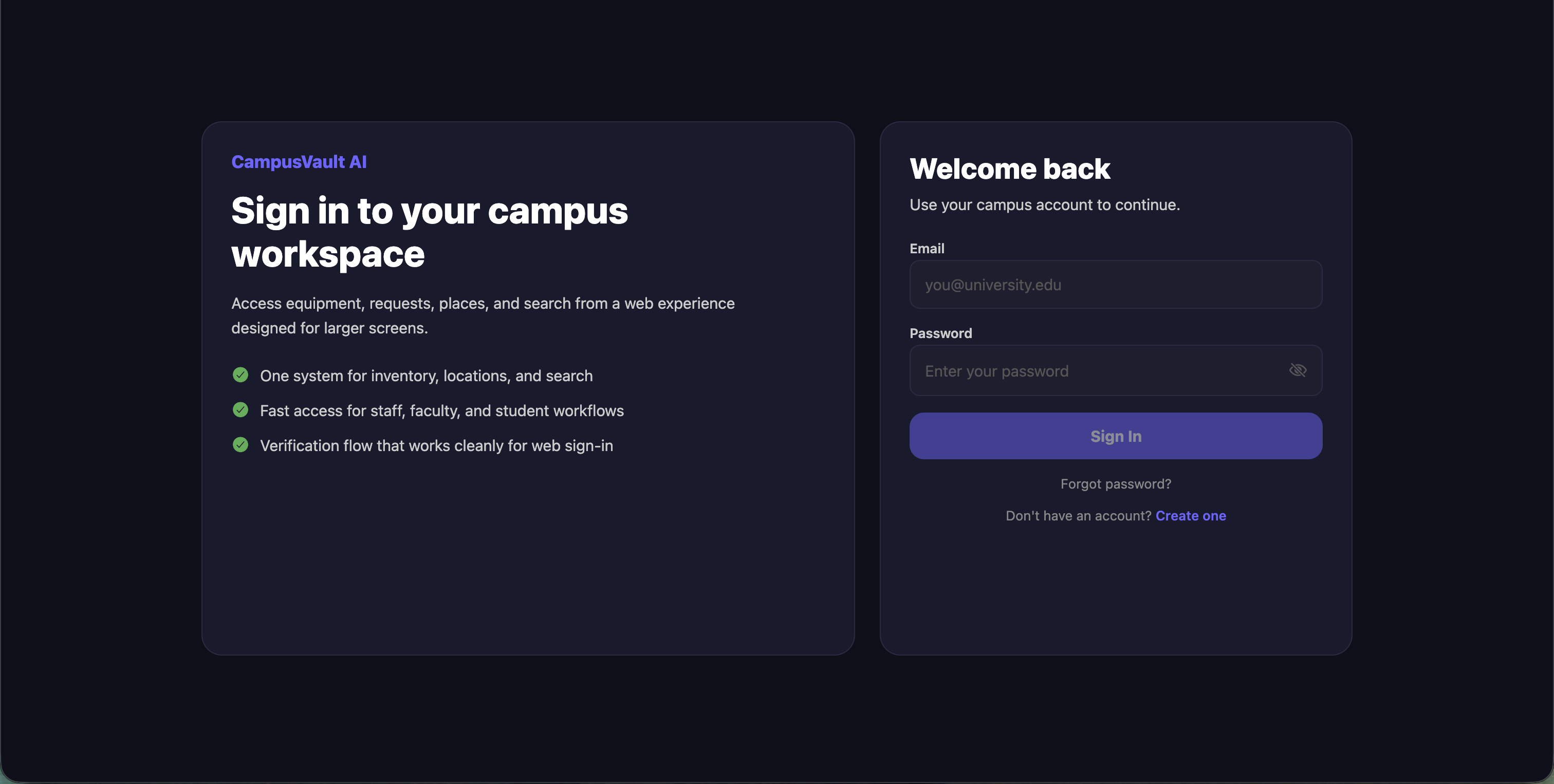
Sign-In
-
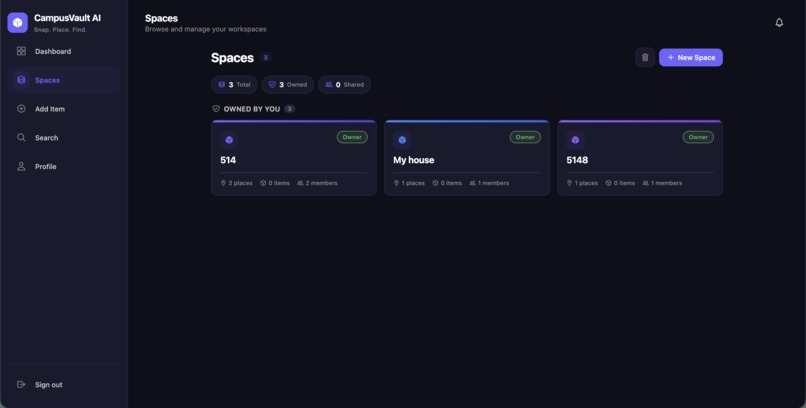
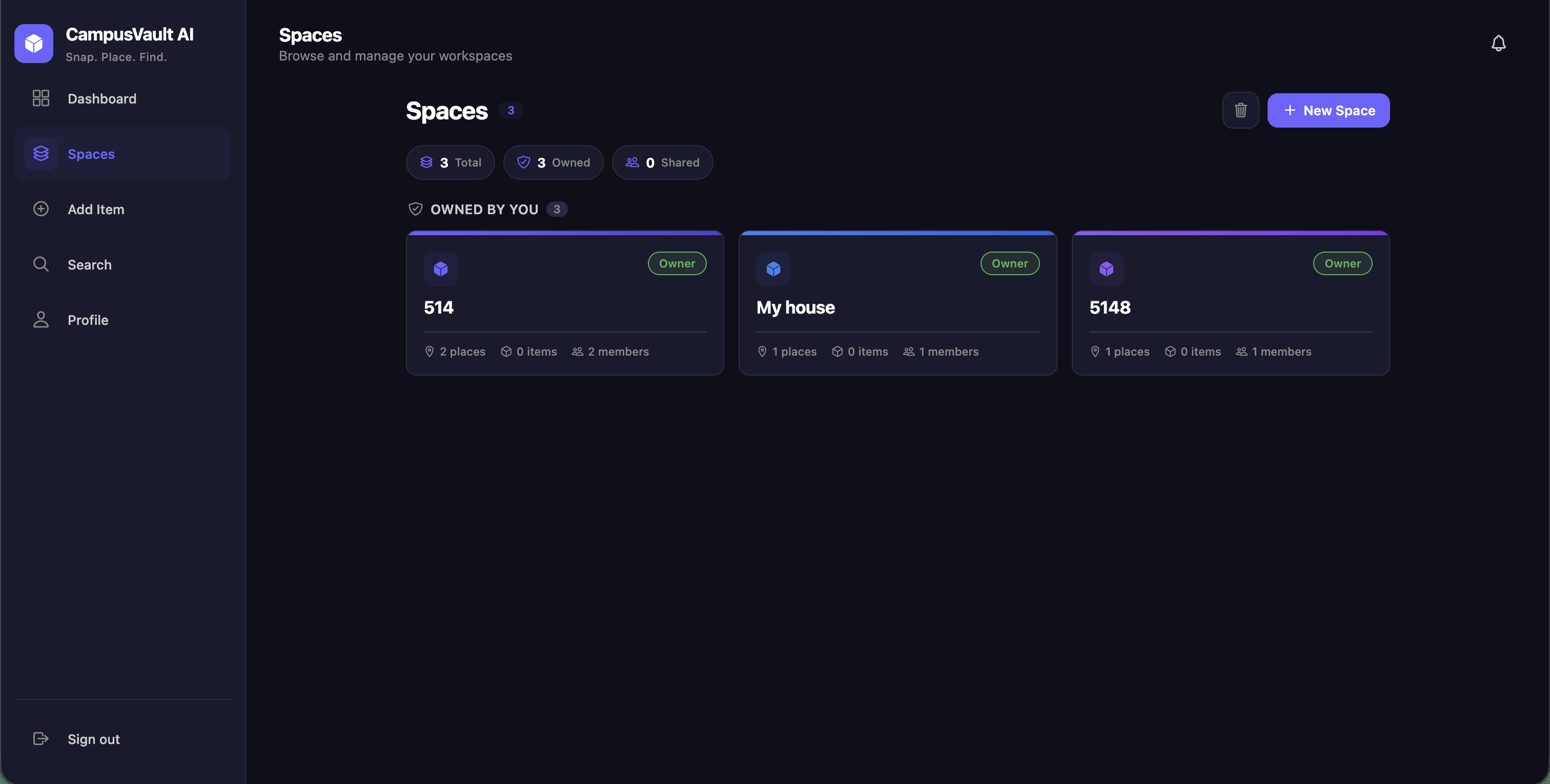
Space
-
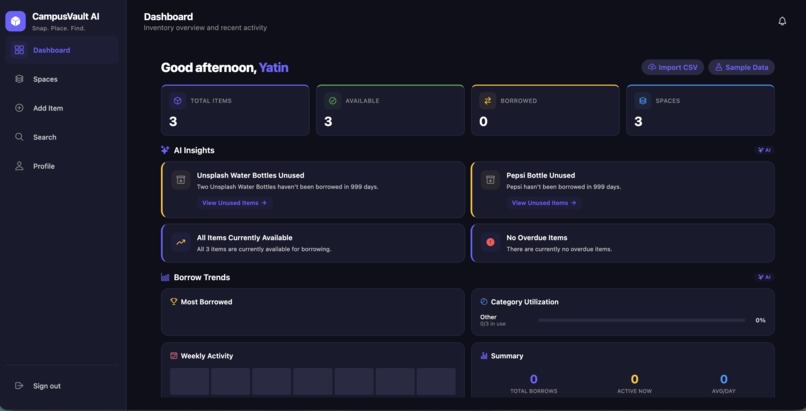
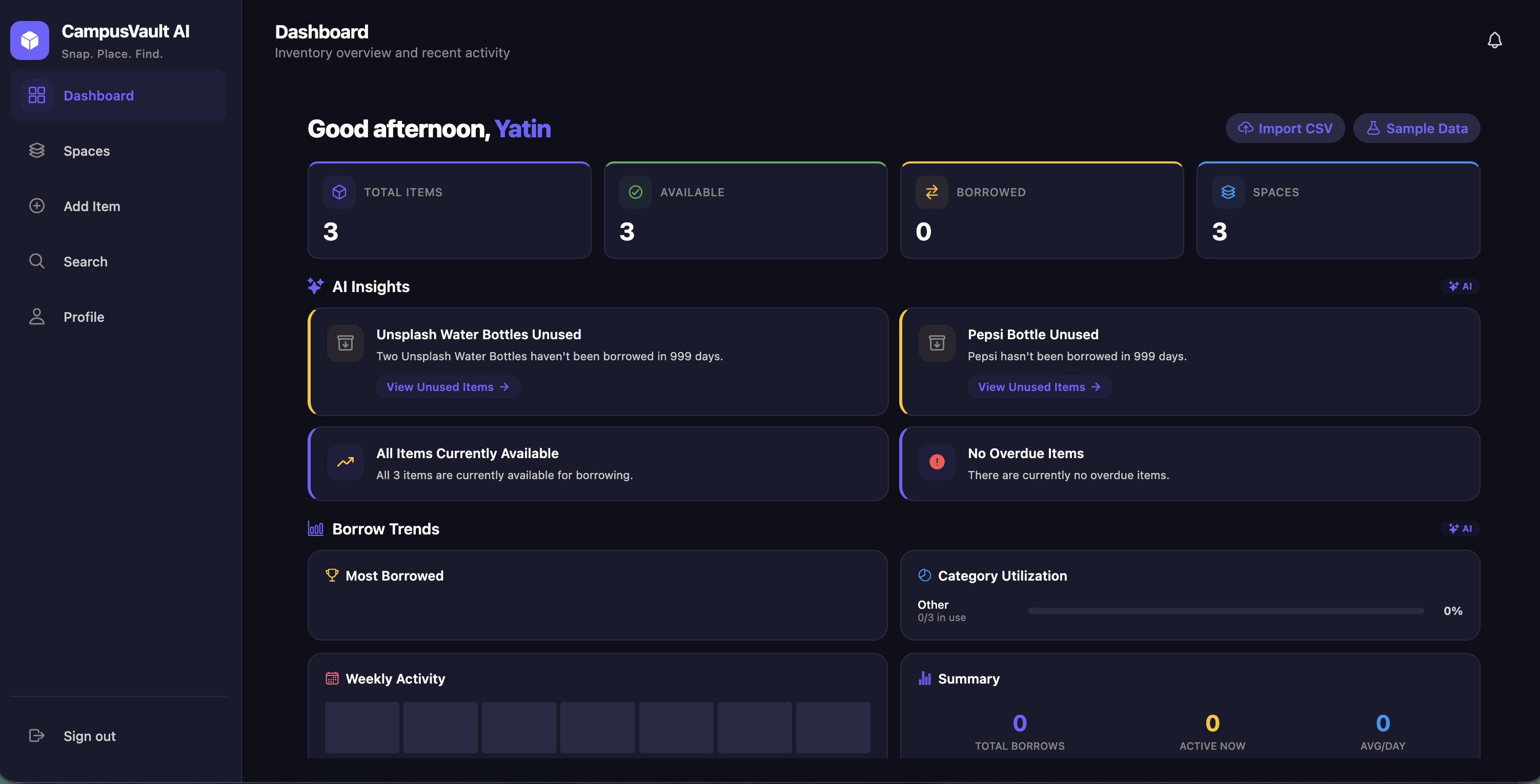
Dahsboard
-
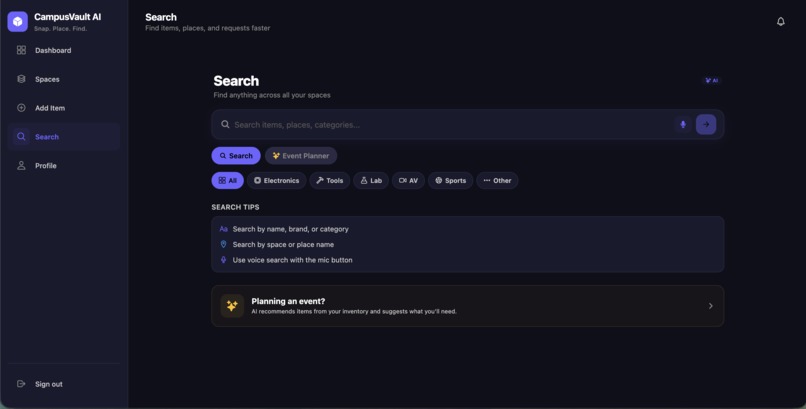
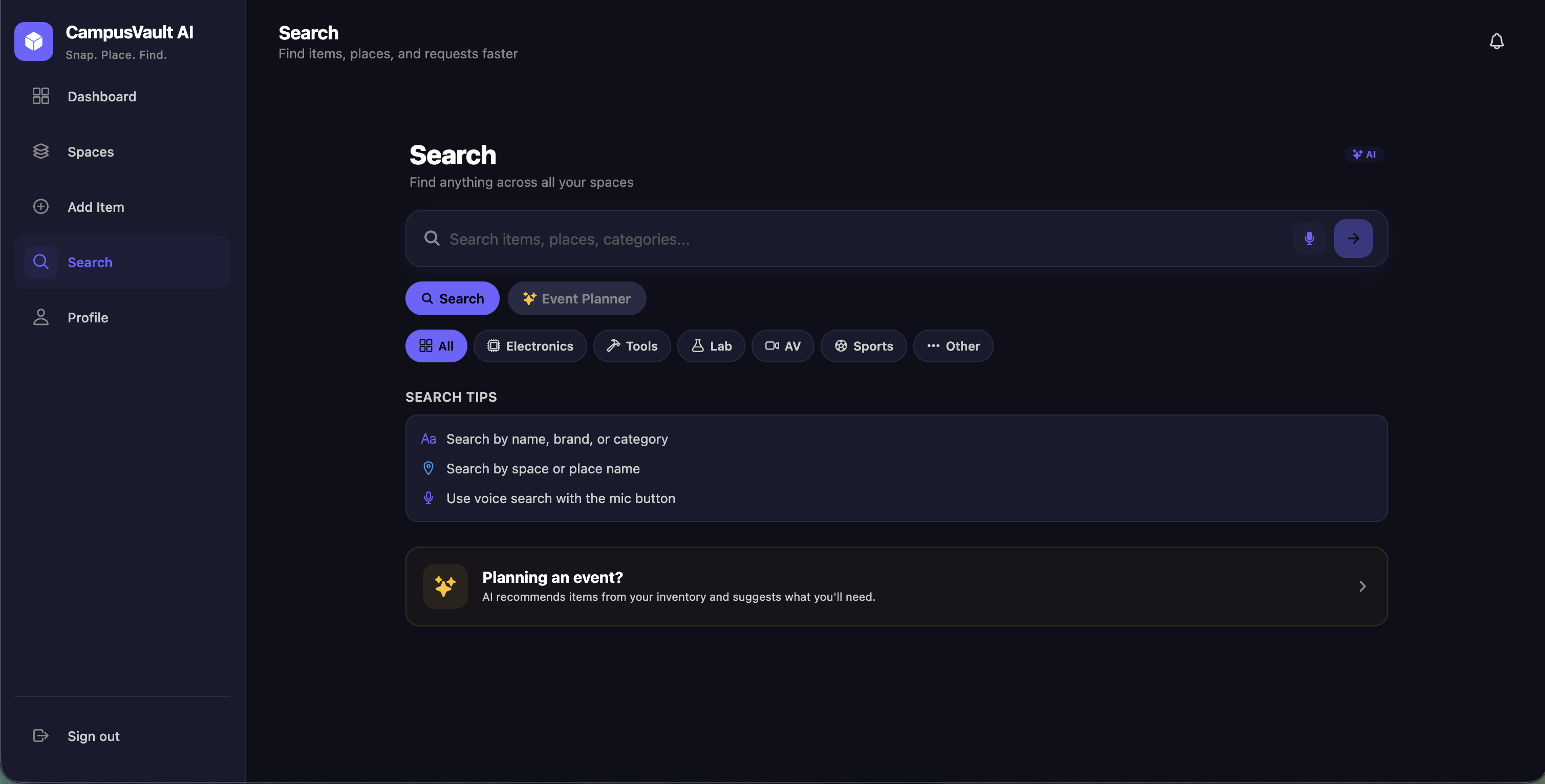
Search
-
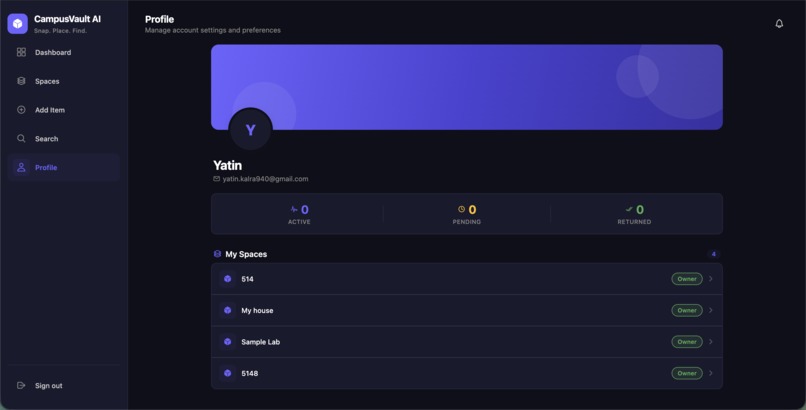
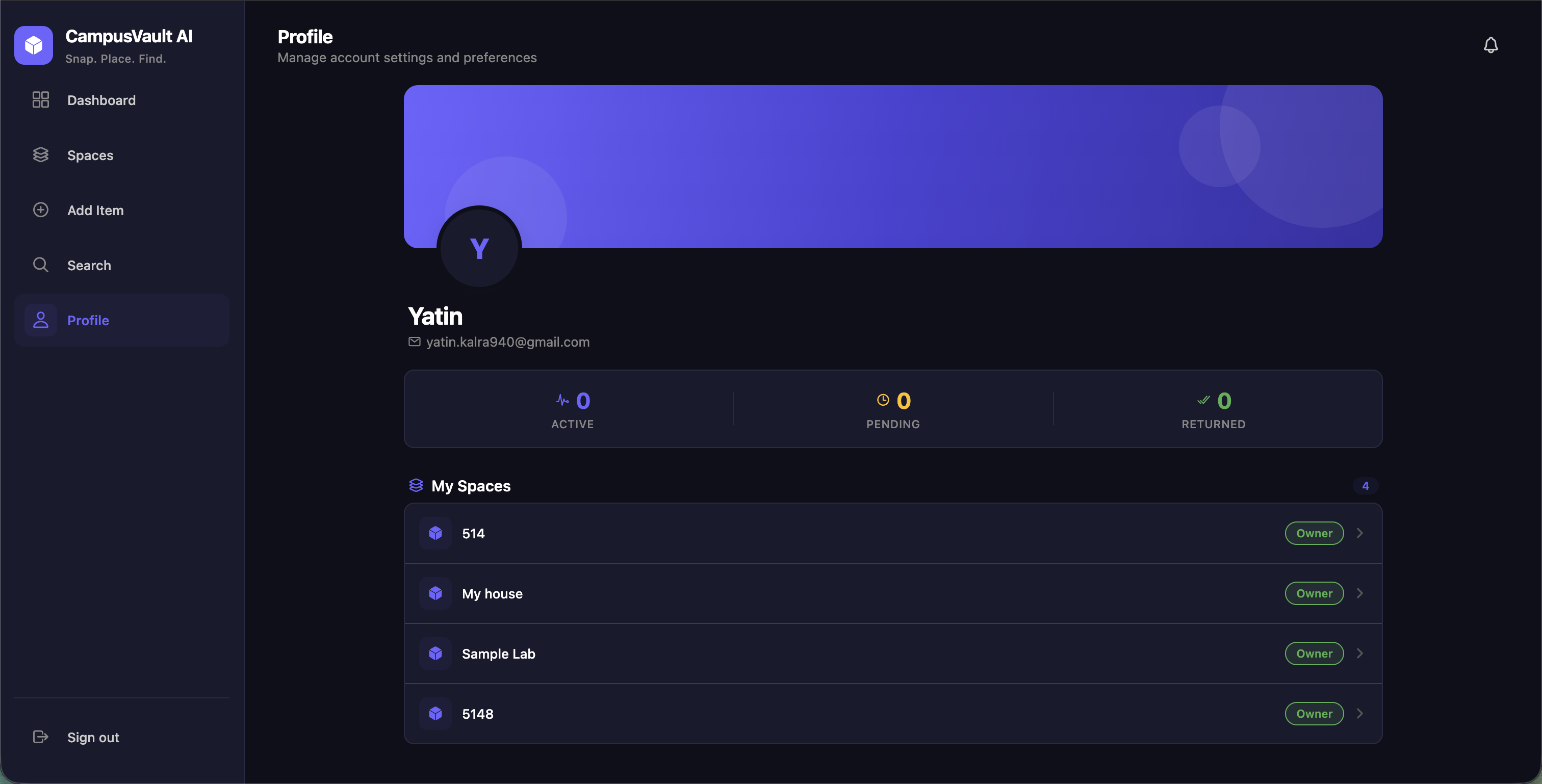
Profile
-
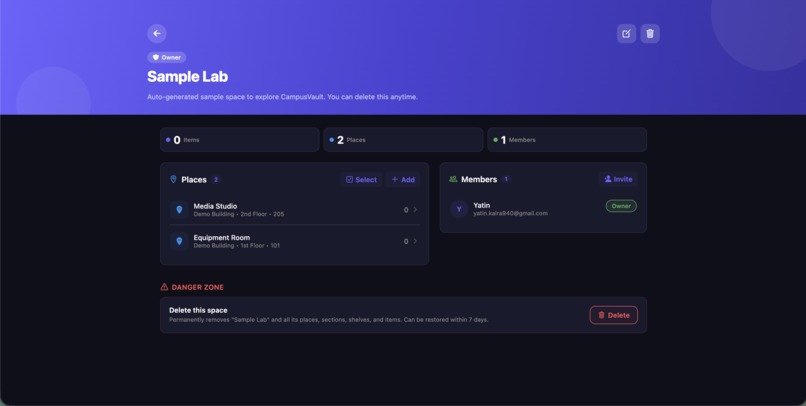
Places
-
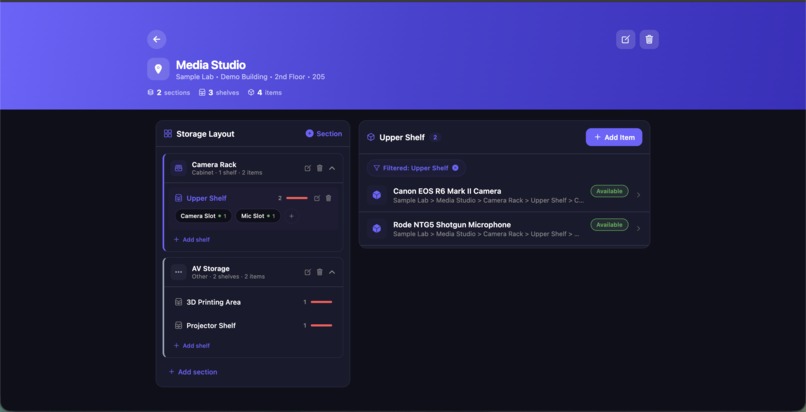
Individual iteam
Inspiration
We've all been there. You walk into a university lab looking for an oscilloscope, and nobody knows where it is. The professor thinks it's in Room 101. The TA says someone borrowed it last week. There's a spreadsheet somewhere, but it hasn't been updated since 2024.
University labs, makerspaces, and media centers manage thousands of items across dozens of rooms, and most of them still track everything with spreadsheets, sticky notes, or memory. Equipment goes missing, students waste time searching, and nobody has a clear picture of what's available.
We wanted to build something that feels effortless. Not another spreadsheet with a login page. Something where you can photograph an item and it's cataloged. Where you can say "find me a camera in the media lab" and actually get an answer.
What it does
CampusVault AI is an inventory management platform built specifically for universities. The core idea is simple: Snap. Place. Find.
Snap : Point your camera at any item. Amazon Nova Pro analyzes the photo and extracts the item name, brand, category, and tags automatically. No manual data entry.
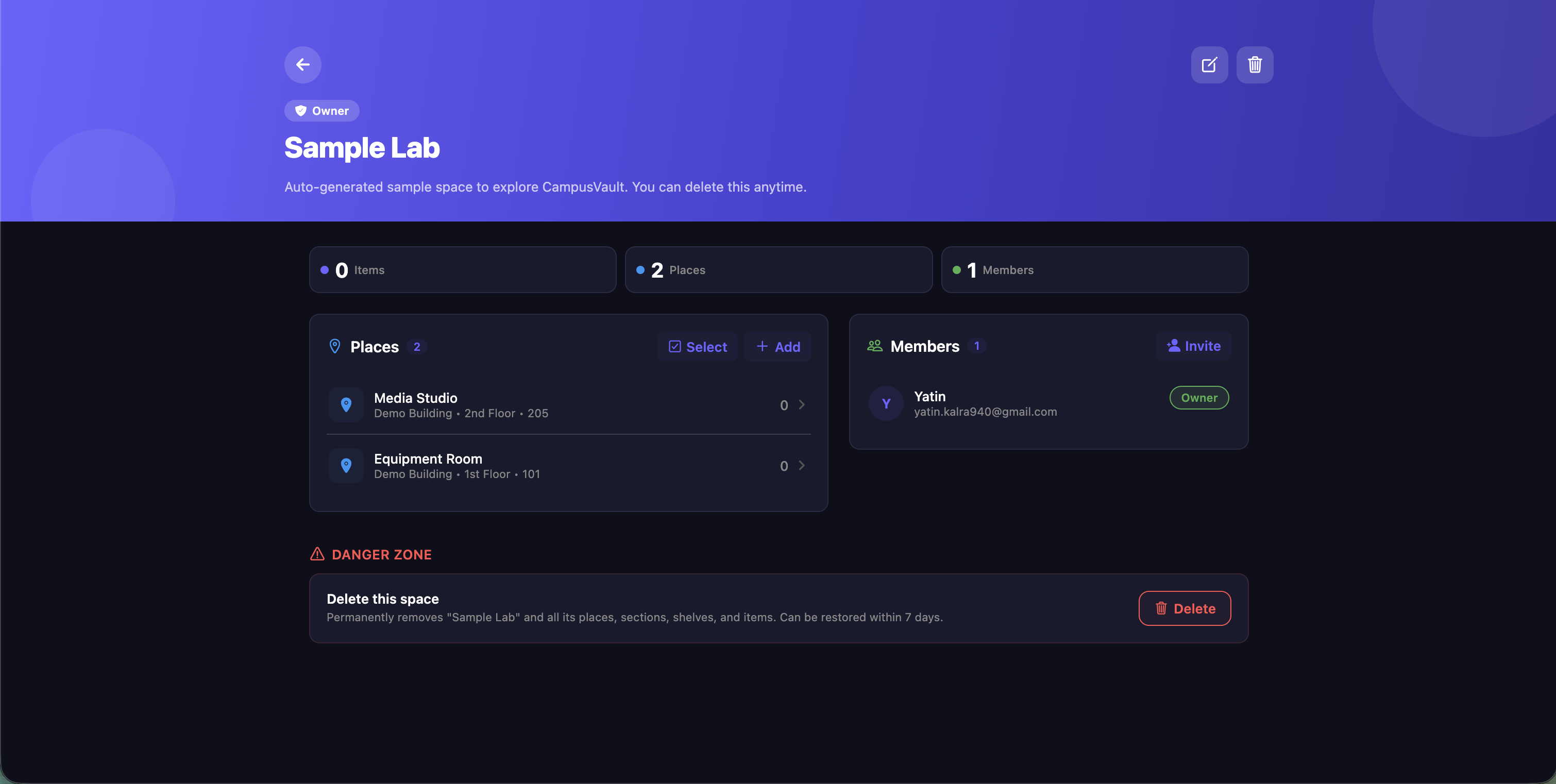
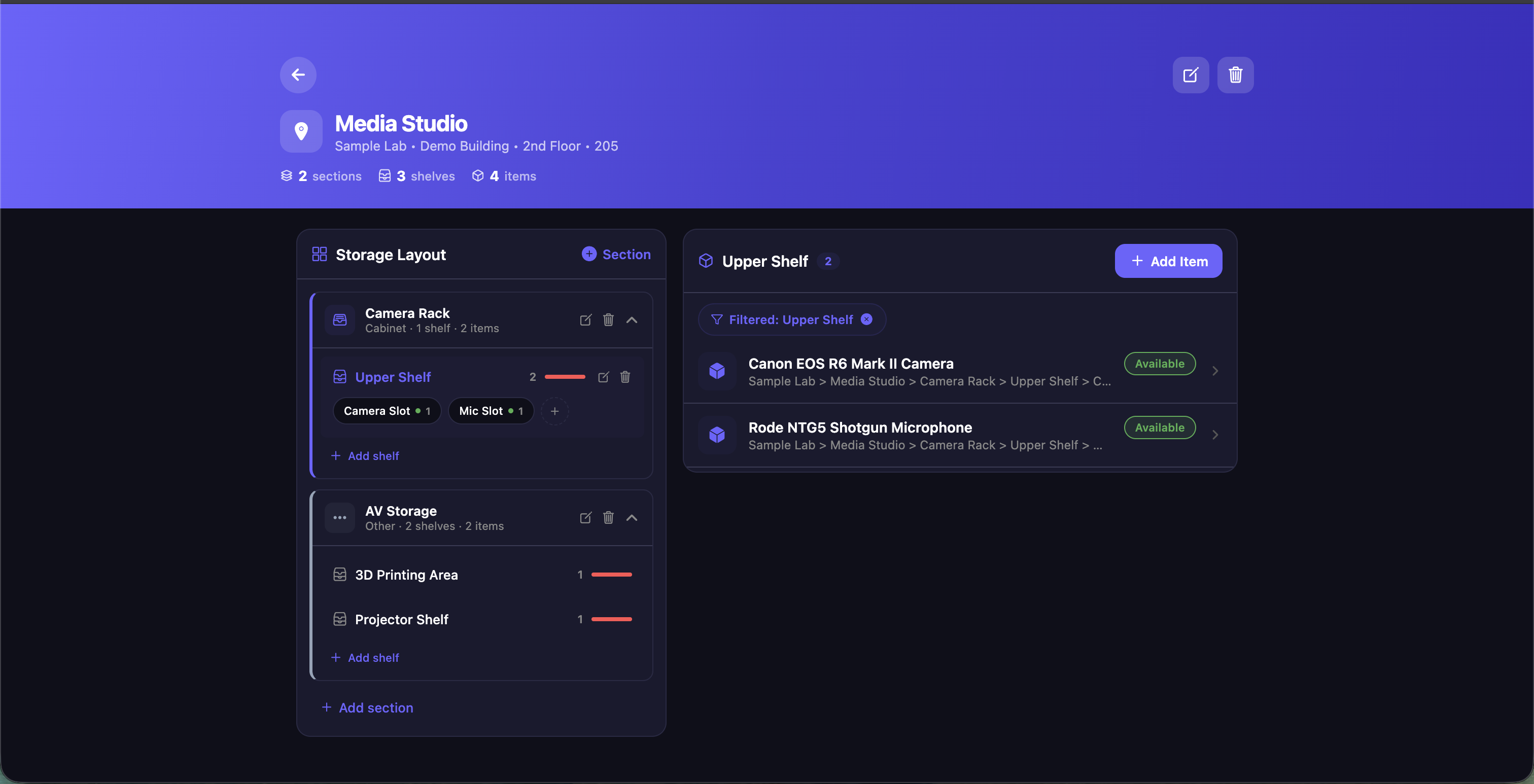
Place : Organize items into a hierarchy that mirrors the real world: Spaces (labs, departments), Places (rooms), Sections, Shelves, and Positions. Every item knows exactly where it lives, down to the shelf slot.
Find : Search by typing or talking. Ask "show me all the borrowed electronics in the engineering lab" and Nova understands your intent, not just keywords. Voice search lets you find items hands-free while you're carrying equipment.
Beyond the core, CampusVault handles the full borrow lifecycle. Students request items, managers approve, the system tracks due dates, and an autonomous AI agent sends overdue reminders on a schedule. Low-stock alerts catch consumables before they run out. CSV import lets teams migrate from existing spreadsheets in seconds.
How we built it
The frontend is built with Expo (React Native), so it runs as a native mobile app and a full web dashboard from one codebase. The backend is NestJS with DynamoDB for storage, S3 for images, and Cognito for auth.
The real depth is in how we use Amazon Nova. We don't just use one model, we use five, each chosen for what it does best:
Nova Pro handles the heavy vision and language tasks: analyzing photos to extract item metadata, and transcribing voice input into structured queries.
Nova Lite powers natural language search ranking and event planning. When you search "cameras for a film shoot," it understands the intent and ranks results by relevance, not just string matching.
Nova Embeddings generates 1024-dimensional vectors for every item, enabling semantic search. "Recording device" finds microphones even though those words never appear in the item name.
Nova Act runs as an autonomous agent on a 6-hour cron cycle, checking for overdue borrows and sending reminder notifications without any human intervention.
Nova Sonic enables real-time voice search, speak your query and get results while your hands are full.
The search system itself is a hybrid pipeline: local fuzzy matching (Levenshtein distance + Dice bigram similarity) for instant results, Nova NL ranking for intent understanding, and semantic embeddings for conceptual matches. All results are filtered by the user's access permissions.
Challenges we ran into
Getting five different AI models to work together coherently was harder than expected. Each model has different latency characteristics and output formats, so we had to design the search pipeline to gracefully combine fast local results with slower AI-ranked results.
The storage hierarchy (Space → Place → Section → Shelf → Position) needed to be flexible enough for a simple one-room lab but also scale to a multi-building department. Getting the data model right took several iterations.
Making the photo analysis reliable across different lighting conditions, angles, and item types required careful prompt engineering with Nova Pro. Lab equipment doesn't look like consumer products, so generic object detection wasn't enough.
Accomplishments that we're proud of
The snap-to-add flow genuinely feels magical. You take a photo, and within seconds the item is fully cataloged with name, brand, category, and tags. No typing required.
The hybrid search system actually understands what you mean. Searching "something to measure voltage" returns multimeters. That's not keyword matching - that's real comprehension.
The entire platform works seamlessly across web and mobile from a single codebase, with responsive layouts that adapt from phone screens to wide desktop monitors.
We built a real product, not a demo. CSV import, QR codes, role-based access control, borrow workflows with approval chains, consumable tracking with low-stock alerts these are features that make it usable from day one.
What we learned
AI is most powerful when it's invisible. The best features in CampusVault are the ones where users don't think about AI at all, they just take a photo and it works, they just ask a question and get an answer. The five Nova models work together behind the scenes, but the user experience is simple.
We also learned that hybrid approaches beat pure AI approaches. Our search combines traditional fuzzy matching with AI ranking and semantic embeddings, and the combination is better than any single approach alone.
What's next for CampusVault AI
We want to add predictive analytics using borrow history to forecast demand and suggest when to restock consumables. Integration with university procurement systems would let CampusVault automatically trigger purchase orders when supplies run low.
Multi-university federation is another goal: letting universities share equipment catalogs for inter-campus borrowing. A chemistry department at one school could see available spectrometers at a partner institution.
We're also exploring using Nova's vision capabilities for condition assessment, photographing an item when it's returned and automatically detecting damage compared to its original photo.
Built With
- amazon-bedrock
- amazon-cognito
- amazon-nova-act
- amazon-nova-embeddings
- amazon-nova-lite
- amazon-nova-pro
- amazon-nova-sonic
- amazon-web-services
- axios
- dynamodb
- expo.io
- nestjs
- react-native
- typescript
- zustand

Log in or sign up for Devpost to join the conversation.