-
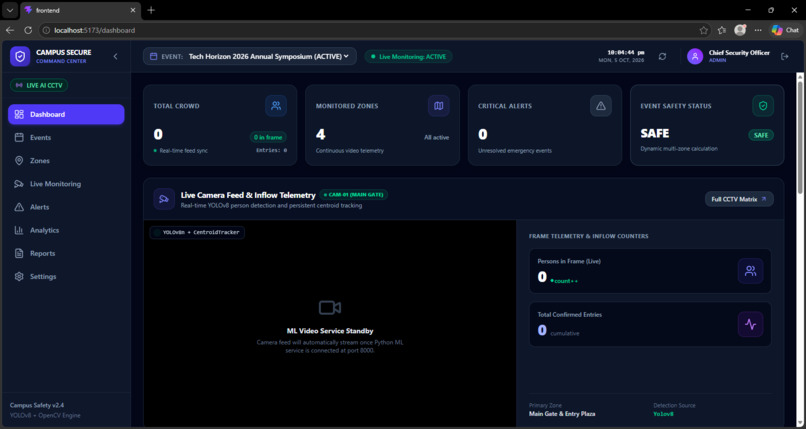
CampusSecure AI Command Center – Real-Time AI-Powered Crowd Monitoring, Zone-Wise Analytics, and Event Safety Dashboard.
-
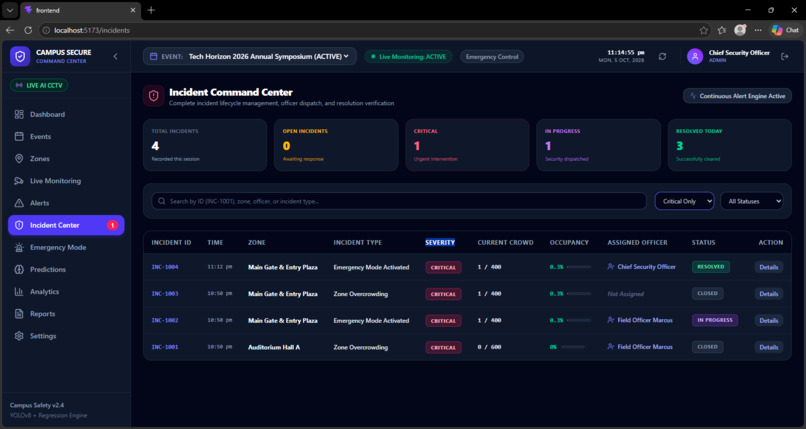
Real-Time Incident Tracking, Severity Classification, Security Officer Assignment, and Incident Resolution Monitoring
Inspiration
Campus events such as cultural programs, sports events, exhibitions, and convocations can bring hundreds of people together in a short period of time. During such events, security teams often depend on CCTV cameras and manual observation to monitor crowd conditions. When multiple locations become crowded simultaneously, identifying overcrowding and responding quickly can become difficult.
This inspired us to build CampusSecure AI – Smart Crowd & Event Security, an AI-powered system that converts real-time camera feeds into meaningful crowd-safety information. Our goal was to help campus security teams monitor different zones, identify crowd buildup early, and make faster, data-driven decisions.
What it does
CampusSecure AI provides real-time, zone-wise crowd monitoring and event security analytics.
The system:
- Detects people from CCTV/IP camera video using YOLOv8
- Tracks individuals across frames using DeepSORT
- Divides the campus event area into predefined ROI zones
- Calculates zone-wise crowd counts and density
- Monitors occupancy against configured capacity
- Classifies crowd conditions as Normal, Warning, or Critical
- Provides real-time alerts when crowd thresholds are exceeded
- Displays live information through a centralized web dashboard
- Stores crowd information for historical analysis
- Supports multiple camera feeds
- Uses aggregate crowd analytics without facial recognition
This allows security personnel to quickly identify which zones require attention instead of manually analyzing every camera feed continuously.
How we built it
We designed the system as a complete AI-based video analytics pipeline:
CCTV / RTSP Camera → OpenCV → YOLOv8 → DeepSORT → ROI Zone Assignment → Crowd Analytics → Alerts → Dashboard
OpenCV is used for video acquisition and frame processing. YOLOv8s performs person detection, while DeepSORT assigns unique tracking IDs and maintains tracking across consecutive frames.
For zone monitoring, we define Regions of Interest (ROI) for locations such as the auditorium, main gate, food court/canteen, and open event areas. Detected people are assigned to zones using point-in-polygon logic.
The system calculates crowd density using:
$$ \text{Crowd Density} = \frac{\text{Number of People}}{\text{Zone Area}} $$
The resulting information is processed by the backend and displayed on the dashboard using live statistics, status indicators, charts, and zone-level analytics.
Our fine-tuned YOLOv8s model achieved a reported 91.4% [email protected], while the optimized implementation is designed to achieve up to 48 FPS per stream under the project configuration.
Challenges we ran into
One of our biggest challenges was detecting and tracking people accurately in crowded environments. People can overlap, move close to each other, or temporarily disappear from the camera view.
Maintaining consistent tracking IDs was another challenge. Simply detecting people in every frame can lead to repeated counting, so we integrated DeepSORT to maintain tracking identities across frames.
We also faced challenges with real-time video processing, including processing speed, memory usage, and handling multiple camera streams. Optimizing the video-processing pipeline and using GPU-based processing were important for improving performance.
Another challenge was converting camera footage into meaningful zone-level information. We solved this by creating configurable ROI polygons and assigning detected people to the appropriate zones.
Finally, we had to design the dashboard so that complex AI outputs could be understood quickly by security personnel. We focused on presenting the most important information: people count, density, occupancy, zone status, alerts, and historical trends.
Accomplishments that we're proud of
We are proud of building an end-to-end AI-based crowd monitoring system rather than developing only an isolated detection model.
Some of our key accomplishments include:
- Achieved a reported 91.4% [email protected] with our fine-tuned YOLOv8s model
- Integrated YOLOv8 + DeepSORT for detection and tracking
- Developed zone-wise ROI-based crowd monitoring
- Implemented crowd density and occupancy analysis
- Created Normal / Warning / Critical crowd-status classification
- Designed a centralized real-time security dashboard
- Integrated automated alert-processing capabilities
- Designed the architecture to support multiple camera feeds
- Focused on privacy-conscious aggregate analytics without facial recognition
Most importantly, we transformed raw CCTV footage into actionable information that can support campus event security and crowd-management decisions.
What we learned
This project gave us practical experience in both AI and full-stack development.
We learned how object detection models work in real-world video streams and how tracking algorithms can be combined with detection to maintain consistent identities.
We also learned that building a real-world AI system involves much more than training a model. Video preprocessing, ROI configuration, tracking, backend communication, database management, real-time visualization, performance optimization, and user experience are all important parts of the solution.
We gained hands-on experience with:
- Computer Vision
- YOLOv8
- DeepSORT
- OpenCV
- Python
- Real-time video processing
- ROI and zone-based analytics
- Backend development
- Database integration
- Web dashboard development
- Real-time alerts
- Performance optimization
The project also taught us how to convert a real-world problem into a complete technical workflow and how to design an AI solution around the needs of actual users.
What's next for CampusSecure AI – Smart Crowd & Event Security
Our next goal is to make CampusSecure AI more robust and deployment-ready.
Future improvements include:
- Multi-camera perspective calibration across different campus venues
- More extensive testing under dense crowd conditions
- Improved handling of occlusion and difficult lighting conditions
- Complete SMS and email alert integration
- More advanced crowd-flow and movement analysis
- Predictive crowd-risk analytics to identify potential overcrowding before critical conditions occur
- Emergency Mode for faster response during critical situations
- Incident management and centralized event records
- Improved historical analytics and reporting
- Expansion to additional campus locations and larger camera deployments
Our long-term vision is to evolve CampusSecure AI from a crowd-monitoring dashboard into a complete intelligent campus event safety platform that helps security teams move from reactive monitoring to proactive crowd-risk management.

Log in or sign up for Devpost to join the conversation.