Inspiration
A first-gen student shouldn't have to know the difference between a subsidized and unsubsidized loan at 18. An F-1 student shouldn't have to figure out SSN applications, OPT timelines, tax filing as a nonresident alien, and visa compliance — all while passing exams in a country they just moved to. They shouldn't have to Google "can my landlord keep my deposit" at midnight before finals. They shouldn't miss a scholarship because no one told them it existed. They shouldn't spend money on transport because they don't know the bus route yet, or struggle with budgeting in a currency and system that's completely new to them. International and first-gen students carry an invisible second curriculum — legal status, financial survival, cultural navigation — that their classmates never have to think about. There's no class for it. No orientation covers all of it. And the offices that could help are scattered, jargon-heavy, and only open 9 to 5. We wanted to close that gap — not with another resource page, but with something that actually talks back.
What it does
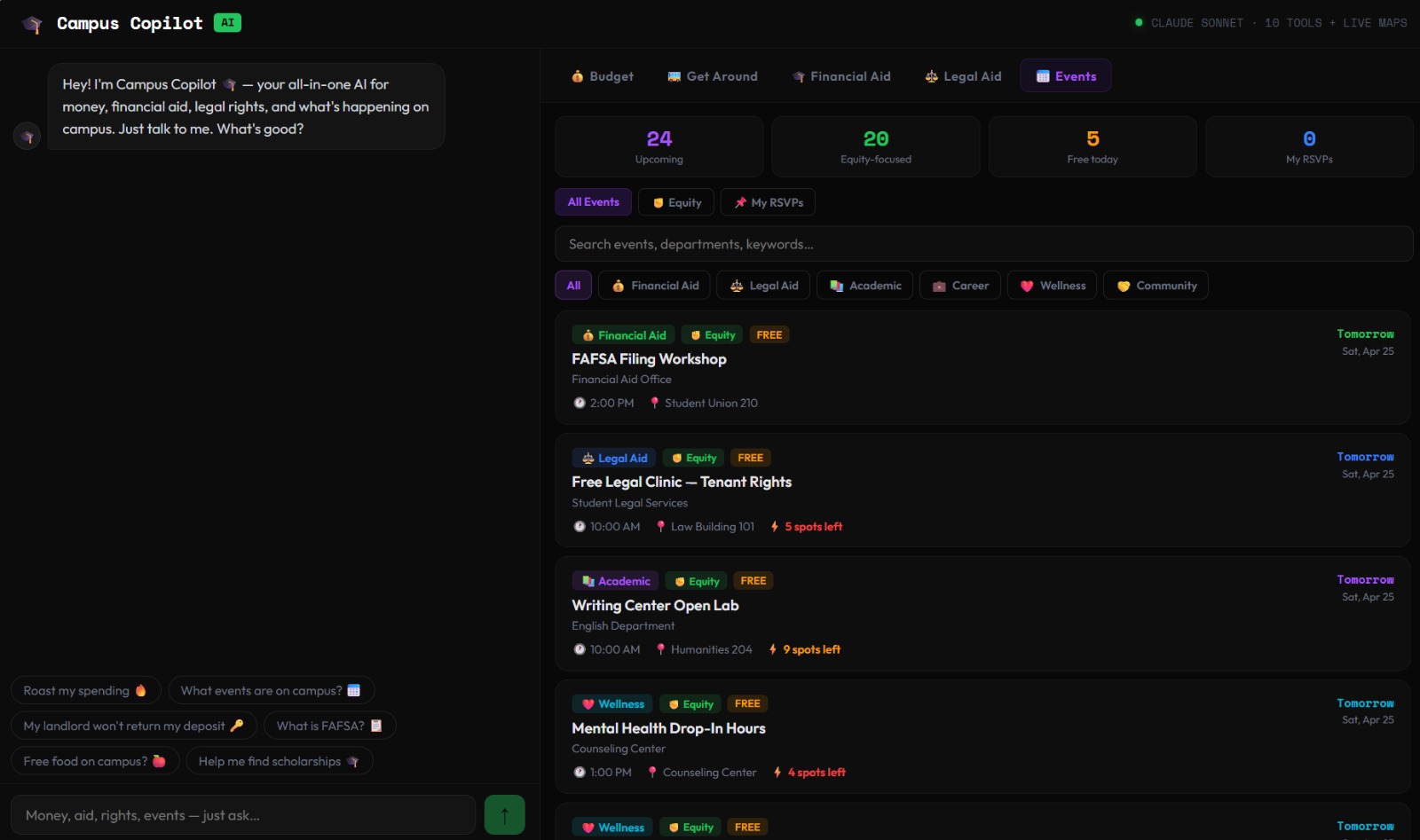
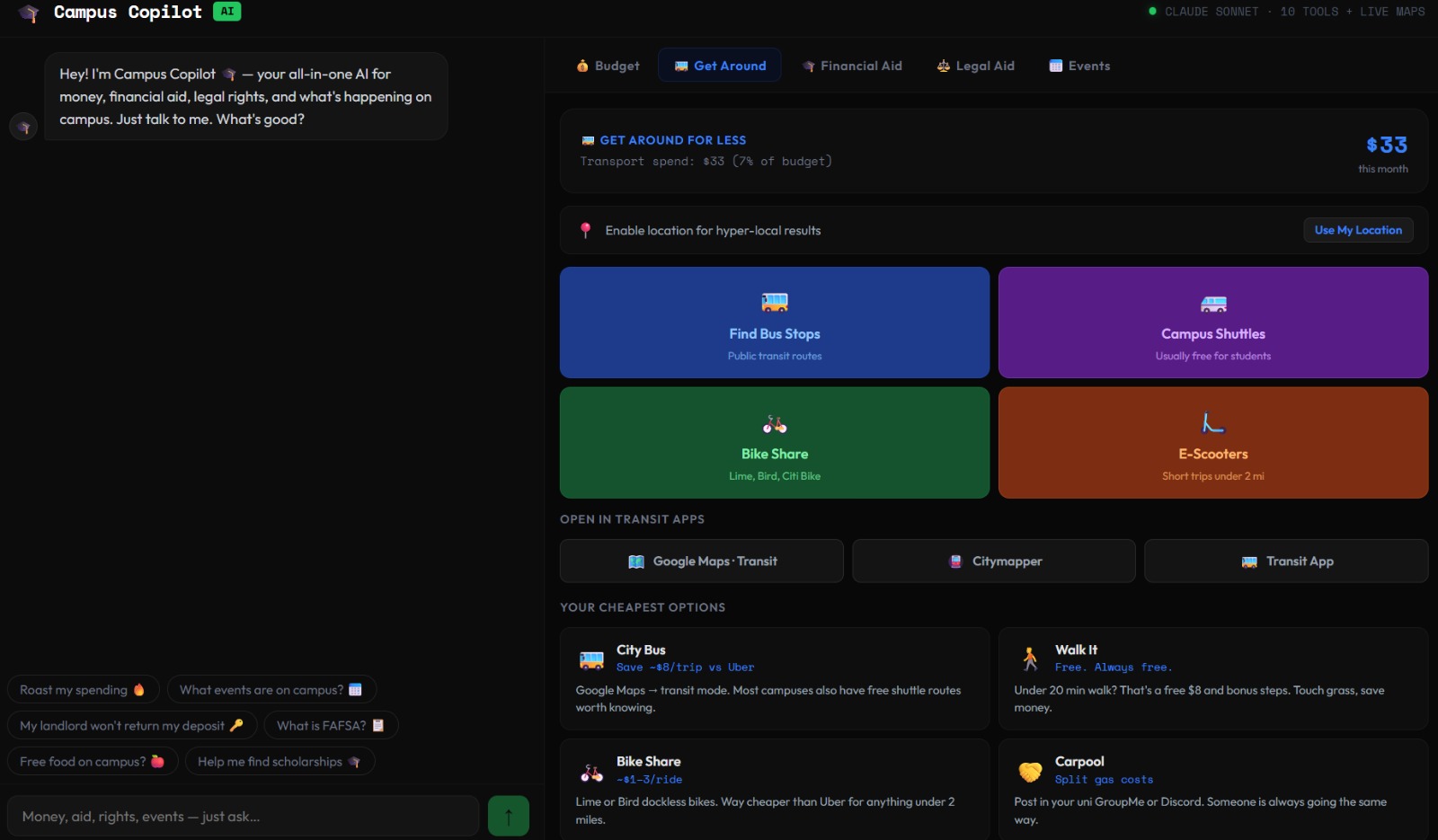
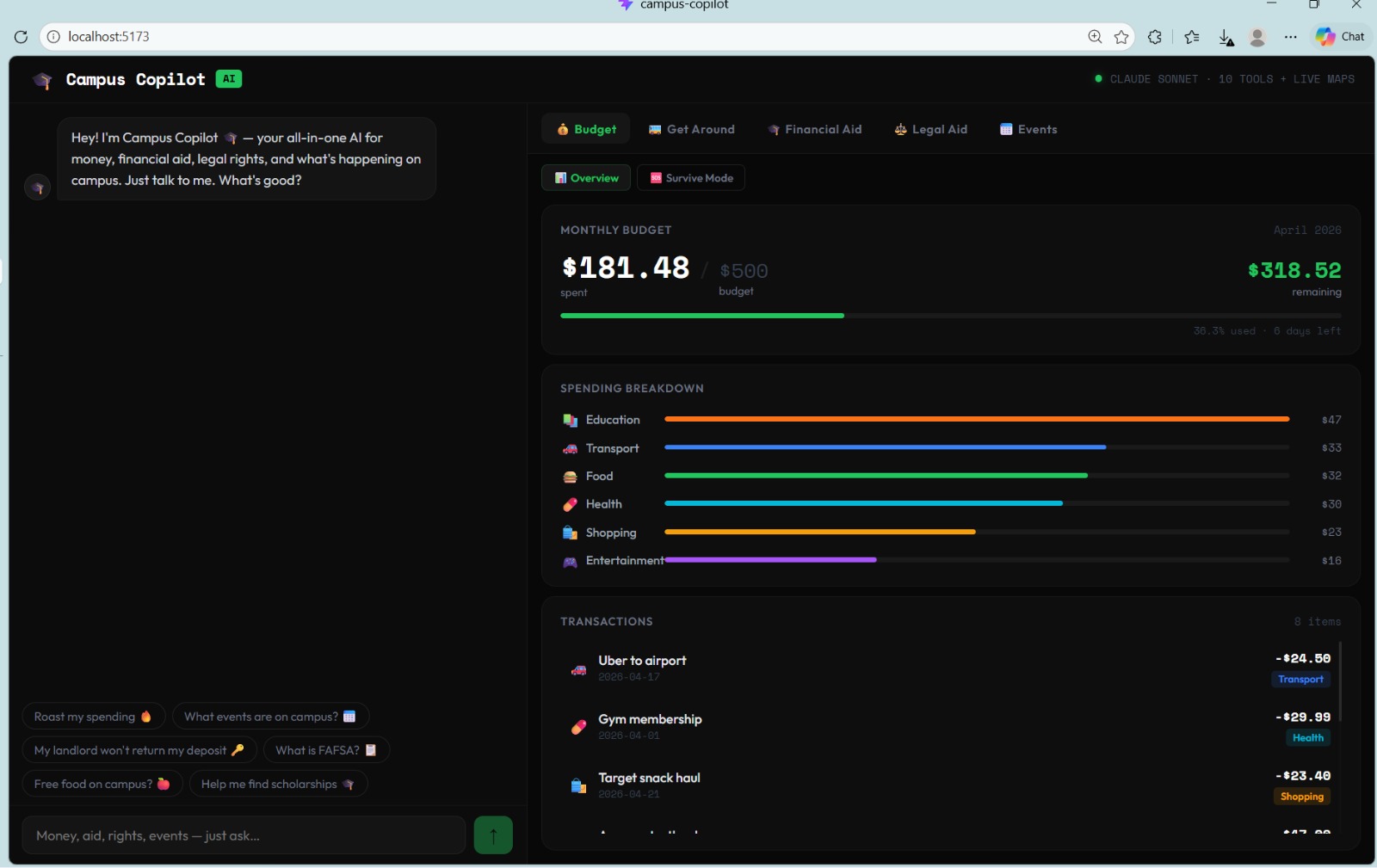
Campus Copilot — a single AI-powered app that combines five tools students actually need: 💰 Live budget tracker with survive mode 🎓 Financial aid navigator (FAFSA, scholarships, emergency funds) ⚖️ Legal aid guide (tenant rights, Title IX, immigration, workplace) 📅 Campus events across every school and department 🚌 Transit finder with real GPS + map integration One chat. Claude handles the rest.
How we built it
We started with a single financial aid chatbot and kept asking one question: what else does this student need right now? Every feature grew from that. We built in layers — first the chat UI with streaming Claude responses, then wired in tool calls so Claude could control the UI instead of just talking. Then budget tracking. Then financial aid panels. Then legal aid with interactive checklists. Then 24 campus events with filtering and RSVP. Then the survive mode with recipe cards and map integration. Then a dedicated transit tab with live GPS. The stack is intentionally minimal — React, Vite, and the Anthropic API. No backend, no database, no extra dependencies beyond React itself. Everything runs in a single JSX component with 10 Claude tool calls that bridge natural language to real UI actions. The hardest engineering decision was the system prompt. Claude needed to be three different people in one conversation — a sarcastic budget coach, a patient financial aid counselor, and a calm legal guide — and switch between them automatically based on what the student typed. Getting that tone-switching right took more iteration than any feature.
Challenges we ran into
The legal liability question was the hardest design decision. Claude is not a lawyer. But a scared student at midnight needs something. Our solution: always lead with a disclaimer, always end by pointing to a real human (Student Legal Services), and frame Claude as a navigator — not an authority.
Accomplishments that we're proud of
Built a fully working, multi-feature AI app in a single hackathon session — from blank screen to five integrated tabs Claude doesn't just answer questions — it controls the UI. Typing "my landlord won't return my deposit" opens the legal panel, loads the housing rights checklist, and explains tenant rights simultaneously. That felt like magic the first time it worked The equity cross-linking surprised us. Claude proactively mentions the campus food pantry when a student hits survival mode, and surfaces the free legal clinic when someone asks about tenant rights — without being told to do it explicitly, just from the system prompt framing We got the tone right. Students shouldn't feel judged asking about money or legal trouble. The app talks like a friend who happens to know things — not a government website Zero extra packages. The entire app ships as one file
What we learned
- Tone is a feature. Claude needed different personalities for different tabs — sarcastic for budget, warm for financial aid, calm with a disclaimer for legal. Getting that right took more prompt iteration than anything else.
- Equity means assuming nothing. Every acronym gets explained. Every resource gets a "what to bring." We wrote the system prompt as if the user has never heard of FAFSA, a security deposit, or an F-1 visa.
## Whats next for Campus Copilot.
- Connect to real university APIs so events and deadlines are live data
- Onboarding quiz that unlocks personalized scholarship matching
- Push alerts before FAFSA deadlines and scholarship closes
- Offline mode for students on limited data plans
- Peer navigator network for questions AI shouldn't answer alone
Built With
- claude
- react
- vite

Log in or sign up for Devpost to join the conversation.