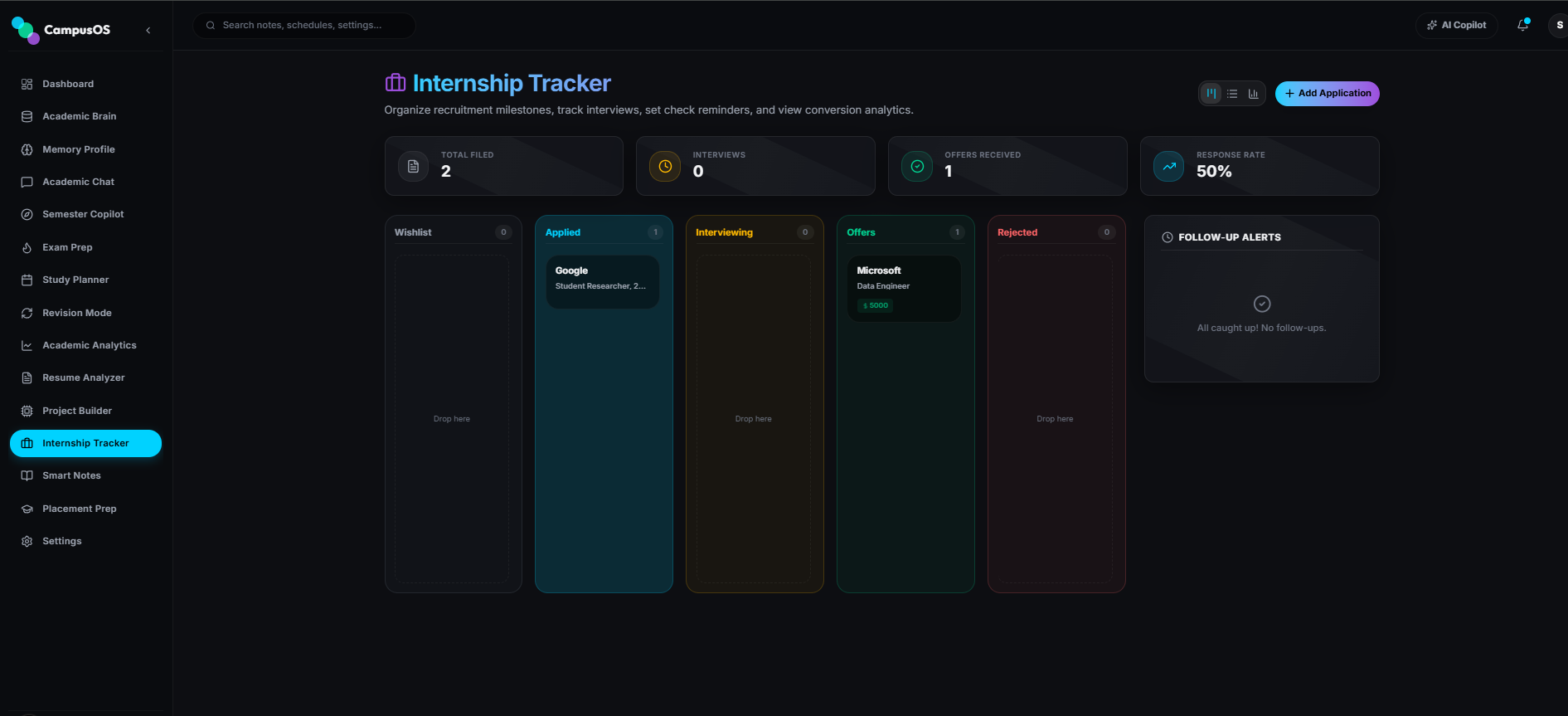
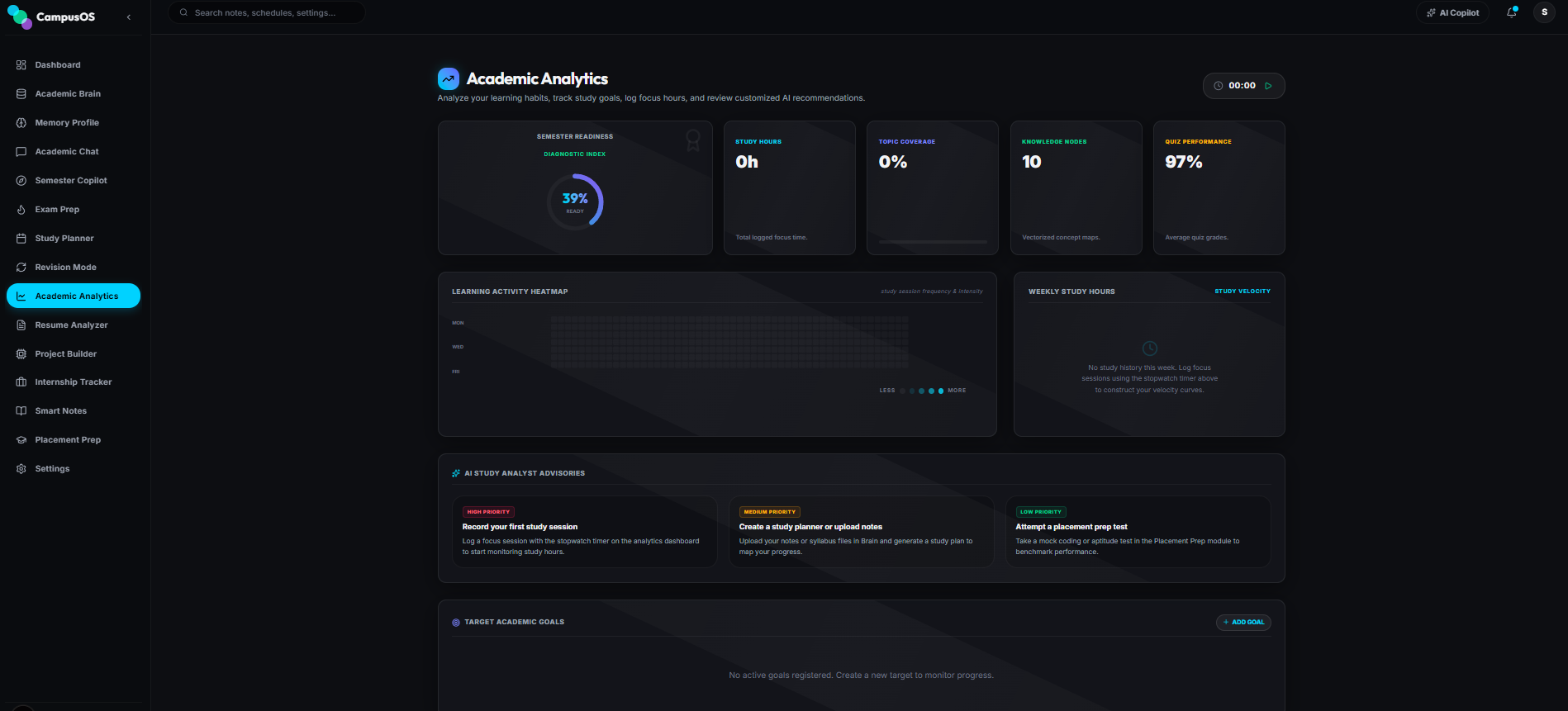
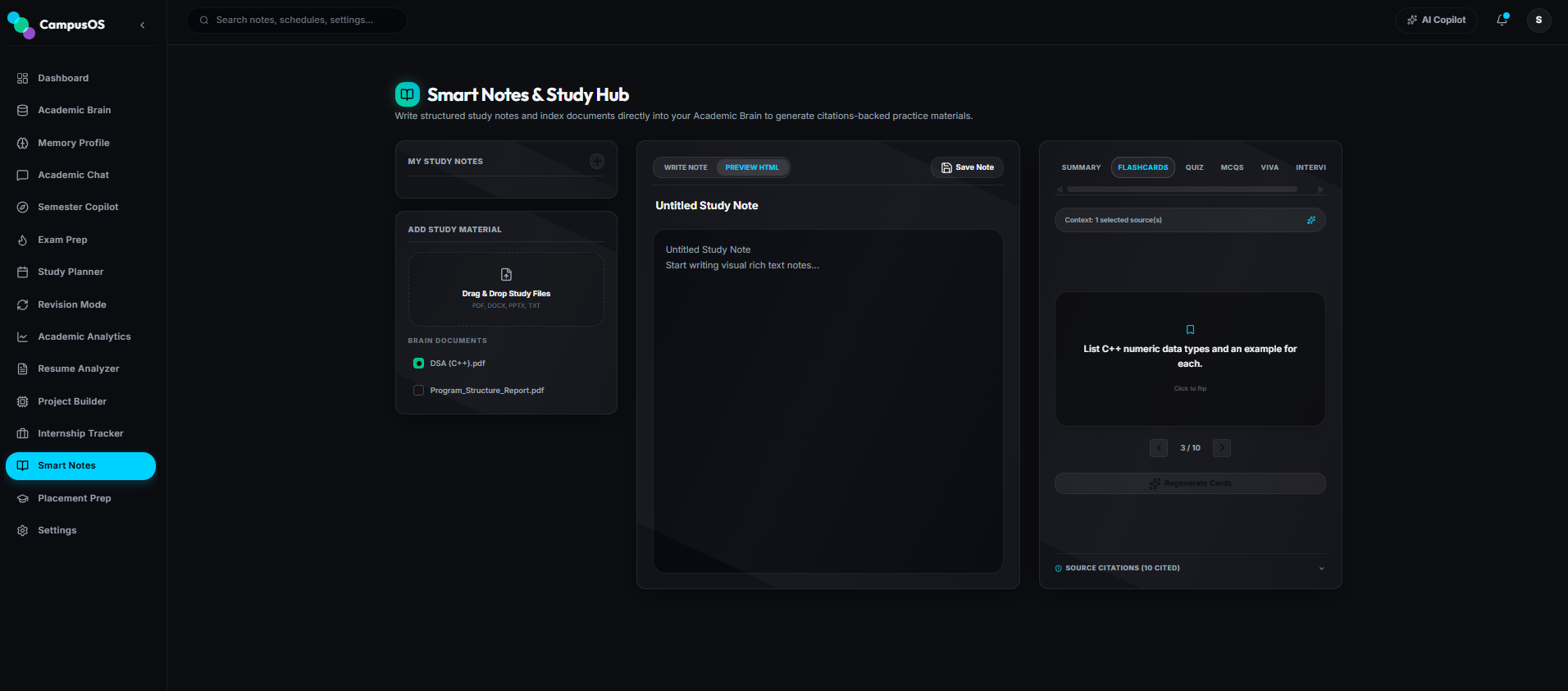
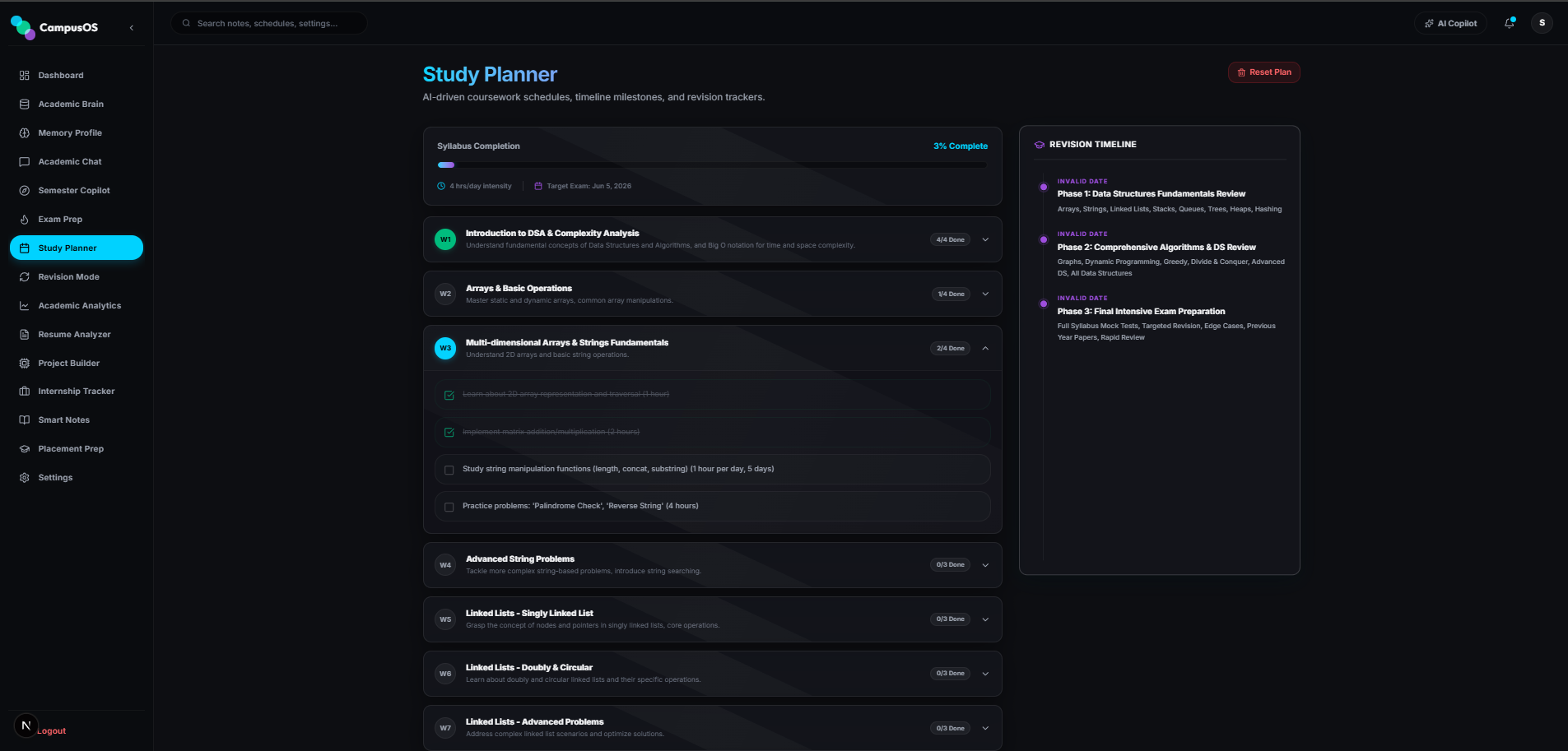
CampusOS — The AI Academic Twin
Inspiration
As students, we constantly switch between dozens of disconnected tools throughout our academic journey.
Our notes are scattered across PDFs and documents. Study plans live in calendars. Flashcards exist in separate apps. Assignments are buried in folders. Career preparation happens on different platforms. When we need help understanding a concept, we open an AI chatbot that knows nothing about what we've already learned.
This fragmentation creates a fundamental problem: students spend years learning, yet they never build a system that truly understands their academic journey.
We asked ourselves a simple question:
What if students had an AI that learned exactly what they learned?
That idea became CampusOS.
Instead of creating another note-taking app or another study planner, we set out to build an Academic Twin — a personalized AI system that evolves alongside the student, understands their learning materials, tracks their progress, and helps them make better academic decisions.
What It Does
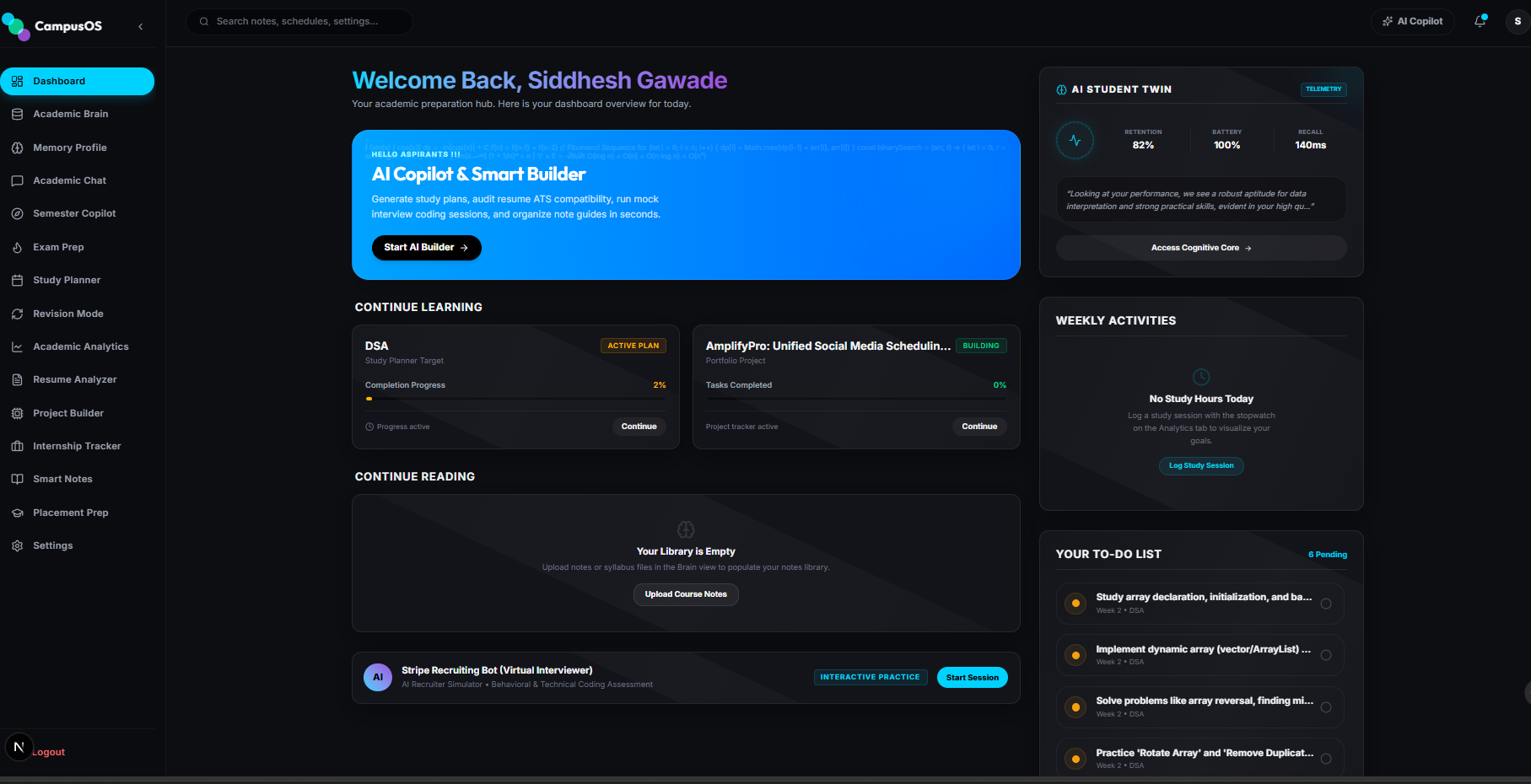
CampusOS is an AI-powered Academic Operating System that transforms study materials into a personalized intelligence layer.
Students can upload:
- Syllabi
- Lecture notes
- PDFs
- Assignments
- Presentations
- Previous year papers
- Study resources
CampusOS processes this information through its Academic Brain, creating a structured knowledge base using vector search, knowledge graphs, retrieval-augmented generation (RAG), and memory systems.
Once the Academic Brain is created, the platform becomes capable of:
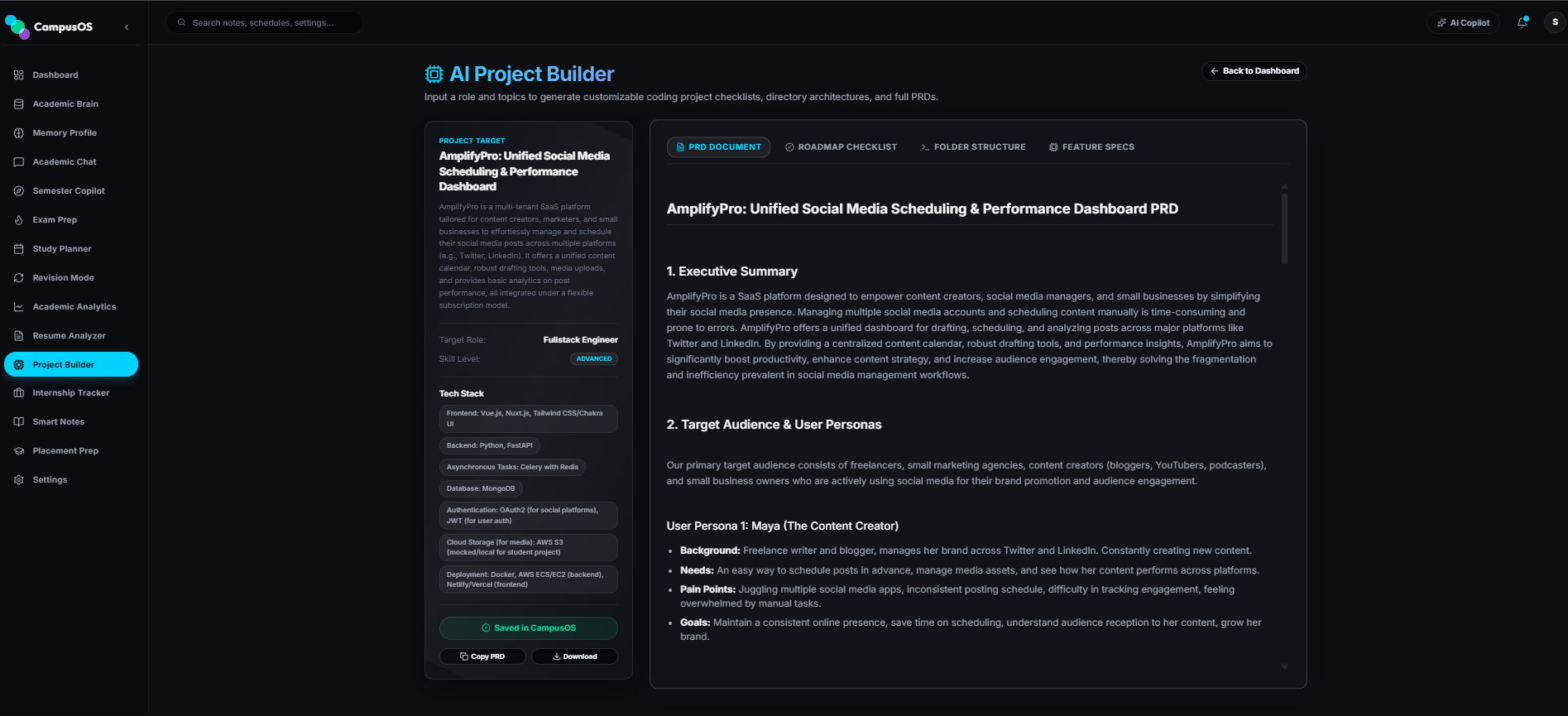
- Generating personalized study plans
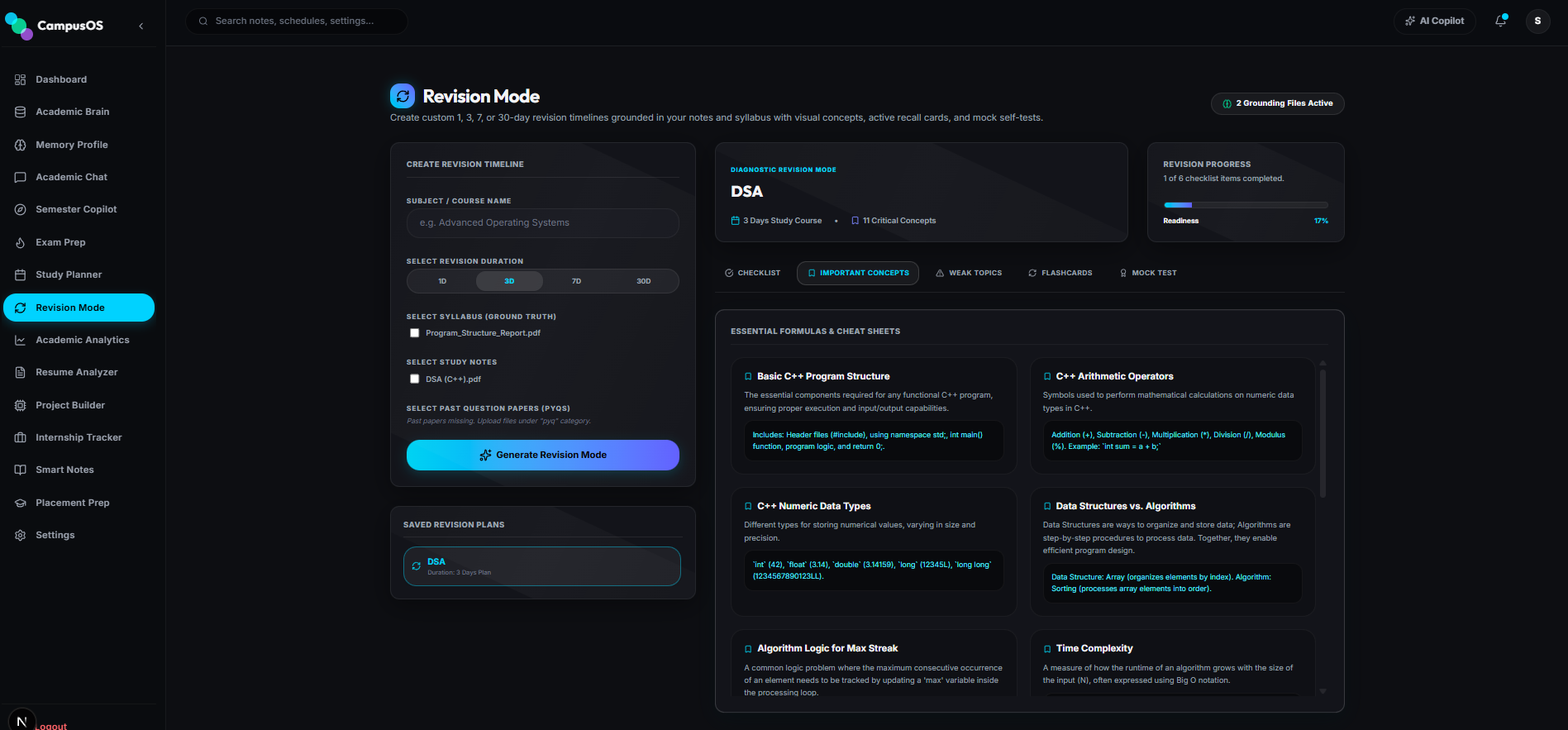
- Creating revision schedules
- Producing quizzes and flashcards
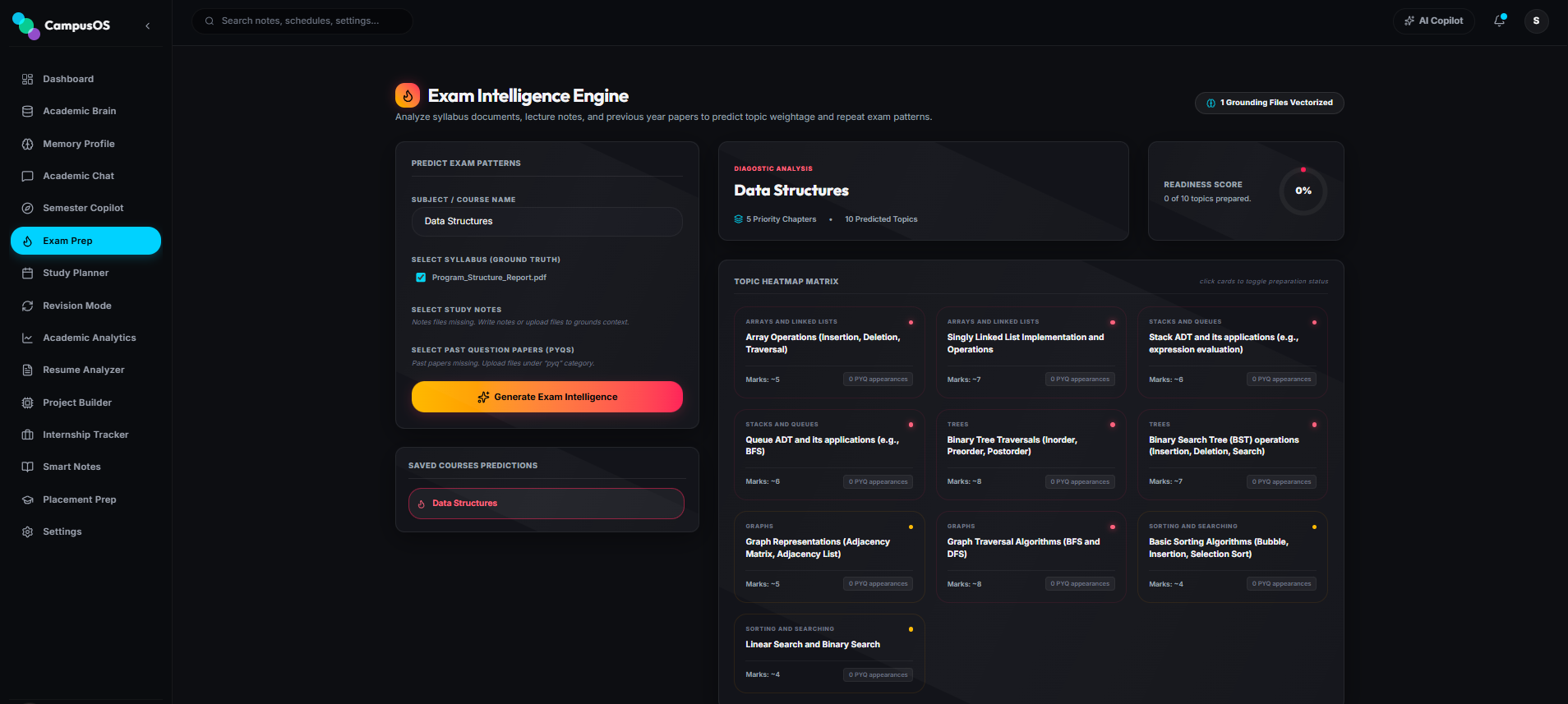
- Predicting important exam topics
- Answering questions using personal study materials
- Tracking academic growth
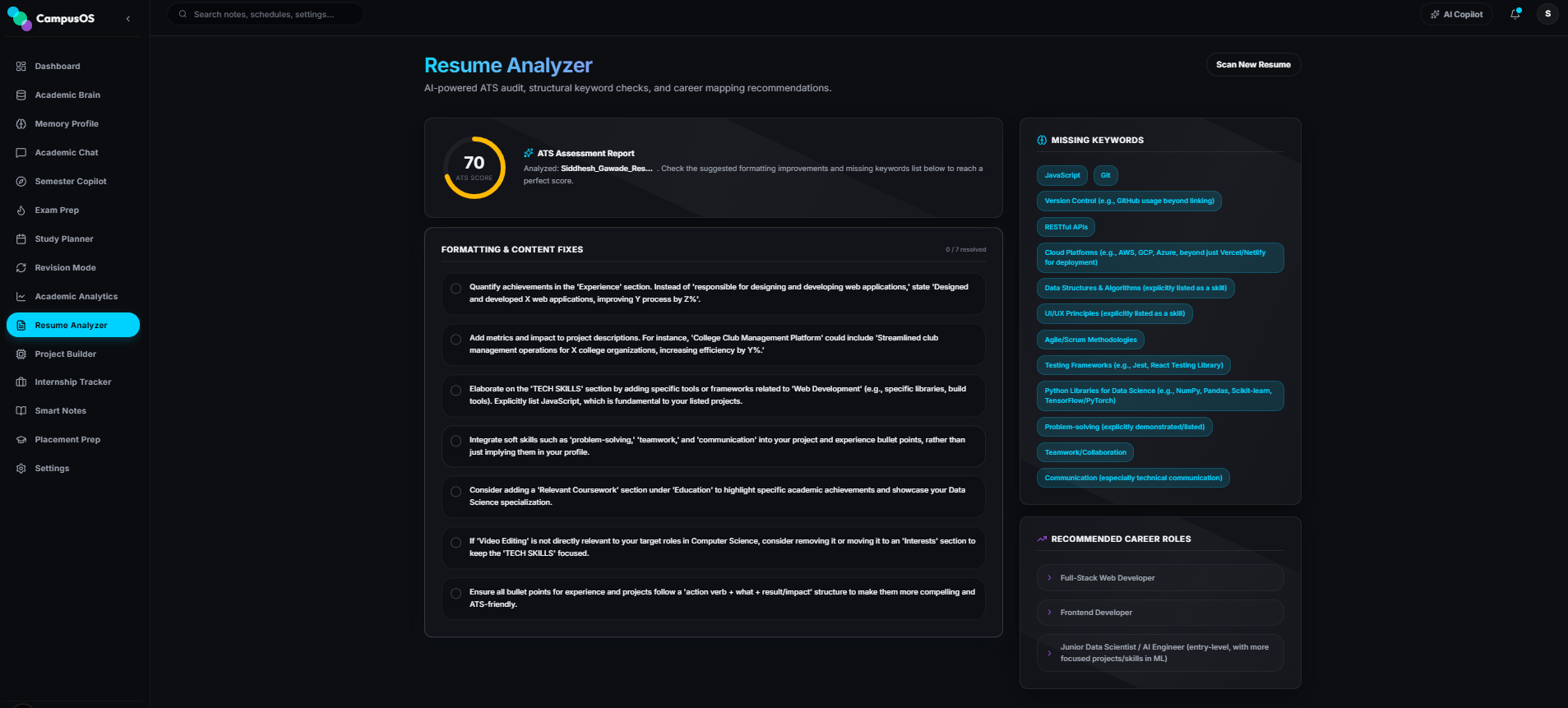
- Assisting with placements and internships
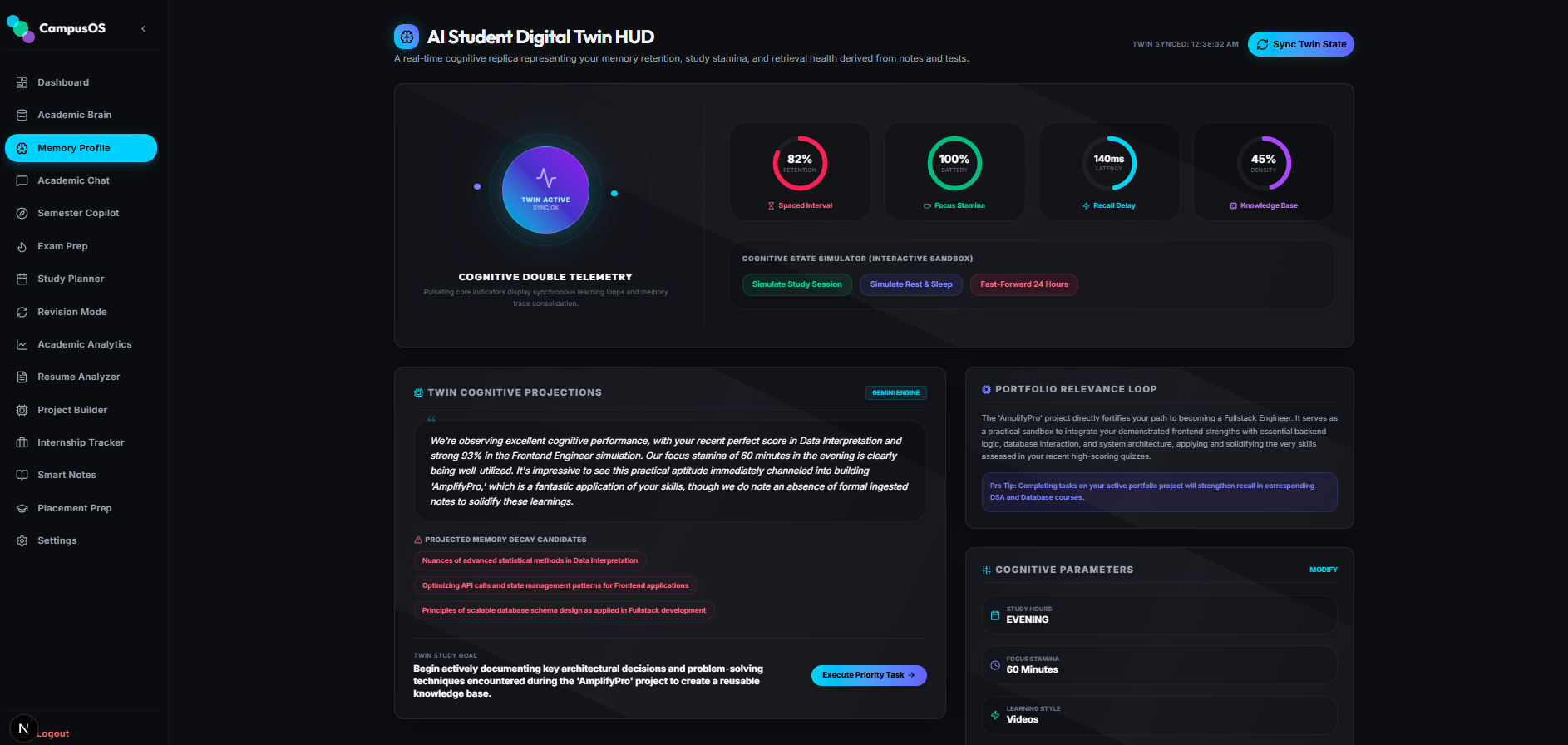
- Building a living Academic Twin that evolves over time
Unlike traditional AI tools, CampusOS doesn't rely on generic responses. Every recommendation is grounded in the student's own learning data.
How We Built It
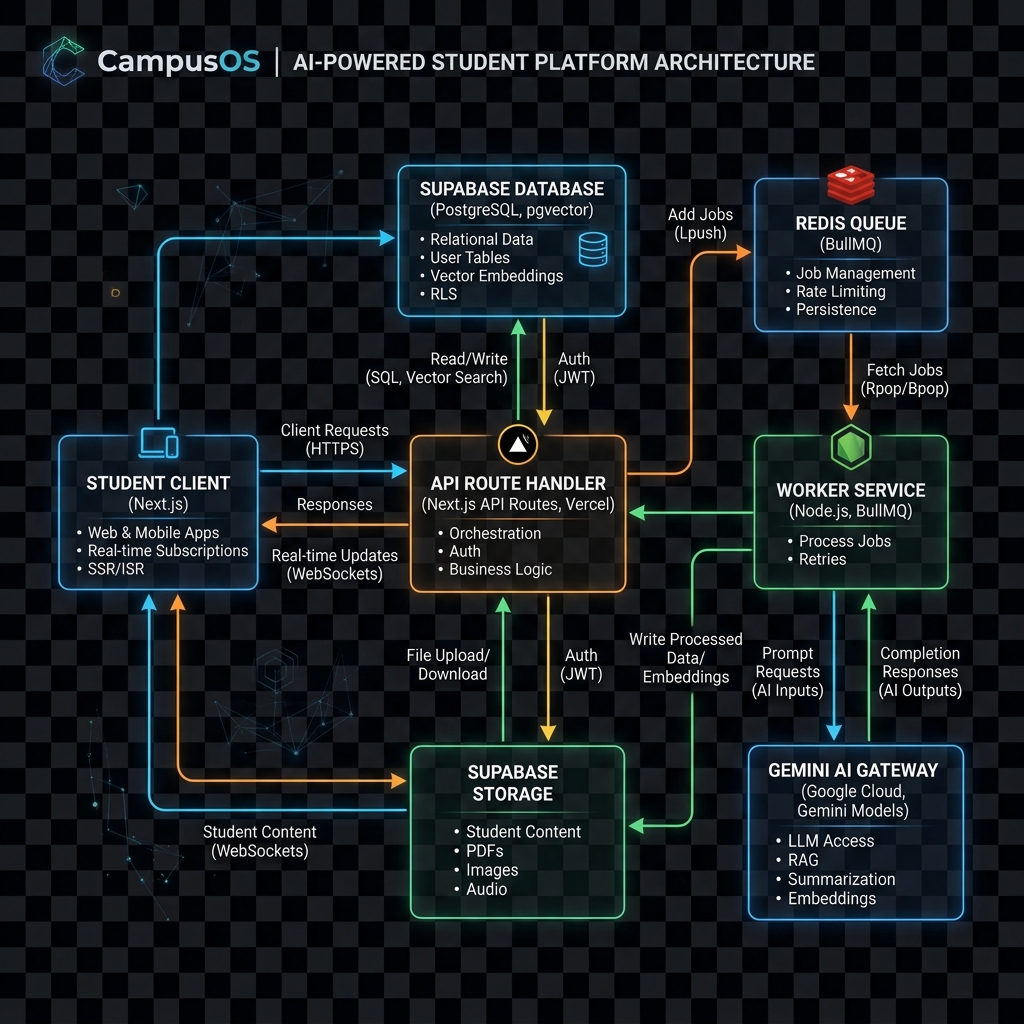
CampusOS was designed as a full-stack AI platform with scalability and production readiness in mind.
Frontend
- Next.js 15
- TypeScript
- Tailwind CSS
- Shadcn UI
- Framer Motion
We focused heavily on creating a modern SaaS experience with responsive layouts, reusable components, smooth interactions, and an onboarding-first user journey.
Backend
- Supabase Authentication
- PostgreSQL Database
- Supabase Storage
- Row Level Security (RLS)
The backend architecture was designed around secure user isolation and scalable data management.
Academic Brain
The Academic Brain is the core intelligence layer of CampusOS.
The workflow:
- User uploads study material.
- Documents are processed and parsed.
- Content is chunked into semantic sections.
- Embeddings are generated.
- Vectors are stored using pgvector.
- Knowledge graphs are created.
- Context is retrieved through RAG pipelines.
This allows CampusOS to provide highly personalized responses based on the student's own academic content.
AI Layer
CampusOS uses Google Gemini models to power:
- Study planning
- Academic analysis
- Knowledge retrieval
- Resume evaluation
- Exam preparation
- Personalized recommendations
To improve scalability and efficiency, the architecture includes:
- Centralized AI gateways
- Token optimization strategies
- Embedding reuse
- Context compression
- Vector retrieval pipelines
- Rate limiting mechanisms
Challenges We Faced
Building CampusOS presented several technical and product challenges.
Creating a Meaningful AI Experience
Many educational AI applications generate generic outputs.
Our challenge was creating an AI system that truly understands the student rather than providing one-size-fits-all responses.
This led us to design the Academic Brain architecture powered by personal knowledge retrieval.
Eliminating Fake Data
Most student dashboards rely on hardcoded statistics, dummy progress bars, and fabricated analytics.
We adopted a strict product philosophy:
No fake data.
Every metric, recommendation, and insight must originate from actual user activity or uploaded materials.
This required redesigning the entire onboarding and analytics experience around real data collection.
Building for Scale
Educational AI applications can become expensive and slow when handling large numbers of users.
We spent significant effort designing:
- Background processing pipelines
- Vector optimization strategies
- Request management systems
- Caching layers
- AI cost optimization techniques
to ensure the platform could grow beyond a simple hackathon project.
Knowledge Graph Construction
Transforming unstructured study material into meaningful concept relationships was one of the most challenging aspects of the project.
We developed workflows to identify concepts, build relationships, and organize academic knowledge into a structure that could be queried intelligently.
What We Learned
This project taught us far more than building a traditional web application.
We gained experience in:
- Retrieval-Augmented Generation (RAG)
- Vector databases
- Knowledge graph design
- AI architecture
- Scalable SaaS engineering
- User onboarding design
- Educational product design
- Prompt engineering
- AI cost optimization
- System architecture
Most importantly, we learned that great AI products are not built by simply connecting a model to a chatbot.
The real challenge is designing systems that create meaningful, personalized experiences grounded in real user data.
Impact
CampusOS was created with a simple vision:
Every student deserves an AI that truly understands how they learn.
By transforming scattered academic resources into a personalized Academic Twin, CampusOS helps students organize knowledge, improve learning efficiency, prepare for exams, and make more informed educational and career decisions.
Rather than replacing learning, CampusOS aims to become a trusted companion that helps students learn more effectively throughout their academic journey.
Future Vision
We see CampusOS evolving into a lifelong learning companion.
Future developments include:
- Real-time lecture transcription
- Collaborative Academic Twins
- Institution-wide deployment
- Learning pattern prediction
- Career intelligence systems
- Research assistance
- Cross-semester knowledge tracking
- Multi-modal learning support
Our long-term goal is to create an AI system that grows with students from their first semester to their professional careers.
CampusOS is not just a study tool.
It is the foundation for a personalized AI-powered learning ecosystem.
Built With
- ai
- education
- gemini
- knowledge-graph
- next.js
- postgresql
- productivity
- rag
- saas
- supabase
- typescript
- vector-database

Log in or sign up for Devpost to join the conversation.