-
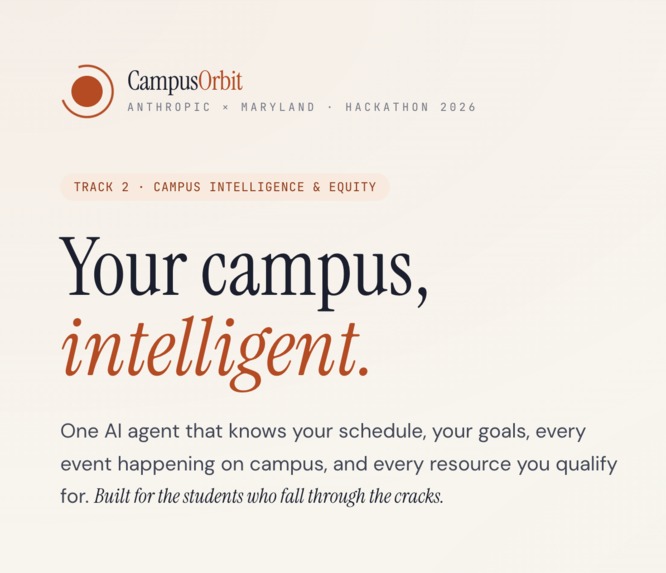
homepage
-
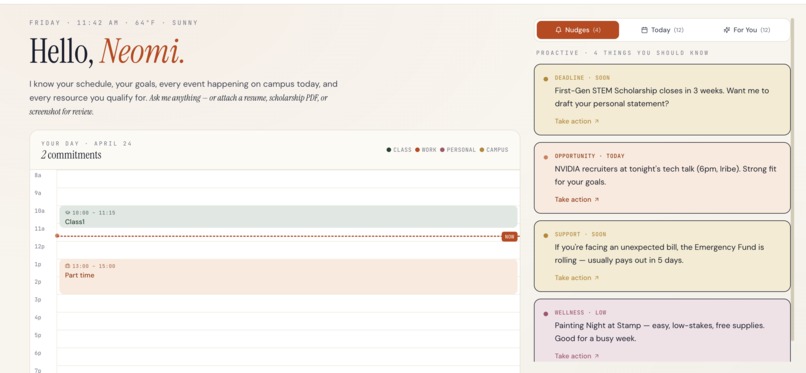
dashboard
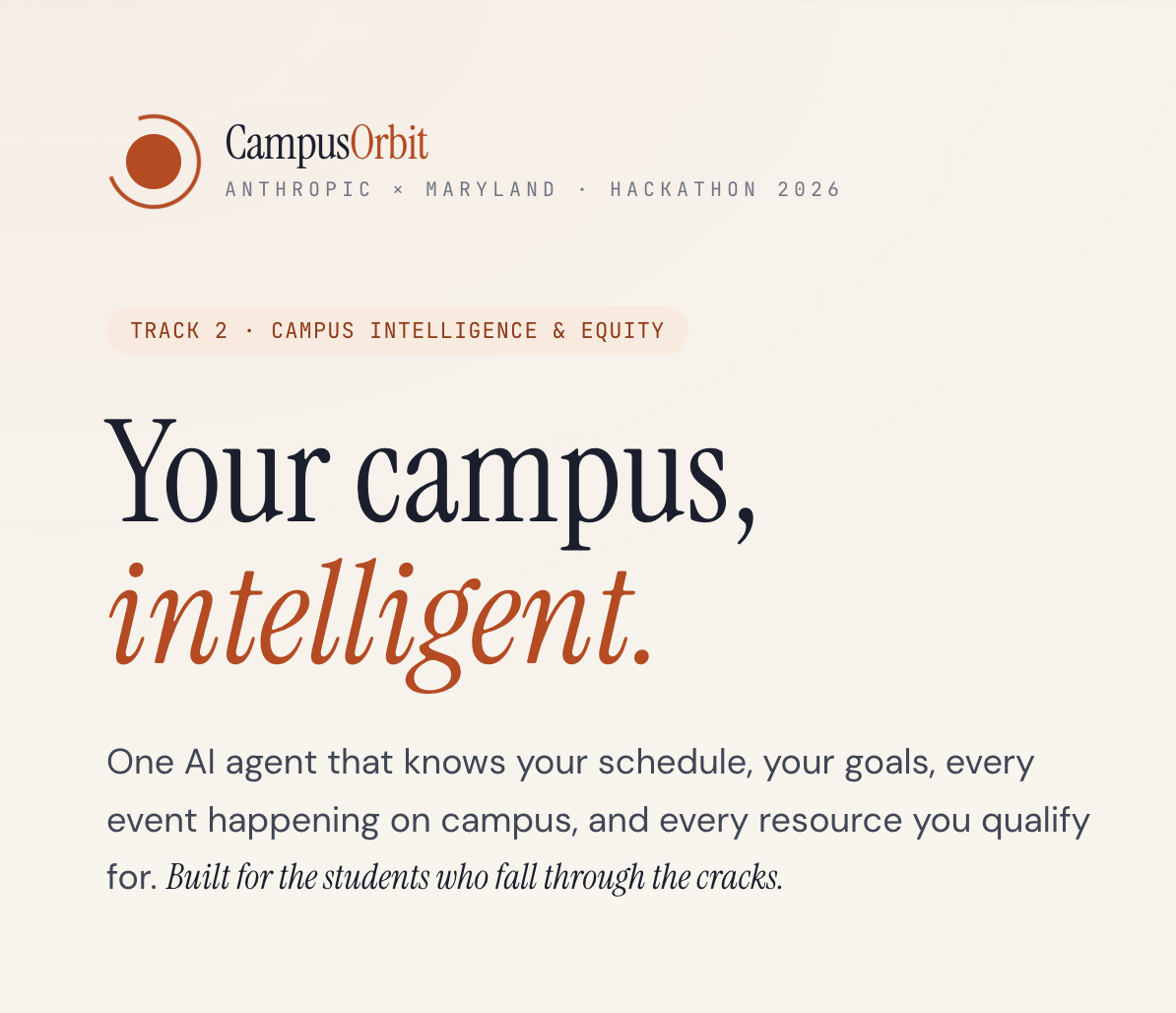
Project Name:
CampusOrbit CampusOrbit turns scattered campus systems into a single intelligent guide—matching students with the right resources, opportunities, and next steps at the right time.
Track:
Campus Intelligence & Equity
Who we built this for and why they need it:
We built CampusOrbit for students overwhelmed by navigating campus systems—especially first-gen, low-income, transfer, and non-traditional students. Universities offer many resources, but they’re scattered across portals and hard to navigate. Students miss opportunities not because they don’t exist, but because they’re difficult to find and prioritize. CampusOrbit solves this by acting as a personalized campus agent that turns complex information into clear, actionable next steps.
How we used Claude / AI:
Claude powers the core intelligence of CampusOrbit. It: Understands natural questions Uses student profile + calendar + campus data for context Generates personalized outputs like: Ranked events Action plans Scholarship eligibility insights Email drafts This ensures responses are specific, not generic.
What could go wrong and how we addressed it:
Inaccurate recommendations → We avoid final decisions and encourage verification with official sources Privacy concerns → Minimal data collection, optional inputs, local storage Generic AI responses → Grounded with structured campus data Sensitive situations → Direct users to official support resources when needed
What’s next:
Live campus data integration Google Calendar sync Scholarship parsing Smarter search with vector databases User feedback loops Admin tools for universities Long term, CampusOrbit can become a universal layer that helps students navigate campus with clarity and confidence.## Inspiration Campus resources exist, but students often do not know where to look, what applies to them, or what to do first. CampusOrbit was built for students who are overwhelmed by disconnected portals, hidden events, confusing scholarship requirements, and scattered support systems.
What it does
CampusOrbit is an AI-powered campus assistant that personalizes university life around each student’s schedule, goals, background, and needs.
Students can:
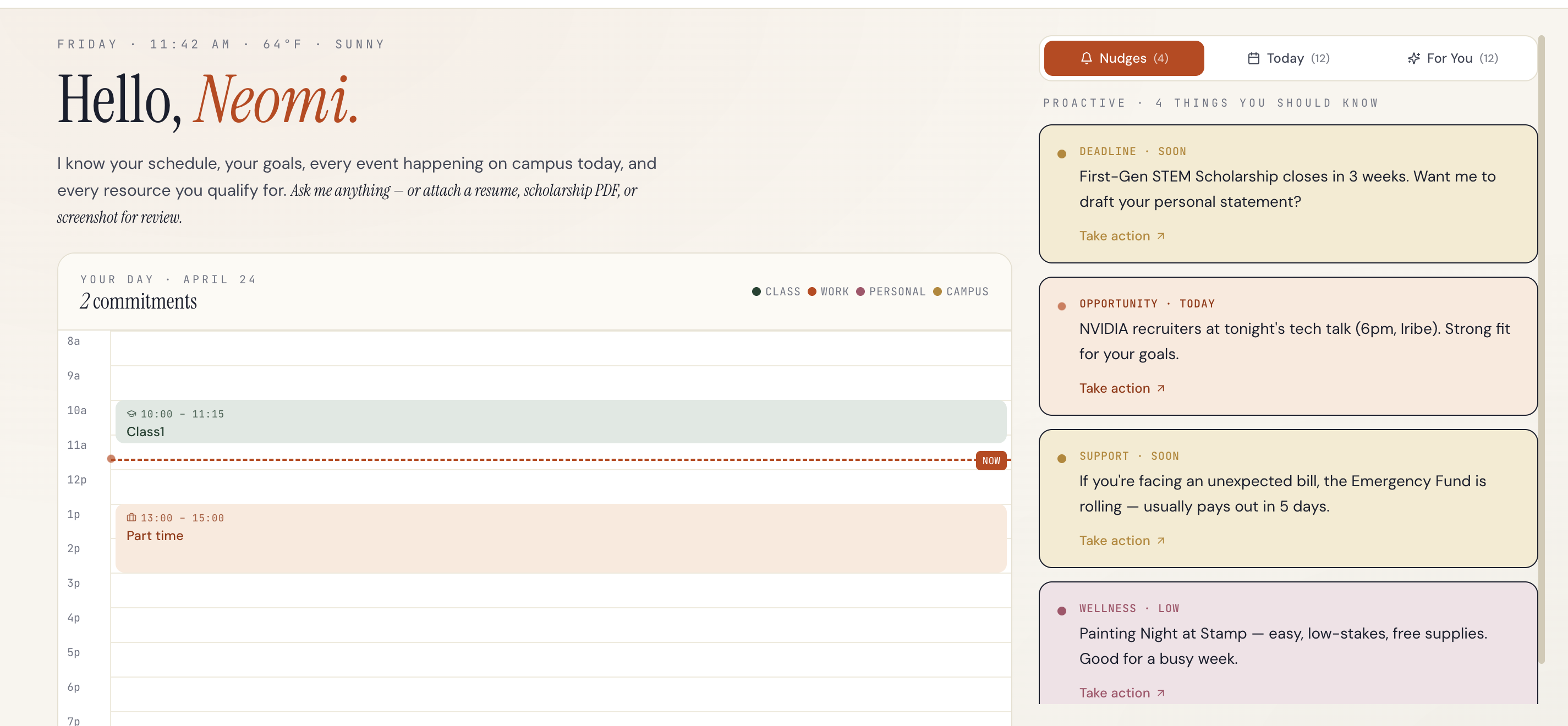
Ask what events or opportunities fit their calendar Get personalized campus resource recommendations Check scholarship eligibility through guided questions Discover food, tutoring, career, advising, and financial support Add recommended events to their calendar Receive proactive nudges for deadlines, workshops, and opportunities Demo different student profiles to show how the same campus can serve different needs
The problem
A student’s background should not determine whether they find support. But in practice, first-gen students, transfer students, commuters, low-income students, international students, and students with heavy work or family responsibilities often miss resources because campus information is fragmented.
CampusOrbit solves this by bringing events, resources, scholarships, and next steps into one conversational interface.
How we built it
We built CampusOrbit as a full-stack, AI-powered prototype that brings together campus events, resources, and student context into one unified system. The frontend was developed using React and Vite, designed as a clean, intuitive interface that feels more like a personal command center than a traditional portal.
We created a seeded dataset of campus events, resources, and opportunities, then layered an AI agent (powered by Claude) on top to interpret student intent and generate personalized responses. Each user logs in as a demo persona with a unique profile, including goals, interests, and schedule, allowing the system to tailor recommendations in real time.
We also implemented calendar-aware logic and built a lightweight calendar export feature using .ics files, so users can instantly add recommended events to their personal calendars. The system combines conversational AI, rule-based matching, and contextual ranking to deliver relevant, actionable guidance instead of generic information.
Challenges we ran into
One of the biggest challenges was balancing scope with clarity. Campus life includes a wide range of needs—events, academics, finances, career support—and trying to include everything risked making the product feel unfocused. We addressed this by anchoring the experience around three core user questions: what should I do, what am I eligible for, and what should I do next.
Another challenge was avoiding generic AI responses. Without grounding, AI tends to give broad advice. We solved this by structuring the agent around a curated dataset and injecting user profile and calendar context into every interaction.
We also had to design a system that feels personalized without requiring sensitive data. This required careful decisions about what information to ask for and how to provide value while respecting privacy.
Accomplishments that we're proud of
We’re most proud of how real and relatable the product feels in a short demo. By creating multiple student personas, we show that the same campus can produce completely different experiences depending on who you are—and how CampusOrbit adapts to each one.
We also built a system that goes beyond information delivery. Instead of just listing resources, CampusOrbit turns them into clear, prioritized actions with context and reasoning.
The calendar integration, personalized event ranking, and proactive nudges bring the experience to life and make the product feel genuinely useful rather than conceptual.
What we learned
We learned that the real problem is not lack of resources, but lack of clarity. Students are overwhelmed not because help doesn’t exist, but because it is too fragmented and difficult to navigate.
We also learned that personalization is most effective when it reduces decision fatigue. Instead of giving more options, the system should narrow choices and guide action.
Finally, we saw how important trust is in AI systems—students need to understand why something is recommended and what to do next, not just receive an answer.
What's next for CampusOrbit
Next, we would focus on scaling CampusOrbit beyond a prototype into a real campus-integrated system. This includes connecting to live university event feeds, enabling secure Google Calendar integration, and expanding the resource database through partnerships with campus offices.
We would also improve the intelligence layer by incorporating feedback loops, allowing the system to learn from user behavior and refine recommendations over time. Scholarship parsing, document uploads, and deeper career support tools are also key areas for expansion.
Long term, CampusOrbit could become a central layer across universities—helping students navigate not just campus life, but their entire academic and career journey with clarity and confidence.
Built With
- anthropic-api
- claude-sonnet-4
- google-fonts
- javascript
- lucide
- node.js
- react
- tailwind-css
- vite

Log in or sign up for Devpost to join the conversation.