Inspiration
Institutions such as universities, colleges, and service organizations still depend heavily on phone calls to complete operational tasks. A request may look simple from the user's perspective, but behind the scenes it can require contacting the right person, asking several questions, coordinating multiple people, verifying information, and escalating exceptions.
We wanted to build an AI system that does more than generate a response.
CampusOps AI turns an operational request into real-world action.
The key insight was that phone calls should not be treated as a standalone chatbot experience. They should be one step inside a larger operational workflow: plan the task, call the right people, collect structured evidence, verify the result, and take the next action.
CALL-E made this possible by giving our application a way to use AI agents for real phone conversations.
What it does
CampusOps AI is an AI Phone Operations Orchestrator.
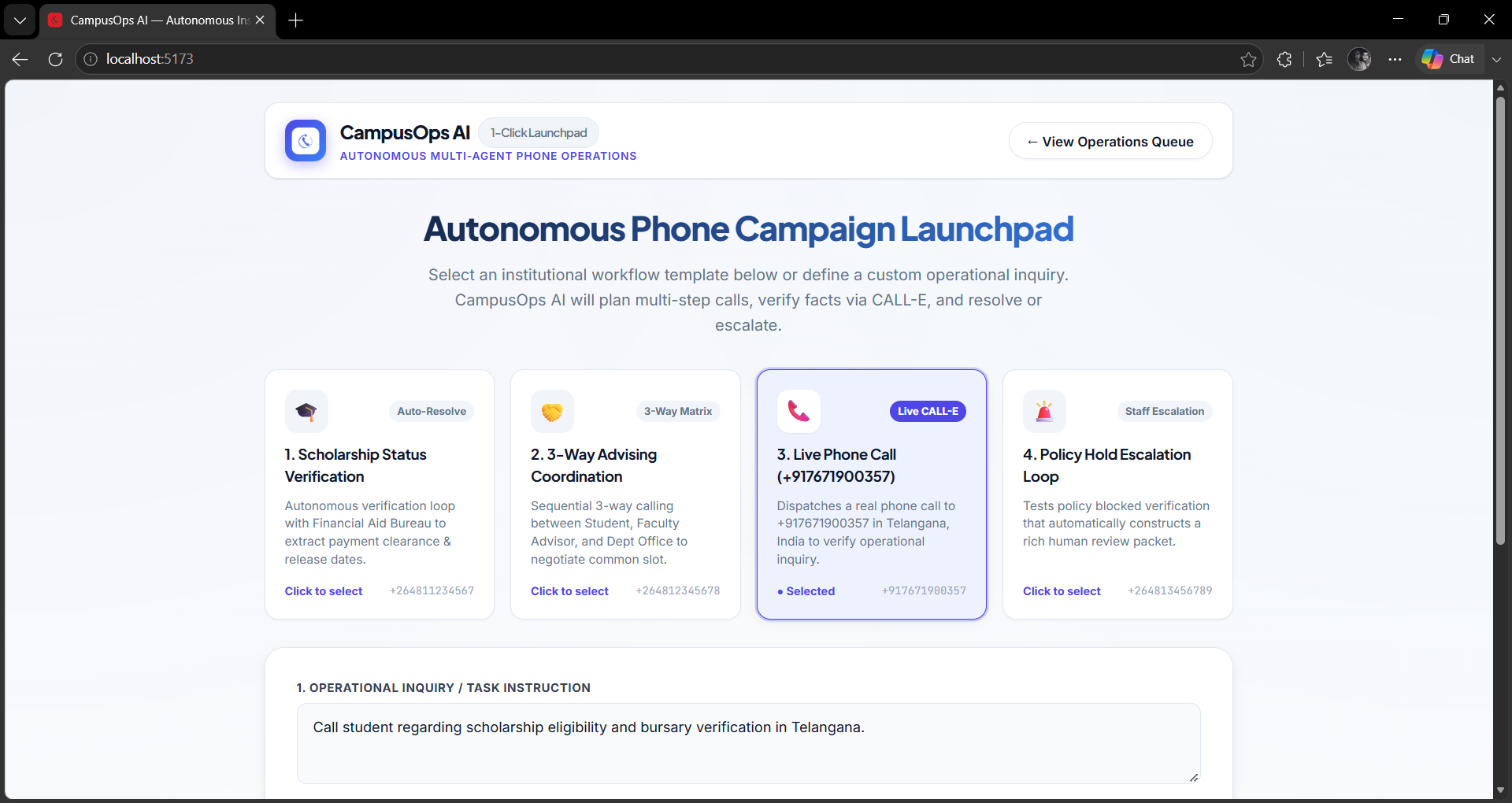
A user submits an operational request, and CampusOps AI determines what needs to happen next. Depending on the request, it can:
- Verify information by calling an external office and collecting evidence.
- Coordinate multiple people by contacting participants and finding a workable outcome.
- Escalate unresolved cases with a structured review packet for a human operator.
The system is designed around a verification loop rather than simply trusting a phone conversation.
For example:
Request → Plan → CALL-E phone call → Structured result → Evidence verification → Resolve or escalate
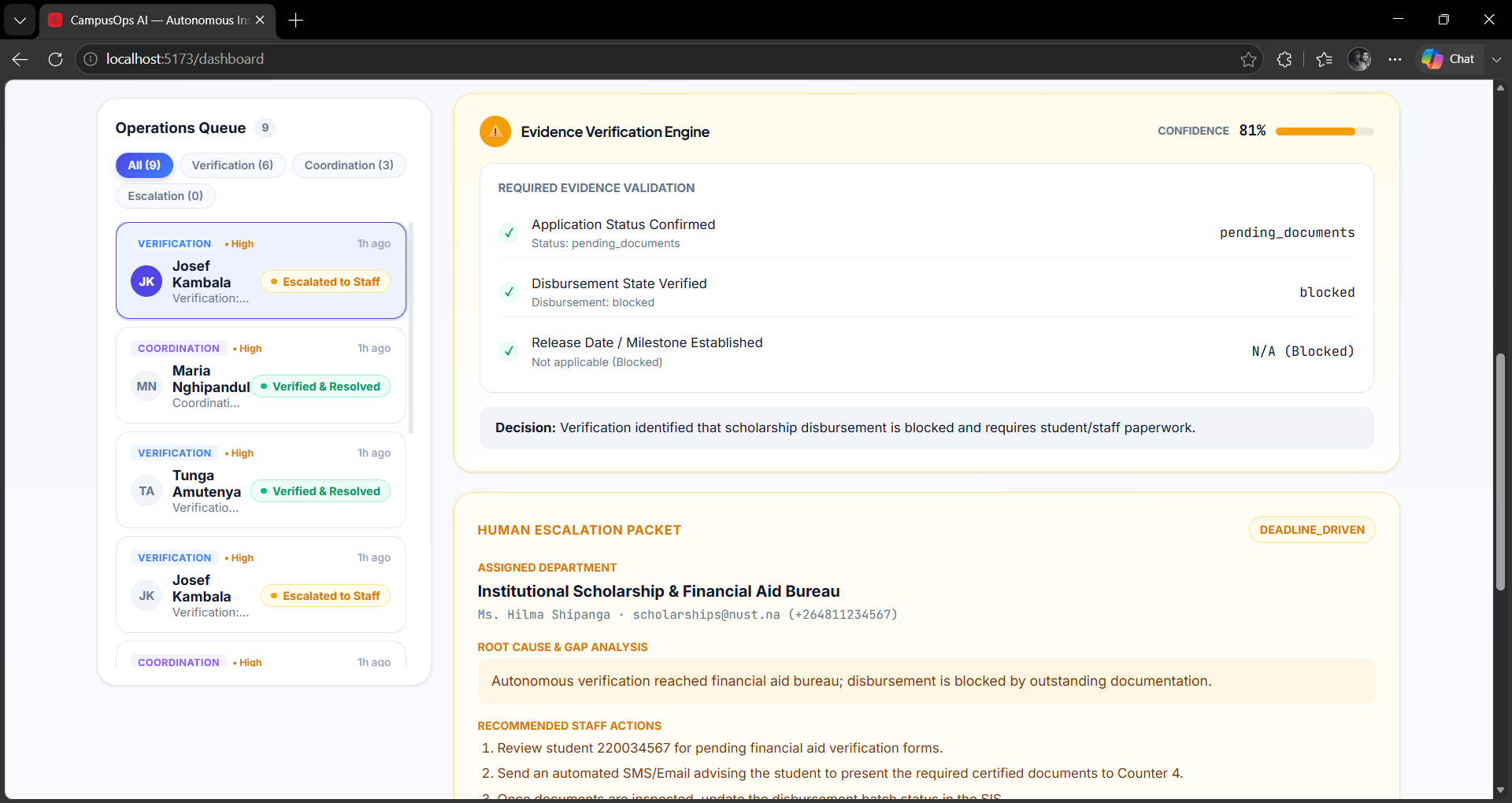
For verification workflows, the system checks required facts and calculates confidence before marking a case resolved.
For coordination workflows, it maintains a participant availability matrix and identifies a common outcome.
When information remains incomplete or contradictory, CampusOps AI does not pretend the task succeeded. It creates an escalation packet containing the original request, collected evidence, unresolved issues, and recommended next action.
The result is an AI system that can move a task from request → action → evidence → decision.
How we built it
CampusOps AI is built as a modular workflow orchestration system.
At the center is an AI planner that converts an operational request into a structured workflow. The planning layer uses a Gemini → Groq → deterministic fallback strategy so that the application can continue operating even when a preferred model is unavailable.
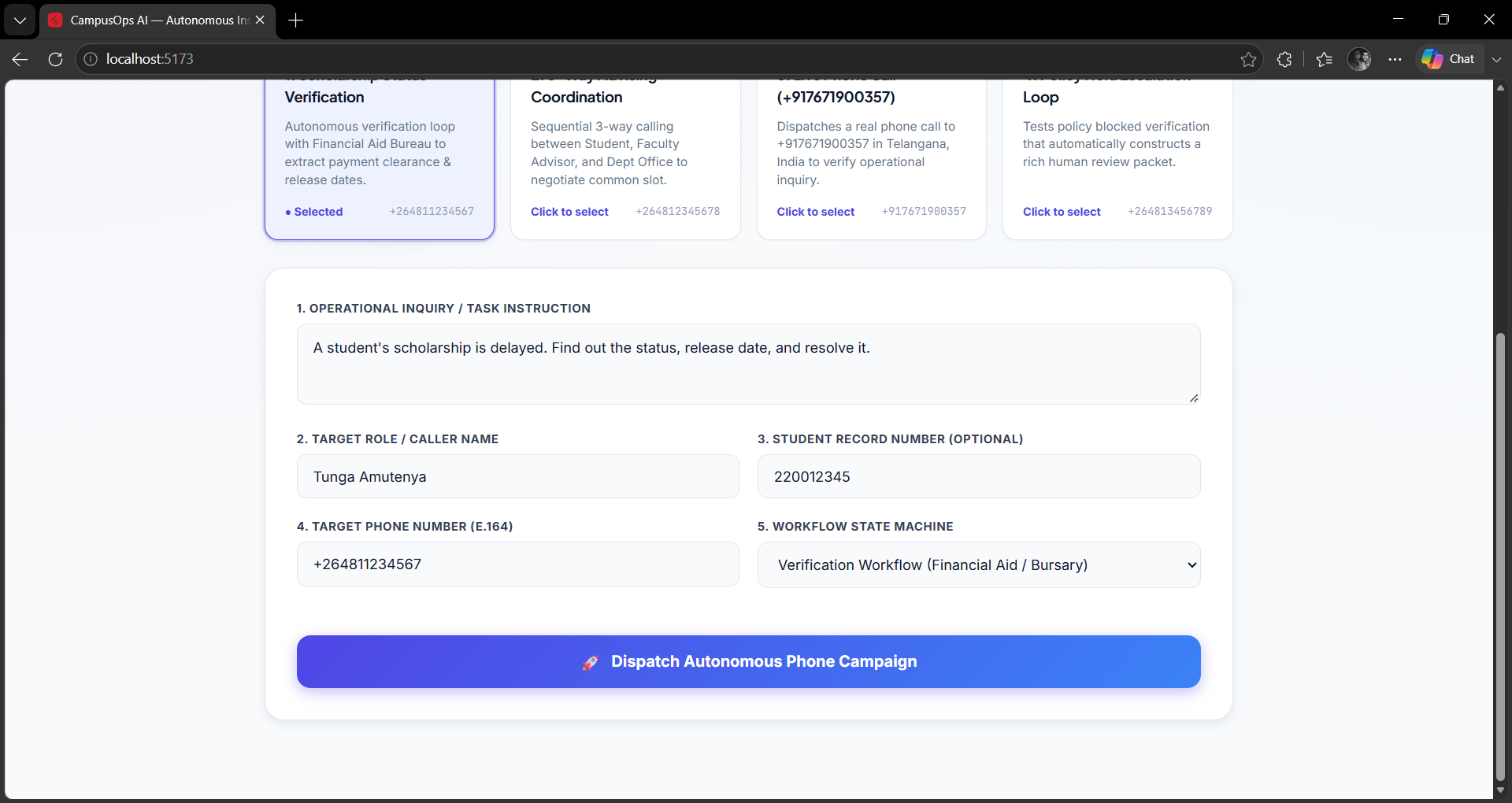
The workflow layer contains three primary paths:
- Verification Workflow — gathers information through CALL-E and validates the required evidence.
- Coordination Workflow — contacts multiple participants and builds a coordination matrix to determine a workable result.
- Escalation Workflow — packages unresolved cases for human review.
CALL-E provides the real phone execution layer. The application creates calls, polls call lifecycle state, retrieves results, and defensively parses returned data into structured application results.
We also built a deterministic mock transport so workflows can be tested without making unnecessary phone calls, while the live verification path allows the same system to execute real CALL-E calls.
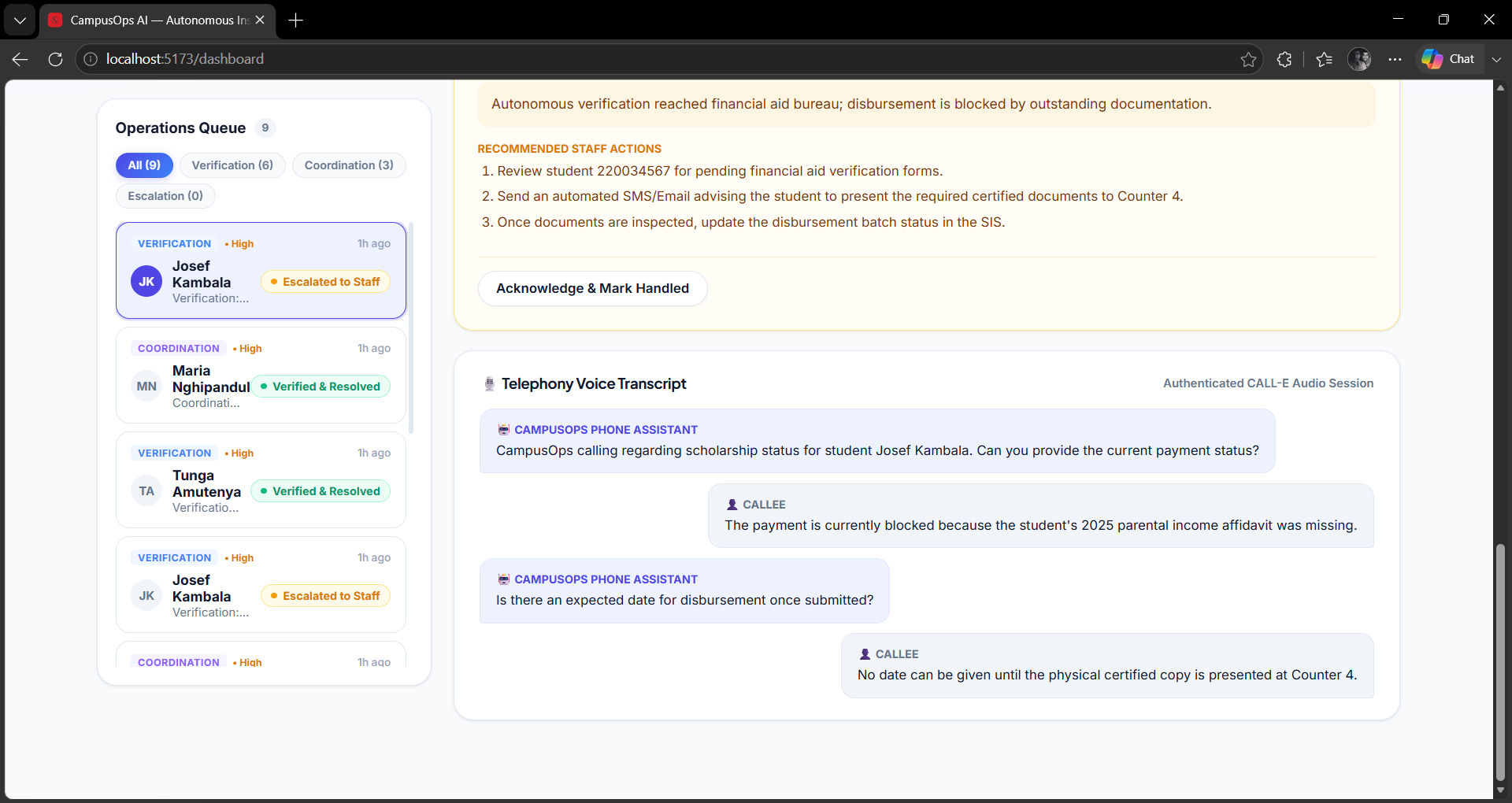
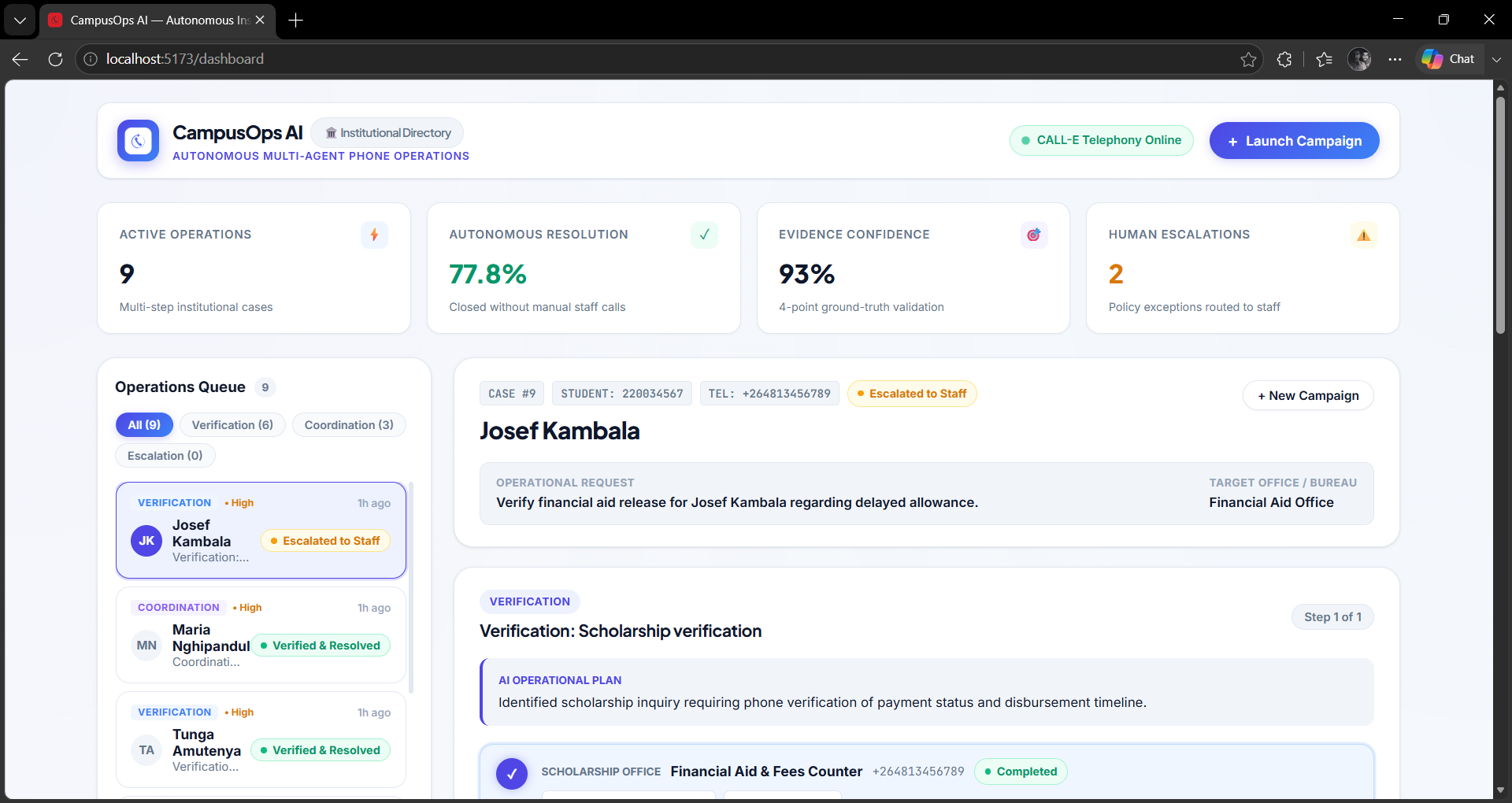
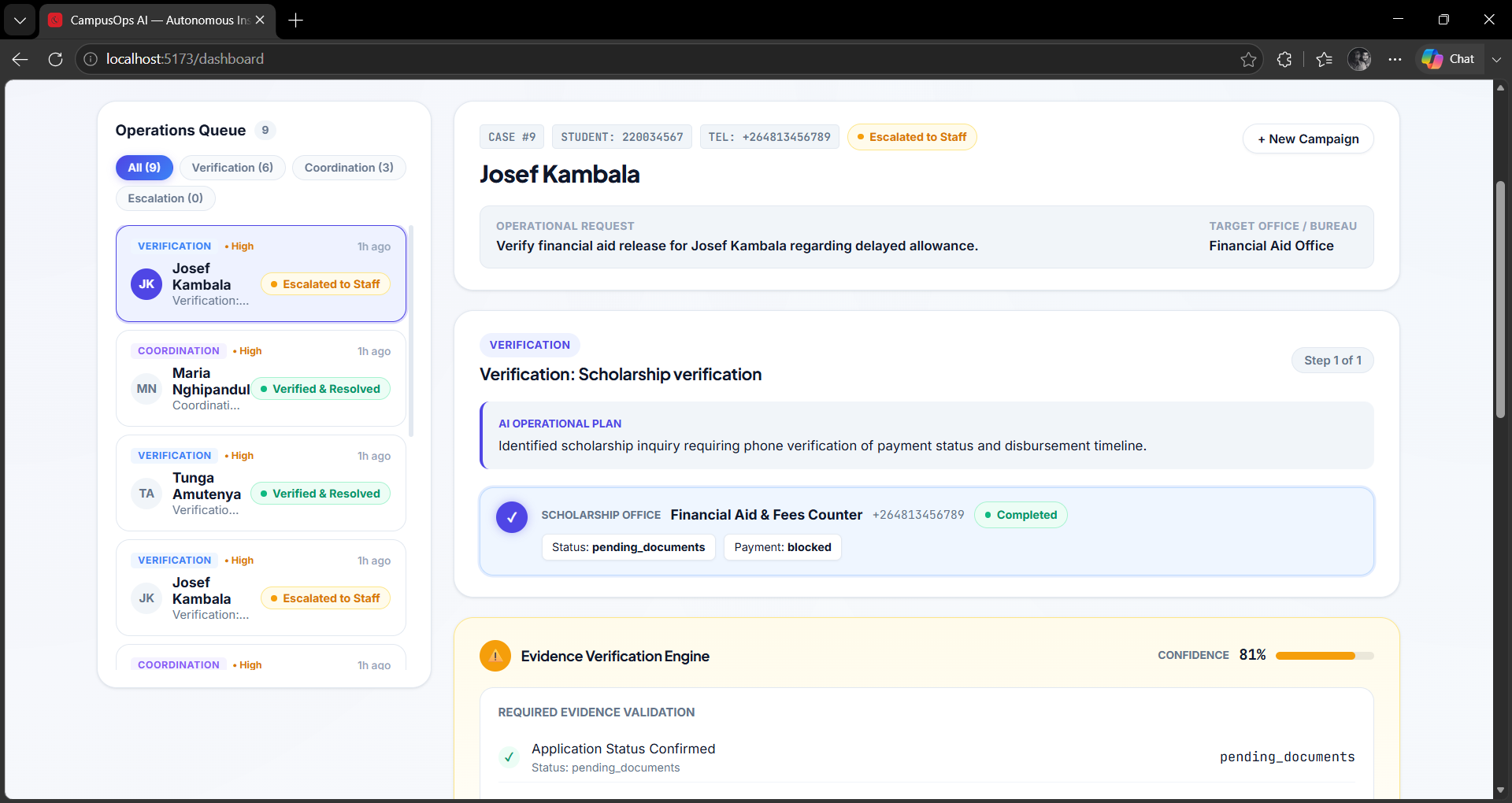
The frontend provides a visual operational workspace with:
- Workflow timeline
- Evidence verification
- Confidence and resolution state
- Multi-party coordination matrix
- Escalation cards
The project also includes a dedicated CALL-E skill specification with safety guidance and examples.
Before submission, we validated the implementation with automated tests and a production frontend build. The test suite completed with 37/37 tests passing, alongside successful live CALL-E workflow verification.
Challenges we ran into
The biggest challenge was designing around the uncertainty of real phone conversations.
A phone call does not return a perfectly structured API response. People can provide incomplete answers, introduce ambiguity, answer questions in unexpected ways, or provide information that conflicts with what the system already knows.
We therefore had to design the application around defensive parsing, evidence verification, confidence thresholds, and explicit escalation rather than assuming every call would produce a clean answer.
Another challenge was making the system useful without turning it into an overly broad autonomous agent. We focused on a small number of operational patterns and made the architecture extensible instead of adding unnecessary features.
We also needed to balance live telephony with reliable development and testing. The deterministic mock transport allowed us to test the orchestration logic repeatedly, while the live CALL-E path verifies that the application can perform the actual phone operation.
Accomplishments that we're proud of
We are proud that CampusOps AI is not only a concept or simulated voice interface.
It actually connects workflow orchestration to real phone execution through CALL-E.
We built:
- A multi-step AI planning layer
- Real CALL-E phone execution
- Evidence-based verification
- Multi-party coordination
- Automatic exception escalation
- Structured call-result parsing
- Deterministic mock testing
- A visual workflow interface
- A dedicated CALL-E Agent Skill
- Automated test coverage and validation
Most importantly, the system has a clear failure path.
If the AI cannot establish enough evidence to safely resolve a request, it does not manufacture certainty. It escalates the case with the information a human needs to continue.
That makes CampusOps AI more than a voice agent. It is an operational system that knows when to act, when to verify, and when to ask for human help.
What we learned
We learned that the difficult part of AI phone automation is not simply making an AI speak naturally.
The difficult part is building everything around the conversation.
Real-world automation needs planning, state management, structured outputs, verification, retries, failure handling, and human escalation. A successful phone call is only useful when its result can be trusted and connected to the larger workflow.
We also learned the value of designing the system so that live infrastructure and deterministic testing can coexist. This allowed us to iterate quickly without depending on a real phone call for every development cycle, while still validating the critical path with real CALL-E execution.
Most importantly, we learned that autonomy should include knowing when not to act.
What's next for CampusOps AI
The next step is to expand CampusOps AI from a small set of institutional workflows into a general-purpose phone operations platform.
Future directions include:
- More institutional and business workflows
- Deeper integrations with existing operational systems
- Richer evidence and audit trails
- More sophisticated multi-party negotiation
- Automatic retry and follow-up workflows
- Human-in-the-loop approval for sensitive actions
- Additional CALL-E-powered operational skills
The long-term vision is simple:
Give an organization an operational request, and let CampusOps AI determine who needs to be contacted, make the necessary real-world calls, verify what happened, and move the task toward completion.
CampusOps AI does not just generate an answer.
It takes the next real-world action.
Built With
- agentic
- agents
- automation
- call-e
- human-in-the-loop
- llm
- multi-agent
- orchestration
- phone
- python
- react
- telephony
- typescript
- verification
- voice
- workflow

Log in or sign up for Devpost to join the conversation.