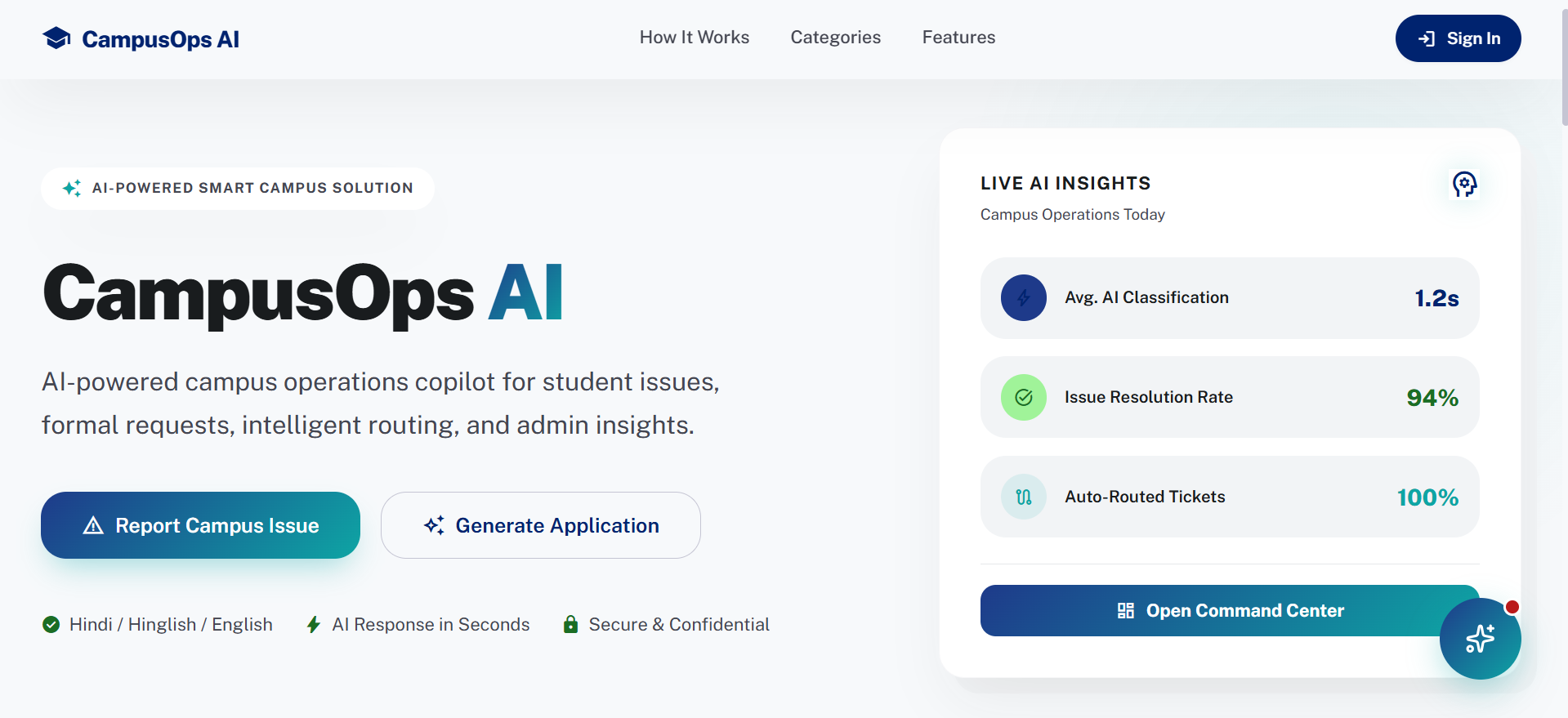
Inspiration Every campus has daily problems: hostel water issues, canteen complaints, library Wi-Fi problems, lab faults, certificate requests, fee issues, and exam-cell queries. The problem is not only that these issues exist — the bigger problem is that students often do not know where to report them, how to explain them properly, or how to write formal requests. We wanted to build something more useful than a normal complaint portal or chatbot. That inspired us to create CampusOps AI, an AI-powered campus operations copilot that converts messy student problems into structured actions. What it does CampusOps AI helps students and campus administrators manage campus support in one place. Key features include:
AI Campus Issue Triage: Students describe an issue in natural language, Hindi, English, or Hinglish, and Gemini classifies it.
Smart Routing: The issue is routed to the correct campus unit such as Hostel, Library, Canteen, Lab/IT, Exam Cell, Accounts, Security, or Administration.
Priority Detection: CampusOps AI detects whether the issue is Low, Medium, High, or Critical priority.
Ticket Creation: The system creates a structured campus ticket with status, category, priority, summary, and suggested action.
AI Application Generator: Students can generate formal applications for bonafide certificates, leave requests, fee extensions, scholarship requests, lab permissions, and more.
Admin Command Center: Admins can view campus issue analytics, urgent reports, department workload, and hotspot areas.
Duplicate Issue Clustering: Similar reports like multiple Library Wi-Fi complaints are grouped so admins can focus on root problems.
QR-Based Reporting: Campus locations can have QR codes so students can scan and report issues with the location auto-filled.
Campus AI Assistant: The chatbot guides students to the right action, such as creating a ticket, generating an application, or tracking a request.
How we built it We built CampusOps AI using the MERN stack and Google Gemini API. Tech stack:
Frontend: React.js, Vite, Tailwind CSS, Framer Motion
Backend: Node.js and Express.js
Database: MongoDB with Mongoose
AI: Google Gemini API
Charts and Analytics: Recharts
Map/Hotspots: Leaflet
Authentication: JWT and bcrypt
Deployment: Render
The main AI workflow uses Gemini to convert unstructured student input into structured data containing category, priority, campus unit, sentiment, issue type, summary, suggested action, and admin review status. Example output: { "category": "Hostel", "priority": "High", "campusUnit": "Hostel Warden / Hostel Maintenance", "sentiment": "Frustrated", "issueType": "Issue", "summary": "Water supply is unavailable in Hostel B for 2 days.", "suggestedAction": "Send maintenance staff to inspect and restore water supply.", "requiresAdminReview": true} We also used Gemini for formal application generation, chatbot intent detection, campus issue classification, multilingual understanding, and admin-friendly summaries. Challenges we ran into One major challenge was making the AI output reliable. Gemini can generate natural language easily, but our app needed structured data that the frontend and backend could use. We solved this by designing strict prompts and adding fallback handling. Another challenge was converting a broad idea into a focused hackathon product. We did not want to build just another chatbot, so we designed the system around real campus workflows: reporting an issue, routing a ticket, generating an application, viewing admin insights, and detecting duplicate reports. We also faced deployment and environment configuration issues, especially around API URLs, backend CORS, MongoDB connection, and secure handling of API keys. The map feature also needed special handling because campus locations like “Hostel B” or “Central Library” are text names, but maps need latitude and longitude. We solved this by adding demo campus coordinates for hackathon walkthroughs. Accomplishments that we're proud of We are proud that CampusOps AI feels like a complete product, not just a prototype. Our biggest accomplishments are:
Building an end-to-end AI workflow from student input to admin action.
Using Gemini for practical structured outputs, not only chat responses.
Creating a formal application generator that solves a real student problem.
Adding an admin command center with analytics and hotspot visibility.
Adding duplicate issue clustering to reduce repeated reports.
Building QR-based location reporting for real campus deployment.
Creating a polished UI that is easy to demo and understand.
The strongest part of CampusOps AI is that it connects students and administrators through one AI-assisted operations flow. What we learned We learned that AI becomes more useful when it is connected to real actions. A chatbot alone is not enough. The real value comes when AI can classify, route, generate, summarize, and help users complete a task. We also learned how important prompt design is when building AI applications. A small change in prompt structure can affect the reliability of the whole system. From the technical side, we improved our understanding of:
Gemini API integration
structured JSON generation
MERN stack architecture
secure environment variables
frontend-backend deployment
admin dashboard design
AI-assisted workflow automation
Most importantly, we learned how to turn an idea into a practical product under hackathon constraints. What's next for CampusOps AI In the future, we want to make CampusOps AI ready for real campus deployment. Planned improvements include:
WhatsApp integration for easier student reporting
Voice-based reporting in Hindi, English, and Hinglish
Real campus map configuration
SLA-based escalation for delayed tickets
Email/SMS notifications to campus units
Role-based dashboards for students, staff, and administrators
Better duplicate detection using embeddings
Integration with existing college ERP systems
Mobile app support
Our vision is to make CampusOps AI a complete smart campus support layer where every student issue or request can be understood, routed, tracked, and resolved faster.
Built With
- bcrypt.js
- express.js
- framer-motion
- google-gemini-api
- jwt
- leaflet.js
- mongodb
- mongoose
- node.js
- react.js
- recharts
- render
- tailwind-css
- vite

Log in or sign up for Devpost to join the conversation.