-
-
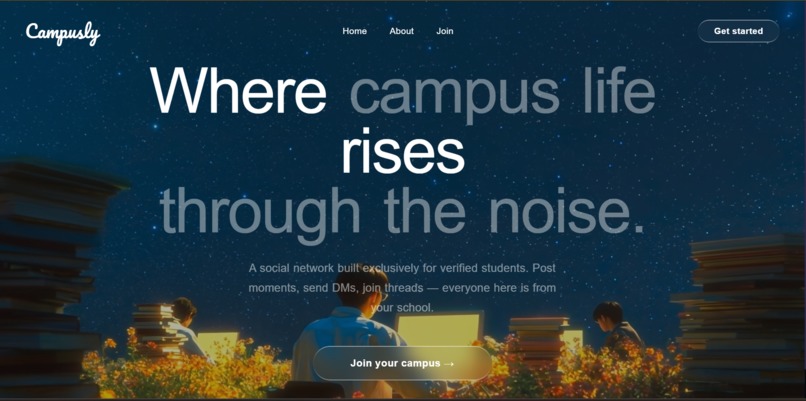
Home Page
-
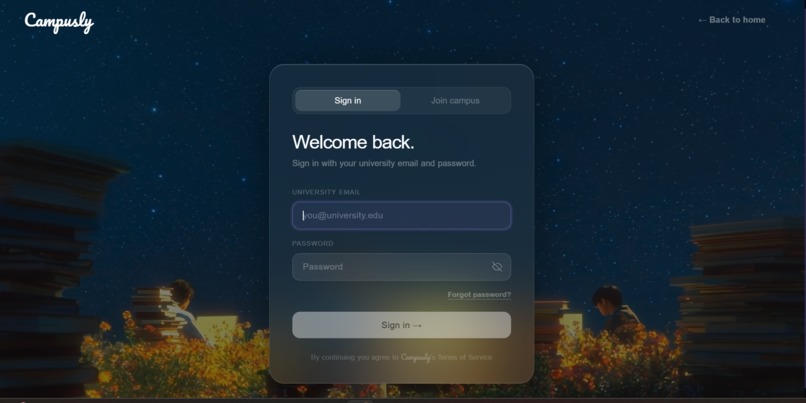
Sign In Page
-
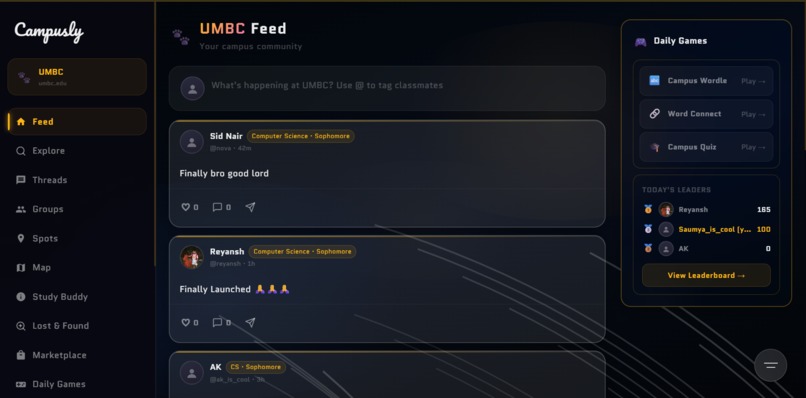
Campus Feed
Inspiration
College is one of the most overwhelming transitions in a person's life. You're dropped into a campus of thousands of strangers, expected to find your people, navigate financial aid, discover events, join clubs, find study partners, and somehow also pass your classes, all while using a dozen disconnected apps that were never designed with students in mind. Facebook Groups are dead. GroupMe is chaos. The university portal is from 2009. There's no single place that just gets campus life. That's the gap Campusly was built to fill. The inspiration came from a simple observation: every campus already has a culture, a vibe, a community; it just has nowhere to live online. Students are already talking, already helping each other, already buying and selling textbooks in Instagram DMs and Discord servers that die after finals week. We didn't invent the behavior. We just built the home it deserved.
What it does
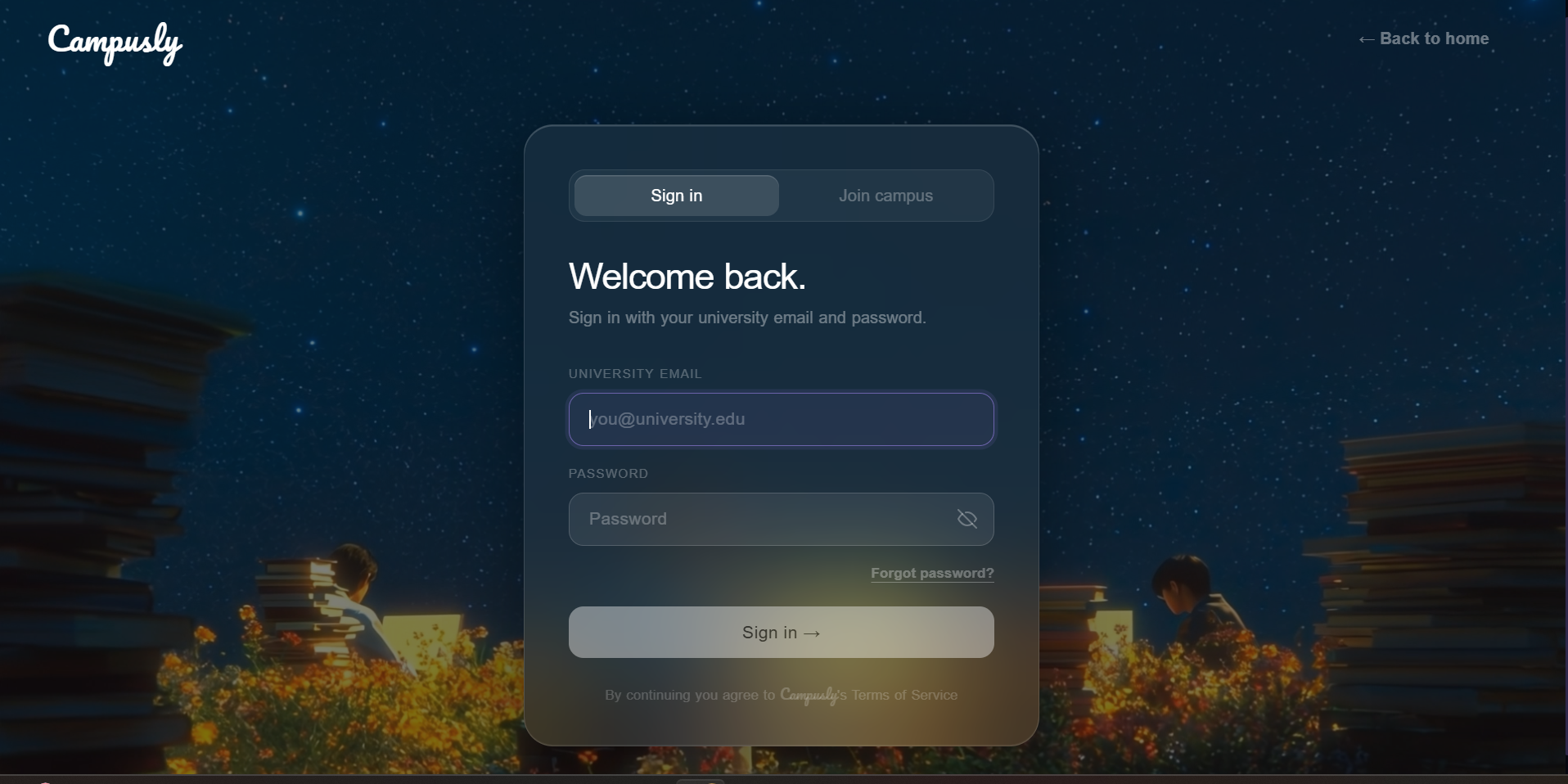
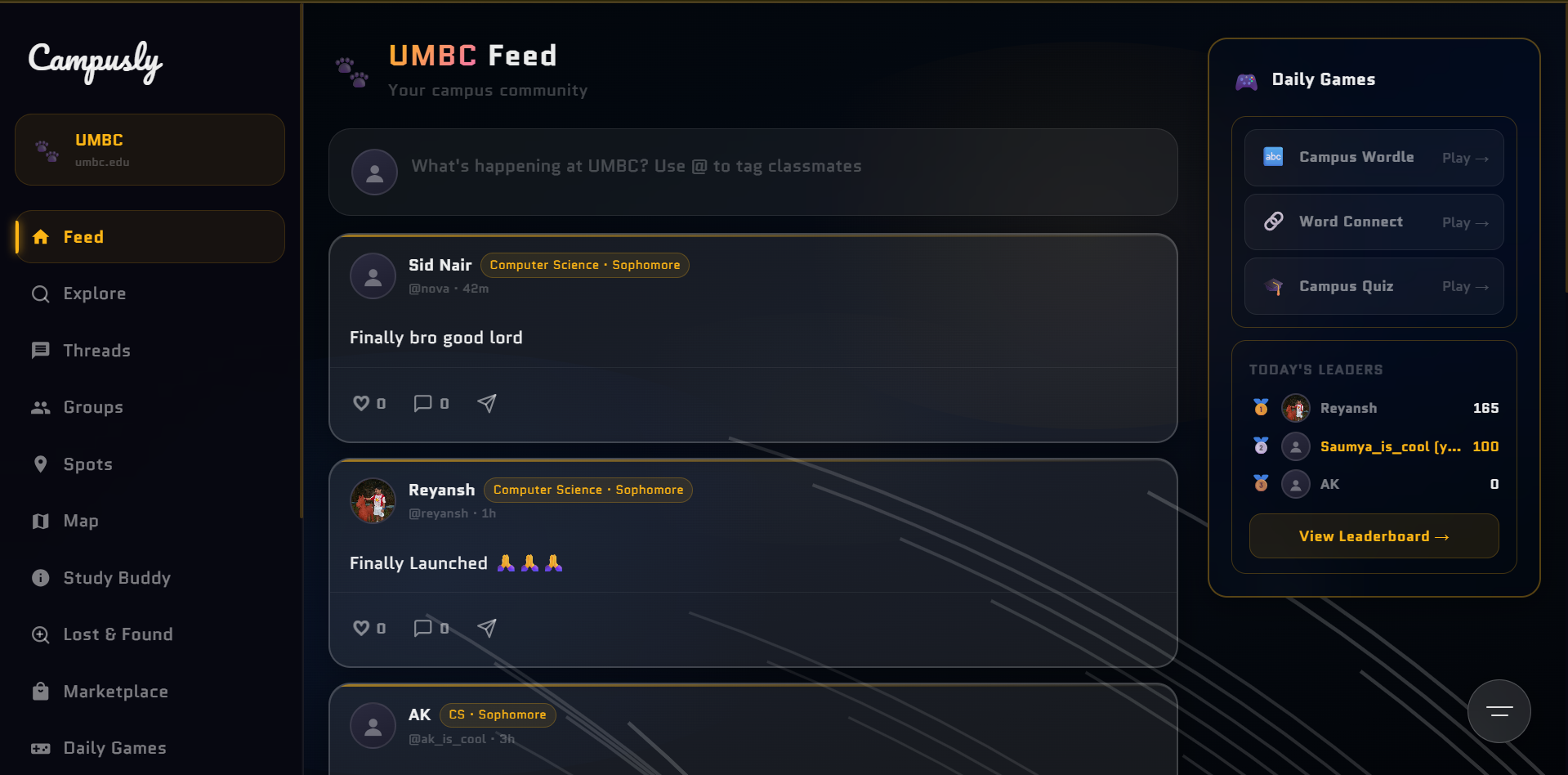
Campusly is a place for students from all colleges to connect with students on their campus. A one-stop shop for finding friends, learning about your campus, and getting involved! Anyone with an edu email can sign up. Once their email is entered, our site will recognize which campus they belong to and send them to their campus’s hub. Once registered, students have access to a wide variety of information and tools, from finding events on campus to posting to the main feed to tell people about an exciting project they’re working on to learning about scholarships and financial aid that’s available to them, and so much more!
How we built it
We built Campusly using React 18 with Vite as our frontend toolchain, styled with a custom CSS variable system that supports full light/dark mode toggling. The backend is powered entirely by Supabase, handling authentication via .edu email OTP verification, a PostgreSQL database for all user data, real-time subscriptions for live feed updates, and storage buckets for media uploads. For direct messaging, we built a custom WebSocket relay server deployed on Railway, since Supabase Realtime wasn't suited for low-latency one-on-one DMs. The frontend is deployed on GitHub Pages with a custom domain (campusly.us) via GoDaddy.
Challenges we ran into
The hardest challenge was building a truly campus-aware system automatically detecting which university a student belongs to purely from their .edu email domain, then routing them into their own isolated community with its own color scheme, emoji, and feed. We also struggled with real-time architecture: Supabase Realtime works beautifully for feeds and notifications, but wasn't reliable for instant DMs, so we had to architect and deploy a separate WebSocket server. Mobile responsiveness was another major hurdle, and the entire UI had to be redesigned from a slide-in drawer sidebar to a fixed topbar to a split-view messages pane, all without a mobile framework.
Accomplishments that we're proud of
We're proud that Campusly feels like a real social network, not a hackathon prototype. Every campus gets its own branded color palette pulled from its actual school colors. The feed supports rich posts with images, video, @mentions with live autocomplete, and per-author color-coded tags. The daily games (Wordle and a campus-specific quiz) reset every 24 hours and are genuinely fun. We also shipped groups, study buddy matching, a lost & found board, a marketplace, a spots/map feature, threaded discussions, and live DMs all within a single cohesive product.
What we learned
We learned that social products are deceptively hard. The technical pieces, authentication, database, and real-time are solved problems. The real challenge is the feel: making sure every interaction is fast, every empty state is encouraging, every notification is meaningful and not spammy. We also learned a lot about Supabase's Row Level Security, PostgREST filter syntax quirks, and the limits of Realtime subscriptions at scale. And we learned that mobile is not an afterthought; it requires a near-complete rethink of our layout architecture.
What's next for Campusly
We want to onboard real students at real campuses and gather feedback. On the product side, we're planning push notifications via a service worker, a campus events calendar with RSVP, verified club and organization pages, a scholarship and financial aid aggregator specific to each school, and a peer tutoring marketplace. On the infrastructure side, we're looking to migrate to a dedicated backend (Node.js + Postgres) to support more complex queries and better scalability as we grow.
Built With
- css
- github
- html
- javascript
- railway
- sql
- supabase


Log in or sign up for Devpost to join the conversation.